

A folding table-leg assembly must do more than fit beneath a tabletop. It must reach the intended open position, engage the buyer-approved lock, clear the frame and users’ knees, release as designed, and fold into the planned storage envelope. A component image can show the general mechanism but not whether it fits a particular table or whether the buyer can repeat the expected operation.
A folding table leg lock OEM brief should connect the table, mounting interface, open geometry, lock and release, clearance, use assumptions, and sample checks. This lets an importer compare suppliers on the same component and prevents the word “locking” from standing in for a defined function. It does not establish a universal load rating or a safety conclusion for an untested table.
Define the table and component boundary
Start with the table that the legs are meant to serve. Identify the tabletop material and thickness, overall dimensions, apron or underside frame, mounting zone, fastener access, intended number of users or work items if relevant, and whether the table is used indoors, at events, or in another context. Avoid submitting the leg in isolation if the fit depends on tabletop geometry.
Clarify what the supplier is quoting: a pair of legs, a folding bracket, a complete leg assembly, or a finished table base. List the included hinge, brace, lock, release lever, feet, fasteners, spacers, and any mounting plate. If the buyer will combine the legs with another supplier’s tabletop, assign responsibility for mounting holes, fastener selection, and final assembly verification.
The table’s open footprint and folded envelope are different requirements. Specify both. In the open position, the leg spread affects stability, chair clearance, and frame fit. In the folded position, the leg stack-up affects storage, carton dimensions, and whether a latch or catch is needed to keep parts together. Give the supplier the intended storage direction and any maximum envelope the buyer must meet.
Draw the interface between the bracket and tabletop. Include hole locations, slot direction, plate dimensions, fastener type, and any reinforcement plate. Mark the cosmetic underside and any visible edges. A bracket that attaches with the same hole count can still have a different mounting pattern or access issue. If fasteners are not included, say so and identify who selects and verifies them.
Specify the lock and release behavior
“Locking leg” can refer to different ways of holding an assembly open. The buyer should ask the supplier to show the mechanism and describe how it engages and releases. Record whether the lock is automatic or manually set, where the user applies force, how the open position is identified, and whether the mechanism can be operated after the table is assembled. Do not assume a particular product feature from a catalog label.
Define the states the buyer needs: fully folded, moving between positions, and fully open. If a lock must engage only at a defined point, state that. Ask which parts can move during operation and whether the instructions need to warn about pinch points or require the user to support the tabletop. A product-safety reviewer should assess the actual design and instructions; this guide does not replace that review.
A good sample plan observes the action in a repeatable order: place the assembly on the defined surface, open the legs, confirm the intended lock state, apply the agreed buyer-defined observation, release the lock using the proposed instruction, and fold the legs. Record any interference with the apron, tabletop underside, cross-brace, or fasteners. If the buyer specifies a cycle or load test, the buyer and qualified reviewer should define method, sample count, conditions, and acceptance criteria. Do not invent a cycle count or treat a brief hand operation as durability proof.
| Specification area | Buyer should define | What to record on sample |
|---|---|---|
| Table interface | Top thickness, mounting zone, hole pattern and frame | Fit, fastener access and revision |
| Open position | Leg spread, floor contact, lock engagement point | Position and observed lock state |
| Release | User action, access, sequence and instructions | Whether the stated operation is clear |
| Clearance | Apron, cross-brace, feet and user-facing space | Interference points in both positions |
| Folded envelope | Direction, stack-up and retention for storage | Folded dimensions and part movement |
| Finish and material | Component specification and cosmetic faces | Appearance, sharp edges and stated supplier data |
| Test requirements | Buyer-defined methods and limits | Method, conditions, report and disposition |
A folding table leg lock OEM specification should also state what the supplier may not change without approval. A different bracket, hinge, spring, pin, foot, or fastener may alter fit or operation even when the leg’s outside dimensions remain similar.

Check mounting, open clearance and folded storage
Install the sample on the intended tabletop or a controlled fixture that replicates its mounting dimensions. Confirm the plate orientation and use the actual fasteners proposed for production. If the buyer will provide screws, identify their size and engagement assumptions in the technical file and have the responsible reviewer verify the arrangement. Do not rely on the supplier’s demonstration fixture if it hides the buyer’s interface constraints.
Move the assembly from folded to open and back while observing its full path. Note whether the bracket contacts an apron, cable, frame, or neighboring leg. Check the open position from all sides and record where feet touch the floor in the specified setup. The buyer may observe fit and movement but should not infer a stability or load performance value without an agreed test.
For fold-under furniture, the stowed position may be as important as the open position. Measure the resulting thickness, orientation, and any protrusion of fasteners, release levers, feet, or brackets. Check whether legs can rub against one another or the tabletop finish during storage and transit. If multiple units are stacked or nested, review the actual packed configuration rather than assuming the sample’s fold direction is intuitive.
If the legs are sold as a replacement or accessory component, record which table models and revisions they fit. Avoid a broad “universal” compatibility claim unless the buyer has defined and verified the supported interface range. A component can fit a specific hole pattern yet still have a clearance or lock conflict with another table.
Review material, finish and evidence without overclaiming
Ask the supplier to identify the proposed material, dimensions, finish, and joining details in the drawing or bill of materials. If the buyer needs a particular finish or corrosion-related requirement, name the environment and evidence requested. Do not infer material grade from magnetism, color, weight, or a listing headline.
Inspect the finished sample for burrs, edge condition, coating coverage, visible welds or joints, and appearance on the faces the customer can see. Record whether the inspection is visual or measured. If the project calls for coating thickness, corrosion testing, load testing, or fatigue evaluation, specify a recognized method and the responsible laboratory or engineer. A photo or supplier statement cannot establish the result of a test.
The intended application matters to the technical review. A temporary event table, a household craft table, and a commercial work surface may carry different use expectations and risk levels. The buyer should not use “heavy duty” as a substitute for a defined requirement. Have the product-safety or engineering reviewer specify the relevant test plan and determine whether the component and complete table need separate evaluation.
Approve the instructions and change-control record
Instructions should match the product as supplied. If a leg must be opened in a particular order, the wording and illustration should show that sequence. Identify any lock indicator, release action, required tools, and caution that the responsible reviewer considers necessary. Confirm that the document version matches the sample revision and appears in the retail pack if required.
The sample-approval record should include the table model, component SKU, drawing and bill-of-materials revision, fasteners, finish, instructions, and any test or engineering review. Add photos of the fully open, transition, and folded positions. Record the sample checks and the exact conditions; do not reduce the approval to “looks fine.”
Set change-control triggers for the lock, hinge, bracket plate, leg length, spread, feet, material, finish, fasteners, or assembly order. If a supplier proposes a substitute, ask for the revised drawing and written impact analysis before accepting it. The buyer’s reviewer should decide whether a new sample or test is needed based on the change, not on a generic promise that the replacement is equivalent.
Compare suppliers on a common brief
Send every supplier the same table drawing, interface details, lock description, use scenario, open and folded envelopes, required finish, fastener scope, instruction needs, target quantity, and testing questions. Ask suppliers to return a marked drawing and list deviations. This helps separate a similar-looking component from one that matches the buyer’s real design.
When comparing offers, distinguish the following: component price; tooling or fixture assumptions; included hardware; surface finishing; assembly and packaging; sample and test responsibilities; lead-time assumptions; and change-control support. A supplier may propose a different lock that meets the buyer’s stated requirement, but the choice should be compared against the same open/release behavior, clearances, and approval criteria. An unpriced or unexplained substitution makes the quotation hard to evaluate.
A folding table leg lock OEM conversation should ask the supplier to identify the product facts it can verify and the design or test questions that need the buyer’s engineer. This is more useful than asking a seller to guarantee a leg is “safe” without an agreed standard or method.
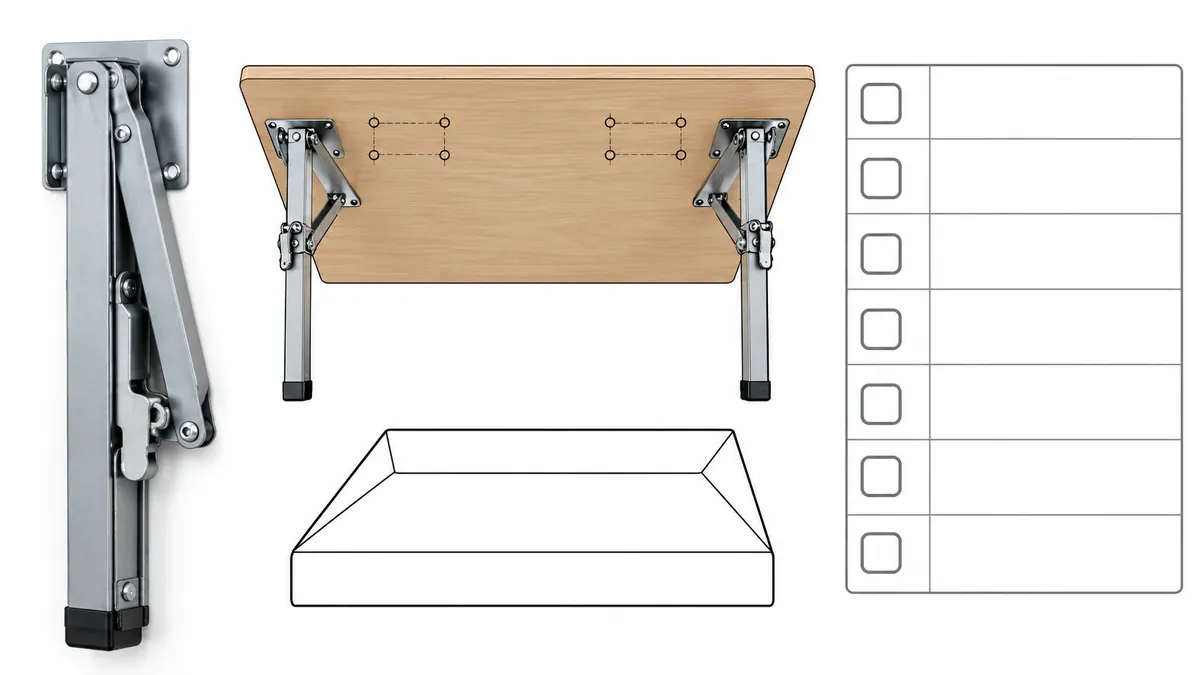
Buyer checklist and common questions
Before RFQ, record tabletop dimensions and material, mounting locations, frame or apron, intended use, open spread, folded envelope, lock and release expectations, finish, fasteners, instructions, packaging, and market. During sampling, confirm model identity, install with the proposed hardware, operate the lock using the stated instructions, observe both positions and transition, check interference, and document the result.
Does “locking” mean the legs cannot fold accidentally? It is a product claim that needs a defined mechanism and evidence. Ask how the lock engages, how it is released, and what evaluation supports the claim for the complete table.
Can the buyer test legs without the tabletop? A component-only check may verify a mechanism, but it cannot establish mounting fit, apron clearance, or behavior in the assembled table. Use the intended table or a controlled fixture that reproduces its interface.
Does one open-and-close cycle prove durability? No. It is an operation check only. If repeated use matters, define a test method, cycle count, conditioning, acceptance criteria, and report scope with a qualified reviewer.
Should the buyer specify a particular bracket style? Specify the function and interface first. If the project requires a specific architecture, identify it on the drawing. Otherwise, ask suppliers to propose alternatives and compare their geometry, operation, clearance, and evidence.
What if the supplier changes the lock after approval? Treat it as a revision change. Compare the function, installation, open and folded dimensions, instructions, and evidence, then have the buyer’s reviewer decide whether a new sample or test is necessary.
Keep adjacent capability claims grounded
Koitor’s documented scope is bathroom and home-storage metal hardware. This guide addresses an adjacent furniture component and does not claim that Koitor currently manufactures folding table legs or validates their load performance. Buyers should verify capability and engineering responsibility for the exact design before placing an order.
For the company’s documented OEM context, review home-storage hardware manufacturing. To discuss a project, contact Koitor with the tabletop drawing, bracket interface, lock expectations, sample revision, order assumptions, and required engineering or test evidence through the contact page.
Sources and product-specific observations
- Testrite folding table-leg component options and selection factors
- Folding table-leg supplier listings
- Individual folding bed-tray report about legs that did not stay open
- Model-specific folding banquet-leg reviews
Supplier pages and individual user reports are examples, not verified defect rates, test results, or evidence of Koitor capability.
Discuss a metal component and sample brief
Share the component drawing, mating product, interface, intended movement, finish, and any required test evidence. Supplier feasibility and responsibility for performance claims must be confirmed against the actual project.
OEM / MARCA BLANCA
Convierte esta guía de abastecimiento en un resumen del producto
Indícanos el producto que deseas, el tamaño, el acabado, la cantidad del pedido y los requisitos de embalaje. Tu equipo recibirá un análisis práctico de la viabilidad de fabricación antes de recibir el presupuesto.

 English
 Español
 Português
 Français
 Deutsch
 العربية