
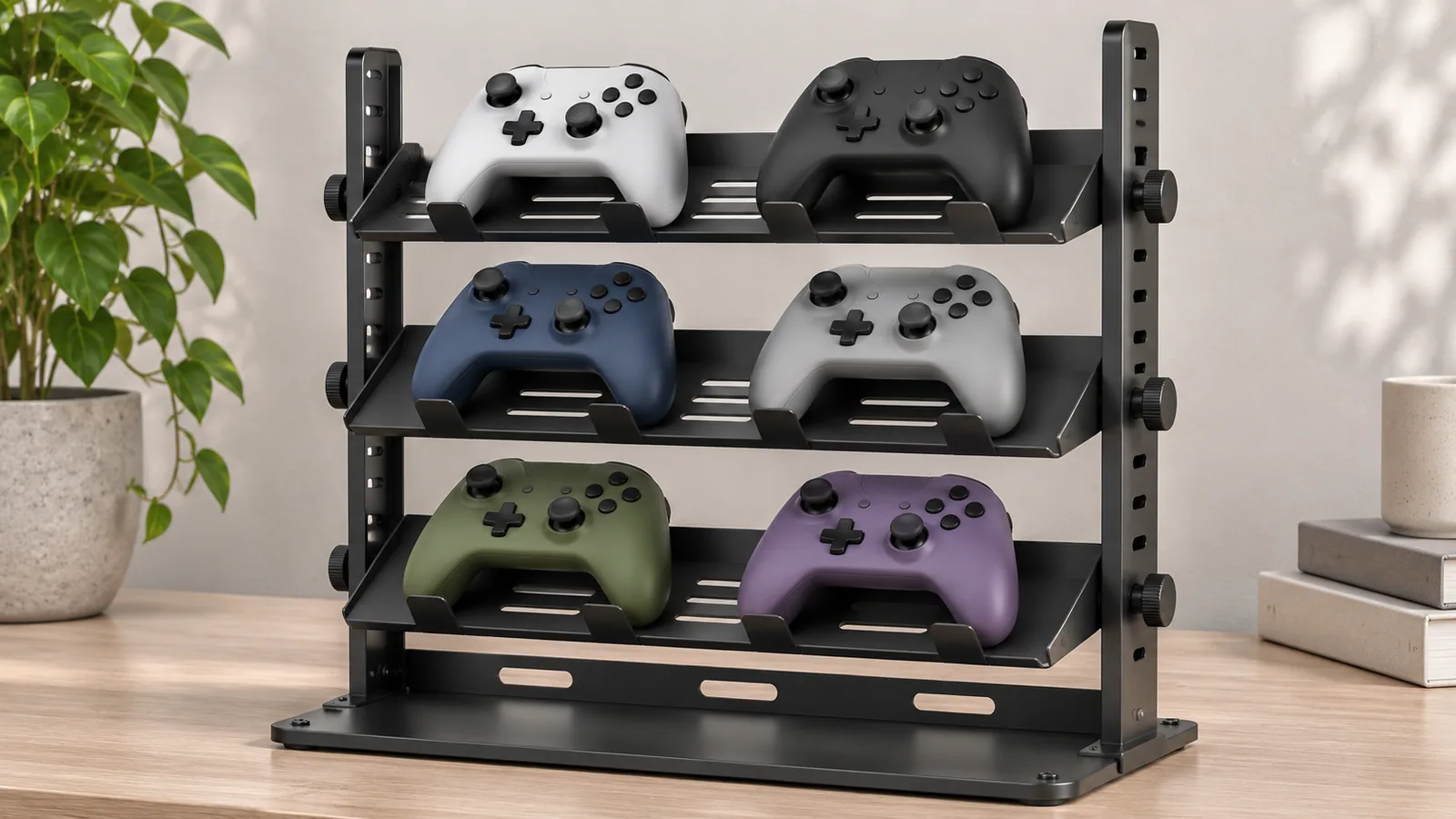
Game controller rack fit specification should name the controllers, the intended cradle and tier setting, the occupied arrangement, and whether the product is passive storage or powered equipment. A multi-tier rack can fit one controller in an empty sample yet create a trigger, grip, or retrieval conflict when adjacent positions are occupied. Buyers should approve the actual support components and adjustment behavior, then describe cable clips and charging scope accurately. A fit check does not establish load, electronic, or long-term performance.

Why does game controller rack fit specification start with the device set?
“Fits most controllers” is not a useful sample instruction unless the supplier defines what “most” means and provides evidence for the included references. Controllers differ in grip shape, shoulder buttons, triggers, sticks, attached grips, and cable or dongle arrangements. A cradle that holds the central body may still touch a control, interfere with a neighboring tier, or make retrieval awkward. Buyers should start from named references and define the configuration they expect to sell.
Current product catalogs show that a controller organizer may combine a metal frame with separate polymer or soft-contact components, adjustable tiers, rotating supports, or cable clips. These are properties of the named product. They do not make those features universal, establish Koitor production capability, or prove that a third-party cradle is interchangeable. A manufacturer’s controller rack listing describes a specific arrangement of these components. One manufacturer’s product listing even prompted a user review that expected charging from what proved to be a passive stand. That single observation illustrates a claim-scope risk; it does not establish a common return reason or widespread market confusion.
The buyer’s SKU decision should explicitly state whether the rack is a passive holder, whether any cradle rotates by design, whether adjustment is user-operated, and what components are included. A cable clip can retain or route a named cable if tested for that purpose, but it does not provide power. A rack with no verified electronic parts should not be presented as a dock, charger, or charging station. A complete game controller rack fit specification ties those included features to the same frame, cradle, and revision used in the sample.
Which references and settings belong in the fit matrix?
List each controller by a buyer-controlled reference or manufacturer/model name. If the device has an optional grip, protective shell, battery pack, or cable, record that configuration separately. Identify the tier assigned to each device and the cradle position or rotation setting approved for that combination. If the sample includes a purchased cradle or ring, capture the supplier, item number, material description, and revision where those facts are documented.
Map the contact points. Observe whether the cradle supports the body as intended and whether it touches triggers, buttons, sticks, seams, or other protrusions. The matrix should record what was seen, not make assumptions about a controller’s internal structure. If the responsible device maker provides handling restrictions, use the current official guidance rather than inferring safe contact from a photo.
Review both individual and populated conditions. Test one controller in an empty rack to understand basic positioning, then place the approved group in the intended tiers. Check access to each device while the neighboring positions remain occupied. A tier that looks wide enough on a drawing might still be hard to reach when the adjacent grip projects into the hand path. Record which positions were filled and which were left empty.
Adjustment must be defined as a behavior. Can the user move a tier, rotate a cradle, or remove a component? What position is shown in the approved product image? Does the supplier intend that support to move freely or remain at a set orientation? Do not assume it locks, holds a particular torque, or remains stationary because a sample appears still during a brief observation. If the buyer expects a fixed setting, put that requirement in the specification and agree how it will be confirmed.
| Matrix field | Record for each controller and tier | Approval purpose |
|---|---|---|
| Controller | Named reference, revision, and attached accessories | Identifies the device actually reviewed |
| Tier | Position, height, and neighboring occupied positions | Reproduces the assortment arrangement |
| Cradle | Supplier, part revision, orientation, and contact area | Controls a purchased or adjustable interface |
| Control clearance | Trigger, button, stick, and grip contact observations | Identifies interference for buyer review |
| Adjustment | User movement and approved position | Avoids assuming a lock or fixed setting |
| Power scope | Included charger, electronics, clip, or explicit absence | Prevents a passive stand from being mislabeled |
| Retrieval | Placement and removal with adjacent tiers populated | Checks the intended access path |

How should the physical sample be accepted?
Request a sample that matches the intended frame, cradle supplier, pads, fasteners, and selected tier arrangement. Confirm the revision before the fit review. If a component is a substitute, capture that fact and decide whether it is representative. A sample with a different cradle may demonstrate the frame’s general concept but cannot substantiate the exact product configuration being released.
Place each named controller in its assigned position without forcing or compressing the device into the support. Observe contact with triggers, controls, and adjacent devices. Record the placement and retrieval sequence. If the rack offers an adjustment, move it only according to the supplier’s stated operation, and document the selected setting. Do not add an improvised tie, lock, cushion, or stop to make an unapproved configuration appear suitable.
Where the product holds multiple tiers, perform the review with the intended positions filled and any advertised partial configuration stated. Note whether a controller can be lifted out without moving another device. This is an observed access assessment, not a quantified ergonomic test unless the responsible team establishes an appropriate protocol. It does not establish a universal user experience or long-term cycle life.
Keep the evidence precise. Record sample ID, drawing revision, controller references, cradle identity, pad or insert revision, photographs, observed contacts, and open questions. If the product team requires force, retention, or durability criteria, those need a defined method and appropriate technical ownership. A quick hand movement should not be converted into an unsupported load, friction, or cycle-life number.
How should buyers separate passive storage from cable or power features?
First identify the offered components. A passive frame with purchased cradles may provide mechanical storage only. A clip could keep a cable near a device, but it does not establish electrical charging, power delivery, data connectivity, or safe cable routing. The listing and packaging should say whether chargers, cables, power supplies, or electronic modules are included. If no such parts are present, state that the rack is a passive holder.
If cables are part of the intended configuration, use the actual cable type and plug reference. Observe whether routing creates a snag or pulls on the controller during placement and retrieval. A visual clip fit does not prove cable compatibility with every plug, device, or charger. Do not route cables through a sharp edge or claim electrical safety from a metal frame review. Electrical and power claims require qualified evidence outside a passive storage sample check.
Avoid language such as “charging rack” or “charging dock” unless the final SKU contains the necessary verified electrical system. The same rule applies to claims about charging speed, compatibility, heat management, or data transfer. If the rack merely stores a device while it is disconnected, call it a controller holder or organizer and describe only the included functions.
Change control matters here. A new cradle, cable clip, tier height, or frame revision can affect device fit and advertised scope. If a component changes supplier or material, the buyer should decide whether a new paired sample is needed. Keep the product description, BOM, carton label, image, and approved configuration aligned so that the commercial content does not promise a component that is absent from the shipment.
Which sourcing mistakes should a product manager avoid?
One mistake is using a short compatibility list as proof of broad fit. A few tested models can support a defined list, but they do not prove every device sold under the same gaming platform. Keep the compatibility claim aligned with the actual references and cases reviewed.
Another mistake is evaluating only the empty rack. The occupied configuration can change clearance, stability questions, and retrieval access. Review the complete set of tiers the buyer intends to show in its product photography and instructions. If a tier is optional or removable, say so and verify what is included.
Do not confuse a rotating support with a locking support. The observed catalog may describe rotation, but unless a locking feature is in the supplier’s confirmed drawing and evidence, do not introduce one in the claim. Similarly, do not infer cradle material from appearance or a generic phrase like “soft-touch.” Identify the actual component and request supplier documentation if its material matters.
Avoid implying that metal alone guarantees a load rating, stability, or durability. Frame geometry, joints, support components, assembly, and use all matter. A compatibility sample does not test the rack’s structure or the user’s desk. If those claims are needed, specify separate evidence and ensure the responsible party has the relevant design and test information.
Finally, do not reproduce a competitor’s proprietary appearance or mechanism. Use the sources to understand product-system variation and buyer decisions, then develop an independent, documented specification. An OEM quotation should identify the buyer’s intended interface and required component responsibility rather than ask a supplier to copy a branded rack.
How can an OEM discussion support a controller rack project?
Koitor Hardware is a family-owned custom metal hardware manufacturer with documented bathroom and home storage hardware experience. Current controller-rack production, polymer molding, rotating cradle mechanisms, charging electronics, controller testing, or related certifications are not confirmed. A buyer can share a lawful metal-frame concept for a project-specific feasibility discussion, but should not assume an existing gaming accessory SKU or proprietary cradle capability.
Provide the frame drawing, controller references, proposed cradle or ring source, intended tiers, adjustment behavior, finish direction, and packaging scope. Identify which components are supplied by the buyer or a specialist vendor. Ask the metal supplier to confirm the work it can actually undertake and which interfaces need another supplier’s drawing or acceptance. This makes an early feasibility response more useful than a request framed only around a product name.
Koitor’s OEM home storage hardware page explains the relevant general supplier scope. The existing headphone-holder guide concerns a desk edge and headband interface, while the related remote-control organizer guide covers compartment fit. Those are related storage contexts, not substitutes for the adjustable multi-tier controller and passive-versus-powered decisions described here.
What should the buyer request before ordering?
- The exact frame drawing and revision, with each tier and adjustment shown.
- Named controller and accessory references for every claimed configuration.
- Cradle, ring, pad, or clip supplier identity and revision where documented.
- Contact observations for controls, triggers, grips, and adjacent tiers.
- A sample review of insertion and retrieval with occupied neighboring positions.
- A clear statement of whether supports rotate, adjust, or are fixed in the released SKU.
- A written list of included electronics, chargers, cables, and power supplies—or confirmation that none are included.
- Separate evidence requirements for structural rating, electronics, retention, and durability claims.
- Packaging, label, image, and instruction wording that matches the shipped components.
- A change-control rule for device list, frame, cradle, pad, finish, or cable accessory revisions.
Preguntas frecuentes
Does one controller fitting a sample prove the full rack is compatible?
No. It establishes only the observed device, cradle, tier, and sample condition. Buyers should also review adjacent occupied positions and retrieval.
Does an adjustable cradle automatically lock in place?
No. Confirm the supplier’s specified behavior. Do not claim a lock or fixed retention unless that feature is documented and supported.
Does a cable clip mean the rack charges a controller?
No. A cable clip is not an electrical system. Describe the exact included parts and do not imply power delivery without verified components and evidence.
Can a metal rack be called universal?
Only when a defined compatibility scope is substantiated. A few sample references should be listed precisely rather than generalized to every controller.
Does Koitor currently offer a gaming controller rack?
No current controller rack, molded cradle, or charging accessory capability is confirmed. A project-specific metal feasibility discussion would need a buyer drawing and component scope.
Discuss a Metal Storage Concept
Share a lawful frame drawing, named device references, purchased-component details, and the intended passive or powered scope for feasibility review.
OEM / MARCA BLANCA
Convierte esta guía de abastecimiento en un resumen del producto
Indícanos el producto que deseas, el tamaño, el acabado, la cantidad del pedido y los requisitos de embalaje. Tu equipo recibirá un análisis práctico de la viabilidad de fabricación antes de recibir el presupuesto.


 English
 Español
 Português
 Français
 Deutsch
 العربية