
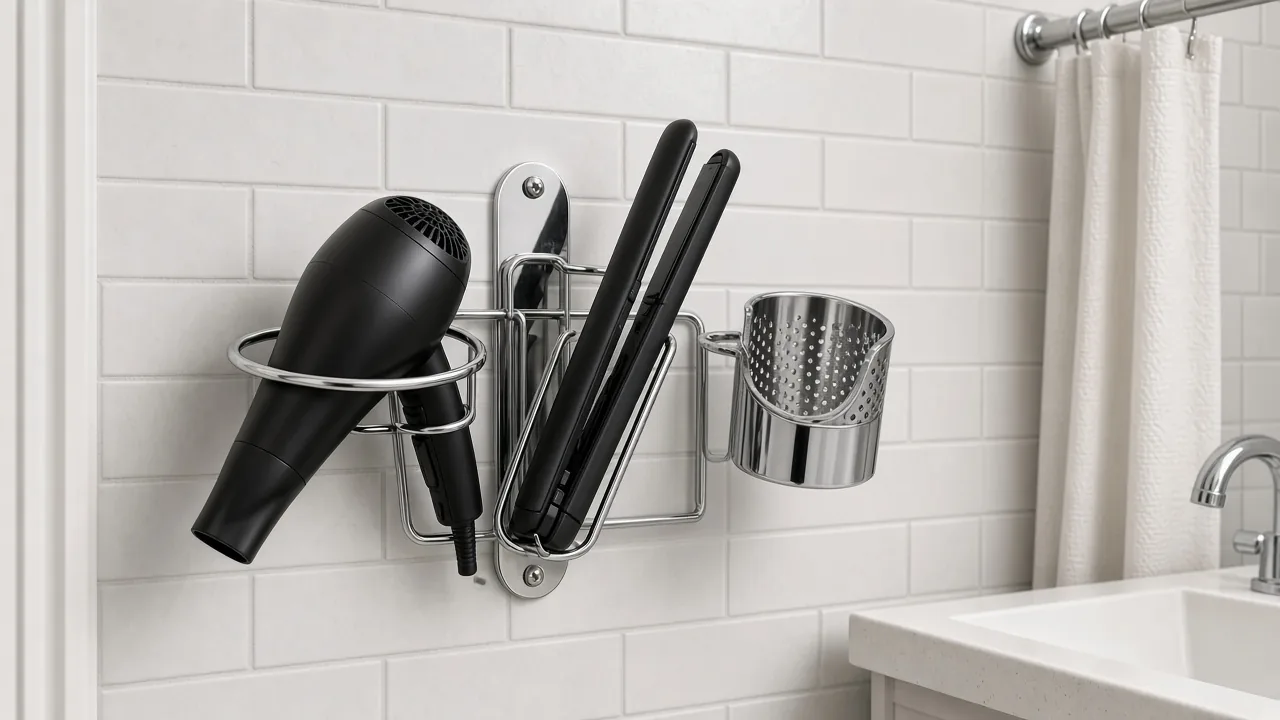
A tool that fits the opening can still leave water in the cup. Hair tool holder rust should be frozen at the drip cup, the drain path, and a wet-tool scenario, not at opening size alone. If a wet dryer or straightener will be put away, standing water and the cup floor are first-to-rust sites and must be named before rust-resistant artwork is approved.
This guide is for importers and private-label teams writing a screw-mounted metal hair-tool holder specification. It does not own opening-size matrices, wall heat-clearance gaps, or cord-path layout. Koitor Hardware, a family-owned China OEM manufacturer of bathroom and home-storage metal hardware, can review a drip-cup brief with a drawing or a sample; the buyer still has to name the wet-tool condition and the claim.
Why a correct opening size does not clear cup rust
Opening size answers whether a dryer barrel, a straightener, or a brush sits in the holder. It does not answer whether condensate, rinse water, or a wet tool leaves a pool on the cup floor. Those are different measurements and a different claim.
A rust line on this SKU is a substantiation problem. Advertising claims need a reasonable basis before they are made; the U.S. FTC Policy Statement Regarding Advertising Substantiation is a useful reminder of that duty, not a Koitor laboratory result. The file should say how the cup drains, what was observed after a wet tool was put away, and which words are then allowed.
Worked example: a first article accepts a named dryer and a named straightener. The openings are correct. A week later, a brown ring appears in the cylindrical cup where water stood under the dryer nozzle. Fit was never the failure. The drain and the cup floor were never in the file.
Worked example: the cup has decorative perforations on the wall but a closed floor. Water enters through the side holes and does not leave. A shopper sees “ventilated” in a bullet and still finds standing water. Perforation is not the same as a drain path.
Heat clearance and cord path stay off this page. A holder can sit far enough from the wall for a hot tool and still rust in the cup. Do not rewrite a heat brief here, and do not treat a heat pass as a rust pass.
Custom bathroom hardware manufacturing can quote a metal hair-tool holder, but only if the inquiry lists the cup construction, the drain decision, and the intended listing language. A request that only says “holds a dryer” is a fit brief, not a rust brief.
Which drain or no-drain decisions belong in the RFQ?
Name the cup type for each station on the holder. A circular dryer ring, a slotted straightener well, and a cylindrical brush or tool cup do not share the same water path. If only one cup is a closed well, that cup owns most of the rust risk and must be called out on its own line.
Write whether the cup floor is open wire, a perforated sheet, a louvered pan, or a closed stamping. Then write where water is supposed to go: through the floor to the wall, through a defined drain hole, into a removable tray, or nowhere because the design intends a dry tool only. “It will evaporate” is not a drain decision unless you also write the wet-tool rule that makes evaporation realistic.
Drain hole size and location are project figures, not a Koitor standard in this article. If the program needs a numeric hole or a hole count, agree them on the finished coated sample and write them with a plus-and-minus tolerance. Keep that measurement in its own clause, not inside a sampling-plan sentence.
A removable drip insert changes the file. If the insert is plastic, the rust question may move to the metal cup around it or to the screw plate. If the insert is metal, it has its own floor and its own drain. Say whether the insert is a service part, and how a missing insert is treated in acceptance.
Coating or plating inside a deep cup is often thinner, or less well covered, than on the visible face. Faraday cage effects in powder coating, and rinse or drain marks in plating, show up on the floor first. Ask for an inside-cup observation on the finished sample, not only a face photograph.
No-drain is an allowed design if the listing and the instructions say so. A no-drain cup should not be sold with a “put wet tools away” lifestyle photo. Either add a drain, add a removable tray that is emptied, or limit the artwork to dry tools and write that limit in the file.
Wall attitude matters. A cup that drains on a bench can hold water when the holder is screwed to a vertical tile. Observe the finished holder in the installed attitude, with the backplate against a vertical fixture or a wall stand, not only lying on a table.
Material family should be written as a project choice, not as a slogan. A stainless cup, a coated steel cup, and a mixed assembly with a stainless ring and a coated well do not share the same observation emphasis.
Stainless can still stain at a weld or a crevice if water stands. Coated steel can look fine on the face and fail on an inside floor. Name the family after the sample is agreed, and keep that name in the drip-cup file.
The joint between the cup and the backplate is a water trap when the cup is welded, riveted, or screwed from behind. A hidden rear cavity can rust out of the shopper’s sight and then mark the wall. If the design has a closed back, say how that cavity is sealed, drained, or left open, and include a look at the wall-facing side after the wet scenario.
Cleaner use is not a substitute for a drain, but it can change the picture. A cup that is wiped daily may hide a standing-water problem in a home and still fail in a showroom that leaves a wet tool overnight. Write the scenario you will actually run, and do not assume household wiping in the sample room unless that wiping is part of the written method.
| Cup decision | What to freeze | What a wet-tool sample should show | What to keep off artwork until then |
|---|---|---|---|
| Floor construction | Open wire, perforated sheet, louvered pan, closed floor, or a removable insert | The floor matches the drawing and can be inspected after coating | A “ventilated” bullet that only shows side holes |
| Drain path | Hole location, open floor, tray, or an explicit no-drain rule | Water leaves the cup, or the no-drain rule is followed in the photo and the insert | A wet dryer photographed in a closed cup |
| Wet-tool scenario | Which named tools are put away wet, for how long, in the installed attitude | The cup floor and seams are observed after that scenario | A rust-resistant line with no wet-tool method |
| Inside coverage | Finished coating or plating on the cup floor and at seams | Coverage is looked at inside the cup, not only on the front face | A face-only beauty photo used as rust evidence |
| Service insert | Whether a tray or cup insert is included, and what happens if it is missing | The insert is present in the check, or the missing-insert rule is applied | A claim that assumes an insert the box does not include |
| Wording | Rust-resistant, a narrower process phrase, or silence | The words match the drain file | An open-ended rust slogan on the carton |
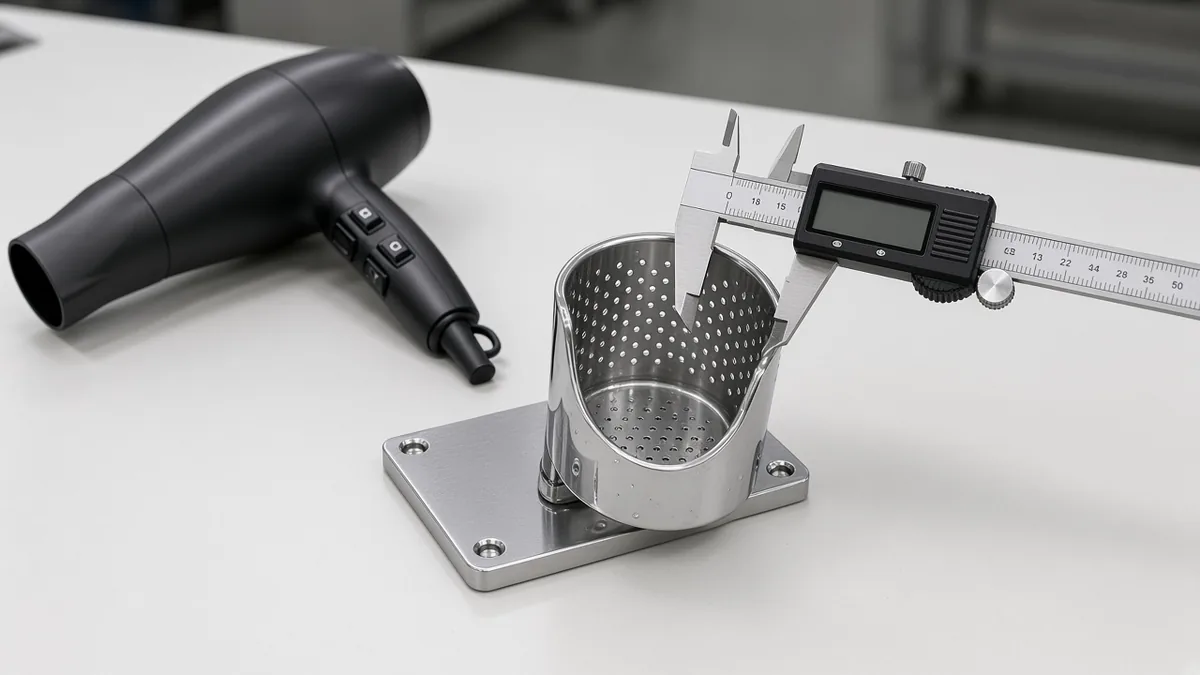
Which cup surfaces should be observed after a wet-tool scenario?
Write a simple wet-tool method that the sample room can repeat. Name the tool or a water-wet stand-in, the fill or drip amount you will actually use, the hold time, and the installed attitude. Then look at the cup floor, the lower seam, the drain hole edge, the joint between cup and backplate, and any crease where a perforated sheet is rolled.
Do not invent a Koitor hour figure or a cabinet rating here. If a project later adds a salt-spray or similar method, ASTM B117 y ISO 9227 are method names only. They do not convert hours into years on a bathroom wall. Salt spray test report interpretation helps a buyer read what a report covered. This page only asks whether the specimen included the cup floor and the drain path, not a flat coupon from the backplate alone.
Keep the observation method separate from any sampling plan. You may later agree how many holders in a lot are checked, using a scheme such as ISO 2859-1 if both sides want a sampling standard. That scheme does not define the cup floor. Define accept and reject signs first: standing water after the agreed drain time, staining at the seam, blistering at the floor, or a rust bloom at a drain-hole edge, as the project writes them.
A straightener well can rust even when the cylindrical cup is the hero of the photograph. If the well is a closed channel, condensate from a cooling plate can sit along the bottom rib. Include that well in the scenario when the SKU has one.
The dryer ring is often open and looks low-risk. Water can still run down the handle and sit at the ring-to-plate weld or at a concealed screw. If the ring has a lower saddle, observe that saddle. Do not assume an open ring is dry by design.
Dry the exterior if you need a clean photograph, but do not hide the cup floor. The record should include a look into the cup after the hold time, before anyone wipes it for a beauty shot.
If production later changes cup tooling, perforation pattern, or inside coating, the drip-cup file is open again. A first-article pass does not travel with a silent cup substitute.
Shared photography across nearby SKUs is a common leak. A three-cup holder and a two-cup holder may not share a cup floor. A chrome SKU and a powder-coated SKU may not share inside coverage. If the listing uses one lifestyle photo for two constructions, either limit the photo to the construction in the file or shoot both.
Pack the sample so the cup is not already stained when it arrives. A wet-test holder that sits in a closed bag with residual water is not a fair start. Dry the cup after any factory check, and record the incoming condition of the sample cup floor before the agreed scenario begins.
If a cord hook, a cable clip, or a metal grommet is part of the holder, give it a line only when it sits in the drip path. A clip above the cup may stay dry. A hook under the cup may catch runoff. Do not let those small parts inherit a rust-resistant line unless they were in the observation.
What rust-resistant wording should stay off artwork until the file exists?
Once the drain decision and the wet-tool observation exist, choose words the file can support. Many programs are safer with rust-resistant, or with a process phrase such as “coated steel cup with a drained floor,” than with a stronger retail adjective. If the file is incomplete, stay silent on the carton, the insert, and the online title.
Do not print an open-ended rust slogan, and do not write a slogan that the holder will not rust. Those phrases overstate what a cup observation can prove. A hair tool holder rust question in search is a reason to write this page; it is not permission to put those words on the sell-in sheet without a file.
Lifestyle photography must follow the drain rule. A wet tool in a no-drain cup is a claim. A dry tool in a drained cup is closer to the file, but the observation should still use the wet scenario you wrote, not only the dry photo.
Translations must keep the same limit. A version that drops “cup observed after a wet tool” and keeps a short adjective is a new, stronger claim.
If only the visible chrome face was observed, the line must not imply the cup floor was cleared. Either add the floor to the specimen or narrow the sentence.
What belongs on the opening-size or heat pages instead?
Barrel diameter, straightener width, brush-cup opening, and insertion depth belong on the opening-size page. This page may mention a named tool only as the wet object in the rust scenario. It should not republish an opening matrix.
Distance from a hot plate to the wall, cord-exit clearance, and heat shielding belong on the heat-clearance file. That decision remains occupied even when a registry slug is not used as a link. Do not republish it here.
Screw-mount seating, set-screw location, and wall-anchor load are also different files. A holder can be firmly seated and still rust in the cup. Keep mount seating out of the rust sentence.
Finish cleaner compatibility is a neighboring question. A cup can stain from a standing-water rust mechanism or from a harsh cleaner. If both risks exist, write two methods, not one blurred “bathroom wear” claim.
Suction-mounted or adhesive hair-tool holders are a different mount and a different rust map. This page stays on a screw-mounted wall plate. Do not copy a suction-cup claim kit onto this SKU, and do not use this drip-cup file to clear a suction product.
Channel copy should follow the same file. A marketplace bullet that adds a stronger adjective than the carton is still a claim. If the English insert is silent, the bullet should stay silent, or should use only the narrower phrase the cup observation supports.
Spare cups or spare inserts, if they are in the box, should be packed dry and described honestly. A spare metal cup that rusts in a bag will alarm a customer even when the installed cup is still acceptable. Give the spare the same observation or the same packing protection, or say that it is a service part with its own condition.
Install instructions should not undo the drain file. If the sheet tells the shopper to block a drain hole, add a decorative liner, or store the holder in a closed niche where the cup cannot drip, that step belongs in the observation or in an exclusion.
If the brand will sell the same holder into both a steamy bath and a dry bedroom dressing area, write which use the rust file covers. A dressing-area photo does not clear a bath listing. Either run the wet-tool scenario for the bath SKU, or split the listings so the bath offer carries the drain file and the dry offer stays silent on rust language.
Buyer checklist for hair-tool-holder drip-cup rust
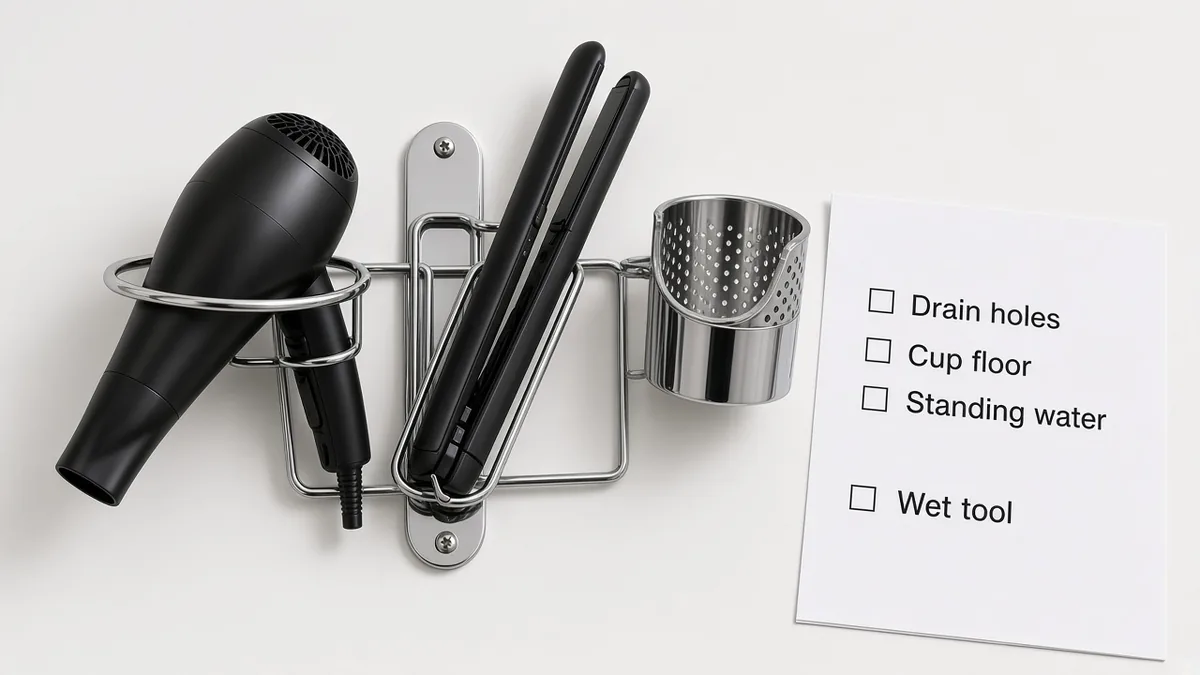
Use this list before a rust-resistant line is approved for a metal hair-tool holder. The hair tool holder rust decision is a cup-and-drain file, not an opening-size reprint.
- Treat opening size as a fit check, and treat the drip cup as a separate rust and drain check.
- Name the floor construction for each cup or well on the holder, including any removable insert.
- Write a drain path or an explicit no-drain rule, and make the artwork follow that rule.
- Write a wet-tool scenario with named tools, a hold time, and the installed attitude.
- Observe the cup floor, seams, drain-hole edges, and cup-to-backplate joints after that scenario.
- Look at finished inside-cup coating or plating, not only the front face.
- If a cabinet method is later used, require specimens that include the cup, and treat ASTM B117 or ISO 9227 as methods only.
- Keep the observation method out of any sampling-plan clause.
- Choose rust-resistant language, a narrower process phrase, or silence; do not print an open-ended rust slogan.
- Leave opening-size and heat-clearance decisions on their own pages, and send the cup brief with the inquiry.
Preguntas frecuentes
The dryer fits. Why is rust still an issue?
Fit and dryness are different. Water from a wet tool or from condensate can stand in the cup even when the opening is correct. Freeze the drain and the cup-floor observation separately.
Are side perforations enough?
Not by themselves. Side holes can let water in without letting it out if the floor is closed. Name the floor and the drain path, then observe them.
Can I skip a drain if I tell shoppers to put tools away dry?
Yes, if that limit is written in the file and the photography follows it. A wet-tool lifestyle photo would undo the limit. A no-drain design is a claim about use, not a silent default.
Does a backplate salt-spray coupon clear the cup?
No. A flat coupon does not include the cup floor or the drain-hole edge. If a cabinet method is used, the specimen should include the cup in the installed attitude.
What if the program adds a plastic insert later?
Treat it as a change. The insert may hide or move the rust site. Update the drain file and the wet-tool method, and say whether a missing insert is still acceptable.
What should a first sample include?
The finished holder, a clear view into each cup, the drain decision, a written wet-tool scenario, photographs after that scenario, and the intended listing phrase or an explicit decision to stay silent.
Trabaja con Koitor Hardware
Need a hair-tool-holder drip-cup brief reviewed?
Send Koitor your drawing or sample, the cup and drain decision, and the intended listing phrase. Our team can review drip-cup construction and a wet-tool observation brief before quotation. MOQ can start from about 100 pcs depending on the product; samples usually take 5–7 working days after details are confirmed; bulk production usually takes 4–6 weeks depending on the project.
OEM / MARCA BLANCA
Convierte esta guía de abastecimiento en un resumen del producto
Indícanos el producto que deseas, el tamaño, el acabado, la cantidad del pedido y los requisitos de embalaje. Tu equipo recibirá un análisis práctico de la viabilidad de fabricación antes de recibir el presupuesto.
 English
 Español
 Português
 Français
 Deutsch
 العربية