
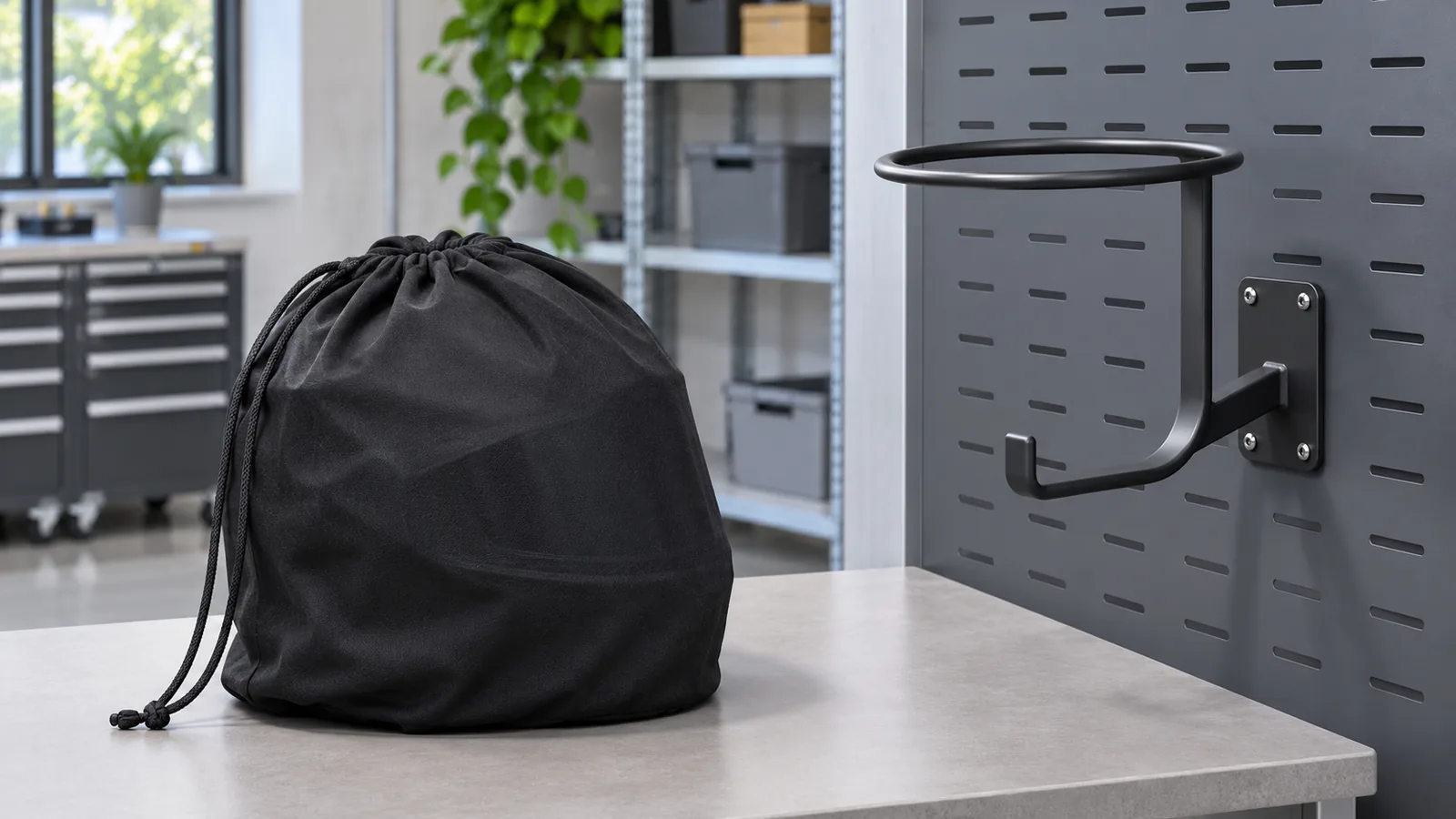
A helmet storage rack should not be approved for contact with a helmet until the buyer has checked the exact helmet maker’s instructions and claim restrictions. Physical fit is not enough: a support can match a shell shape while the helmet maker prohibits hanging or hooking the product. In that case, the prohibition governs the storage recommendation. A padded surface, short trial or absence of visible marks does not create permission to use a contact method the maker has expressly disallowed.
What should a buyer verify before selecting a helmet storage rack?
First identify the headgear category and exact models the assortment will name. A motorcycle helmet, bicycle helmet, children’s helmet, hard hat and display helmet may have different construction and manufacturer guidance. Do not apply instructions from one category to another. Record maker, model, product generation and the official storage document or webpage that applies to each target model.
Then separate the product’s physical geometry from its permitted use. Buyers can inspect whether a support has a hook, cradle, shelf, peg or other shape, but this does not settle whether the named helmet maker allows contact or hanging. A product page should not say “fits helmets” or show a helmet on a support merely because the shape appears to accommodate it. The intended use claim needs evidence from the relevant maker and a clearly defined product model.
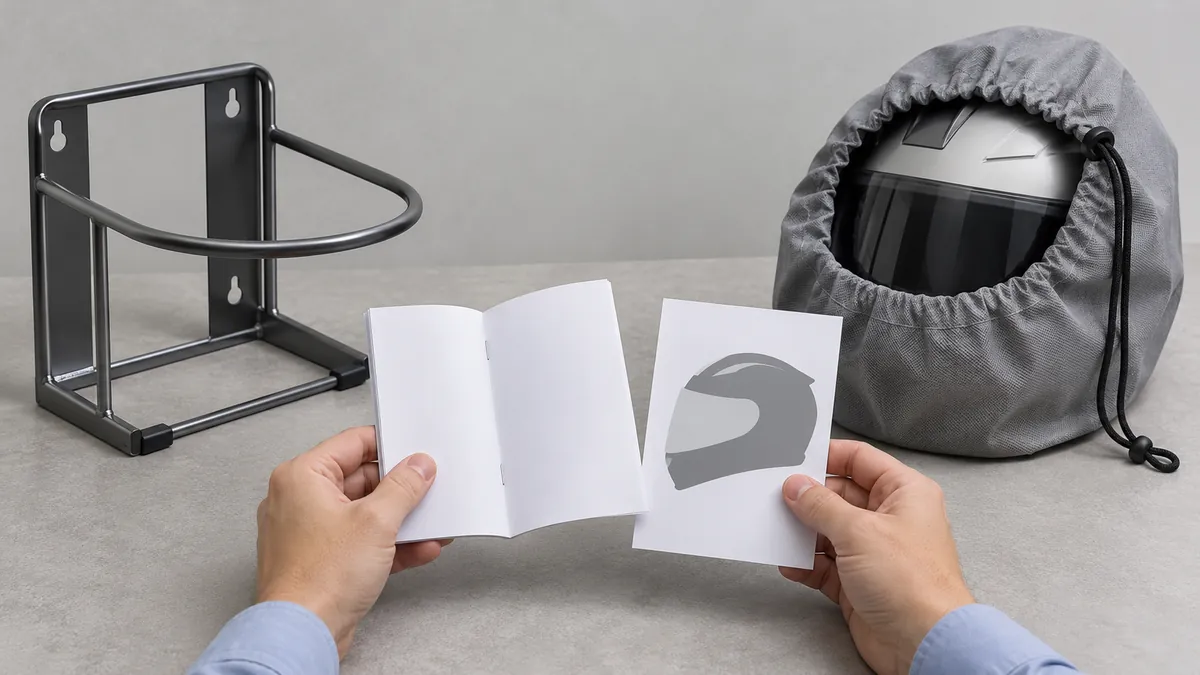
The image is a conceptual procurement illustration. The helmet stays in its storage bag and separate from the empty support. It is not evidence that the helmet can be hung, that a rack is approved, or that Koitor currently makes a helmet storage product.
What do the helmet maker’s instructions say about contact?
The buyer must read the actual instructions for the named helmet, including cautions about storage and the protective liner. HJC’s official helmet-usage page explicitly prohibits hanging or hooking its helmets and warns that doing so can damage protective foam or liner components; it recommends using the helmet bag for storage. For a helmet within that instruction scope, a proposed hook or hanging rack must not be marketed as an approved storage method. See HJC helmet usage guidance.
This restriction should not be narrowed to a small hook tip, a bare metal contact or a visibly sharp edge. If the instruction prohibits hanging or hooking the helmet, an importer should not reinterpret it as permission to use a broader padded hook, a wider cradle or another contact shape. A visual fit check cannot overrule the maker’s stated storage restriction. When a model’s instructions are unclear, seek clarification from the helmet maker before making a compatibility or storage claim.
Product-category examples are not transferable evidence. Yamazaki Home lists a magnetic/screw-mounted hook designed for two children’s helmets and states model-specific installation and load details. That example is about that named children’s product and does not prove compatibility with motorcycle helmets, other helmet models or their protective liners. It is useful as a reminder that the exact target category and maker scope matter, not as an endorsement for a different class of headgear. Review the Yamazaki Home product page.
Why does physical fit not establish permission or protection?
Dimensions can answer whether an object occupies a space; they cannot answer every material, storage or safety question. A helmet may rest on a support without slipping during a showroom check while still being stored in a way the maker prohibits. A soft sleeve or padding may change visible contact marks, but that does not establish that the liner or shell remains unaffected. A rack designer’s opinion cannot replace the helmet manufacturer’s guidance.
The same boundary applies to claims about safety, impact performance, retention, ventilation, drying, hygiene or reduced damage. A storage accessory is not a substitute for the helmet’s care instructions. Do not claim that a stand protects a helmet or preserves its protective performance unless the responsible helmet maker or other appropriate evidence supports that specific statement. A buyer should avoid claims based on “it looks stable,” “it fits most shells” or “the foam is covered.”
Use a decision sequence that stops when the maker’s rule disallows the intended contact:
- Identify exact helmet models and official storage guidance.
- Record any explicit prohibition or permitted storage method.
- Determine whether the planned rack would hang, hook, cradle, clamp or otherwise contact the helmet.
- If instructions prohibit the proposed method, remove that use claim from the product scope.
- If instructions permit or do not address the method, request model-specific clarification or evidence before approving compatibility language.
- Keep dimensional fit, permitted use and performance substantiation as separate review records.
The buyer should also consider whether the rack is intended to hold an empty helmet bag, helmet accessories, a retail display sample or another item that does not contradict the manufacturer’s restriction. Any alternative product use must be accurately described and must not imply that a helmet itself can be hung or supported against instructions.
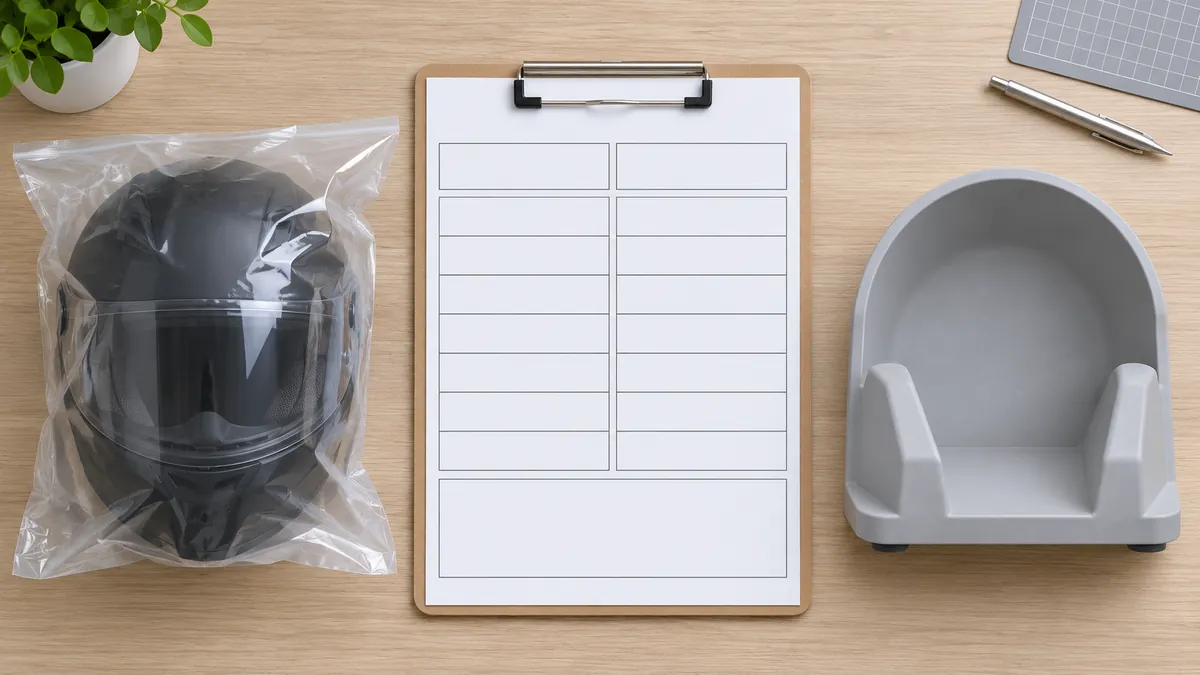
This distinction matters in assortment development. A metal rack may be technically manufacturable while the proposed application claim remains unsupported or inconsistent with a helmet maker’s instructions. The product brief should define what the rack is sold to store and what it is not claimed to do.
How should importers build a model and claim matrix?
Keep the maker instruction attached to every named product pairing. A SKU that is sold as a generic shelf may not require a helmet compatibility claim. A product promoted for a specific helmet, however, should identify its model evidence and the scope of the review. If a single accessory listing spans multiple helmet manufacturers, each maker’s guidance must be checked separately.
| Matrix field | Evidence to record | Decisión del comprador |
|---|---|---|
| Helmet category | Motorcycle, bicycle, child, hard hat or other | Which market and user group does the listing target? |
| Maker and model | Exact model name, generation or identifier | Which instructions are applicable? |
| Official guidance | Current maker URL, document revision and review date | Does the maker permit the proposed storage method? |
| Rack interaction | Hook, hanging, cradle, shelf or non-contact arrangement | What contact or support is actually proposed? |
| Claim status | Approved, prohibited, unclear or unverified | What may the product page truthfully say? |
| Visual assets | Image, packaging and instruction references | Do images imply a use the copy does not support? |
| Scope owner | Buyer, helmet maker, rack supplier or project reviewer | Who resolves an open claim question? |
For HJC models covered by the official prohibition, a helmet hanging or hooking claim should be excluded. Mark the row as “not approved for hanging or hooking under maker instructions” and do not use a generic sample result to reverse that outcome. For other makers, do not assume that HJC’s restriction applies; research their own instructions and retain the evidence. The matrix should preserve both the prohibition and its product scope.
What should visual and sample review cover?
Review visual materials for implied use as carefully as the physical sample. A hero photo that shows a helmet suspended from a hook communicates a product claim, even if the caption is cautious. Packaging, icons, instructions, marketplace alt text and comparison charts can also imply compatibility. If the intended rack use does not permit helmet contact, the image should show an empty rack or a separately bagged helmet that is clearly not supported by it.
At a sample review, record only what the sample establishes: dimensions, assembly, finish appearance, parts and packaging, for example. Do not record “helmet approved” from a dry fit. The presence of a bag around the helmet should not be used to imply that a prohibited hook becomes acceptable; HJC recommends its helmet bag as a storage method, but that is not permission to hang the bagged helmet from a hook. Keep the bagged item separate when illustrating the source restriction.
If the maker confirms a permissible rack method for a specific helmet, preserve the confirmation, date, model range and exact support design. A change to contact geometry, material, padding, instructions or product generation could affect the scope, so recheck before extending the claim. Do not turn a single model confirmation into “fits all helmets.”
What should a buyer ask a rack supplier to provide?
Ask for the product drawing, intended item contact, material and finish details, package contents and any existing compatibility evidence. Make clear that the supplier must not state that a helmet is safe to hang or that a liner is protected without appropriate support. If the supplier only proposes a generic rack shape, keep it as a concept until the buyer has resolved maker instructions and allowed use.
The supplier should identify any components outside its own scope, such as pads, straps, hardware or packaging inserts, and who supplies them. Buyers should also make product copy consistent across the listing and instructions. A specification table should separate the rack’s physical dimensions from a helmet compatibility statement and from any performance claim.
Koitor is a family-owned factory focused on bathroom and home storage hardware. Current company materials do not confirm a helmet storage rack product. This article is adjacent-category claim-control guidance, not a Koitor product or capability assertion. A buyer with a custom metal product idea can request a scope review through the contact page; the OEM home storage hardware page provides general company context only.
How should the team manage changes after the first approval?
Recheck the maker guidance when the assortment adds a helmet model, refreshes a product generation or changes the rack contact design. A prior review applies only to its documented scope. Keep the evidence date and archive an obsolete instruction copy when a current source replaces it, while preserving the historical record for earlier shipments. If a maker’s page is temporarily unavailable, do not treat a cached snippet as a confirmed update; hold the claim until the buyer can verify an authoritative source.
The same revision discipline applies to marketing assets. A new lifestyle photograph, package insert or marketplace infographic can reintroduce a prohibited hanging scene after the engineering team has removed that claim from the specification. Include content and image review in the release checklist. Product copy, product photography and customer instructions should all describe the same allowed use. A metal supplier’s drawing approval does not approve the helmet maker’s claim scope.
Buyer checklist before approving a helmet storage product
- Identify the exact helmet category, maker and model range.
- Read current official storage instructions for each named helmet.
- Record any prohibition against hanging, hooking or other contact.
- Do not override an explicit maker restriction with a physical fit test.
- Separate dimensions, permitted use and performance substantiation.
- Review photographs, labels, packaging and alt text for implied claims.
- Keep an empty rack and helmet separate in visuals where contact is not approved.
- Mark unclear or unverified pairings as not approved for compatibility claims.
- Do not claim universal fit, liner protection or preserved safety without evidence.
- Recheck claims when the helmet or rack design changes.
Preguntas frecuentes
Can every motorcycle helmet be hung on a hook?
No. Check the specific helmet maker’s instructions. HJC explicitly prohibits hanging or hooking helmets within its guidance and recommends its helmet bag for storage.
Does a padded hook make a prohibited storage method acceptable?
Do not assume so. Padding does not create permission when the maker prohibits hanging or hooking. Ask the helmet maker if an alternative method is unclear.
Does a physical fit test prove helmet compatibility?
No. It checks only physical interaction under the test setup. It does not override maker instructions or prove that protective components remain unaffected.
Can a rack be marketed for children’s helmets because one product lists that use?
Only within the exact scope of the relevant maker’s product evidence. A children’s helmet hook does not establish compatibility with motorcycle or other helmets.
Can an image show a bagged helmet hanging from the rack?
Not when the applicable maker instruction prohibits hanging or hooking the helmet. A bag is a storage recommendation in HJC’s guidance, not an exception that permits suspension from a hook.
Trabaja con Koitor Hardware
Discuss a Metal Storage Hardware Concept
Share a drawing, intended use, contact restrictions and target pack. Koitor can confirm whether a metal concept fits its current bathroom and home storage hardware scope before quotation.
OEM / MARCA BLANCA
Convierte esta guía de abastecimiento en un resumen del producto
Indícanos el producto que deseas, el tamaño, el acabado, la cantidad del pedido y los requisitos de embalaje. Tu equipo recibirá un análisis práctico de la viabilidad de fabricación antes de recibir el presupuesto.


 English
 Español
 Português
 Français
 Deutsch
 العربية