
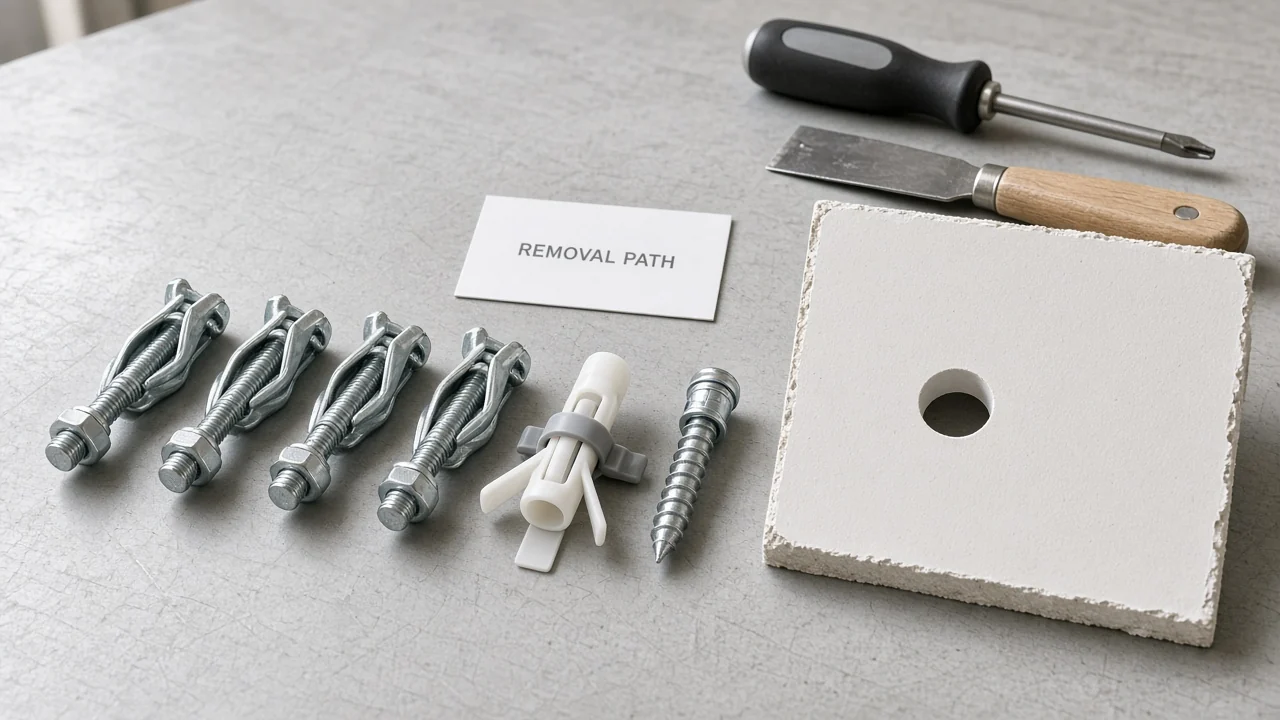
A service sheet can only tell a buyer how to remove a toggle bolt after it names the toggle family that was actually packed with the accessory. A classic spring-wing toggle, a retained or strap-style toggle, and a self-drilling threaded anchor sold under a toggle name all come out of a hollow wall in different ways.
If the sheet skips that step, it ends up printing a single “unscrew it and push it through” line that is right for one family and wrong for the others. The result is a wall with a spinning screw, a plastic strap snapped off behind the board, or a self-drilling body that tears the paper face.
This guide is for importers, distributors and private-label teams who already sell towel bars, robe hooks, shelves and storage accessories with toggle fixings in the kit. Koitor Hardware is a family-owned China OEM manufacturer of custom metal bathroom and home storage hardware. The guide covers how to write the take-down section of a service sheet, not a new anchor product.
The first-hang sequence already lives on the published how to install a toggle bolt guide, and selection between anchor types lives on the toggle bolt vs molly bolt comparison. This page picks up where those stop: the accessory is coming off the wall, and somebody has to decide what happens to the anchor.
What does how to remove a toggle bolt depend on first?
It depends on two facts the service sheet has to state before any step: which toggle family is in the wall, and what the supplier’s documentation says happens to that family when the screw is withdrawn. Everything else, including the patch and any reinstall, follows from those two facts.
Most consumer questions about this task come from people who never knew which family they had. Forum threads ask why the screw spins without backing out, why the wing fell into the cavity, or why a self-drilling anchor will not budge. Each of those complaints describes a different family behaving exactly as designed.
For a buyer, the practical question is narrower. If a listing or a leaflet says the accessory is easy to remove or easy to relocate, which packed anchor does that sentence assume, and what does the cited sheet say about taking it out? Without that pairing, the sentence is a promise nobody can check.
Start the sheet with a short identification block. Name the family in the supplier’s own words, show a photo or line drawing of the packed part, and give the bolt thread and length only if the supplier’s data states them. If a value is not documented, leave the field named and blank rather than filling it from a competitor’s chart.
Then state the documented path for that family. A path is one of a small number of outcomes: the wing is released and left in the cavity, the anchor body is backed out whole, the anchor is pushed through and abandoned, or the anchor is cut or sunk flush and patched. The supplier’s sheet decides which outcome applies.
A useful test is whether a service technician who has never seen the product could pick up the sheet and know, before touching a screwdriver, which of those outcomes to expect. If the answer depends on guessing the family from the hole size, the sheet is not finished.
How do spring-wing, retained and self-drilling toggles come out?
The three common families share a name but not a mechanism. The removal behavior follows the mechanism, so the sheet should describe the mechanism briefly before giving any steps. That way, a reader who finds a different part in the wall knows immediately that the sheet does not apply.
Spring-wing toggles
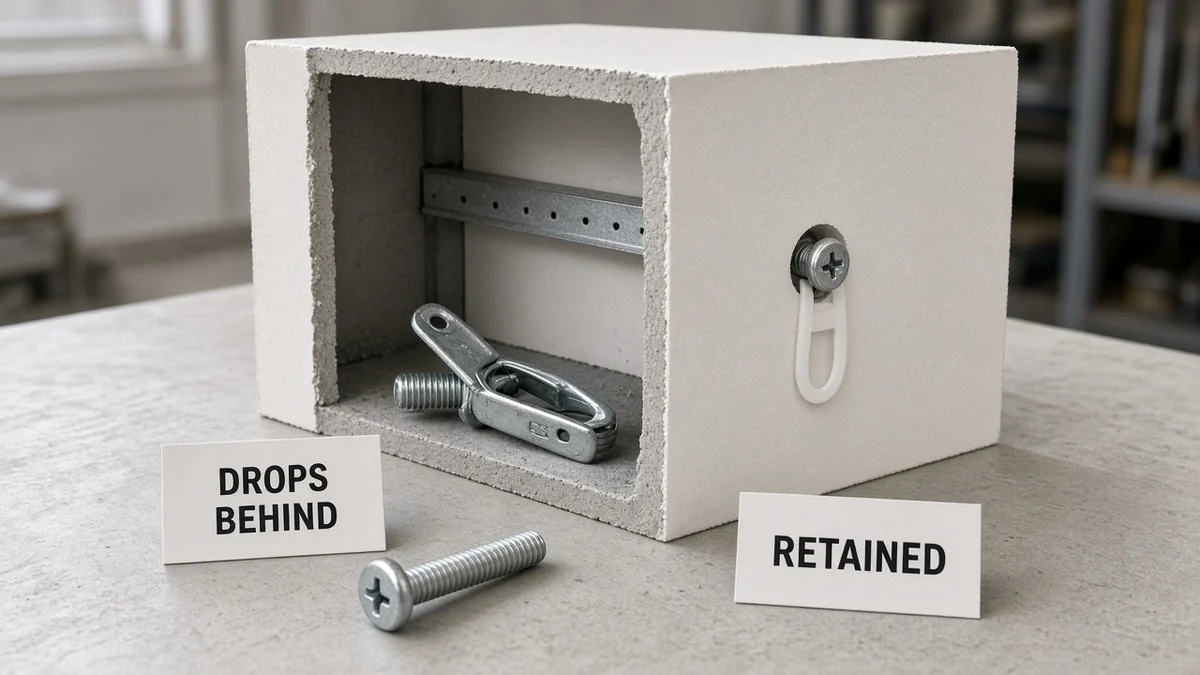
A spring-wing toggle is a machine screw threaded into a folding wing nut. The wings are pushed through a drilled hole, spring open behind the board, and clamp the accessory when the screw is tightened. The wing is never designed to come back out through the same hole.
When the screw is backed out fully, the wing is released and drops into the wall cavity. That is the normal outcome, not a failure. A removal sheet for this family should say so plainly, so the user does not try to fish the wing out or pry at the hole and widen it.
The common snag is a screw that spins without backing out. That happens when the wing has lost its grip on the back of the board and turns with the screw. Supplier guidance usually suggests holding light outward pressure on the screw head or the accessory while turning, so the wing bites again. The sheet should repeat only what the supplier documents.
Retained or strap-style toggles
Retained toggles use a metal channel or bar on a plastic strap or collar. The installer pushes the channel through the hole, pulls the strap to seat it, slides a cap down, and snaps the strap off. The anchor body stays held in the hole even when the screw is removed.
That retention is the point of the design: the screw can be removed and refitted while the channel stays in place. Whether a particular brand supports reuse of the channel with a new accessory is a documented property of that product, not a general rule. The sheet should say “per supplier data” or leave reuse unstated.
When a retained toggle has to be abandoned, the usual documented approach is to remove the screw, push the collar and channel through the wall so they drop into the cavity, and patch the hole. Some sheets describe cutting the collar flush instead. The sheet should name one path and cite it.
Self-drilling toggles sold under a toggle name
Some threaded self-drilling anchors include a small toggle or flip arm, and retailers often shelve them with toggles. Their removal behaves more like a threaded anchor: once the screw is out, the body may back out counterclockwise, or the toggle arm may hold it in place.
Because the arm and the threaded body interact, forum users often report that these will not back out cleanly. If the supplier’s sheet does not document reverse removal, the safer sheet wording is to treat the body as an abandon-in-place part: sink it slightly below the surface and patch over it. Do not invent a turning technique.
Mixing these three families is the single most common error in removal leaflets. A sheet written for spring wings tells the reader the anchor will drop away; a reader with a retained toggle then pries at a channel that was designed to stay put, and tears the face paper.
What should a toggle removal service sheet list?
A removal section does not need many words, but it needs the right fields in a fixed order. The order matters because each field narrows the next one. Identification comes first, the documented path second, the patch or reinstall note third, and exclusions last.
The table below is a working template for that section. It lists field names and the source each field should come from. It deliberately carries no hole diameters, no load values and no reuse ratings, because those are product data that belong to the named supplier sheet and nowhere else.
| Campo | What to write | Source |
|---|---|---|
| Packed toggle family | Spring-wing, retained or strap-style, or self-drilling with toggle arm, in the supplier’s own name | Packing list and supplier drawing |
| Visual ID | Photo or line drawing of the packed part next to the screw | Supplier sheet or factory sample photo |
| Documented removal path | Wing released into cavity, channel retained, body backed out, or abandon and patch | Supplier’s install or service sheet |
| Spinning-screw note | Only the handling advice the supplier documents | Supplier sheet; blank if not stated |
| Reuse statement | Reuse permitted, not permitted, or not documented | Supplier sheet; default to not documented |
| Patch pointer | A pointer to standard gypsum-board finishing practice, with no material brand promised | General finishing reference |
| Exclusions | Ceilings, overhead hangs, grab bars and other safety-critical fixings | Brand policy |
Keep the language plain. “Back the screw out fully. The spring wing will drop inside the wall. Patch the hole” is a complete path for one family. It is not a complete path for a retained toggle, and the sheet should never let the reader assume it is.
Photos beat paragraphs
Most removal mistakes start with misidentification. A side-by-side photo of the packed toggle, ideally with the cap or strap visible, prevents more damage than a paragraph of steps. If the packing list changed between production runs, the sheet should show the part for each run or carry a version note.
Version the sheet with the kit
If a later run switches from spring wings to retained toggles, the old removal path becomes wrong overnight. Tie the sheet’s version to the kit’s bill of materials, and treat any anchor change as a trigger to review the removal section, not only the install section.
Keep the tool list honest
A removal sheet rarely needs more than a screwdriver that fits the screw head and a putty knife for patching. If the supplier documents a specific bit, list it. Do not add drills, pliers or cutters “just in case,” because each extra tool invites a different method the sheet does not support.
Should the sheet cover patching or putting a fixing back?
It should point to patching and say clearly whether reinstall in the same hole is documented. It should not turn into a drywall repair course, and it should not imply the wall will be undamaged. A toggle hole is usually larger than the screw, so some repair is the normal expectation.
Gypsum board finishing has its own body of practice. ASTM publishes a standard specification for application and finishing of gypsum board, and finishing products carry their own instructions. A hardware service sheet can point the reader toward that practice without promising a particular compound, number of coats or invisible result.
For reinstall, the sheet should separate three cases. The first is reinstalling the same accessory with the same retained anchor, which is only possible if that family documents it. The second is installing a new anchor in a fresh location. The third is enlarging or reusing the old hole, which the sheet should not approve unless the supplier does.
For spring-wing families, a fresh anchor is the normal answer, because the old wing is gone. The first-hang sequence for that fresh anchor belongs on the toggle bolt installation guide. The removal sheet only needs one sentence that sends the reader there.
What a user should expect after removal
Be specific about the outcome without promising it. “Expect a hole larger than the screw that needs patching” is honest. “Leaves no trace” is not, and it invites complaints when the wall shows a filled patch under paint. If the accessory covered the hole area, say that the new position may differ.
Rental and hospitality returns
Distributors selling into rentals and hotels often get asked whether accessories can be removed at move-out. That question is really about the patch, not the anchor. The sheet can state the documented path and the expected repair, and leave lease terms or property policies to the property owner.
Where does removal stop and another guide take over?
Removal is one step in a chain that includes selection, first hang, and sometimes relocation. Each of those decisions already has, or should have, its own document. A clean removal sheet points to them in one line each instead of repeating their content.
Selection between toggle and molly-style anchors belongs on the toggle bolt vs molly bolt comparison. That page already notes that removal and reinstallation depend on the selected design. The removal sheet should not reprint its comparison table, and it should not try to settle the choice after the fact.
A molly-style sleeve anchor is a different family with a different removal path. Its expanded sleeve is crimped against the back of the board, so it does not drop away like a spring wing. If a kit packs molly anchors, the removal section should follow a molly-specific path, and this toggle section should say “not this family” and stop.
The choice of anchor versus stud fixing for bathroom accessories is covered in the towel bar anchor kit drywall versus stud buyer guide. If the reader is moving a towel bar to a stud, the removal sheet should point there for the new fixing and keep its own scope to taking the old toggle out.
Packing and inspection of the anchor bag itself is a factory control question. The hardware kit packing inspection checklist covers how to verify that the bag matches the bill of materials. A removal sheet is only correct if that check passed, so the two documents should reference the same anchor part number.
Ceilings and safety-critical fixings
Ceiling and overhead toggles, grab bars and anything that supports a person are outside a general accessory service sheet. Removing an overhead fixing has a fall hazard, and grab-bar installations follow their own product and code requirements. The sheet should list these as exclusions in one sentence and give no steps.
Power tools and hidden services
Some readers reach for a drill or a rotary cutter when a screw will not come out. Before any cutting tool goes into a wall, hidden wiring and pipes become a real hazard. OSHA’s guidance on hand and power tools sets out general safe-use principles; the service sheet should keep its own steps hand-tool only unless the supplier documents otherwise.
What must a toggle removal sheet not print?
Some of the most damaging lines in a removal sheet look helpful. They are usually borrowed from a video or a forum post that described one family in one wall. The sheet should be checked against the following list before release, and any line that matches should be removed or replaced with a cited statement.
- A universal removal trick presented as working for every toggle, such as “always push it through” or “pull while turning.”
- A reuse promise for any anchor body or wing that the supplier does not document as reusable.
- Hole diameters, screw lengths or load values that are not in the named supplier’s data.
- A statement that removal leaves the wall undamaged or needs no repair.
- Any step for ceiling, overhead or grab-bar fixings.
- A molly-sleeve or plastic-plug sequence copied into the toggle section.
- A claim that Koitor manufactures a specific toggle SKU, unless a current packing list and quote say so.
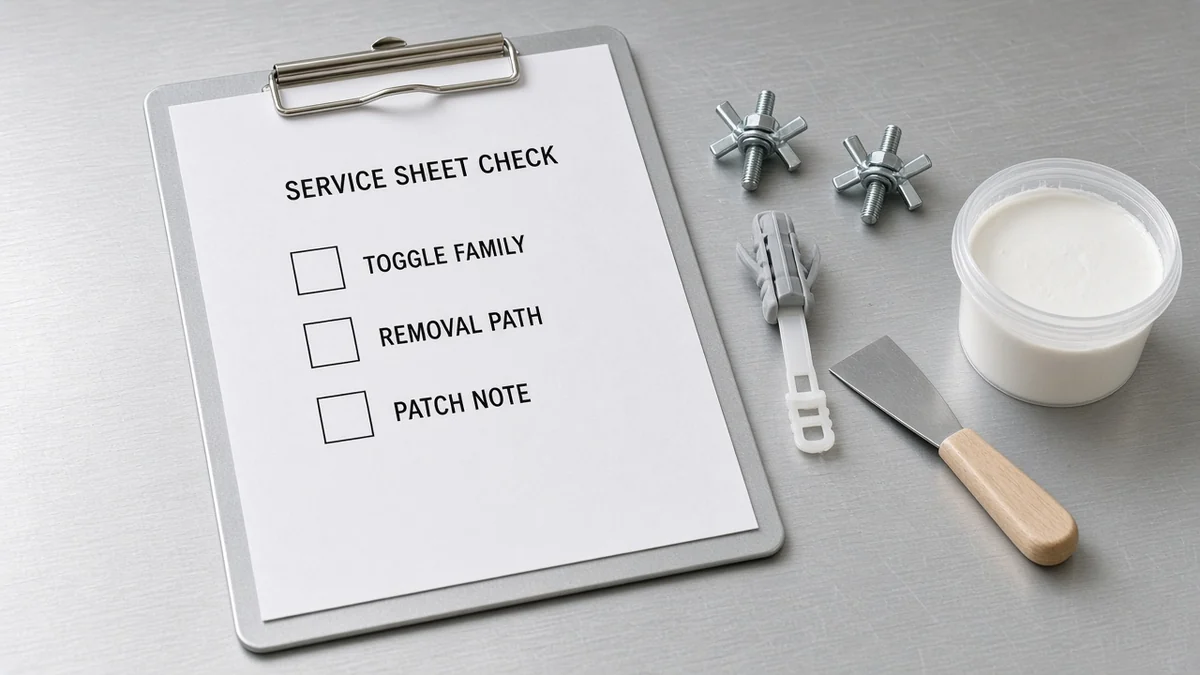
The final review is simple. Read the removal section with the packed anchor in hand. If every line matches what that part does and what its supplier says, the section is ready. If any line describes a different part, fix it before the sheet goes to translation or print.
Who signs off
The brand owner usually approves the wording, and the supplier confirms the anchor data. Koitor can review whether the removal language and the packed family line up and flag gaps. Final approval of product claims stays with the brand that publishes the sheet.
Translation risk
Toggle terminology varies across markets. “Spring toggle,” “butterfly anchor,” “gravity toggle” and “hollow wall anchor” may all appear in translated leaflets. Fix the family name in the source language with a photo, and ask translators to keep the photo reference, so the family does not drift between languages.
When to rewrite instead of edit
If a removal section was written before the anchor family was known, editing it line by line rarely works. It is faster to delete it, confirm the family from the packing list, and rewrite the four core fields: family, path, reuse, and patch pointer. The exclusions line can usually be kept as written.
Frequently asked questions about toggle bolt removal
Can I just pull a toggle bolt straight out of drywall?
Usually not without damage. A spring wing is wider than the hole by design, and a retained channel is held by its collar. Pulling either one tears the board. The normal approach is to remove the screw and follow the family’s documented path, which may leave the wing or channel behind the wall.
Why does the screw spin when I try to remove a toggle?
The wing has usually lost its grip on the back of the board and is turning with the screw. Light outward pressure on the screw head often lets the wing catch again, but the service sheet should only repeat what the supplier documents for that part.
Is “remove a toggle bolt from drywall” a different task?
No. It is the same removal decision with the wall type stated. A sheet that already names drywall as the documented substrate covers it. It is not a reason to write a separate leaflet or a separate drywall chart.
Can a toggle anchor be reused after removal?
Spring wings are normally lost in the cavity, so reuse does not arise. Some retained designs allow refitting a screw. Reuse is a property of the named product, so the sheet should state it only when the supplier documents it and otherwise say reuse is not documented.
Does this cover molly bolts or plastic anchors?
No. Molly-style sleeves and plastic expansion plugs are different families with different removal paths. A kit that packs them needs a removal section written for that family, not a copy of the toggle steps.
What if I do not know which toggle family is in the wall?
Check the original packing list or install leaflet first. If neither is available, look at the screw head and the hole: a retained toggle often shows a cap or collar flush with the wall. If the family still cannot be confirmed, treat the anchor as abandon-in-place and patch, rather than guessing a method.
Does Koitor make toggle anchors?
This guide does not claim that. Koitor makes custom metal bathroom and home storage hardware and reviews install and service wording for the fixing kits packed with it. A specific anchor part comes from the packing list and quote for each program.
Trabaja con Koitor Hardware
Review a toggle-bolt removal sheet
Send the packed-anchor drawing or supplier sheet, the accessory being taken down, and the installed condition. We can review the removal wording and the named toggle family. We will not issue a universal removal trick, a reuse promise, or a ceiling or grab-bar approval.
OEM / MARCA BLANCA
Convierte esta guía de abastecimiento en un resumen del producto
Indícanos el producto que deseas, el tamaño, el acabado, la cantidad del pedido y los requisitos de embalaje. Tu equipo recibirá un análisis práctico de la viabilidad de fabricación antes de recibir el presupuesto.


 English
 Español
 Português
 Français
 Deutsch
 العربية