

A guide on how to remove a toilet paper holder, for an importer, is a service-sheet decision about the wall-fixture release method. Name the architecture first, then name whether the holder releases with a set screw, a concealed plate, a pin, or another method written on the drawing, before any “easy to remove” or “easy to replace” line is printed.
Consumer threads about holders with no visible screws are useful only as demand evidence. They are not a Koitor procedure, not a hex-size standard, and not a damage-free guarantee.
This guide is for importers, distributors, and private-label teams who need a service sentence that matches the hardware actually designed. Koitor Hardware is a family-owned custom metal hardware factory in China, working as an OEM on bathroom and home storage programs.
Send the holder drawing, the concealed-fastener or set-screw design, and any service sentence the replacement program must carry. We can review the wording and the method name. We will not issue a removal-time, a pry method, or a no-damage claim.
What does a guide on how to remove a toilet paper holder actually freeze?
It freezes the release method for the wall fixture: the architecture, the named method, and the tool or exclusion the service sheet must carry. It does not freeze the first-install kit, the spring-roller dimensions, or a mounting-height chart.
The live toilet-paper-holder installation article already reserves a removal guide as a neighboring file and states that in-service loosening is not its thesis. This file is that neighboring decision. It should not rewrite the first-install page, and it should not treat “how to replace a toilet paper holder” as the target keyword. Replacement planning, spare-part codes, and a new-holder kit are different questions.
Searchers often want to get a holder off the wall because they cannot see a screw, or because a post has loosened. That demand is real. For an importer, the usable work is to name the method so a brand does not print “easy to remove” on a design whose release is undocumented. This page is not a consumer pry-it-off tutorial.
A custom tissue holder manufacturer can be a commercial send-off for a holder program. Matching a finish or a post style is not the same as inventing a default release method. If you are developing a holder, bring the fastener design with the drawing.
Why must architecture be named before the release method?
The method only makes sense after the architecture is named. A set-screw post, a concealed plate or hidden rose, a pin or detent, and some other named method do not share a service sentence. If the sheet says only “remove the holder,” a later technician will try the method they know, which may not be the method that was designed.
Name the architecture in the same words the drawing uses. If the post covers a plate, say so. If a decorative cap hides a set screw, say where the cap is and that the screw is behind it. If the bar itself is the part that releases, say whether that release is a pin, a spring, or another named device. The bar’s paper-roll function is not the wall-fixture release. Spring-roller dimensions stay on their own file.
Open-arm and spring-roller styles can share a wall plate and still differ in how the roll is changed. That is a neighboring product decision. This file should not treat roller style as the answer to a wall-fixture removal question. A technician can replace a roller and still be unable to get the plate off the wall.
Freestanding holders and holders with shelves are also different products. If the SKU in hand is a standing unit, use the existing freestanding toilet paper holder stability checks as a send-off for that stability question. If the SKU is a holder with a shelf, use the existing toilet paper holder with shelf specification for that specification. Neither file is a wall-fixture release method, and this file should not borrow their theses.
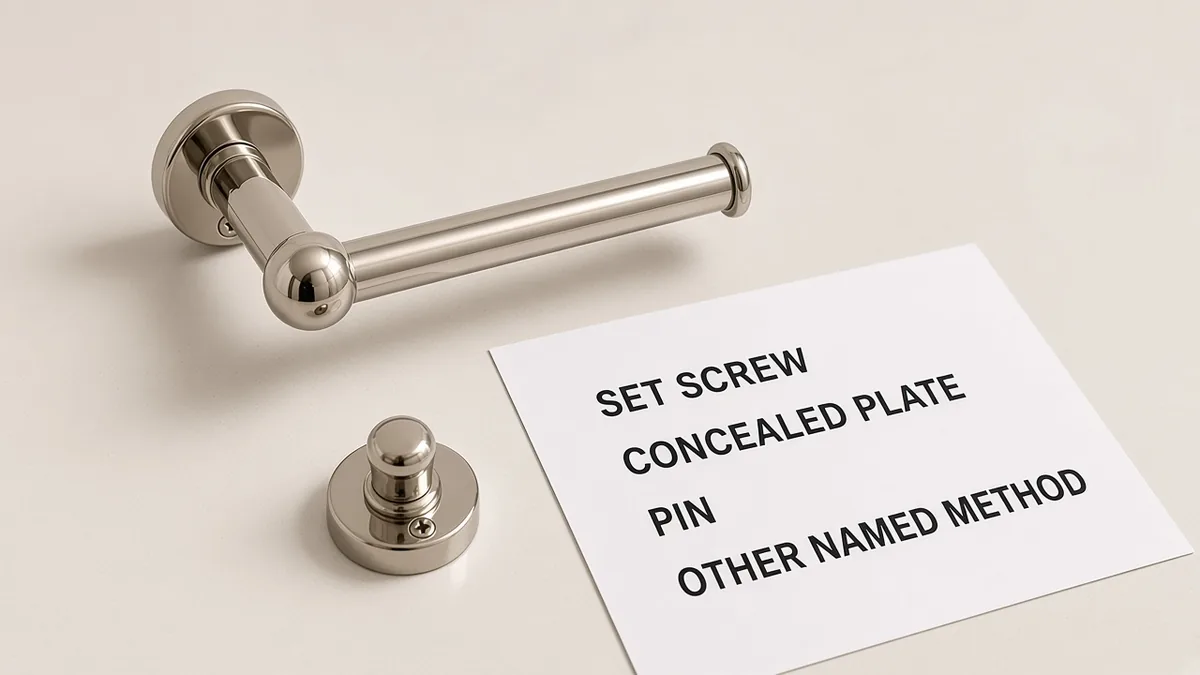
What must the service sheet show, or explicitly exclude, about the tool?
If the named method needs a tool, the service sheet must show that tool or explicitly exclude it. A hidden set screw with no tool note will be treated as a mystery fastener. A concealed plate with no release note will be treated as a part that has to be forced.
This file should not invent a hex size, a bit type, or a torque value as a Koitor standard. If a project or brand file names a tool, the sheet can carry that name. If no tool is supplied in a service kit, the sheet should say so.
Write exclusions in plain language. “Service tool not included” is a complete sentence when the architecture needs a tool. Leaving the line blank is how a later replacement guide assumes a key was packed with the original holder, or with a spare-part kit that never existed.
The sheet should also show any cap, cover, or slot the method uses. A set-screw access under a cap is a different service action than a set screw that is already visible. A concealed plate that slides after a hidden latch is released is a different action than a plate that is supposed to lift after a screw is loosened. Name the parts. Do not hide them under “no visible screws.”
Do not add a pry instruction, a knife instruction, or a “damage-free” promise. Those lines are how finishes are marked and how returns are argued. If a method can be described without force, describe the method. If the drawing does not support a no-damage claim, do not print one. Koitor will not issue a damage-free guarantee in this article.
Do not add a minute-count. “Removes in seconds” is a marketing line, not a service field. If a brand wants a time claim, it needs its own evidence. This article will not supply one.
Why are “no visible screws” threads demand evidence, not a factory procedure?
Consumer and forum threads often start from a holder that appears to have no screws. The question is then how to get it off without breaking the wall or the finish. That thread is evidence that concealed-fastener designs are common, and that buyers want a documented method. It is not a procedure Koitor can copy, and it is not proof that every concealed holder uses the same release.
Some of those threads describe prying a plate, twisting a post, or guessing a hex size. Those descriptions are mixed, unofficial, and often destructive. They should not be cleaned up and reprinted as a factory service sheet. The useful translation is: if your design hides the fastener, the service sheet has to name the method and the tool or exclusion before anyone writes “easy to remove.”
A thin search term about how to replace a toilet paper holder is also not this page’s target. Replacement can mean a new SKU, a new plate hole pattern, or a spare-part code. Those questions belong on first-install, replacement-planning, or parts files. This file stays on getting the designed wall fixture off by the method it was built to use.
If a later technician still damages a wall, that outcome is not evidence that a damage-free line should have been printed. It is evidence that the method, the tool, or the exclusion was missing, or that the person used a method the sheet never named. The service file should stay honest about what it does not promise.
| Architecture family | Release method to name | What the service sheet must show or exclude | What this row is not |
|---|---|---|---|
| Exposed or concealed set-screw post | Set screw, and the access point for that screw | The tool if one is required, or an explicit exclusion that the tool is not supplied in the service kit | A hex size invented as a Koitor standard, or a first-install kit list |
| Concealed mounting plate or hidden rose | Concealed plate, sliding rose, or other named hidden plate method | How the plate or rose is released, and whether a cap, a slot, or a hidden fastener is part of that method | A ‘no visible screws’ slogan used as if it were a procedure |
| Pin, detent, or other named mechanical release | The named pin, detent, or equivalent, in the project’s own words | Whether a special tool is required, packed, or excluded | A pry-off instruction, a damage-free guarantee, or a minute-count |
| Other named method | The method name from the drawing or brand file, written out | The same tool-or-exclusion rule, plus any cap or cover the method uses | An unnamed ‘easy to remove’ line, or a replacement-planning SKU code |
| Neighboring files, not this thesis | Not applicable | Point to first-install, roller size, replacement parts, or height as separate files | The answer to a wall-fixture release question |
Read the table as a filing rule, not as a factory disassembly sequence. The first four rows are release methods this article is willing to discuss when they are named on a drawing. The last row sends neighboring questions back to their own files.
Which neighboring install, roller, and height files should stay separate?
First-install kit language stays on the live toilet-paper-holder installation article. That page already owns how the holder goes on, and it should not be rewritten here as a removal essay. Spring-roller dimensions and open-arm versus spring-roller choices stay on their existing files. Hex-key size, when it is a program-wide kit question, stays on its accessory-kit file. Do not reprint a drive size here as a Koitor default.
Replacement-parts planning stays on its existing planning page. A spare-part code is not a release method, and a release method is not a spare-part code. The two files can mention each other. They should not copy each other’s thesis.
Height stays on height files. If a commercial or project program needs a holder-height datum, use the live commercial toilet paper holder height guide as a send-off only. Do not reopen a height chart as the answer to a removal question, and do not print unofficial holder-height inches here.
A neighboring article on how to remove a towel rack can remind you that fixture-removal questions are already being asked in the same bath. It is a different fixture. Do not clone that rack page onto a toilet-paper holder, and do not invent a link if you are only naming it in prose.
A fabricante de accesorios de baño a medida can match a finish across a bath collection. Matching the metalwork is not the same as inventing a default release method for every SKU in the set. A hook, a bar, and a holder can share a finish and still release in three different ways.
What should be checked before an easy-to-remove line is printed?
Use the checklist below as a service-sheet and replacement-program review, not as a field teardown sequence. Koitor’s practical manufacturing insight here is that a small-batch OEM can build a post, a plate, and a concealed fastener to a drawing, but it should not be asked to print “easy to remove” until the method and the tool or exclusion have been named.
During sample review, the useful questions are simple. Can a reader tell, from the sheet, whether the holder uses a set screw, a concealed plate, a pin, or another named method? Is the access point visible on the drawing? Is a tool packed in a service kit, or is it excluded in writing? That is documentation hygiene. It is not a timed removal test, and it is not a damage trial.
When the fastener design changes, revise the service sentence in the same change. A later move from an exposed set screw to a concealed plate can leave an old “loosen the set screw” line stranded in a manual. Record that as a method revision, not as a silent design tweak.
Lifestyle photographs should not imply a pry bar, a knife, or a “no tools needed” claim the sheet does not support. If a photo stylist shows a holder already off the wall with no method in view, the image is illustrative only. It is not a procedure.
If two markets share a holder outline but not a release method, do not force one service sentence into both manuals. It is cleaner to keep one outline and two named methods than to print a blended “easy to remove” line that is true for neither design.
Incoming samples can be reviewed against the service sheet without being destroyed. The reviewer should be able to point to the access cap, the plate, or the pin on the sample and find the same name on the sheet.
If the sample has a hidden fastener and the sheet has no method name, the sample has failed the documentation check. That failure is not a reason to run a timed removal trial, and it is not a reason to print a no-damage line.
Retail packs that include a small service card should use the same method name as the longer sheet, not a shorter slogan. A card that says only “twists off” will be applied to set-screw posts and to concealed plates alike. If the card cannot carry the full method, it should point to the sheet instead of inventing a shorter action.
If a later order changes only the decorative cap, check whether the access path changed with it. A deeper cap can hide a set screw that used to be obvious. A shallower cap can expose a fastener the old sheet still calls concealed. Treat the cap change as a method review, not as a finish-only change.
Collection manuals that cover a bar, a hook, and a holder in one booklet should still keep a holder-specific release paragraph. A shared finish chapter is not a shared method chapter. If the booklet uses one “how to take the fixture off the wall” section for every SKU, the holder will inherit a method it does not have.
When a service letter is sent to retailers, use the same method name as the sheet that shipped with the holder. A later letter that introduces a new name for the same fastener will be read as a new design. Keep the vocabulary stable, and record a revision only when the method itself changed.
Do not add a list of household tools “that usually work.” That list becomes, in the field, a permission to improvise. If the designed method needs a named tool, name it or exclude it. If the designed method needs no tool, say that the method is tool-free only after the method itself has been named.

- Name the wall-fixture architecture before any easy-to-remove line: set-screw post, concealed plate or rose, pin or detent, or another method named on the drawing.
- Name the release method in the same words the drawing uses, including the access point for a hidden fastener or cap.
- If the method needs a tool, show the tool or exclude it in writing; do not invent a hex size as a Koitor standard.
- Show any cap, cover, or slot the method uses; do not hide those parts under “no visible screws.”
- Do not print a pry instruction, a damage-free guarantee, a minute-count, or a factory removal procedure.
- Do not reprint the first-install kit, spring-roller dimensions, or a height chart as the answer to a removal question.
- Do not treat “how to replace a toilet paper holder” as this page’s target, and do not turn the file into a spare-part catalog.
- Keep freestanding holders and holders with shelves on their own files when those are the SKUs in hand.
- Revise the service sentence whenever the fastener design changes.
- Do not ask the factory to supply a no-damage claim or a removal-time for an unnamed method.
Preguntas frecuentes
Can the manual say the holder is easy to remove?
Only after the architecture, the release method, and the tool or exclusion are named, and only if the sentence does not go beyond that method. “Easy to remove” is not a substitute for a missing method name. This article does not supply a minute-count or a damage-free guarantee.
Is a guide on how to remove a toilet paper holder the same as a replacement-planning page?
No. This file names the wall-fixture release method. Replacement planning covers spare-part codes, a new SKU, or a later kit. The live installation page covers first install. Keep those files separate.
What if there are no visible screws?
Treat that appearance as a reason to name a concealed method, not as a procedure. The sheet should say whether the design uses a hidden set screw, a concealed plate, a pin, or another named method, and what tool is required or excluded. Do not reprint a forum pry tip as factory data.
Should the service sheet include roller size or holder height?
No. Roller dimensions and open-arm versus spring-roller choices stay on their own files. Height stays on a height file, including the commercial holder-height guide when that is the question. Those neighboring files do not answer the release-method question.
Can Koitor give us a standard hex size or a no-damage method?
Koitor can review whether the wording matches the designed fastener and whether a tool is packed or excluded. Koitor will not invent a hex size, a pry method, a removal-time, or a damage-free guarantee in this article. If a project file names a tool, bring that file with the drawing.
Does a holder with a shelf or a freestanding holder use this same file?
No. Those are different products. Use their existing specification or stability files, and do not treat a standing base or a shelf as a wall-fixture release method.
Trabaja con Koitor Hardware
Need a toilet-paper-holder release method reviewed?
Send Koitor the holder drawing, the concealed-fastener or set-screw design, and any service sentence the replacement program must carry. Our team can review the wording and the method name, without issuing a removal-time or a no-damage claim. MOQ can start from about 100 pcs depending on the product; samples usually take 5-7 working days after details are confirmed; bulk production usually takes 4-6 weeks depending on the project.
OEM / MARCA BLANCA
Convierte esta guía de abastecimiento en un resumen del producto
Indícanos el producto que deseas, el tamaño, el acabado, la cantidad del pedido y los requisitos de embalaje. Tu equipo recibirá un análisis práctico de la viabilidad de fabricación antes de recibir el presupuesto.


 English
 Español
 Português
 Français
 Deutsch
 العربية