

How to remove rust from chrome depends on whether the orange material is removable surface rust and whether the chrome plating is still intact. Use only a rust-removal product whose instructions explicitly cover the actual chrome finish, then remove residue as directed and inspect the remaining surface. Rust removal does not deposit new chromium, fill pits, or repair missing plating. If chrome is peeling or the compatible instructions are unavailable, stop and seek a finish assessment instead of escalating abrasion or chemicals.
How to remove rust from chrome: identify the surface first
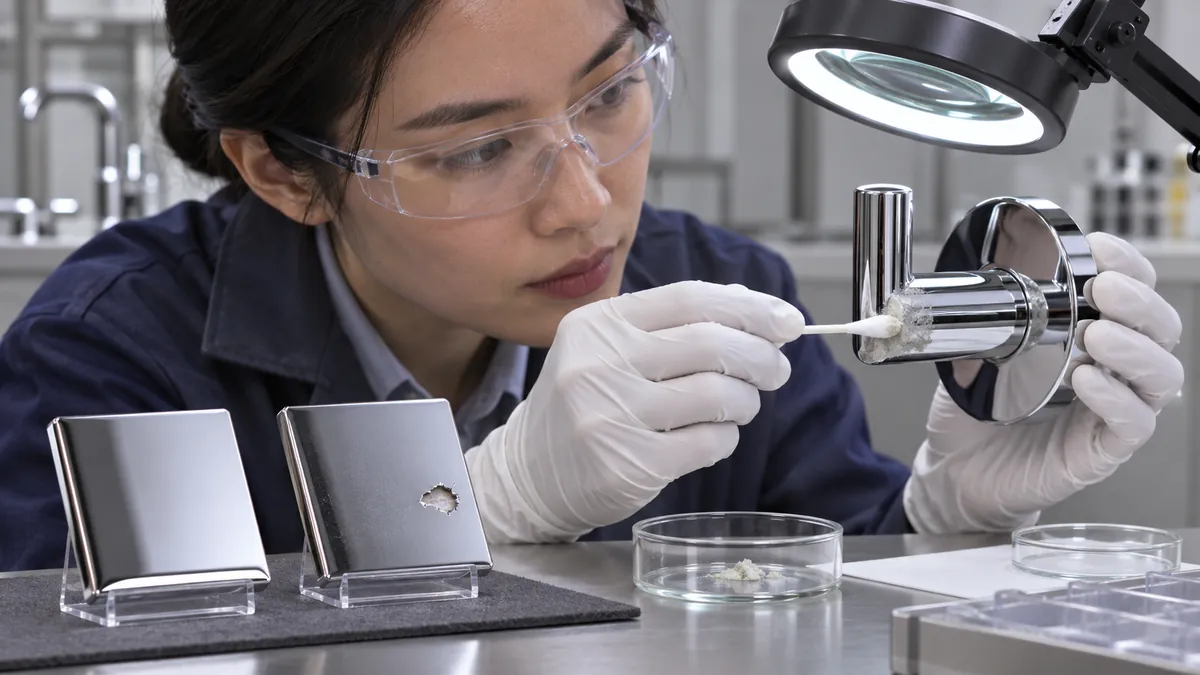
“Chrome” usually describes a plated or chrome-like finish, but buyers should confirm what the actual product specification says. The visible surface may be intact plating with contamination, a plated layer with pits, or a damaged area where an underlying material is exposed. A photograph may help record the appearance, but it cannot prove the layer structure or identify every corrosion product.
Before selecting a treatment, distinguish loose soil from a rust-colored spot, and distinguish a spot from visible finish failure. Note where the mark is located, whether it is raised or recessed, whether it changes after the maker-approved routine cleaning method, and whether the surrounding finish appears continuous. Do not scrape or aggressively rub the area to “test” it; that can alter the evidence and damage a thin finish.
A simple endpoint map keeps the next step clear:
| Observación | What it may mean | Reasonable next decision |
|---|---|---|
| Loose dirt or soap residue | Surface soil | Follow the product maker’s routine chrome-care instructions |
| Local orange material on otherwise intact-looking chrome | Removable rust may be present | Consider only a product explicitly suitable for that chrome finish |
| A remaining pit after material is removed | Surface damage or loss of material may remain | Record the pit and request finish assessment |
| Flaking, peeling, or exposed substrate | Plating integrity is visibly compromised | Stop DIY removal and ask a qualified finish provider about repair |
| Unclear appearance or unknown finish | The treatment boundary is unknown | Confirm the actual finish and instructions before acting |
This table describes observations and decisions, not a diagnostic test. A visible spot does not establish the substrate, plating thickness, or corrosion mechanism. The responsible maker or finisher should assess uncertain parts.
Rust removal is not replating
A compatible rust-removal step may release or remove rust from a surface; it does not replace missing metal or add a new chrome layer. These endpoints are different. If the orange material disappears but a pit, rough area, or exposed base remains, the appearance has changed but the coating has not thereby been repaired.
This difference matters because a user can otherwise mistake “the rust came off” for “the chrome is restored.” Record what changed after the step: whether visible rust was removed, whether a mark remains, and whether the plating appears continuous. A cleaner or remover should not be credited with restoring the plated layer unless a qualified repair process has actually done so and the result has been evaluated against an agreed requirement.
For a buyer defining decorative chrome-plating scope on bathroom accessories, see the EN 248 scope checklist; routine care still follows the item maker’s instructions. This article addresses the more specific question of a rust-removal step on chrome, with the endpoint kept separate from ordinary washing and from plating repair. Intentional finish stripping is a different specialized process from rust removal; this article does not provide a stripping procedure.
Use product-specific instructions, not a universal recipe
The primary source reviewed for this topic is a dated guide from rust-treatment maker Jenolite. It describes applying its named remover to small rust areas on chrome-suitable surfaces and wiping away released rust. That is a bounded example of a maker describing a product for a particular finish. It is not a recommendation that every bathroom fixture can be treated the same way, nor evidence that the product is available in every market or that its current formulation has not changed.
Read the current product label and instructions before use. Confirm the exact finish named, application method, limits, residue-removal step, and any precautions. Do not infer compatibility from the word “metal,” from a product photo, or from an online account about another object. A chrome-plated automotive trim piece, a bathroom accessory, and a decorative item may have different substrates, coatings, age, or care instructions.
Do not use this article as a basis for sanding peeling chrome, soaking an entire fixture, using a set exposure time, mixing acids or cleaners, or substituting steel wool or another abrasive. Those methods are outside the supported source evidence and can alter or scratch the surface. If the product instructions do not clearly cover the item, do not improvise: contact the item maker or a qualified finish supplier.
A cautious assessment sequence
A careful process separates evidence collection from treatment. It does not guarantee that a home method is appropriate for every product.
- Identify the item and finish. Locate the care instructions, product specification, or manufacturer information. If the finish is uncertain, pause.
- Document the condition. Note the location and visible extent of the spot. Photograph it before treatment if documentation matters.
- Remove routine soil only as directed. Use the item maker’s approved care method and allow the surface to be inspected without residue.
- Assess the endpoint. Look for continuous plating, pitting, flaking, or exposed base without scraping the surface.
- Check the remover’s current instructions. Confirm that the product explicitly allows the actual chrome finish and intended application.
- Apply only within those directions. Do not invent a concentration, temperature, time, immersion method, or abrasive step.
- Remove residue as instructed. Follow the product maker’s stated wipe, rinse, or other cleanup direction.
- Inspect again. Record whether rust-colored material was removed and whether plating damage remains.
- Stop if the finish is failing. Peeling or missing plating calls for a finish assessment, not a stronger rust treatment.
The steps intentionally leave the exact cleaning and use method to the current product directions. A general article cannot determine the compatibility of an unidentified finish. If a product instruction says not to use the remover on a surface, that restriction takes precedence.
How to interpret what remains
A useful inspection distinguishes “material removed” from “surface restored.” If orange material is gone but a dark dot, pit, roughness, or color difference remains, document the remaining condition rather than continuing to rub until it disappears. The remaining mark may be damage rather than a deposit. Repeated abrasion can enlarge the affected area and make later evaluation more difficult.
If the plating is visibly flaking or the underlying surface is exposed, avoid treating the item as intact chrome. A rust remover cannot replate it. A qualified finisher can determine whether localized repair, full refinishing, replacement, or another response is appropriate for the item and its value. This article does not prescribe a repair chemistry, guarantee restoration, or claim that every fixture can be economically replated.
For a buyer or distributor handling a customer complaint, retain a clear record: item identifier, finish description if known, where the mark appeared, the care method used, the product instructions consulted, and the post-treatment appearance. Keep the original condition photos and do not present an edited image as proof of performance. If several pieces are affected, separate the observed defect from the suspected cause and provide representative examples for assessment.
Why chrome can show rust-colored marks
A rust-colored mark does not, by itself, prove exactly what has corroded. It may be a removable deposit or an indication of a condition involving the plated system or exposed underlying material. The appearance needs evaluation in context. A general web article cannot identify the substrate or confirm the plating stack from color alone.
The buyer should avoid a categorical diagnosis such as “the chrome itself rusted” or “the supplier used the wrong steel” without evidence. Instead describe the observation and request the information needed to evaluate it: the specified base material, finish requirements, sample or lot identity, storage/use conditions, and any relevant inspection record. These details support a more focused review while avoiding an unsupported conclusion.
If the item was exposed to moisture or cleaning chemicals, record the observed conditions without assuming they caused the mark. If the item is part of a bathroom assortment, actual care instructions and finish documentation matter. The age of the product and prior cleaning history can also influence what is visible, but those facts should be confirmed rather than guessed.
Questions for a finish supplier or product maker
For an OEM sample or a production complaint, practical questions include:
- What finish does the approved specification actually require?
- Does the current care or remover instruction expressly cover that finish?
- Is the visible condition removable surface material, a pit, or a suspected plating failure?
- What result should be recorded after the approved step?
- If coating is missing, who can assess repair or replacement?
- Which item revision, sample, or lot does the instruction cover?
- Are there relevant process or inspection records that can be shared for this specific case?
These questions do not presume that a supplier has a particular laboratory, restoration capability, or certification. They help define the scope of a technical response. For metal hardware sourcing, a drawing and finish specification should define the approved appearance and the applicable acceptance evidence before production. A generic statement that an item is “chrome plated” may not capture all buyer requirements.
Common mistakes
Treating rust removal as chrome repair. Removing visible rust-colored material does not replace missing plating or fill pits.
Applying an automotive tip to an unidentified bathroom item. Similar appearances do not prove identical finish systems or care instructions.
Scrubbing harder when a pit remains. The surface defect may be damage. More abrasion can change or remove additional finish.
Using a guessed contact time. Product directions differ. Do not invent a dwell time or assume an online method applies.
Mixing cleaners or chemicals. This article does not recommend chemical combinations. Follow each product’s current instructions and warnings.
Making a cause claim from a photograph. Color alone cannot establish the substrate, coating stack, or failure mechanism.
Promising a restored finish. A rust-removal step may remove material that is on the surface; it does not prove plating restoration or future corrosion performance.
Preguntas frecuentes
Can rust be removed from chrome?
A product explicitly suitable for the actual chrome finish may remove some rust under its instructions. First identify the finish and condition. A visible pit or missing plating remains a separate repair question.
Does a rust remover restore chrome plating?
No. Rust removal does not add a new chrome layer or replace material that is missing. A finisher must assess plating repair or refinishing.
Can I use steel wool or sandpaper on rusty chrome?
This article does not recommend those abrasive methods. They can scratch or remove finish and are not supported by the bounded source evidence used here. Follow the item maker’s instructions or request a specialist assessment.
What if the chrome is peeling?
Stop DIY rust removal and ask the product maker or a qualified finish provider to assess the actual item. A peeling finish is different from a small removable deposit on an intact surface.
Is every chrome product cared for the same way?
No. Confirm the actual product, finish, and current care instruction. Similar appearance alone does not prove equivalent coating or substrate.
How can a buyer document a complaint?
Record the item and revision, condition, location, care method, instruction followed, and appearance after the step. Keep unaltered photos and separate observations from suspected causes.
Conclusión
The right answer to how to remove rust from chrome starts with the finish and the surface condition. Follow only current instructions that explicitly apply to the actual item, remove any residue as directed, and inspect what remains. If the mark is a pit, peeling layer, or exposed substrate, rust removal has not repaired the plating. Buyers sourcing custom metal bathroom or home-storage hardware can discuss drawings, samples, finish scope, and requirements through Koitor’s OEM hardware manufacturer page o contact page; this does not imply a Koitor restoration service.

Applying the distinction to buying and quality reviews
The cleaning-versus-repair distinction is useful before an item becomes a customer complaint. A product specification can identify the material and finish family, list approved care information, and state the visual acceptance condition for a sample or production lot. The specification should not claim an unverified corrosion life or a universal cleaning method. It should define what the buyer will inspect and which records or approvals apply.
When a sample review finds a rust-colored mark, use a consistent sequence: record the sample and revision; photograph the location; identify the finish requirement; check whether the approved care instruction applies; and record the result of any authorized step. If the mark remains or the plating appears discontinuous, refer it for technical assessment. Keeping this sequence avoids two common record problems: changing the sample during informal testing, and describing a suspected coating defect as a proven material failure.
A purchasing team may need to decide whether to hold a lot, request additional evidence, or evaluate a replacement. The article cannot decide that outcome for a specific order. The applicable purchase specification and acceptance criteria govern. A single image or user report may trigger investigation, but the finding should be tied to the actual sample, quantity, condition, and criteria before it is generalized to a shipment or supplier process.
If a finish supplier recommends a treatment, ask that it be written for the known surface and state the expected endpoint. “Rust should come off” is not enough when the buyer needs to know whether the finish should remain continuous, how residue is removed, and what condition indicates stop. Any instruction that introduces a new chemical or abrasive should be reviewed against the product’s care requirements and the user’s applicable safety information.
Build a clear decision record
A short record can use separate fields for the observation, action, result, and conclusion:
- Observation: What color or surface condition was visible, and where?
- Identification: What product, revision, substrate, and finish are documented?
- Instruction: Which current maker instruction was consulted?
- Action: What approved step was actually used?
- Resultado: What material or appearance changed, and what remained?
- Disposición: Was the item accepted, held, referred, repaired, or replaced under the applicable process?
Separating these fields reduces hindsight bias. If a spot disappears after an approved step, that supports the statement that the visible material was removed in that instance. It does not by itself prove the coating is intact underneath, establish the cause, or guarantee future service. If a pit remains, the record should preserve that fact rather than omit it because the orange color is gone.
For repeated reports, compare like with like. Confirm that the products share the same finish specification, manufacturing revision, handling conditions, and relevant inspection method before looking for a pattern. A mix of different products or prior care histories can make a trend appear more certain than the evidence supports. If the underlying records are not available, label the conclusion as preliminary and seek the missing information.
What this guide can and cannot establish
This guide establishes a decision boundary: a finish-compatible rust-removal product may remove surface rust under its own directions, while replating or repairing missing coating is a different operation. It offers a way to document observations and identify when an item should be referred for assessment.
It does not identify the exact corrosion mechanism in a particular product, select a chemical for an unknown finish, determine whether an item complies with a contract, or certify a supplier’s process. It does not provide an exposure time, immersion recipe, abrasive method, or restoration guarantee. Those decisions require the actual product documentation and, when the surface is damaged or uncertain, a qualified assessment.
That boundary is especially important for B2B communication. A distributor can explain the approved care steps and collect consistent complaint information without promising a repair that the manufacturer has not validated. A brand owner can ask a finishing supplier for a documented scope without assuming that a named process will restore every part. Clear limits protect the buyer and make technical follow-up more useful.
Keep aftercare claims within the evidence
A care guide should tell customers which documented steps apply and where to ask for help. It should not transform one example product into a guarantee for an entire finish family. If a product changes supplier, substrate, plating specification, or intended environment, review the care statement against the new configuration. A buyer should preserve the approved version alongside the product revision so old instructions are not automatically applied to a changed item.
For distributors, a practical response to a report can begin with neutral language: ask for the product reference, photographs of the condition before cleaning, and the care method already used. Then determine whether the current instructions cover the surface and whether a finish specialist should inspect it. This response acknowledges the report without assigning blame or promising a result before the cause is known.
A general maintenance statement should distinguish routine cleaning from rust treatment and from refinishing. If a brand cannot confirm a compatible rust remover, the answer should be to pause and seek product-specific advice, not to suggest a substitute chemistry based on a similar-looking object. That conservative boundary is more useful than a universal recipe that may be wrong for the actual plating system.
For care content used across a product line, version control matters. Keep the approved instruction linked to the finish specification and review it when the finish or supplier changes. If a retailer receives a complaint about a different revision, use the corresponding documentation instead of assuming the old instruction still applies. A dated, scoped instruction makes follow-up more precise and prevents a narrow product example from becoming an unsupported promise for the whole range.
If a care instruction names only a particular product type, check whether the hardware item fits that definition before applying it. A product-specific instruction should travel with the matching item and finish documentation, especially when a distributor handles several visually similar surfaces.
Source note
The bounded example of a named chrome-suitable remover comes from Jenolite’s dated guide to removing rust from chrome and other delicate metals. Check the current product label and instructions before use; this article does not claim current product availability or a universal method.
Discuss a related hardware project with Koitor
Share the relevant drawing or sample, product revision, finish, order quantity, and packaging scope to clarify the manufacturing discussion. Topic-specific accounting, care, textile, or coating decisions remain with the appropriate buyer and technical owners.
OEM / MARCA BLANCA
Convierte esta guía de abastecimiento en un resumen del producto
Indícanos el producto que deseas, el tamaño, el acabado, la cantidad del pedido y los requisitos de embalaje. Tu equipo recibirá un análisis práctico de la viabilidad de fabricación antes de recibir el presupuesto.

 English
 Español
 Português
 Français
 Deutsch
 العربية