
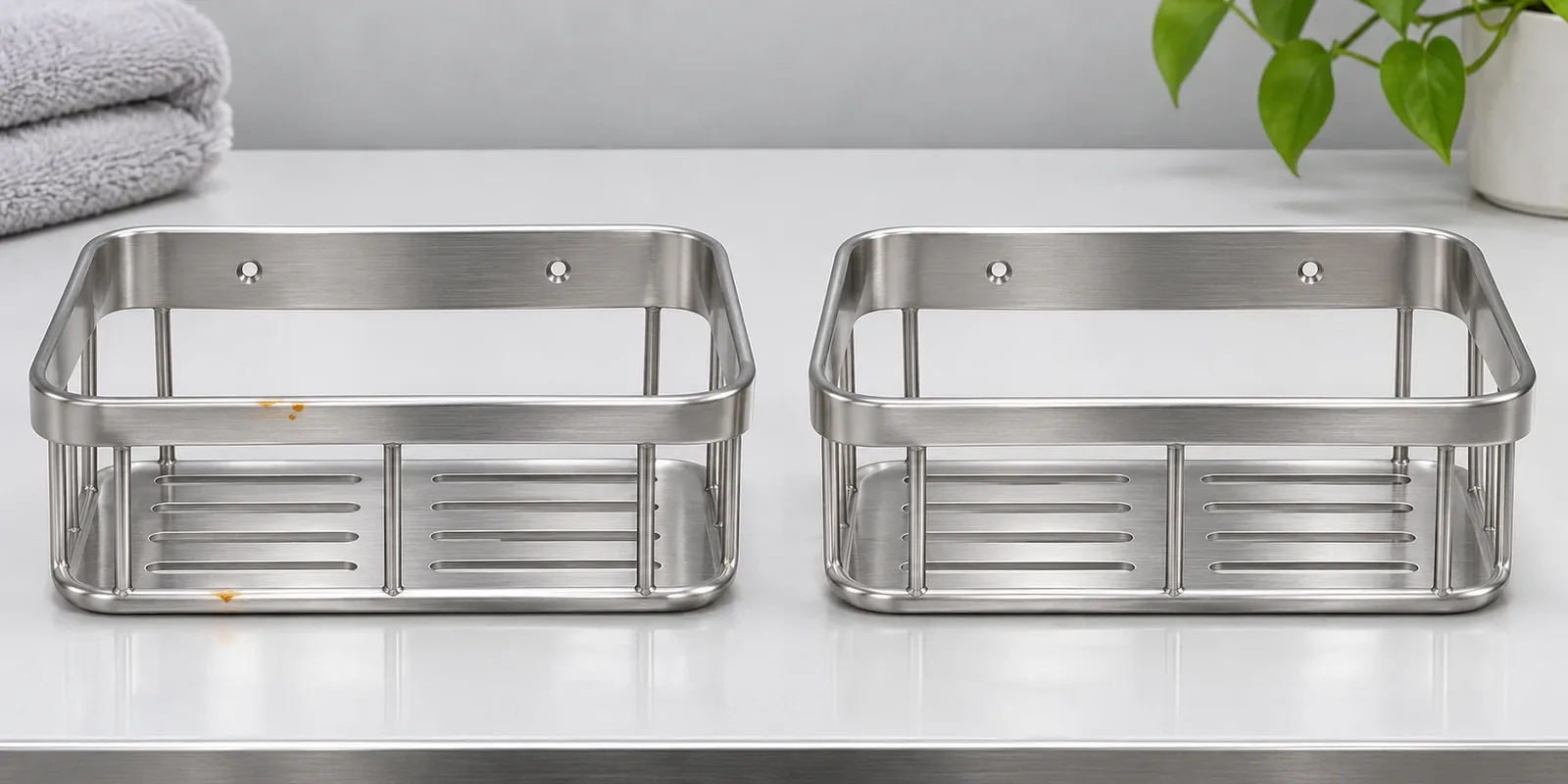
How to remove rust from stainless steel starts with identifying the actual finish and product-care instructions, then wash with a mild cleaner, rinse and dry; if a mark remains, use only a non-scratching cleaner confirmed as suitable for that surface and test it in an inconspicuous area. Avoid steel wool, contaminated tools, harsh chloride cleaners and aggressive acids. A brown mark may be removable iron contamination, but pitting, roughness, repeated staining or an unknown coated finish needs manufacturer or specialist assessment rather than increasingly abrasive cleaning.
What problem does stainless-steel rust-stain removal solve?
Buyers and end users search for how to remove rust from stainless steel because brown or orange marks appear on a surface that they expect to resist corrosion. The immediate task is to clean a mark without damaging the brushed, polished, coated or otherwise finished surface. The larger task is to determine whether the mark is superficial contamination, residue, damage, or evidence of a continuing material or exposure issue. When users ask how to remove rust from stainless steel, a safe answer needs to explain both a cautious cleaning sequence and when the surface should be assessed instead of scrubbed.
Stainless steel is not immune to every corrosion condition. Its corrosion resistance depends on material composition, surface condition, environment, exposure and maintenance. Iron-containing particles from tools, dust or handling can contaminate a surface and produce rust staining; a stain can therefore appear without proving that the entire item is made from a low-grade material. Conversely, cleaning one mark does not establish the product grade, restore a damaged surface, or prove the underlying cause is gone.
For importers, the distinction matters in product support. A care instruction should not promise that every stain can be removed with one household ingredient. A complaint workflow should ask for product identification, finish, installation location, cleaning history and clear photographs before diagnosing a cause. If the exact product has a maker-issued care guide, follow it first.
This article addresses light surface staining on stainless hardware. It is not a restoration procedure for pitting, deep corrosion, weld discoloration, passivation failure, food-contact compliance or structural damage. It does not authorize acid pickling, industrial passivation, abrasive blending or chemical mixtures at home. Those tasks require the relevant manufacturer guidance and qualified handling.
What should you check before cleaning a rust mark?
Before applying a cleaner, determine what the surface is and what the mark looks like. The same item may have bare stainless, a brushed finish, a polished surface, a colored coating, a plated layer, or mixed materials. A method suitable for an uncoated surface may scratch or discolor a coating. If the product material or finish is not known, pause and find the product label, supplier documentation or manufacturer care instructions.
Inspect the mark in good light without scraping it. Note its location, shape, color, whether it is raised or rough, whether it appears near a joint or fastener, and whether similar marks occur on other surfaces. Take a photo before cleaning. A removable stain may sit on the surface, while pitting, flaking, a blistered coating or persistent roughness suggests that surface condition needs a different response. A photograph can guide triage, but cannot confirm alloy grade or determine the full cause.
Remove nearby objects that could shed iron particles, and use clean, soft materials dedicated to the stainless item. Do not use a pad or brush previously used on ordinary carbon steel. Particles embedded in a tool can transfer to the surface and create new marks. Avoid abrasive powders, metal scouring pads and improvised scrapers unless the product maker explicitly approves them for that exact finish.
Check cleaning history as well. Chloride-containing products, bleach, residue, deposits, construction dust or an unsuitable abrasive can create or worsen a surface problem. Ask which cleaner was used, whether it was diluted, how long it remained, what tool was used, and whether the item was rinsed and dried. Do not assume that a household recipe is harmless just because it is common online.
What staged cleaning approach is safest for a light stain?
Use the least aggressive method first and stop when the surface is clean. Manufacturer instructions for the specific product take priority. If none are available and the finish is confirmed to be compatible, a cautious sequence is: wash with mild soapy water using a clean soft cloth, rinse thoroughly with clean water, dry with a soft cloth, and inspect. If a mark remains, test a non-scratching stainless-steel cleaner that its label identifies as suitable for the surface, following the maker’s directions and testing a small hidden area first.
Work in the direction of a brushed grain where the finish visibly has one. Use light pressure and a clean section of cloth. Do not rub across the grain with a rough pad or make repeated passes simply to remove every discoloration. Rinse away cleaner residues as directed and dry the surface. A cleaner left behind can create a new appearance or exposure issue.
El British Stainless Steel Association cleaning guide emphasizes routine mild cleaning, rinsing and drying, and cautions against contaminated carbon-steel tools and scratching methods. Its separate iron-contamination guidance explains why stains can form without proving that the whole item is made from a particular grade. Its advice is useful for general stainless care, but the exact product’s finish and care instructions still govern. A suitable non-scratching cream or polish may be appropriate for some light staining; it is not a universal treatment for every coated or specialty surface.
Do not mix cleaners. Do not combine acids, bleach, ammonia, descalers or other household chemicals. Never use strong-acid passivation or pickling processes as casual household cleaning. If a cleaner label is unclear, the finish is uncertain, or the product is a high-value or regulated item, ask the maker before proceeding.

How can you tell a removable stain from surface damage?
There is no reliable universal visual test that identifies the cause of every brown mark. A removable surface stain may improve with compatible cleaning, while a damaged surface can remain rough, pitted, discolored or recur after cleaning. A coating defect or corrosion at a joint may also need inspection beyond a general cleaning step. Do not claim the diagnosis is certain from color alone.
| Observación | Possible interpretation | Buyer or user response |
|---|---|---|
| Light mark improves after mild cleaning and rinsing | Surface residue or light contamination may be involved | Stop when clean, dry, record the method and continue compatible care |
| Mark remains but surface feels smooth | Staining, residue, finish variation or another condition remains possible | Check the care guide and cleaner compatibility; do not increase abrasion automatically |
| Pitting, flaking, roughness or a damaged coating is visible | The surface may be physically damaged or corrosion may be continuing | Stop cleaning and request maker or qualified specialist assessment |
| Marks recur in the same area | Repeated exposure, contamination source, trapped moisture or a material/finish issue may be involved | Document use and cleaning conditions; inspect the location and escalate the case |
| Similar stains appear across unrelated items | A shared cleaning tool, airborne particles or environmental source may be relevant | Check surrounding sources and avoid assuming a single product defect |
These patterns are triage prompts, not definitive diagnoses. The BSSA explains that iron contamination can cause rust staining on stainless steel, which is why a brown mark does not alone establish the stainless grade. Its cleaning guidance also distinguishes routine surface care from more specialized treatment. If the surface is visibly damaged or the mark recurs, contact the product maker rather than repeatedly polishing the same area.
For an importer, collect consistent evidence before opening a supplier claim: model or order reference, material/finish declaration if available, installation environment, exposure and cleaning timeline, photos at useful angles, any chemicals used, and whether the mark changes after approved cleaning. This record helps separate maintenance questions from product-quality investigations. It does not assign fault by itself.
Which tools and cleaners should you avoid?
Avoid carbon-steel wool, ordinary steel brushes and any abrasive pad that can scratch the finish or transfer iron particles. Do not assume a “stainless” label on a tool makes it safe for every polished, brushed, coated or plated product. If a manufacturer permits a particular pad or polish, follow its instructions and test a hidden area first.
Avoid bleach and other chloride-containing cleaners unless the product maker explicitly approves the exact product and use. Avoid leaving any cleaning solution to dry on the surface. Do not use a blade, knife or metal scraper to lift a stain. Abrasion can change the grain or gloss; a scratch may then become more visible than the original mark.
Also avoid strong acids, improvised acid mixtures and industrial passivation recipes found outside the product manufacturer’s care instructions. Acid treatments used in controlled manufacturing are not automatically safe consumer cleaning procedures. They may require concentration controls, protective equipment, waste handling and a defined process. This article does not provide chemical recipes or a home passivation method.
Do not keep escalating because the stain did not respond to the first attempt. Repeated scrubbing can remove or alter a finish without solving the underlying condition. If the mark is persistent, obtain advice about the exact product and finish. A supplier can advise whether the surface is coated or whether specialist restoration is appropriate.
Before cleaning, also decide how you will judge the result. Photograph the surface from a fixed angle and distance under neutral, consistent lighting. Record whether the mark is raised, rough or visible only under reflected light. This does not replace a technical inspection, but it makes before-and-after comparison more useful and reduces the temptation to keep scrubbing for a cosmetic difference that may be a scratch or finish variation. Use a clean cloth for the initial rinse and a separate clean cloth for drying so residues and transferred particles are not returned to the surface.
If the item has multiple finishes, test the method only on the confirmed compatible surface and keep the product label available. Do not soak an assembled item when water could enter a joint, tube, adhesive interface or fastener cavity. Follow the maker’s instruction on disassembly and drying. Where the hardware has a coating over stainless steel, cleaning the base metal successfully may still leave the coating damaged; the goal is to clean without changing the approved appearance.
What conditions can cause rust staining on stainless hardware?
Stainless steel relies on a protective surface condition, but contamination, deposits, exposure and damage can contribute to staining or corrosion. Iron particles may transfer from tools, nearby grinding or cutting, shipping materials, dust, or handling. Moisture and residue can remain at joints, overlaps or poorly drained areas. Chlorides and unsuitable cleaning may also contribute to problems depending on the material and exposure.
These are possible mechanisms, not proof of what happened to a particular product. A brown mark alone cannot reveal whether it came from external iron, a damaged finish, the selected grade, fabrication residues, installation conditions or a combination. The investigation should compare the product’s actual material and finish records with its environment and care history.
For product teams, prevention begins before the consumer sees a stain. Define the material and finish honestly, control contamination between operations, protect cosmetic faces, specify cleaning and packaging, and inspect relevant surfaces under agreed conditions. If the product includes welds or fasteners, consider how residues and dissimilar components are managed within the verified process. Do not imply that a single rinse or passivation claim guarantees corrosion-free performance in every installation.
In the field, keep surfaces clean and dry according to the manufacturer’s instructions. Avoid leaving wet cloths, cleaner residue or metal particles in contact with hardware. If a product is installed in a particularly aggressive environment, ask the manufacturer whether the selected grade and finish are appropriate. Do not infer a service life or universal suitability from a general grade name.
How should importers respond to a rust-stain complaint?
Start with a neutral, evidence-based support response. Acknowledge the appearance concern, request the product identification and photos, and ask about installation, nearby work, exposure, cleaning products and tools. Provide only the care steps approved for that exact product. Do not tell the customer the mark proves poor quality, and do not promise that a cleaning method will restore the item.
A useful complaint record contains:
- Product model, purchase order, production lot or other available traceability reference.
- Material and finish information from the approved specification.
- Installation location and exposure, including moisture, cleaning frequency and nearby metal work.
- Date first observed and whether the mark has spread or returned.
- Cleaner name, dilution, contact time, rinse method, cloth or pad used, and any prior attempts.
- Clear photos of the full product, the mark, joints and surrounding installation.
- Results from any maker-approved cleaning step, including the method and timing.
- Whether the issue is isolated, repeated across a lot, or present on unrelated products.

Separate what is observed from what is inferred. “Orange marks are visible near the lower joint after several weeks” is an observation. “The supplier used the wrong grade” is a hypothesis requiring evidence. Compare the approved material, process records and acceptance criteria before deciding whether to correct care instructions, request technical review or open a quality investigation.
When several buyers report a similar issue, compare the cases without assuming a common cause. Look for shared production lot, finish, packaging, installation region, cleaning advice or exposure pattern. If the cases involve different products and dates, a common household cleaner or local environment may be more relevant than one manufacturing change. If the marks cluster on one lot or feature, retain representative samples and request supplier review against the approved specification. Preserve the original photos and notes so the investigation can be repeated by another team member. Close the record with the confirmed corrective action or unresolved question; do not convert an unconfirmed hypothesis into public care advice.
If a product is within a warranty or regulated claim process, follow its documented escalation channel. A buyer should not ask the customer to use an unapproved chemical or abrasive for diagnostic purposes. A specialist can determine whether professional cleaning, repair or replacement is appropriate after reviewing the specific surface.
How can a hardware manufacturer prevent avoidable staining risks?
Koitor Hardware is a family-owned factory and specialized OEM manufacturer of bathroom and home-storage metal hardware. Within its confirmed product scope, the factory can discuss product drawings, samples, metal fabrication, finishing, assembly, packaging and buyer communication. It should not be presented as an accredited corrosion laboratory or as providing a restoration or passivation service unless the project verifies those capabilities.
Importers can share the product identity, finish requirements, installation environment, expected cleaning instructions and packaging plan during development. Discuss cosmetic surfaces, protection during handling, weld and fastener locations, drainage, inspection access and how the product will be identified after production. These details help suppliers and buyers agree what evidence belongs in a sample approval and what care advice is appropriate.
If a product is stainless steel, ensure the drawing, purchase specification and care copy use the same material and finish description. Avoid absolute claims about corrosion resistance. A supplier should distinguish a general material family from the exact product and exposure limitations. For towel racks and related bathroom accessories, see the custom bathroom towel-rack manufacturing page y el custom bathroom hardware overview for confirmed OEM context.
For a small-batch program, an approved physical sample and clear packaging specification can help establish appearance expectations. The buyer should state which marks are cosmetic, what cleaning has already been performed, and how the surface is to be inspected. This improves discussion without pretending that a photo or visual sample certifies long-term corrosion resistance.
Buyer checklist and frequently asked questions
Before cleaning or escalating a stainless-steel rust stain, confirm:
- The exact product, material family and surface finish, if known.
- The manufacturer’s care instructions and approved cleaning products.
- Whether the mark is light staining, residue, pitting, coating damage or an uncertain condition.
- The cleaner, concentration, contact time, cloth and tools already used.
- Whether the stain is isolated or recurring and where it appears.
- Whether the product can be tested first in an inconspicuous area.
- Whether the method uses a clean, non-scratching cloth and thorough rinsing and drying.
- Whether the issue requires manufacturer or specialist review instead of more abrasion.
Can stainless steel rust?
Stainless steel can stain or corrode under some conditions. The alloy and surface condition provide corrosion resistance, but the material is not immune to every contaminant, exposure or cleaning method. A brown mark does not by itself identify the cause or grade.
Is every orange mark removable iron contamination?
No. Iron contamination is one possible cause, but residue, surface damage, coating issues and continuing corrosion are also possible. A compatible mild cleaning test may help with light staining; persistent, rough or pitted areas need assessment.
Can I use steel wool or bleach to remove the stain?
Do not use steel wool or chloride-containing bleach unless the product maker explicitly approves it for the exact surface. Abrasion can scratch or transfer particles, and unsuitable cleaners may damage a surface. Follow product instructions and do not mix chemicals.
Will vinegar remove rust from every stainless product?
There is no universal vinegar instruction for all stainless grades, coatings and finishes. Household recipes can be unsuitable for a specific product. Use the maker’s care guidance and ask before applying an unapproved acid or cleaner.
When should I stop and contact the manufacturer?
Stop if the mark is persistent, returns, looks pitted or rough, affects a coating, appears near a joint, or if the material and finish are unknown. Share the product identity, photos and cleaning history so the manufacturer can advise on the actual surface.
Trabaja con Koitor Hardware
Discuss Stainless Hardware Material and Finish Requirements
Share the product drawing or sample, material and finish information, target market, care instructions and packaging expectations. Koitor can discuss confirmed metal hardware OEM scope and the product details needed for a supplier review.
OEM / MARCA BLANCA
Convierte esta guía de abastecimiento en un resumen del producto
Indícanos el producto que deseas, el tamaño, el acabado, la cantidad del pedido y los requisitos de embalaje. Tu equipo recibirá un análisis práctico de la viabilidad de fabricación antes de recibir el presupuesto.


 English
 Español
 Português
 Français
 Deutsch
 العربية