
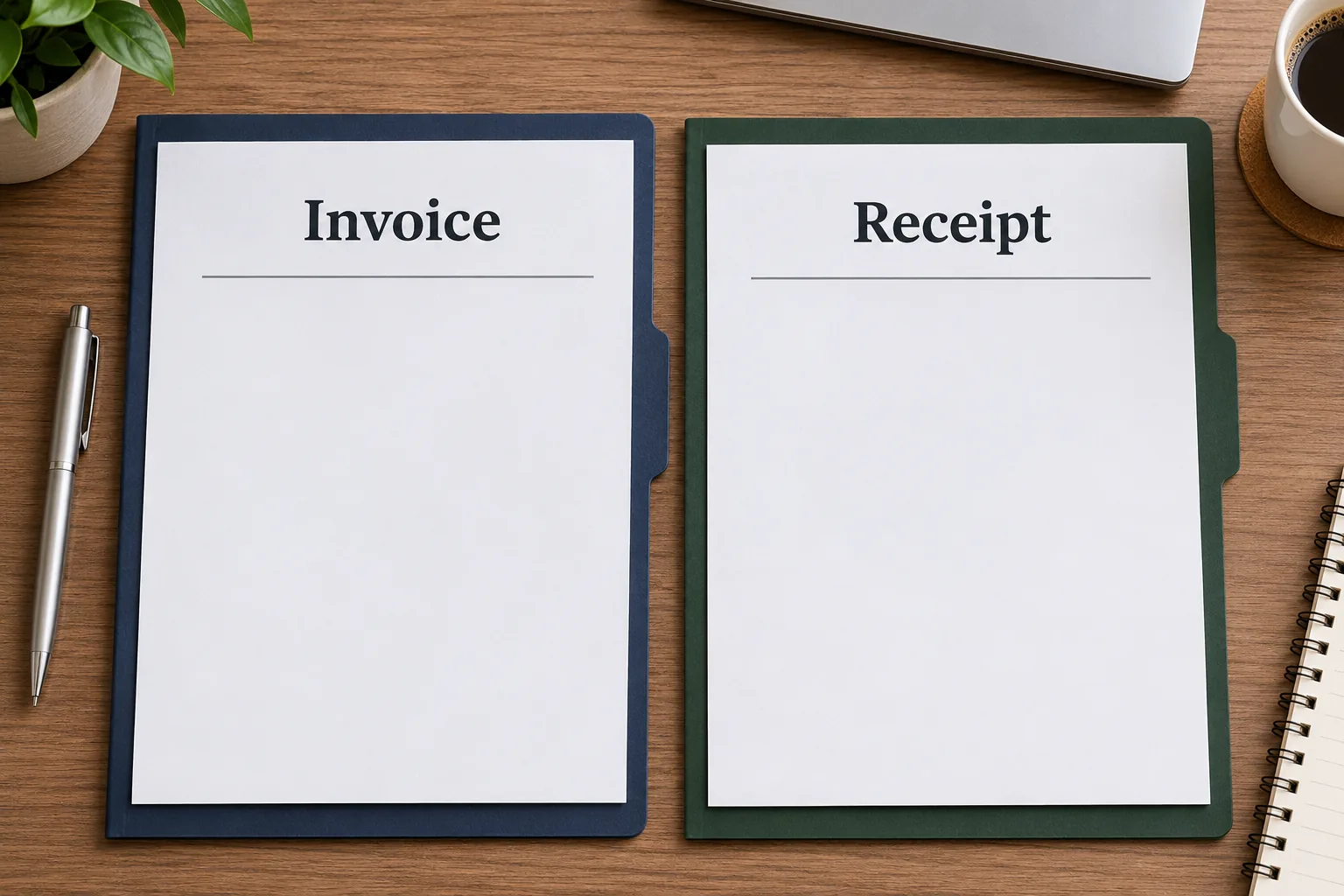
Invoice vs receipt is a comparison between a payment request or billing record and evidence that a payment was received, but the word “receipt” can also refer to a record that goods physically arrived. An invoice alone does not prove that funds were paid or cleared. A payment receipt does not prove that a shipment arrived or that products passed inspection. Importers should identify which event each document records, match the relevant amount and reference to the order, and keep payment, delivery and acceptance evidence separate.
What does “invoice vs receipt” compare?
An invoice identifies goods or services being billed and the amount requested or recorded under the seller’s billing process. A payment receipt acknowledges a payment event. Intuit QuickBooks explains this distinction as invoice for collecting or requesting payment and receipt as evidence of payment. Its product-support page describes an invoice for a customer who will pay later and a sales receipt for an immediate-payment transaction in QuickBooks. That software behavior is an example, not a universal rule for every international supplier or trade arrangement.
The useful distinction for a buyer is what the document is intended to prove. An invoice may state an amount due, a payment request, a reference, or other transaction details. A payment receipt may record an amount received, date, method, and reference. Document formats vary, and the exact fields depend on the parties’ process and applicable requirements. This article does not define tax-valid documents, accounting entries, invoice timing rules, or legal consequences.
| Récord | Main question it addresses | What it does not automatically prove |
|---|---|---|
| Invoice | What amount is billed or requested, and for which order or goods/services? | That the buyer paid or the seller received cleared funds |
| Payment receipt or acknowledgment | What payment does the issuer acknowledge, for what amount and reference? | That goods were shipped, delivered, inspected or accepted |
| Bank/payment transaction record | What transfer or transaction appears in the financial channel? | That the intended seller received it or that it settles every invoice balance |
| Goods-receiving record | What goods or packages were recorded as received at a location? | That the supplier was paid or that products passed full quality inspection |
| Inspection or acceptance record | What defined product characteristics were checked under an agreed process? | That payment was made or every shipping document is correct |
The table separates documentary purposes; it does not prescribe a company accounting system. A buyer should read the document title, issuer, content, order reference and related records together. If a document uses the word “receipt,” determine whether it acknowledges money, goods, or both under a specific company process.
Does an invoice prove that payment was made?
No. An invoice by itself usually records a billing request or amount associated with a transaction. It does not establish that the buyer sent funds, that the intended recipient received them, or that the payment settled the full amount. Even a statement marked “paid” should be connected to the issuer, invoice/order reference, amount, currency, date, and the parties’ confirmation process.
A buyer handling a custom hardware order might have a pro forma invoice for an initial deposit and a later commercial or sales invoice for a balance. The exact document names, milestones and local requirements depend on the transaction. If a supplier issues a receipt for part of the amount, the buyer should match that receipt to the related invoice or order and record the remaining balance according to the authorized process. Do not infer that the entire order is paid because one payment record exists.
A simple payment reconciliation table can help:
| Reconciliation field | What to compare |
|---|---|
| Issuer/recipient | Is the document from the expected party and addressed to the right buyer or account? |
| Order reference | Does it identify the relevant purchase order, invoice or supplier order? |
| Amount/currency | Does the acknowledged amount match the payment instruction or expected installment? |
| Date | Is the document date being confused with the date funds were initiated or received? |
| Payment status | Does the issuer state received, partially received, pending or another status? |
| Balance | Is the remaining amount reconciled against the current invoice and approved terms? |
| Supporting evidence | Which transaction record or confirmation is accepted by the parties’ process? |
This framework does not say which banking evidence is sufficient in every country, how a transfer clears, or what accounting treatment applies. Finance and procurement teams should follow their company controls and use the responsible bank or payment provider for transaction questions. If there is an inconsistency, ask the supplier through a known, authorized channel to confirm the actual payment reference and status.
A helpful way to prevent document confusion is to build an event timeline for the order. Record when the invoice was issued, when the buyer initiated a payment, when the supplier acknowledged receipt, when goods were dispatched, when cartons arrived, and when any inspection was completed. Do not assume these events occur in a fixed order for all contracts or use the same date. The timeline only describes what the relevant records say. If a date or status is missing, mark it as unconfirmed instead of inferring it from a later document.
For a partial payment, link each acknowledgment to the invoice and order but preserve the amount actually acknowledged. If the buyer sends a deposit and later pays a balance, the two events should not be collapsed into one receipt unless the parties’ record clearly covers both. If a receipt shows a different currency, amount or transaction reference from the buyer’s bank record, ask the authorized contacts to reconcile the difference. This is a document-matching task; it does not determine whether a payment is legally discharged or whether the buyer has fulfilled a contract obligation.
A payment confirmation should also be distinguished from a transfer instruction. A buyer may hold a bank-generated instruction or internal approval record that shows a payment was requested. That is different from an acknowledgment issued by the intended recipient. Which evidence a company accepts depends on its controls, bank channel and transaction process. Keep the issuing party visible when filing the record so a later reviewer can tell who is confirming what.
A reconciliation note can include the record’s source and the person who verified it, subject to the buyer’s normal privacy and document-retention practices. This helps distinguish an issuer’s acknowledgment from an internal estimate or forwarded message, without treating one format as universally sufficient proof.
What does “receipt” mean in an import order?
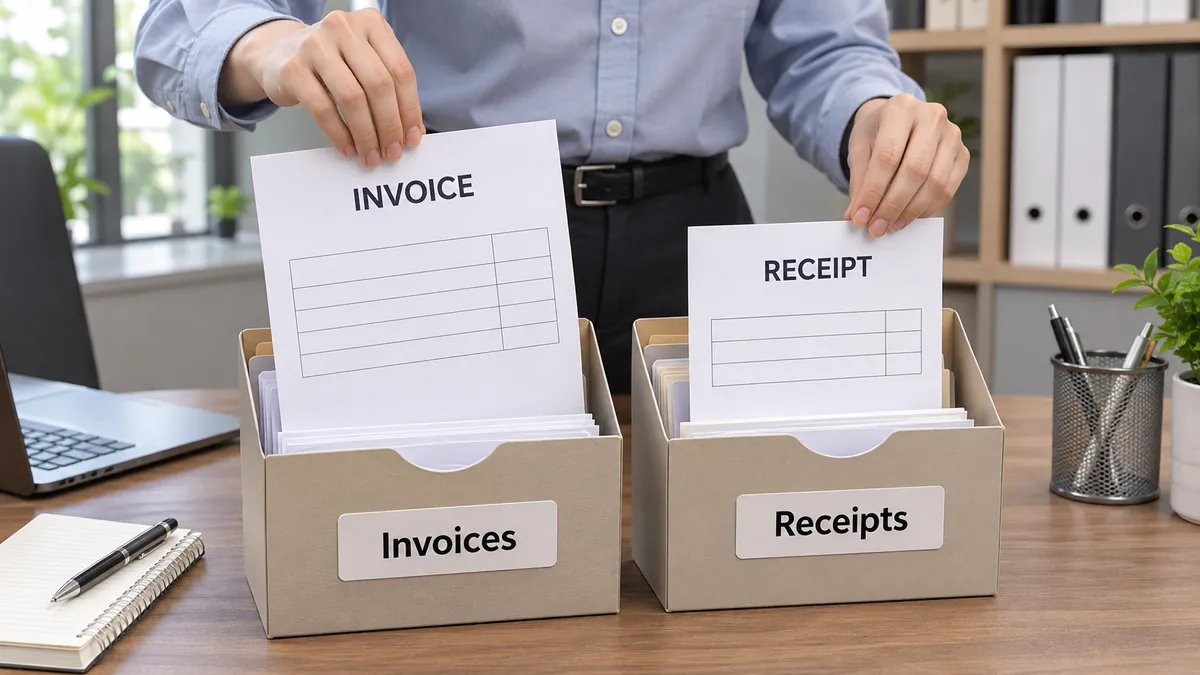
“Receipt” is ambiguous because it can refer to a payment acknowledgment or to the physical receipt of goods. A warehouse might create a goods-receiving record when cartons arrive. A supplier might issue a payment receipt after receiving a transfer. A customer-service email might confirm that a file or sample was received. The reader must identify the event being documented rather than rely on the noun alone.
In an import transaction, these events can happen at different times and be recorded by different parties. The seller may issue an invoice before shipment; a bank transaction may show that the buyer initiated payment; a warehouse may later record the arrival of cartons; and an inspection team may separately record product checks. One event cannot be substituted for another without an explicit process that defines the relationship.
A goods receipt or warehouse receiving record may identify package count, date, condition observed at receipt, or quantity checked according to the receiving procedure. It does not automatically show that payment was made. Nor does a simple note that cartons arrived prove the contents conformed to the drawing, sample, packaging specification, or purchase order. Those questions require whatever inspection and acceptance evidence the buyer and seller agreed to use.
For a metal hardware shipment, a receiving clerk may count cartons or note visible damage, while a quality reviewer may inspect selected product characteristics under a separate plan. A warehouse receipt might record a delivery at the dock, but it should not be presented as a final technical acceptance unless the buyer’s process expressly defines it that way. Similarly, a payment receipt from the seller says nothing by itself about how many cartons arrived. Keeping the issuer and event explicit helps the importer route each record to purchasing, finance, receiving or quality without asking one document to prove unrelated facts.
When a buyer sees the term “receipt” in a supplier message, a useful clarification is: “Does this acknowledge funds against invoice X, or does it record goods received under delivery Y?” This question is particularly helpful when email attachments have short filenames or when several order events happen close together. Use the invoice/order reference for payment; use shipment/package identifiers for delivery; use the agreed inspection reference for quality review. Cross-reference records where useful, but retain each event’s own status and source.
Koitor’s guide to three-way invoice matching addresses the relationship between invoice, order and goods-receiving records. This article covers the narrower meaning of payment receipt versus invoice and clarifies why a physical goods receipt should not be confused with proof of payment.
How should buyers match an invoice to a payment record?
Start with the order and the document that requests payment. Confirm the supplier identity and invoice reference, then compare the requested amount and currency with the payment instruction and any payment receipt or acknowledgment. If the transaction is split into a deposit, progress payment and balance, map each payment to its corresponding milestone and amount according to the agreed terms. Document the amount still open rather than treating the invoice as a one-step record.
For a hypothetical hardware purchase, suppose the seller’s invoice requests a deposit against a custom bathroom accessory order. The buyer’s finance team initiates a transfer, and the seller later acknowledges receipt of an amount that is less than the total invoice. The buyer should record the payment against the correct order, verify the acknowledged amount and date, and keep the remaining balance visible. The example does not prescribe a payment schedule or imply a particular Koitor payment process.
A buyer can ask:
- Which invoice or order does this payment reference apply to?
- Is the acknowledged payment full or partial?
- What amount and currency did the issuer record as received?
- What date does the document describe: invoice issue, transfer initiation, receipt, or posting?
- Is the balance still outstanding under the current commercial terms?
- Does any credit, discount, bank charge or approved adjustment need separate documentation?
- Which party is authorized to confirm the record?
Do not assume the displayed amount on a bank screenshot equals the amount the supplier received or that a document with a “paid” stamp is sufficient for every internal control. Follow the parties’ payment and confirmation procedure. If details do not match, pause the reconciliation and obtain a verified clarification rather than silently changing the amount in a project record.
For supplier bank-transfer record questions, use the dedicated Koitor article on wire-payment receipt reconciliation. If a document concerns a credit or replacement instead of a payment, see the separate guide to supplier credits and replacement goods. Those pages own the specialized scenarios; this article remains about distinguishing basic document roles.
Are pro forma and commercial invoices the same as receipts?
No. A pro forma invoice and a commercial invoice are invoice-related documents with different roles in a transaction or shipment context; neither should be called a payment receipt simply because it contains an amount or appears in a payment workflow. A payment receipt records an acknowledged payment event. The buyer should identify the document’s intended use and not infer that a pro forma or commercial invoice proves payment.
International shipments can involve several documents whose fields overlap, such as order references, descriptions, quantities or values. That overlap does not make the documents interchangeable. Koitor’s article on pro forma versus commercial invoices covers that separate export-document comparison. Buyers should ask the responsible export and finance teams which document controls each part of the transaction and which requirements apply to their shipment.
Do not use this article as tax, customs, accounting or jurisdiction-specific legal advice. Requirements can differ by country, transaction, goods and business process. The buyer should consult appropriate professional or official guidance where document validity or treatment matters.
How buyers can reconcile invoice vs receipt records
What should importers do when the invoice and receipt do not match?
First identify what differs: party name, order number, invoice number, currency, amount, date, payment status or remaining balance. Then identify which record controls that field and who is authorized to resolve it. A receipt may cover a partial payment, a different invoice, a bank charge or an amended amount; it may also be a goods-receiving record unrelated to payment. Clarify the document’s purpose before deciding that it is wrong.
A practical reconciliation workflow is:
- Record the invoice and receipt identifiers and dates.
- Confirm whether the receipt is for money or goods.
- Match the issuer, recipient and order reference.
- Compare amount and currency with the related payment request or agreed transaction record.
- Identify whether payment is partial, complete, pending or unclear according to the issuer’s statement.
- Ask the authorized contact to explain each mismatch and provide a corrected or supplemental record if appropriate.
- Preserve the original and record the resolution under the company’s normal document-control process.
If the supplier changes payment details, use the buyer’s established verification control and contact information already on file. Do not rely on an unexpected new bank account notice as evidence that the payment destination changed correctly. This article does not provide a fraud-protection procedure; Koitor’s specific page on supplier invoice bank-account change verification covers that distinct risk topic.
The correction should not erase the history. Keep a clear record of which invoice or receipt was superseded, whether the payment amount was adjusted, and which party confirmed the new information. Finance or procurement should determine how the correction is represented in internal systems. The purpose here is documentary clarity, not prescribing journal entries or bookkeeping treatment.
If multiple invoices are consolidated into one transfer, preserve the allocation or remittance reference that connects the total to the individual order records. If no allocation is provided, mark it as unresolved and ask the authorized parties to identify how the amount should be applied.
What common invoice and receipt mistakes should buyers avoid?
- Treating the invoice as proof of payment. A billing document and a payment acknowledgment are different records.
- Confusing a payment receipt with goods receipt. Verify whether the document describes funds or physical packages.
- Assuming “paid” means fully settled. Check whether an acknowledgment covers the whole invoice or only a portion.
- Using the wrong order reference. Match each payment record to the correct invoice and purchase order.
- Mixing document date with payment date. The invoice issue date, transfer date and supplier receipt date can differ.
- Assuming a shipment document proves payment. Export paperwork and financial evidence have separate purposes.
- Assuming a goods receipt proves product acceptance. Receiving, inspection and acceptance may be separate stages.
- Changing an amount without a supporting record. Ask the authorized parties to document the adjustment.
- Treating one software workflow as universal. Accounting or invoicing applications may define transaction screens differently.
- Relying on unsupported tax or legal assumptions. Verify applicable requirements with the right professional or official source.
These are reconciliation cautions, not claims about a particular supplier or customer history. A buyer should use the process and evidence required by its own controls and the parties’ agreement.
What checklist helps reconcile payment and goods records?
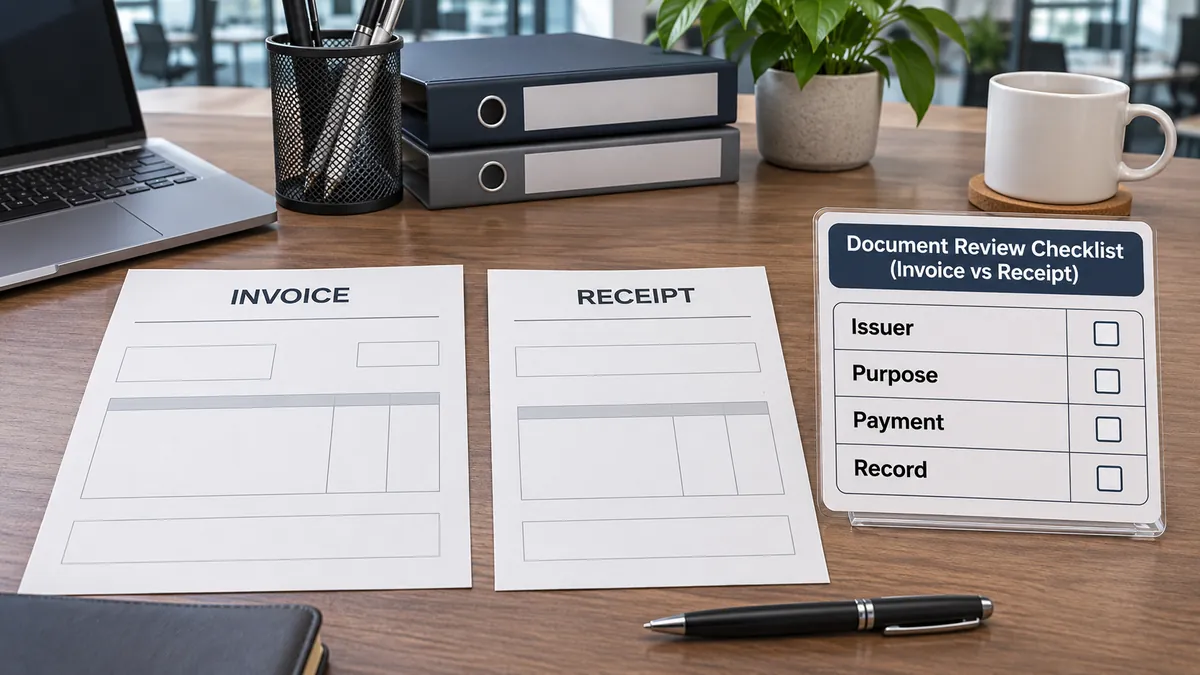
Use this checklist to classify what each document represents and what it can support. Mark each item as verified, not applicable or open.
- [ ] Issuer and recipient identified.
- [ ] Document purpose stated: invoice, payment receipt, goods receipt, inspection record or another function.
- [ ] Related purchase order, sales order, invoice or shipment reference matched.
- [ ] Amount and currency recorded where payment is involved.
- [ ] Payment date, invoice date and goods-receipt date are not conflated.
- [ ] Partial payment or remaining balance clearly shown under the agreed process.
- [ ] Physical package count and condition are recorded separately from payment evidence.
- [ ] Inspection or acceptance evidence is linked separately if required.
- [ ] Any discrepancy has an owner and written clarification.
- [ ] Revised records preserve a traceable connection to the original.
- [ ] Export, tax, accounting or legal document requirements are confirmed with the responsible professional.
Preguntas frecuentes
Does an invoice prove that payment was received?
No. An invoice identifies a billing request or transaction amount; it does not by itself confirm that the seller received funds. Match it to the relevant payment evidence and seller acknowledgment under the parties’ process.
Is a receipt always proof of payment?
No. The word can refer to a payment receipt, a goods-receiving record or another acknowledgment. Read the issuer, content and context to identify what event it records.
Is a goods receipt the same as a payment receipt?
No. A goods receipt records a physical receiving event under a warehouse or buyer process; a payment receipt acknowledges money. Neither one automatically establishes the other event or product acceptance.
Can one payment receipt cover several invoices?
The applicable process varies. If a payment is allocated across invoices, the buyer and supplier should identify the references and amounts so both records can be reconciled. This article does not prescribe accounting allocation rules.
Is a pro forma invoice a receipt?
No. A pro forma invoice is not proof that payment was received. Its role depends on the transaction and shipment documents; consult the appropriate trade and finance sources for the specific use.
What if the supplier says an invoice is paid but the record cannot match the payment?
Identify the invoice, order, amount, currency, date and reference, then ask the authorized supplier and finance contacts to reconcile the records. Follow your company’s verification process and do not infer a cleared payment from an unverified document.
Trabaja con Koitor Hardware
For a hardware order, keep payment requests, payment acknowledgments, shipment documents, goods-receiving records and inspection evidence associated with the correct order references. Koitor Hardware is a family-owned custom metal hardware factory; project-specific document and payment arrangements should be confirmed with the authorized contacts for that order. This article does not claim a particular accounting or payment system.
Clarify an order document or payment reference for a hardware project.
OEM / MARCA BLANCA
Convierte esta guía de abastecimiento en un resumen del producto
Indícanos el producto que deseas, el tamaño, el acabado, la cantidad del pedido y los requisitos de embalaje. Tu equipo recibirá un análisis práctico de la viabilidad de fabricación antes de recibir el presupuesto.


 English
 Español
 Português
 Français
 Deutsch
 العربية