
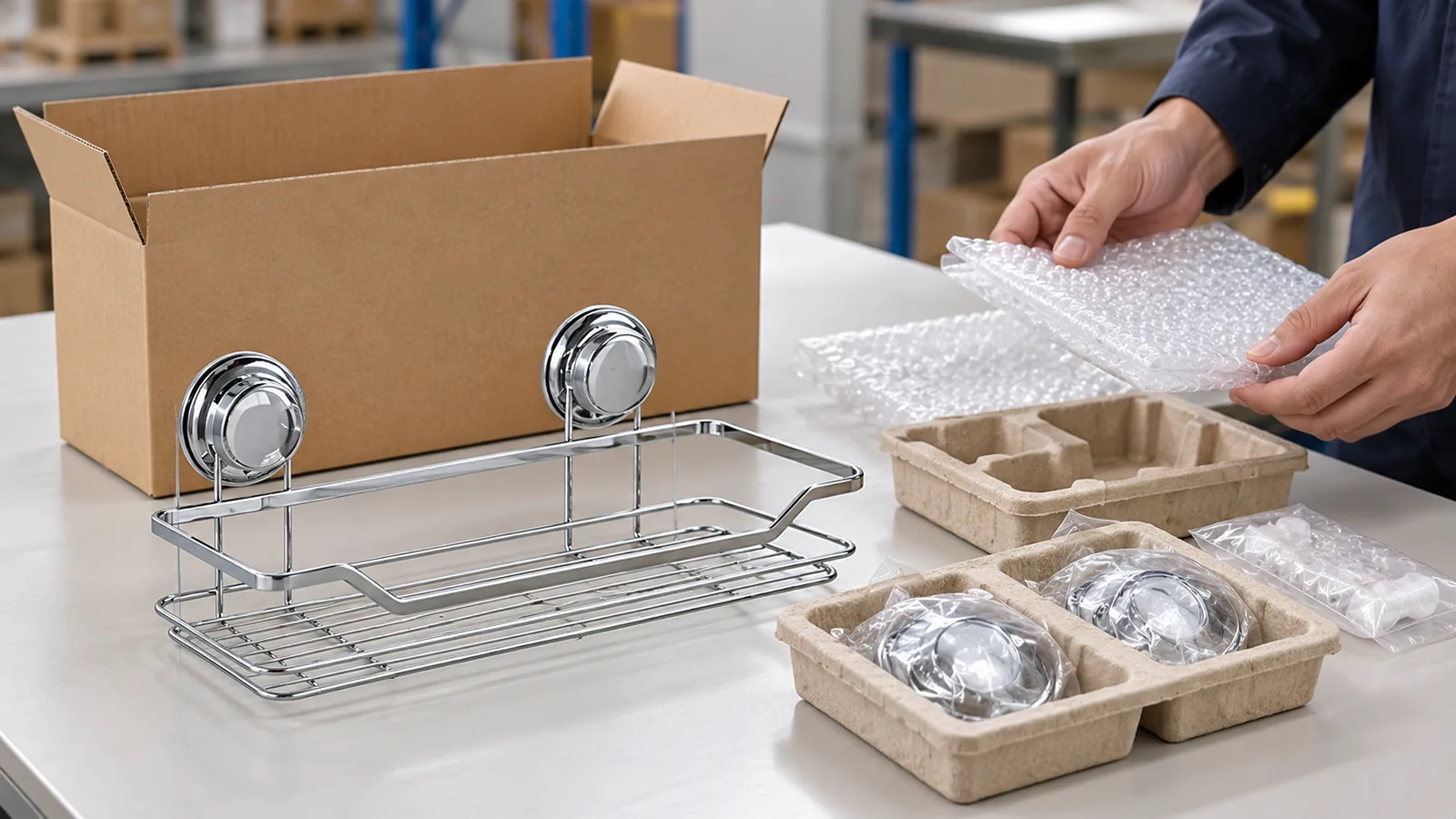
A CONAI packaging EPR importer guide should begin with two separate questions: which company is responsible for the Italian market transaction, and what packaging facts can the overseas supplier document? CONAI’s published rules include importers of packaged goods among packaging users, while the membership and fee treatment depends on the specific company, import route, packaging and destination. Ask the supplier for traceable, revision-controlled material, quantity and weight data; have the Italian responsible entity confirm its status, declaration route and current requirements with CONAI or its adviser. This is a buyer-preparation framework, not legal or tax advice.
For an importer sourcing a metal shower basket, towel rack or home-storage organizer from China, the supplier’s packing list is an important evidence input. It is not a CONAI declaration, a legal packaging classification or proof that any particular company has paid the relevant contribution. The distinction helps sourcing teams request useful facts without assigning duties to the wrong party.
A CONAI packaging EPR importer checklist is most useful when it separates Italian importer decisions from supplier-provided evidence. It lets the factory answer what it can substantiate while the buyer keeps the legal review with the responsible Italian entity.
Who may have a CONAI role when hardware enters Italy?
CONAI distinguishes producer and user companies. Its current English guidance lists importers of “full packaging”—packaged goods—among users. For a CONAI packaging EPR importer reviewing a China shipment, that gives the Italian business a reason to check its role; it does not mean that every participant in the shipment has the same duties.
Before requesting compliance paperwork, map the commercial route for the actual order:
- Which legal entity buys the goods from the factory?
- Which entity imports them into Italy and appears on the customs and commercial records?
- Will that entity resell, distribute or otherwise place the packaged goods on the Italian market?
- Does another Italian group company or distributor take ownership before sale?
- Are the goods sold in Italy, transferred elsewhere in the EU, exported onward, or used internally?
- Is the transaction an import of packaged goods, empty packaging, packaging material, or more than one of these?
The answers help the buyer and its adviser identify the applicable CONAI path. A customs broker, freight forwarder, Chinese factory, Italian importer and downstream distributor may each perform different functions. A delivery term or supplier invoice can allocate commercial responsibilities, but should not be treated as a complete answer to statutory membership, declaration or payment questions.
CONAI says foreign companies generally are not obliged to join directly, subject to a stated e-commerce circumstance tied to platform services. The Italian buyer should check the current rule against its sales channel and legal entities. A Chinese supplier does not need to register merely because its carton ships from China.
Membership and the fee are separate checks. The Italian entity should confirm participation and declaration/payment duties for this flow using CONAI’s mandatory-subject guidance, fee guidance, and current 2026 guide.
What packaging data should the hardware buyer request from a supplier?
Ask for a component-level record tied to each saleable SKU and approved pack-out revision. A total carton weight alone may not tell an Italian buyer which materials or components are included, how mixed materials are represented, or which changes need to be reviewed.
| Requested fact | Practical supplier record | Buyer use |
|---|---|---|
| Product and revision | Buyer SKU, factory code, drawing/sample revision, effective date | Connect the packaging record to the exact item ordered |
| Pack level | Product-contact protection, retail unit, inner pack, master carton, transport protection, pallet or wrap | Identify which layer the supplier is describing |
| Component identity | Name, function, location and one component per row | Avoid grouping distinct pieces into an unclear “packaging” line |
| Material description | Supplier’s best documented material or material combination; state when composition is unknown | Give the importer information to check against CONAI categories |
| Quantity | Number per saleable unit, inner carton, master carton and pallet, where relevant | Scale the record to the actual packaging flow |
| Weight | Net weight per component or per defined group, unit of measure and basis | Support the buyer’s material/weight reconciliation |
| Evidence status | Measured, calculated from a controlled specification, or estimated; method/date or source record | Keep measured facts distinct from estimates |
| Pack-out evidence | Clear photos or a simple diagram; note any third-party packaging vendor | Allow a buyer to see what the component count includes |
| Change history | Previous and new revision, change date, reason and affected SKUs | Trigger review when the approved packaging changes |
Use separate rows for different materials or combinations instead of describing all protective materials as “carton.” A bathroom hardware export pack could contain a paperboard retail box, paper insert, polymer sleeve, protective film, cable tie, carton, tape, edge protector and pallet wrap. This example is only a list of possible components, not a claim about Koitor’s own standard pack-out. The actual list must come from the supplier’s approved sample or production specification.
Tell the supplier which selling unit and shipment configuration the record covers. If one master carton contains several retail boxes or mixed SKUs, state the exact arrangement. If a packaging vendor supplies the carton insert or printed box separately, record who supplied it and whether the hardware factory can verify its material and weight. Mark unknown information as unknown; do not ask the factory to make up a value to complete a spreadsheet.
A concise supplier request can say: “Please provide the packaging components used for buyer SKU [code], pack-out revision [revision/date], with one component per row. For each component, identify its packaging level, function, material or material combination, quantity per sales unit/carton, net weight and unit, measurement basis, and supporting photo or specification. Mark any estimate, unknown material or third-party-supplied part, and notify us before changing the approved pack-out.” Replace bracketed fields with the buyer’s controlled values.
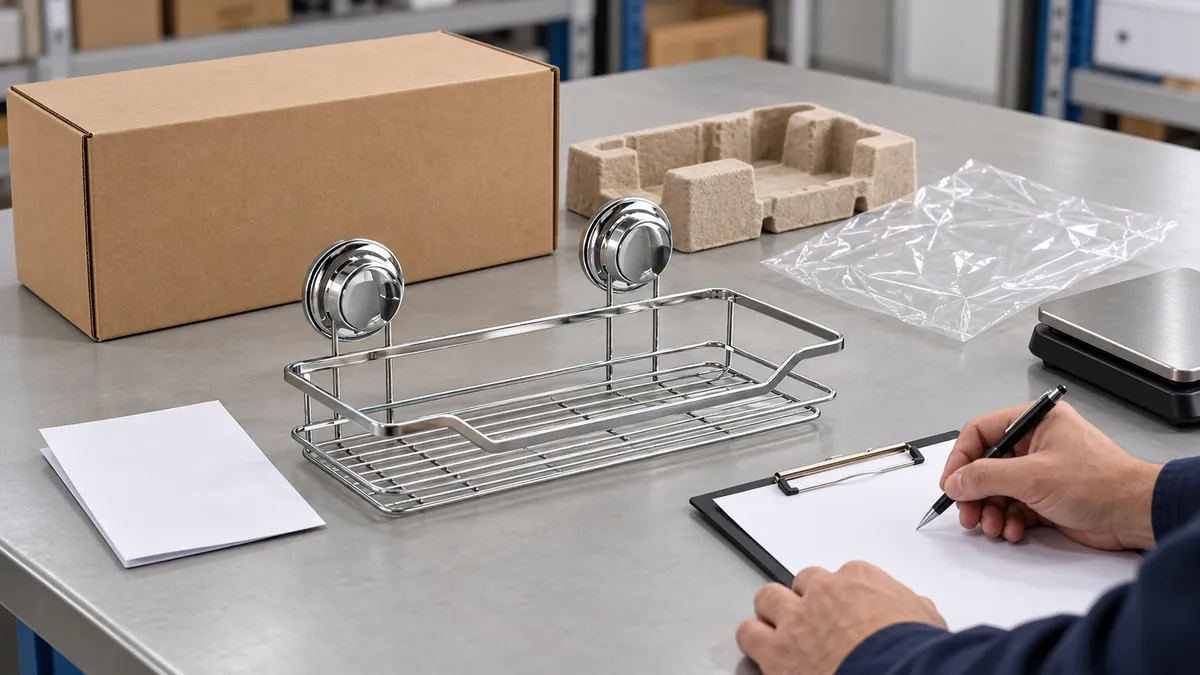
How should importers classify pack levels and verify component weights?
Start from the function of each item, not its common name. CONAI’s definition covers packaging used to contain, protect, handle, deliver or present goods, and distinguishes sales (primary), grouped (secondary) and transport (tertiary) packaging. Components and accessories integrated into packaging can be considered part of it; the criteria also distinguish items that are integral to a product throughout its life cycle. A hardware part is therefore not automatically packaging merely because it is attached to the product or included in a box.
For a metal storage basket, the metal basket is ordinarily the product being sold; a paper sleeve or carton may function as packaging. But borderline items require the current CONAI definition and the actual design, attachment and use. A removable divider, fitted insert, hook, protective cap or accessory may have a product function, packaging function or both. Do not resolve a classification dispute by asking the overseas factory to guess at Italian law.
Separate the supplier’s physical description from the importer’s legal classification:
- Ask what the item is called in the supplier’s drawing or bill of materials.
- Record what it does, where it is located and whether it stays with the hardware in normal use.
- Photograph how the item is packed, attached or removed.
- Ask whether it is consumed, reused, returned or included with the product through its useful life, when known.
- Provide the facts to the Italian compliance owner and ask that person to decide how CONAI’s criteria apply.
El CONAI packaging definition supplies the governing categories and examples. When an item is uncertain, preserve the evidence and request a specific interpretation. A supplier’s material description does not by itself determine a fee band, exemption or filing answer.
For weight, agree the object and unit before anyone places it on a scale. A useful record says whether the number covers one bag, one printed carton, one complete retail pack, a master carton, or a pallet assembly. Define whether adhesive labels, tape, staples or inserts are included. A measured component weight, a value calculated from a drawing and an estimate from an old pack-out are different evidence types, even if a spreadsheet stores them in the same numeric column.
Keep the supplier’s measurement method proportionate and repeatable. For light items, the buyer may ask the supplier to identify scale resolution or to weigh several identical pieces together and report the count and calculation. The article does not prescribe an official measurement method. The aim is to let the Italian reviewer understand where the number came from, reproduce it if needed and spot a mismatch between a per-unit record and the shipment.
If a combination packaging item uses more than one material, ask for the construction and separate material weights when the supplier can reliably substantiate them. Do not have the factory assign CONAI categories or contribution classes without a documented classification process. If components are inseparable or an exact split is unavailable, mark the limitation and ask the buyer’s adviser which current procedure is acceptable.
Which CONAI declaration route should the importer review?
CONAI explains that import obligations vary with the nature and destination of the materials. Its guidance differentiates imported empty packaging from packaged goods, and describes ordinary, simplified and small-business flat-rate procedures for imported packaged goods. The specific route also depends on whether goods or packaging are for users, other operators or direct use by the importer. A supplier data sheet helps prepare that review; it cannot select the route by itself.
Prepare a transaction summary for the Italian entity or adviser that includes the product/SKU, import date or period, quantities, packaging revision, component record, intended destination, sales or internal-use plan, and any available proof that a contribution was handled earlier. Ask whether the shipment contains packaged goods, empty packaging, packaging raw materials, or a combination, and whether multiple procedures or declarations apply to different flows.
The buyer should also reconcile the number of sold units against packaging levels. For example, calculate how many retail boxes enter the Italian channel, how many master cartons contain those boxes, and what transport packaging arrives with them. This operational reconciliation can reveal missing component records or an outdated carton quantity. It is not a contribution calculation; the importer or qualified adviser must apply the current CONAI rules to the facts.
Do not accept “EPR already paid” without the party, material, period and flow. CONAI says imported packaging is subject to the fee and notes an exception for a foreign company voluntarily registered and already paid; the Italian entity must verify applicability.
The official declaration and payment procedure describes different routes for imported empty packaging and packaged goods, including periodic declarations, reporting, invoices and references to the 2026 guide. A buyer should consult the current materials for thresholds, timing, forms and special cases instead of copying an old filing calendar into a new order.
How do PPWR and future packaging revisions affect this data handoff?
The EU Packaging and Packaging Waste Regulation, Regulation (EU) 2025/40, applies from 12 August 2026, with phased and article-specific dates and transition provisions. That current EU framework is relevant to packaging design and information across the European market, but it does not make a generic supplier spreadsheet a CONAI declaration or automatically answer which Italian entity reports a particular import.
A multi-country importer can reuse the underlying factual record—component, material, mass, pack level, SKU, revision and market destination—while maintaining separate country-specific decisions. The legal definitions, obligated parties, reporting systems, thresholds, timing and procedures can differ. Keep the factual supplier layer reusable, and keep the compliance interpretation and filing layer specific to the jurisdiction and effective date.
Supplier facts can be reused across markets, but local reviews differ. See our Spain packaging EPR checklist y U.S. state packaging EPR data guide, then review applicable EU PPWR guidance.

Reopen the record when a carton or packaging component changes, pack quantity changes, a vendor changes, or palletization is revised. Record the effective date, affected SKUs and replaced revision. For a CONAI packaging EPR importer review, this trail connects supplier facts with the shipment period being assessed.
What should a packaging change-control record contain?
Use the same revision discipline applied to a product drawing. A concise change notice should identify the changed component, old and new description, old and new per-unit weight when measured or recalculated, affected quantities and first order/date using the change. Attach a pack-out photo or diagram and state whether other components remain unchanged or still need checking.
When a buyer is developing a new basket, shelf or towel rack, define the packaging approval point before bulk production. The supplier and buyer can agree whether approval covers the sample carton, the loaded master carton, protective materials, label position or pallet pattern. Avoid a blanket “packaging approved” note if the reviewed sample did not show every layer. A product sample approval does not automatically approve a later pack-out change.
A sourcing or compliance manager can use these control steps:
- Assign a buyer SKU and packaging revision to each data sheet.
- Store one row per identifiable component and keep the unit of measurement explicit.
- Separate measured facts, drawing-based calculations, supplier estimates and unknowns.
- Match the pack-out photos to the record and carton quantity.
- Identify third-party packaging components and the supplier that can confirm them.
- Record destination markets and the effective order or production date.
- Require notice before a change to material, supplier, component dimensions, count or pack method.
- Route classification, declaration, payment and legal questions to the responsible Italian entity or adviser.
- Retain the decision and the source facts together so that a future reorder can be compared.
The factory’s role is to provide accurate product and packaging facts within its knowledge and to communicate agreed changes. The Italian importer decides which entity is responsible for each market flow and obtains professional advice where needed. A clear division improves quote preparation, packaging specification and reorder consistency without suggesting that the supplier provides legal certification.
Koitor Hardware is a family-owned custom metal hardware manufacturer. Buyers can share drawings, samples, SKU plans and requested pack-outs for project discussion. Koitor does not provide CONAI legal advice or file the importer’s declaration. See private-label bathroom accessory development o OEM manufacturing context.
Preguntas frecuentes
Does a Chinese hardware supplier automatically need to join CONAI?
No general conclusion follows from the product being made in China. CONAI says foreign companies generally are not required to join directly, while noting a specific e-commerce circumstance. The Italian buyer should confirm the relevant legal entity and transaction against current official guidance.
Is every Italian importer of hardware automatically a CONAI member?
Do not infer a company’s status from the word “importer” alone. CONAI includes importers of packaged goods among users, but application, exclusions and procedural details depend on the company’s activities and the packaging flow. The Italian entity should verify the facts, membership and obligations.
Can a supplier’s packaging list determine the CONAI contribution?
No. A supplier can document physical components, material descriptions, quantities and weights. The responsible Italian business or adviser must apply the applicable definitions, categories, destination rules, declaration route and current contribution provisions.
Should the factory classify every insert or accessory as packaging?
No. Function and the current CONAI definition matter. Record how the item is built, attached, used and disposed of, then have the importer or adviser review uncertain items. Do not treat every product part or accessory as packaging by default.
Can the buyer reuse a packaging record for another EU country?
The physical supplier data may be reused if the SKU and pack-out are identical and the facts remain current. Legal roles, program definitions, declarations and reporting schedules are country-specific, so the importer must separately review each destination market.
Do current PPWR rules replace CONAI reporting?
This article does not make that legal conclusion. PPWR applies from 12 August 2026 with phased and article-specific rules. Italian buyers should review the current CONAI instructions and applicable EU and national provisions for the exact flow.
What should a buyer do when packaging material is unknown?
Ask the supplier or packaging vendor for the relevant specification, product sheet or traceable description. Mark the information as unknown until substantiated; do not guess a material or use a generic label to force a filing field to be complete.
Does a good packaging record guarantee acceptance by CONAI?
No. It is an evidence and communication tool for the buyer’s review. It does not replace an official interpretation, current instructions, the buyer’s legal responsibility or a filing process.
Buyer checklist and official references
Before placing a repeat order, the Italian hardware importer can check whether the supplier record answers the practical questions below:
- Is the buyer’s legal entity and import/sales route identified?
- Does the record cover packaged goods, empty packaging or another flow?
- Does every SKU and pack-out revision have its own traceable identification?
- Are retail, grouped, transport and pallet layers described without assuming their legal class?
- Is each component’s function and best-known material stated?
- Are quantity and weight tied to a clear unit and measurement basis?
- Are estimates, calculations, third-party-supplied components and unknowns flagged?
- Do photos or a diagram match the approved carton and production pack-out?
- Has the Italian compliance owner checked the destination, current role and declaration route?
- Is there a named change-control contact and an effective date for future revisions?
Recheck the official CONAI pages and the 2026 Environmental Contribution Guide notice immediately before filing. The guidance consulted for this article was reviewed on 26 October 2026; rates, thresholds, forms and applicable procedures can change. The source links below support the procedural context; they do not constitute an individual legal opinion.
Official references: CONAI mandatory subjects and enrollment; CONAI EPR fee; CONAI declaration and payment; CONAI packaging definition; Regulation (EU) 2025/40; European Commission PPWR application notice.
¿Necesitas ayuda con un proyecto de accesorios de baño a medida?
Send Koitor your drawing, sample, size target, finish requirement, packaging idea or expected order quantity. Our family-owned factory team can discuss structure, packaging information and small-batch production options before quotation. Italian CONAI interpretation and filings remain with the importer and its adviser.
OEM / MARCA BLANCA
Convierte esta guía de abastecimiento en un resumen del producto
Indícanos el producto que deseas, el tamaño, el acabado, la cantidad del pedido y los requisitos de embalaje. Tu equipo recibirá un análisis práctico de la viabilidad de fabricación antes de recibir el presupuesto.


 English
 Español
 Português
 Français
 Deutsch
 العربية