

A kitchen glove drying rack should be evaluated with the gloves, sink area, and countertop where the buyer expects it to be used. Glove cuffs vary in width and length; some users hang gloves cuff-up, others drape them over a support, and the two approaches create different contact and drip paths. For an importer, the central sample questions are whether the support holds representative gloves without snagging or puncturing them, where water drains, and whether the rack remains stable with wet gloves in place. These checks do not establish a universal drying time, hygiene benefit, or mold-prevention claim.
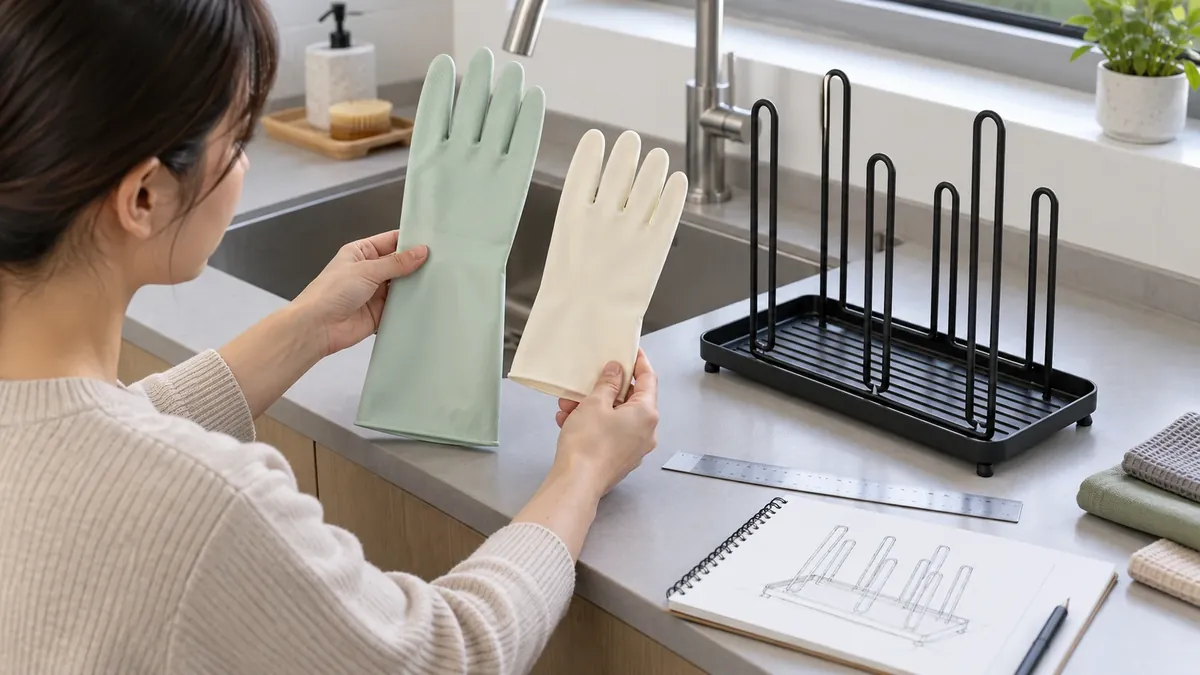
Define the intended glove set
Start by identifying what the product is designed to hold. Household dishwashing gloves vary by size, cuff shape, lining, thickness, and material. Some have long cuffs that can fold over a rod; others have shorter cuffs that may slide off a tapered support. A pair may also have different weights after use if one glove retains more water or if the gloves are not identical.
Collect a small reference set that represents the target market. Record glove size, cuff opening width, cuff length, body length, approximate dry weight, and any unusual feature such as a textured exterior or rolled cuff. If the product is intended for several glove sizes, include the smallest and largest in the test. A rack that holds a large glove securely may spread a small cuff too far; a narrow support chosen for small gloves may not accept a thick cuff.
Clarify the use condition as well. Is the rack for one pair of dishwashing gloves, several cleaning gloves, or a combination of gloves and cloths? Is it meant for a household counter, a sink ledge, a cabinet door, or a pantry shelf? Does the buyer expect the user to place it close to the faucet or remove it to clean the counter? The product should be evaluated against the described use, not a generic phrase like “for kitchen gloves.”
A reference matrix may include:
| Entrada | Information to capture | Sample question |
|---|---|---|
| Glove size | Smallest and largest intended size | Does the support contact the cuff without stretching it excessively? |
| Cuff shape | Straight, flared, rolled, or textured | Can the cuff remain in place when the glove is damp? |
| Storage method | Cuff-up, draped, or another orientation | Does the opening remain exposed to room air as intended? |
| Pair quantity | One glove, one pair, or several items | Does loading one glove shift the other? |
| Use location | Counter, sink edge, cabinet, or wall | Does the rack fit without blocking ordinary sink access? |
| Cleaning routine | Wipe in place or move rack | Can water and residue be reached and removed? |
If the buyer lacks reference gloves, request dimensions and physical samples before freezing the support geometry. Photographs alone can obscure cuff thickness and flexibility. A drawing is useful for defining the rack, but the actual glove is necessary to evaluate contact, grip, and fit.
Choose between cuff-up and draped support
A cuff-up design supports the opening above the rack so the glove body hangs downward. This can expose the inside of the glove, but the support must engage the cuff without creating a sharp edge or excessive stretch. The cuff needs enough clearance to load and remove the glove, yet enough shape or retention to prevent it from slipping during ordinary handling. A narrow hook may create concentrated contact; a wide support can be easier to load but may not fit every cuff.
A draped design places part of the glove over a rod, prong, or frame. It can be easier to load without threading the cuff over a closed support, but a fold may create a contact point where water collects. The glove may also slide along the rod if its material is smooth or its weight is uneven. Testing should use the actual wet glove and intended loading direction, not a dry demonstration sample.
A multi-rod stand may offer several hanging positions or accommodate different items. More rods do not automatically make the design better. Closely spaced supports can cause gloves to touch each other, obstructing access and making cleaning less convenient. Wider spacing increases footprint. The buyer should define the number of supported items and check whether the projected counter area is acceptable.
Avoid claiming that a particular orientation “dries faster” unless the claim is supported by a defined comparative test. Drying can depend on glove material, water left after use, airflow, room temperature, humidity, and placement. A rack can be designed to expose more surface area, but that design intent alone does not establish a measured time or hygiene outcome.
Review contact points and edge conditions
Every contact point should be inspected with the finished sample. Check rod ends, hooks, bends, welds, caps, and any transition where a glove might catch. A sharp burr, rough joint, or narrow gap could snag a glove or make loading awkward. A coating or cap can change the effective support diameter and contact feel, so evaluate the intended final finish and all purchased components.
A metal support should not be assumed safe for every glove material solely because it appears smooth. Use the reference glove to load and remove the product repeatedly, including when the glove is damp. Look for visible punctures, cuts, pulled fibers, permanent stretching, or marks. If a sample shows a problem, record the precise location and orientation rather than describing the whole rack as “too sharp.” A photo with an arrow and sample identifier helps the supplier investigate.
If a polymer cap, silicone pad, suction foot, or other non-metal component is part of the design, clarify who supplies it and how it attaches. The current glove-rack accessory set is unconfirmed for Koitor, so the importer should treat such parts as explicit scope items. Ask about material identification, color, fit, replacement, and packaging. Do not assume that a photographed cap or pad is included in a quotation unless the bill of materials says so.
Map the drip path
A rack may hold gloves securely yet direct residual water onto a countertop, cabinet front, or the floor. Place the product in the intended position and observe where water would fall from the cuffs, fingertips, and lowest points of the glove. If a catch tray or removable base is planned, verify that the drip path lands inside it with representative gloves in each supported position.
Use a consistent sample procedure: wet the glove in a defined way, remove excess water using the same method, hang it in the intended orientation, and observe the resulting drip location over a defined period. If timing or water volume matters, specify the procedure and equipment. For a basic fit review, it may be enough to record whether visible drips reach the nominated counter area or a catch surface. Do not describe the result as a drying-performance test unless it measures drying under controlled conditions.
If the rack is placed beside a sink, check whether it obstructs the faucet, sink basin, soap, or a normal hand movement. If the buyer expects it to sit on a sink ledge, measure the ledge width and check that the base does not overhang in a way that makes placement unstable. If a tray is removable, verify that it can be taken out without lifting the gloves or spilling collected water.
A removable surface can be easier to clean, but it adds a part and an interface. Check whether the tray slides, lifts, or clips into place, and whether water can escape through seams. The sample brief should identify whether a tray is included, the cleaning method expected, and whether the buyer requires a defined corrosion or finish evaluation. Avoid implying that drainage or an open structure prevents mold; that is a product-performance claim requiring evidence and appropriate use conditions.
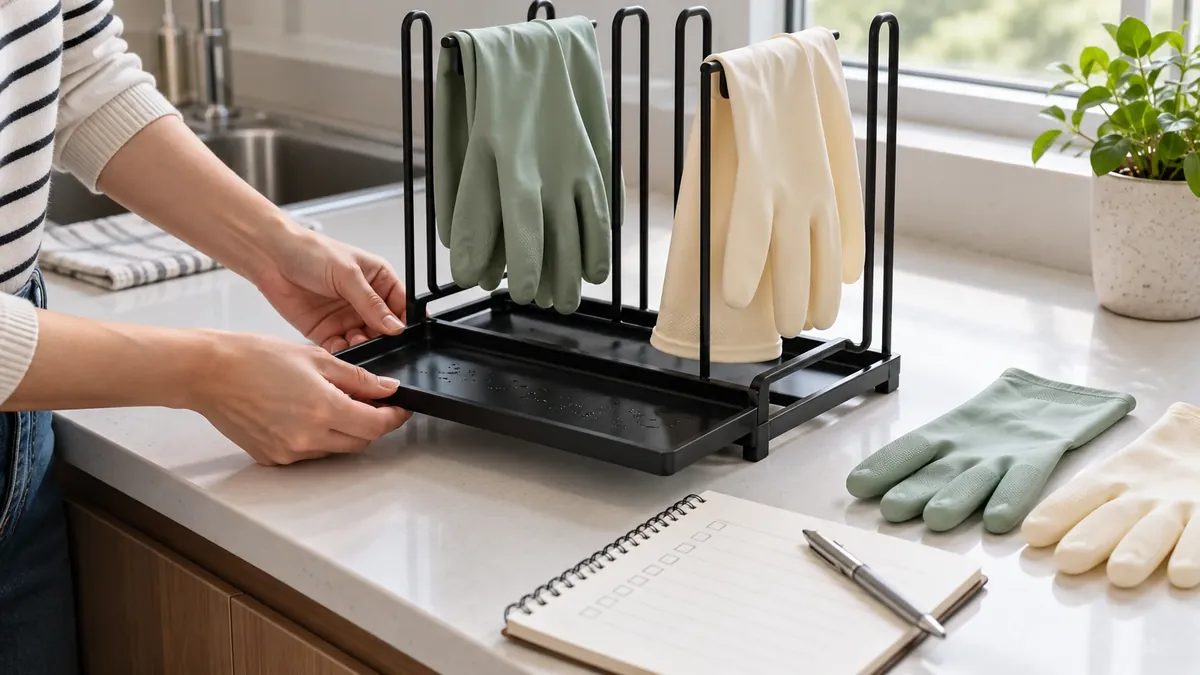
Check stability in the intended location
Test the loaded rack on the countertop or sink ledge described for the product. Evaluate the product empty, with one wet glove, and with the full intended load. Gently place and remove each glove using the expected motion. Observe whether the rack rocks, slides, tips, or shifts into the faucet or other objects. If the base includes suction-style feet, pads, or adhesive components, test them on the specified surface and follow their installation instructions.
A single stable demonstration does not prove compatibility with every surface. Countertops can vary in flatness, texture, moisture, and cleanliness. If stability is a critical claim, define a test surface and method, and consider more than one representative surface. A suction-style base may behave differently on polished material than on a textured or jointed surface; a product listing or supplier statement should not imply universal adhesion without evidence.
Separate body stability from mount or pad performance. The metal stand could be dimensionally sound while a purchased foot does not adhere to the target counter. Conversely, a sticky pad might hold the base but make the product difficult to clean or reposition. Identify which component is under evaluation and note the surface, cleaning state, and elapsed time before testing.
The buyer should not invent a load rating based on glove weight alone. If a numeric limit is needed, specify the configuration and test method, including where the load is applied and how long it remains. A light household glove test is not equivalent to an industrial hygiene rack application. Examples in other market segments may illustrate a possible architecture but cannot establish suitability for household kitchens or prove performance of a different product.
Include access, cleaning, and packaging checks
Check whether a user can load both gloves without touching or moving nearby items. Confirm that the product can be moved for countertop cleaning if that is part of the expected routine. Inspect corners and joints that could retain residue, and clarify whether the design has removable components. These are practical review points; the buyer should avoid unsupported statements about sanitation or sterilization.
Packaging should protect protruding rods and finished surfaces. A rack can rub against its own components in transit, and an accessory can become separated from the main product if it is not secured in the retail package. Ask for an assembled or disassembled packing plan, protection for exposed ends, and a way to identify any separate tray or pads. Conduct a pack-out review with the actual carton if shipping configuration is important.
Product instructions should show the intended orientation, included accessories, and any surface-preparation steps for feet or pads. If suction or adhesive components are supplied, explain their limitations and installation method based on verified product information. Avoid instructions that promise the rack will stay in place on all counters or hold any glove without a defined range.
What to include in a supplier RFQ
A useful RFQ provides enough information to price the same scope and prepare a meaningful sample. Include:
- Intended channel and setting: household kitchen, utility room, or another clearly described use.
- Reference gloves with sizes, cuff dimensions, materials where known, and physical samples.
- Number of gloves or other items to be held.
- Preferred cuff-up or draped arrangement.
- Product envelope and counter footprint constraints.
- Drip location and whether a catch surface is required.
- Finish, color, cosmetic faces, and edge expectations.
- Any pads, caps, trays, fasteners, or purchased components.
- Cleaning and refill expectations.
- Packaging configuration, instructions, and barcode requirements.
- Sample quantities and acceptance steps.
Ask suppliers to state their assumptions in writing. Does the price include feet or a tray? Are the rods welded, formed as one piece, or assembled with another component? Which material and finish are included? Is the sample made with the intended coating or only supplied as a bare-metal prototype? What dimensions are considered critical for the glove fit? If a supplier proposes a different support architecture, ask how it changes fit, contact, drip path, cleaning, and packaging.
Koitor’s documented metal wire and rack-related knowledge can support discussion of a metal product concept, but a current dishwashing-glove rack, suction foot, polymer cap, and product-specific performance tests are unconfirmed. Confirm exact manufacturing capability and supply responsibilities using the buyer’s drawing or physical reference before treating the product as an existing offering.
The kitchen glove drying rack should also be checked against the approved drawing and the final pack-out configuration.
Approve the sample with observable criteria
A clear sample checklist might require that the smallest and largest reference gloves can be loaded without undue stretching, that the damp glove remains on the support during the defined handling check, that no visible snag or puncture occurs during repeated loading, and that the observed drip path matches the intended counter or tray arrangement. It can also check that the rack remains stable during ordinary placement and removal on a specified surface.
State how many repetitions are required and which sample is used. A statement like “does not slip” is incomplete unless the handling action and glove condition are clear. Record any failure in terms a factory can reproduce: “The small cuff slid from the left support after the glove was placed damp and the other glove removed.” That observation is more useful than “bad design.”
Approve only the finished configuration the buyer expects to sell. If the coating, cap, tray, or foot changes after approval, repeat the relevant tests. Retain a sample or signed approval record if the project process allows it. Tie the sample to the drawing revision, finish specification, and component list so production can follow the same configuration.
Sourcing takeaway
The most useful buyer specification connects four things: the reference glove set, the support geometry, the intended placement, and the drip destination. Importers should test cuff fit and retrieval with damp gloves, inspect finished contact points, observe where water lands, and check stability on the target surface. Keep drying-time, hygiene, mold-prevention, and universal surface-compatibility claims out of the product brief unless evidence supports them.
For related metal home-storage projects, see Koitor’s OEM home-storage hardware manufacturing information and confirm the specific product, finish, accessories, and order scope directly with the factory.
Specify how the kitchen glove drying rack sample will be measured, loaded, installed, and approved before the production configuration is released.
Discuss Your Dishwashing-Glove Racks Specification
OEM / MARCA BLANCA
Convierte esta guía de abastecimiento en un resumen del producto
Indícanos el producto que deseas, el tamaño, el acabado, la cantidad del pedido y los requisitos de embalaje. Tu equipo recibirá un análisis práctico de la viabilidad de fabricación antes de recibir el presupuesto.


 English
 Español
 Português
 Français
 Deutsch
 العربية