

Label flagging is an unwanted edge lift or bulge in an applied label, often described at the trailing edge of a wrapped label. It names a visible symptom, not one confirmed cause. Before changing adhesive, identify where the edge lifts, what label construction is used, what surface it contacts, and how it was applied. Pressure-sensitive adhesive labels and wet-glue or hot-melt labeler systems have different failure variables, so a diagnosis for one system should not be applied automatically to another.
For a hardware importer or packaging manager, the practical decision is which evidence to request from the label supplier or application-system owner. A photograph may locate the symptom, but it cannot by itself prove that adhesive strength is the problem. Label size and shape, facestock, surface curve or irregularity, cleanliness and application conditions can all be relevant in a pressure-sensitive label review. Wet-glue and hot-melt systems add adhesive-transfer and compression considerations. Separate the observation from the diagnosis before changing the specification.
What Does Label Flagging Look Like?
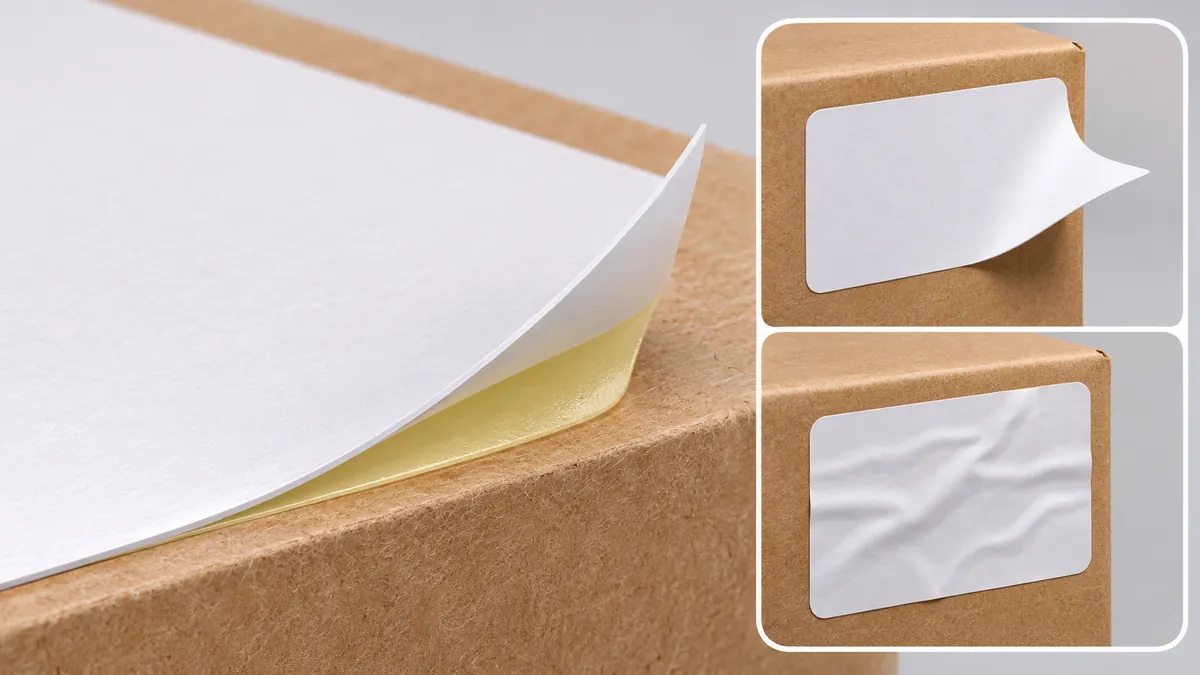
Flagging is an edge of a label that lifts or bulges away from the surface after application. The term is often used for a trailing edge on a label wrapped around a product, but the visible shape alone does not establish why it happened. A raised edge may be the observed condition; it is not automatically evidence of weak adhesive, poor cleaning, a wrong label material or a faulty applicator.
Distinguish the symptom from other visible conditions:
| Observación | What the buyer sees | Why it should be recorded separately |
|---|---|---|
| Edge lift or flagging | An edge is raised or curls away from the surface | The location and direction may help organize evidence, but do not prove the cause |
| Wrinkle or ridge | A fold or raised line appears across the label face | Could involve label placement, geometry or application; it is not the same visual description as an edge lifting |
| Tear or split | Label material is damaged or separated | Different symptom from a lifted intact edge |
| Fading or print change | Text or image loses appearance | Printing durability is a different investigation from label attachment |
| Intentional flag label | A label is designed to extend or stand away from a surface | The appearance may be a feature, not a defect |
| Delamination or broad peeling | A larger area separates from the substrate | Record the separation pattern; do not compress all detachment into “flagging” |
The purpose of this classification is not to assign a defect code from a photograph. It gives the buyer and supplier a shared description to use while gathering the relevant product and process information. If the edge is intentionally left free as a flag label, that geometry must be distinguished from an unintended lift. If the label face is wrinkled, that should not be renamed as edge flagging without documenting what actually happened.
Which Label System Is Being Used?
Start by identifying the application system. A pressure-sensitive label (PSA) uses an adhesive-backed label that bonds when applied under the intended conditions. A wet-glue or hot-melt labeler uses another application arrangement with its own adhesive delivery, transfer and compression variables. Similar-looking edge symptoms can arise in different systems, but the troubleshooting evidence is not interchangeable.
Resource Label Group’s discussion of common label-application problems describes factors including label size and shape, facestock, adhesive fit, surface geometry and application conditions. It discusses flagging alongside other application symptoms. Label Engineering Services describes wet-glue or hot-melt contexts that involve adhesive transfer and compression behavior. These sources help explain why a buyer should identify the system before using a diagnosis; they do not establish a universal cause, frequency, set time or machine adjustment.
The first branch in a review is therefore:
- PSA label: identify the label construction, substrate, label geometry, surface condition and application conditions.
- Wet-glue or hot-melt system: identify the applicator and adhesive system, transfer location and compression-related evidence.
- Unknown system: pause the diagnosis and ask which method was used.
Do not diagnose a PSA label by applying a wet-glue adjustment idea. Do not ask an applicator technician to tune a machine if the label construction or substrate is still unknown. Keep the label supplier, packaging supplier and application-system owner distinct where they are different parties.
How Can a Buyer Organize the Evidence?
A useful investigation begins with the exact observation and follows the branch that the evidence supports. It should not jump from “one edge lifted” to “use stronger adhesive.” Stronger or different adhesive may be a proposal, but the available evidence does not make it the automatic first fix.
Record these attributes for the affected unit or sample:
- Failure location: Which edge, corner or wrap seam lifted? Is the affected region consistent across the samples or does it vary?
- Surface geometry: Is the label on a flat, curved or irregular surface? Where does the surface change direction?
- Label construction: Is it PSA, wet-glue, hot-melt or another specified method? What are the facestock and label dimensions?
- Substrate and condition: What exact product, package or surface is labeled? What condition was presented at application?
- Application method: How was the label positioned and applied? Which party or system performed the operation?
- Timing and handling record: When was the observation made relative to the application and the documented handling conditions? Do not substitute a universal set-time assumption.
- Comparison basis: Which approved sample, drawing or label specification is the current reference?
A symptom/system/evidence map can help:
| Observed branch | Evidence to collect next | Avoid assuming |
|---|---|---|
| Edge lifts on a curved surface | Label shape and size, curve at the location, exact facestock and adhesive system | That every curve requires stronger adhesive |
| Edge lifts near a wrap seam | Label dimensions, overlap or edge position, application method | That a seam is always the cause |
| Ridge or wrinkle crosses the face | Location, direction, label placement and system type | That it is the same as a trailing-edge flag |
| Label tears | Material construction and condition at the damaged area | That adhesive caused the tear |
| Printed text fades | Printing system, exposure and named label specification | That fading and attachment are one failure |
| Deliberate tab or flag is present | Approved artwork and design intent | That the planned protrusion is a defect |
This table is an evidence organizer, not a deterministic decision tree. The same observation may have several plausible contributors. A sample comparison should be controlled by the responsible supplier and based on the actual product or packaging surface.
Why Is “Use Stronger Adhesive” Not a Complete Diagnosis?
“Stronger adhesive” is a proposed change, not a root-cause explanation. If the issue is label geometry on a curve, different label dimensions or shape may be part of a qualified comparison. If the issue relates to the label construction, the facestock or adhesive system needs review. If the method is wet-glue or hot-melt application, adhesive transfer and compression variables belong to that system’s owner. The evidence should determine which alternatives are appropriate for a controlled trial.
A label can lift at an edge without providing a complete explanation of why it lifted. A photograph can record the location and appearance, but it may not show the substrate condition, the label’s construction, how the adhesive was applied, or the conditions around application. Do not claim that one image proves the label surface was contaminated or that the adhesive was too weak.
Avoid setting a universal radius or application wait time from this guide. Resource Label Group’s article gives examples of label-application variables; the research pack explicitly excludes using universal time or temperature numbers as a generic rule. The actual adhesive supplier’s instructions and qualified trial remain the correct basis for a project-specific choice. Similarly, do not infer that a single pressure, roller, temperature or machine adjustment applies across all label systems.
A fair comparison changes an identified input while keeping the observation and sample basis clear. If the label supplier tests a different size or material, record which revision changed. If the packaging team changes application method, record that separately. A trial that changes label size, material, adhesive, substrate and application conditions at once may produce an outcome, but it will be harder to identify which difference mattered.
How Do Surface Geometry and Label Shape Affect the Review?
A label’s relation to the surface is part of its construction and placement context. A flat label on a flat panel presents a different geometry from a label that wraps around a curved item or crosses a changing surface. This observation does not say that a particular radius will fail or that a certain label shape will always resolve it. It tells the buyer which geometry to show the supplier.
For metal bathroom or home-storage hardware, the label may sit on a product, a component, a retail box, or another packaging surface. The product itself and the retail package should not be treated as one substrate. A label applied to a curved metal component is not automatically the same application as a label applied to a carton containing that component. Name the surface and its condition in the record.
If the label touches a curved or irregular product, include a representative surface and location in the sample discussion. If it is on a retail package, include that package material and the relevant surface area. Do not assume that a flat test coupon represents a curved product. Likewise, do not treat an illustrative drawing as proof that the production sample has the same geometry.
For an actual project, the supplier may compare label dimensions, shape or material in a controlled manner. The buyer should define what “acceptable” means for the use: which edge or area may be visible, whether any lift is unacceptable, and how the approved sample is identified. The acceptance criteria belong to the project. This guide does not invent a pass/fail limit.
How Should a Buyer Request a Supplier Trial?
A useful request describes the actual failure without preselecting the cause. Share the labeled item or package, the exact label specification, an image of the affected area, and the application method when known. Ask the responsible label or application-system supplier to identify the evidence needed for a controlled comparison.
A sample record can include:
- Part, package or SKU and its current revision.
- Label artwork or identifier and revision.
- Label dimensions and shape.
- Named label construction and application system.
- Surface material and geometry at the label location.
- Observed symptom, location and the number of samples inspected.
- Photographs that preserve orientation and show the full labeled surface.
- Handling or timing information that is actually documented.
- The proposed change and who supplied it.
- The approval criteria and decision owner.
The sample count is a record of what was observed; it should not be used to imply a defect rate or prevalence without an appropriate sampling method. This article makes no frequency claim. It also does not prescribe a testing plan or statistical acceptance threshold.
If the supplier proposes a label or process revision, compare the proposed revision with the existing approved version and identify exactly what changes. A revised shape, facestock, adhesive system or application setting may affect other requirements, so the responsible parties need to review it. Do not assume a trial on one product and packaging surface applies to a different SKU.
Koitor’s existing label adhesive temperature article addresses a distinct temperature-related topic. For a printed label that fades, use the separate thermal label and fading guide. If the concern is barcode placement near a fold or curve, the barcode quiet-zone article covers that answer. Those pages should not be mistaken for a root-cause diagnosis of label edge lift.
What Should Importers Avoid During Label-Flagging Troubleshooting?
Do not combine all raised label appearances into one failure code. Edge lift, a wrinkle, a tear, a print fade, a deliberate flag and broad peeling are not interchangeable descriptions. A consistent symptom description helps the label supplier answer the right question.
Do not assume that stronger adhesive is always the right answer. The label size, shape, facestock, adhesive fit, substrate condition and application system may all need to be identified. Any proposed change should be selected by the responsible supplier for the actual system and reviewed against the application requirements.
Do not use wet-glue or hot-melt line explanations as if they automatically applied to a pressure-sensitive label. The system owner and evidence differ. A machine-related explanation should be clearly tied to the machine and adhesive process actually used.
Do not infer a universal 24-hour or 48-hour setting or cure time from a general article. Follow the named supplier’s instructions for the actual label and application. No single waiting time is approved here.
Do not infer a root cause from one photo. A photo can show location, approximate shape and relation to the product. It does not necessarily identify the adhesive, label stock, cleanliness, application settings or changes between revisions. Record what the image can show and request the missing source information.
Do not claim that Koitor repairs labeler machines or manufactures adhesive. For a hardware and packaging project, Koitor can discuss the actual product and packaging scope with the buyer and coordinate information needed from the responsible label supplier. The technical label decision remains with the qualified supplier and project owner.
Buyer Checklist Before Revising a Label
Use this checklist before changing artwork, label construction or application settings:
- Describe the visible symptom and exact location.
- Confirm whether the label is PSA, wet-glue, hot-melt or another system.
- Identify whether the condition is unintended edge lift or intentional flag geometry.
- Record the substrate, surface geometry and label location.
- Preserve label dimensions, facestock, adhesive and revision data where available.
- Keep wrinkles, tears, fading and broad peeling distinct from flagging.
- Identify the responsible label supplier and application-system owner.
- Compare a named proposed change against the current approved version.
- Use a representative product or packaging sample where the decision depends on the surface.
- Define the project’s acceptance criteria and approval owner.
- Keep unverified causes labeled as hypotheses.
How Do the Source Examples Bound a Diagnosis?
Resource Label Group’s label-application discussion describes several distinct contributors, including label size and shape, facestock, adhesive fit, curved or irregular surfaces, and application conditions. The value of that source is the set of variables it asks a reader to consider; it is not evidence that one of those variables explains a particular Koitor product. A buyer should use it to frame questions for the responsible supplier, then ask for evidence tied to the actual label and substrate.
Label Engineering Services describes a different system context in which wet-glue or hot-melt operation can involve adhesive transfer and compression. That example helps show why a buyer must first name the application method. It is not a machine-repair instruction and does not tell a product team how to adjust an applicator. If a supplier determines that the issue is within an application line, the appropriate technical owner should investigate that line using its own procedures.
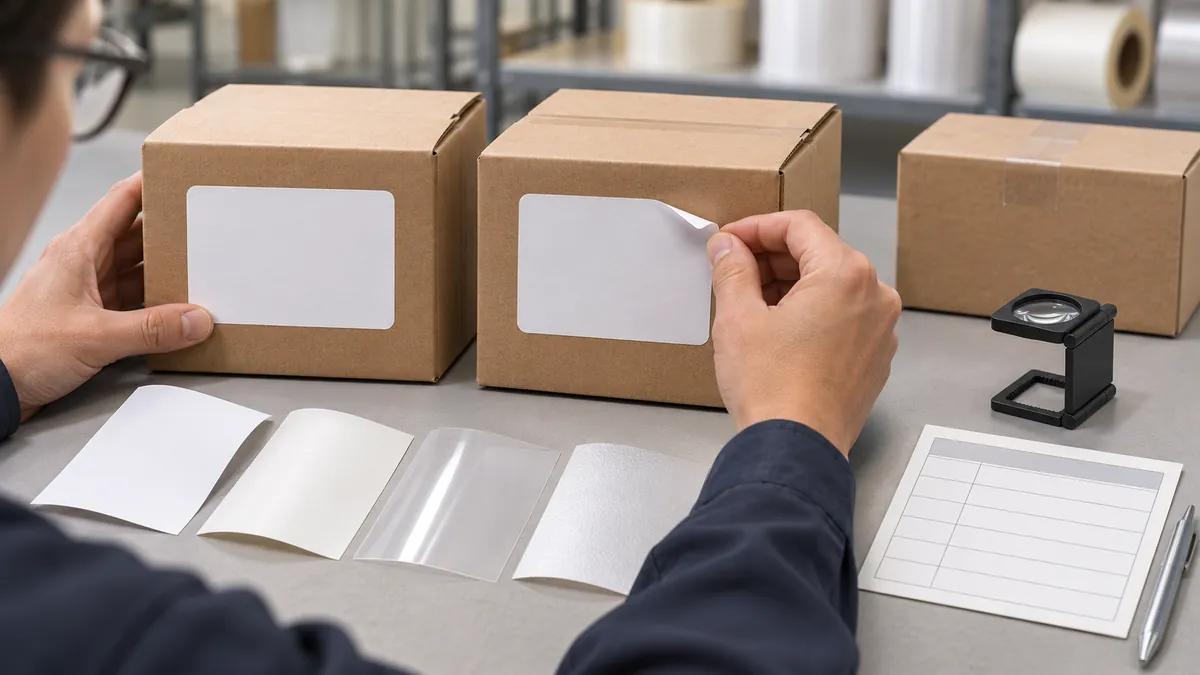
A useful evidence ladder separates what is visible from what is inferred:
| Récord | Directly supports | Does not establish by itself |
|---|---|---|
| Photograph | Appearance and approximate location of the label condition | Adhesive chemistry, cleanliness or a single root cause |
| Drawing or artwork | Intended label dimensions, shape and location when revision-controlled | Actual application quality on a different sample |
| Supplier specification | The stated construction and conditions for the named label | Approval for another substrate or application system |
| Application record | The documented method or settings actually used | That an undocumented cause has been ruled out |
| Representative sample comparison | The observed behavior under the comparison conditions | A universal result for another SKU or package |
The sequence matters. Begin with the observation; then establish what product and system are involved; then decide with the supplier what comparison is justified. Do not describe a hypothesis as a confirmed root cause merely because it is plausible. If a source or process record is unavailable, say that it is unavailable and leave the cause unresolved.
What Do the Label-Flagging Sources Actually Support?
Resource Label Group’s troubleshooting overview describes how geometry, label shape, facestock, adhesive system, application and environment can be relevant when an edge lifts. It distinguishes a raised edge from other visible conditions such as wrinkles or tears. Label Engineering Services’ discussion describes a different wet-glue or hot-melt application context. That difference matters: a pressure-sensitive label diagnosis should not inherit a machine adjustment or adhesive explanation from another label process without confirming the construction.
A practical review record should identify whether the label is pressure-sensitive, wet-glue or another specified construction; show the exact lifted location; and retain a photograph, substrate shape, label dimensions, application record and relevant environmental observations. Compare samples only under the documented, approved method. Do not change adhesive, dwell time or temperature based on the appearance alone, and do not treat a named troubleshooting article as a universal root-cause ranking. The sources help classify the investigation; the label and application suppliers must assess the actual system.
For adjacent label-material and surface-protection topics, see Koitor’s paper versus vinyl sticker guide, y protective-film selection guide.
Preguntas frecuentes
What is label flagging?
It is an unwanted raised or lifted label edge, often described at the trailing edge of a wrapped label. The visible symptom does not identify one cause by itself.
Does label flagging always mean the adhesive is too weak?
No. Label geometry, size, shape, facestock, adhesive fit, surface condition and application conditions may need review. Wet-glue and hot-melt systems also have system-specific variables. A single photo does not prove a cause.
Is label flagging the same as a wrinkle?
No. Flagging describes an edge lift or bulge. A wrinkle or ridge crosses or distorts the label face. Record the observed shape rather than treating all raised areas as the same defect.
Can I fix flagging by using a larger label?
That is not a universal fix. A different size or shape may be one supplier-controlled trial if evidence supports it, but the actual label, surface and application system need review.
Does a lifted edge prove that the surface was dirty?
No. The photograph or symptom alone does not establish the surface condition. Record actual process information and ask the responsible supplier what evidence is needed.
Are PSA and hot-melt troubleshooting steps interchangeable?
No. They use different application systems and may have different evidence and variables. Identify the system before applying advice.
Is an intentional flag label defective?
Not necessarily. Some labels may be designed with a tab or extension. Compare the observed geometry with the approved artwork and design intent.
Does this article set a universal label test or wait time?
No. It does not set a time, temperature, radius, machine adjustment or acceptance threshold. Follow the named supplier’s instructions and the actual project criteria.
Trabaja con Koitor Hardware
Reviewing a Product Label or Hardware Pack-Out?
Share the actual product or package sample, label revision and intended application. Koitor can discuss the confirmed hardware and packaging scope and help identify which project details need review with the responsible label supplier.
OEM / MARCA BLANCA
Convierte esta guía de abastecimiento en un resumen del producto
Indícanos el producto que deseas, el tamaño, el acabado, la cantidad del pedido y los requisitos de embalaje. Tu equipo recibirá un análisis práctico de la viabilidad de fabricación antes de recibir el presupuesto.


 English
 Español
 Português
 Français
 Deutsch
 العربية