

When buyers search “lift off hinge male female,” they need more than a left- or right-hand label. A separable hinge quotation should identify the supplier’s handing convention, the male or female half being supplied, the mating part, and whether the order is for a complete matched pair or individual components. These are separate identity fields. Confirm each against the exact supplier model, drawing, and unit of sale before approving a bill of materials or replacement order.
Guden’s lift-off and slip-joint hinge category is one documented example: it describes separate male and female parts, mirror-handed versions, and four distinct part identities. Another maker, Sugatsune, lists a specific lift-off model as non-handed. These examples show why a buyer must follow the selected manufacturer’s convention rather than impose a universal code system.
What do “male,” “female,” and “hand” identify?
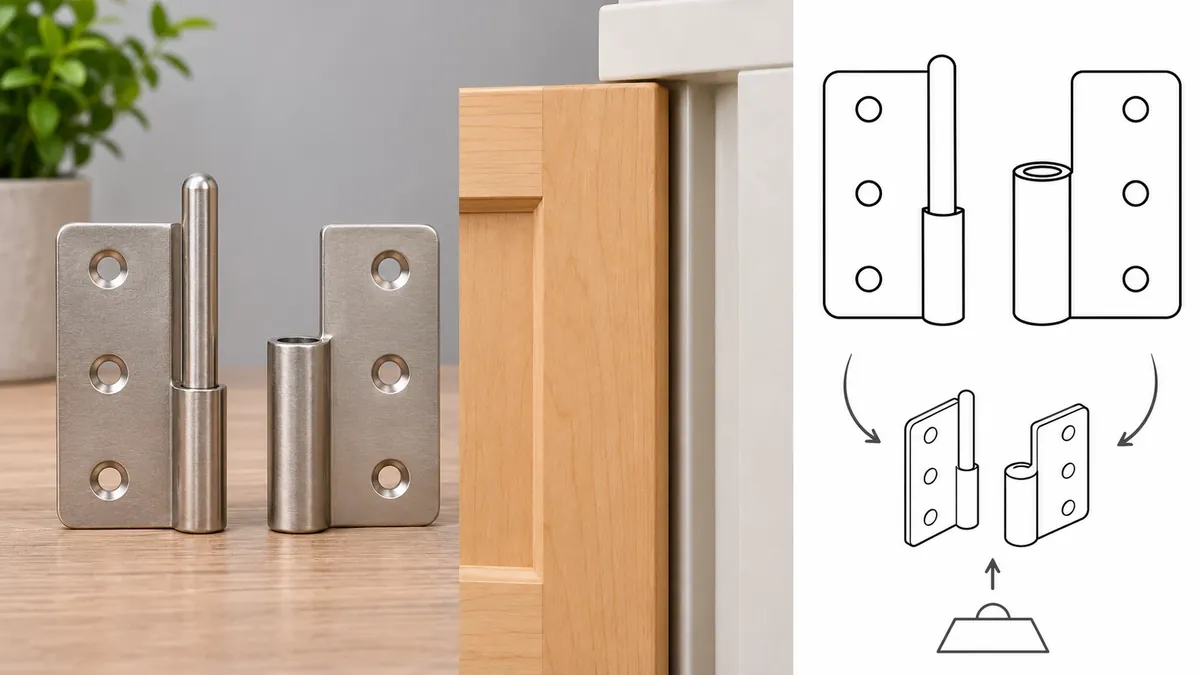
The male and female labels identify mating roles in a particular separable hinge design. A hinge supplier may describe the male half as the pin side and the female half as the receiving leaf side. “Hand” describes another model-specific attribute: the maker’s left/right orientation convention. A complete order record may therefore require both the handed version and the supplied half role.
These dimensions should not be merged into one vague line such as “right lift-off hinge.” That label may leave unanswered whether the buyer wants the male component, the female component, or a complete matched pair. It may also omit how the supplier defines left and right when viewing the assembly. Ask for the exact part code and a supplier reference for the convention. A lift off hinge male female listing is useful only when it preserves that maker’s own naming system and unit-of-sale definition.
Guden’s lift-off/slip-joint hinge category states that its catalog includes right- and mirror-image left-hand versions, with separately sold male and female components identified by codes for each combination. The page lists the four roles as right male, right female, left male, and left female. That is the convention described for the Guden products on that page; it is not a universal naming system for every hinge maker.
The same category page helps demonstrate why a category label is not an order specification. It contains multiple materials, sizes, hole options, and product codes. For buyers comparing lift off hinge male female parts, identify the selected family and exact line item rather than assume “lift-off hinge” supplies every required detail. A similar title or visual shape does not prove that a component mates with another supplier’s half.
How should the buyer separate hand from half role?
Create one row for each supplier-defined component identity and one separate field for the intended assembly quantity. In Guden’s documented example, the hand and half role combine into four identities. A private-label buyer can use a similar matrix as a question structure, but must not reuse Guden’s abbreviations for another supplier unless that supplier explicitly confirms them.
| Guden example identity | Supplier-described hand | Supplier-described half role | Acción del comprador |
|---|---|---|---|
| RM | Right | Male / pin side | Confirm exact code, quantity, and approved mating code |
| RF | Right | Female / leaf side | Confirm exact code, quantity, and approved mating code |
| LM | Left | Male / pin side | Confirm exact code, quantity, and approved mating code |
| LF | Left | Female / leaf side | Confirm exact code, quantity, and approved mating code |
This table is a paraphrase of one manufacturer’s terminology, not a universal component code. Confirm the current part-number mapping directly from the supplier before ordering. The buyer should not assume that another supplier uses the same letters, that a suffix has the same meaning, or that two products with similar hand labels share a mating interface.
Handing also needs a reference viewpoint. A supplier’s diagram may define left and right using a particular side of a door, panel, hinge, or viewer. Do not rely on an informal description such as “the left hinge when looking at it.” Ask which view the supplier uses and attach the current diagram or drawing to the record. A drawing can clarify the convention without proving that the part fits the buyer’s application.
The order must also distinguish a complete matched hinge from an individual half. A supplier may sell male and female parts separately, sell an assembly as a set, or use another package basis. Confirm whether “one” means one half, one matched pair, or another quantity unit. Record quantities needed per finished assembly only after the responsible product designer or supplier confirms the design. This guide does not give a universal hinge count or structural recommendation.
Why should the buyer confirm the mating code and unit of sale?
A code on a quotation identifies only what the supplier says is being offered. It does not automatically prove that the buyer has ordered the mating piece or the correct quantity. The buyer should map every required component to the supplier code and confirm whether a line item is a single half, a pair, or an assembled set.
For an established replacement range, the buyer may have one known component and need its mate. The right question is not merely “Can you supply the other side?” It is “Which exact model, revision, hand, half role, and code is the approved mate for this identified part?” A product image may help identify a family, but a written supplier confirmation and controlled drawing provide a stronger purchasing record.
For a new bill of materials, keep the following fields together:
| BOM field | Example of required information | Por qué es importante |
|---|---|---|
| Manufacturer and family | Exact supplier and product family | Distinguishes products with similar market names |
| Component code | Supplier’s full code, including suffixes | Preserves the offered item identity |
| Hand | Supplier-defined left, right, or non-handed status | Avoids mixing orientation with mating role |
| Half role | Male/pin, female/receiving, or another maker term | Identifies what physical component is purchased |
| Mating code | Supplier-confirmed counterpart, if ordered separately | Shows whether the assembly is complete |
| Unit of sale | Each, pair, set, or other stated basis | Prevents quantity errors |
| Quantity basis | Buyer-designed quantity per assembly or finished product | Connects the order quantity to the approved BOM |
| Source | Drawing, catalog page, quote, or written supplier answer | Makes each mapping traceable |
| Revision status | Model, drawing, and response date | Helps reopen the review after a change |
Do not derive a mating code from a shared prefix or suffix unless the supplier’s documentation explicitly defines that relationship. Do not assume a visually similar male and female component mate across sizes, materials, pins, hole patterns, or product families. The supplier should identify the approved pair.
A hypothetical quote illustrates the risk. A buyer receives a line that says “right lift-off hinge” with one item code. The supplier’s catalog shows separate male and female halves for that family. The buyer should ask whether the line includes both parts and, if not, identify the required counterpart and unit basis. This example does not describe a real buyer error or a Koitor customer case.
If one old half is being retained, the buyer should ask the hinge supplier to confirm the exact new mate. Appearance alone does not establish fit, orientation, or revision compatibility. If the supplier cannot confirm the pairing, record the answer as unresolved and do not present the substitution as approved.
Are all lift-off hinges handed?
No. The supplier’s design and product code determine whether left/right variants apply. Sugatsune’s S-6173-2 lift-off hinge listing describes that named model as non-handed and installable on either the left or right side. The listing is a model-specific counterexample to assuming that every lift-off hinge requires separate left and right versions.
That non-handed statement does not make the Sugatsune model equivalent to Guden’s separable male/female catalog system. The products have different identities, specifications, and supplier documents. The useful buyer lesson is limited: verify whether the selected model has a handing distinction at all before creating separate stock codes. If the manufacturer states a product is non-handed, preserve that rule for the exact model and revision; do not infer that all products in the category are non-handed.
For assortment planning, represent non-handed status as an explicit value such as “supplier-confirmed non-handed” rather than leaving the hand field blank. A blank field could mean the buyer forgot to ask. A confirmed non-handed entry means the supplier has documented the model’s status. Keep the manufacturer source and exact model code next to that field.
The buyer should also avoid turning a category page’s available options into a general market taxonomy. One supplier’s family may offer four hand/half combinations, while another product has a non-handed design, and a third may use a different separable geometry or nomenclature. Product codes and purchasing units must follow the maker actually selected for the order.
How should catalog dimensions be compared?
Hinge dimensions can describe an individual half or the assembled hinge. Guden’s category page explains that it measures each male and female half width from the center of the barrel to the leaf edge and advises that total open width involves the two leaf widths together. This is the source’s own catalog convention. The buyer should retain the definition rather than treating a half-width as a complete hinge width.
When comparing products, record the measurement subject and endpoints beside each value. A clear field can say “individual half width, source-defined from barrel center to leaf edge,” while a separate field identifies “full open width” if the supplier provides it. Do not calculate or transfer dimensions unless the current drawing and supplier confirm the method for the exact product.
| Dimension record | Buyer should specify | Do not assume |
|---|---|---|
| Individual half width | Which half and the maker’s stated start/end references | That it is the open width of the assembly |
| Open or assembled width | The complete component state and drawing view | That the two halves use identical dimensions |
| Disposición de los orificios | Drawing revision, view, and units | That matching visual placement proves interchangeable parts |
| Pin and knuckle identity | Supplier-defined form and exact model | That a similar pin can be mixed across families |
| Overall envelope | Which component or full assembly it describes | That a product photo provides controlled measurements |
These fields help normalize product data; they do not establish a fit, clearance, removal path, structural rating, or installation method. If two catalog values have different measurement subjects, label them “not comparable yet” and request the relevant drawing or clarification. A supplier’s technical drawing should govern dimensions for its model, and a qualified reviewer should resolve any application-specific question.
What sourcing mistakes should importers avoid?
Ordering by hand alone. A left/right label may not state whether the order includes the male half, female half, or complete matched assembly. Confirm both the orientation and role.
Assuming one line item means a pair. Suppliers may sell components individually. Ask for the unit-of-sale basis and list the matching part codes.
Using one manufacturer’s abbreviations for another. Similar-looking codes can carry different meanings. Preserve the supplier’s exact nomenclature and request a current code key if needed.
Treating the half role as a hand. “Male” and “female” identify mating roles in the cited family; “left” and “right” identify the maker’s orientation. They answer separate questions.
Assuming a handed model is universal. A supplier may offer both mirror-handed versions or a separate non-handed design. Confirm the actual model rather than choosing based on a category name.
Comparing the wrong dimension. A catalog value for one half may differ from the full open width of the assembled hinge. Record the measurement subject and endpoints.
Retaining an old part without checking the mate. A replacement half that appears similar may still differ in geometry, revision, pin, material, or hand. Ask the manufacturer to confirm the exact pairing.
Assuming fit means performance. A drawing or sample can help identify a component relationship. It does not prove structural capacity, security, cycle life, or suitability for a specific installation.
Inferring Koitor capability from an external catalog. The cited examples establish their own product information only. They do not show that Koitor manufactures or supplies the named hinges.
What should the supplier response and sample record contain?
For a quotation, request exact codes for the chosen hand and half role, the counterpart code, the unit of sale, and the source drawing. Ask the supplier to confirm whether the listed parts are sold separately or as an assembly. If a non-handed model is selected, retain a product-specific source showing that status.
For sample approval, label each component and preserve the package or document that links it to the code. Record whether the sample review answered identity, mating, appearance, dimensions, or another question. Do not write “fit approved” if the only check was a visual match. Do not use a sample as a substitute for a load or safety assessment.
When a sample arrives as loose parts, keep each component associated with its original label until the supplier identity is verified. If the packaging is discarded or multiple references are placed on one review table, record which sample came from which code before comparing them. This is particularly useful when an order includes mirror-hand versions or when male and female halves are shipped as separate line items. A traceable sample record helps the product team reconcile a later carton, purchase order, and approved drawing without relying on memory.
A controlled handoff can use these statuses:
- Complete matched identity confirmed: model, hand, male/female role, counterpart, and unit basis are all documented.
- One half identified; mate needed: one component is known, but the supplier has not yet confirmed the counterpart.
- Handing convention unclear: the product is identified, but the supplier’s viewing reference is missing.
- Unit of sale unclear: the code is known, but the quote does not say whether it covers a half or assembly.
- Dimension definition pending: the catalog value is present, but its measurement subject or endpoints are not stated.
- Non-handed status confirmed: the supplier identifies the exact model as non-handed.
- Application review required: component identity is known, but a qualified reviewer must assess the actual assembly.
These statuses prevent an incomplete quotation from appearing complete. The buyer can name the next responsible party and keep the order line open until the exact question is resolved. If the supplier’s response changes the code, quantity basis, or mating combination, update the BOM and product data together.
The same identity should appear consistently on the sample label, purchase order, incoming product record, and any replacement-parts list. If a channel uses a shortened customer-facing name, keep the full supplier code and mating role in the controlled internal record. That lets a buyer answer a later service or reorder question without treating a marketing label as the technical identity.
How can Koitor support a related metal-storage project?
Koitor Hardware is a family-owned factory and specialized OEM manufacturer for bathroom and home-storage metal hardware. Its approved profile supports drawing or sample review for confirmed metal components, forming, assembly, finish, packaging, and project-specific product communication. It does not confirm that Koitor manufactures, distributes, tests, or brands the Guden or Sugatsune hinges described above.
For a confirmed in-scope storage project, a buyer can share the lawful frame or panel drawing, identify the bought-in hinge by manufacturer and exact model, describe the assembly interface, and provide finish, packaging, target market, and quantity requirements. Koitor can first confirm whether the metal component falls within verified project scope. The OEM home-storage hardware overview provides general company context, not a hinge catalog or compatibility statement.
Hinge handing, mating identity, rated performance, door removal, mounting, and system suitability remain with the selected hinge manufacturer and the qualified project reviewer. A metal-component drawing discussion cannot substitute for the hinge supplier’s documentation. The buyer should include the selected hinge code and source with any project inquiry so that the interface is clear.
Buyer checklist before ordering lift-off hinge parts
- Exact supplier, model family, and revision are identified.
- Handing follows the selected manufacturer’s diagram and viewpoint.
- Male/female or equivalent supplier-defined half roles are identified separately.
- The exact mating code is confirmed by the supplier.
- The quote states whether each item is a half, pair, or complete assembly.
- Quantity per finished assembly is approved by the responsible product owner.
- Non-handed status is recorded only when confirmed for the exact model.
- Dimensions state whether they describe one half or the open assembly.
- Drawing source, units, revision, and sample identity are retained.
- Similar appearance or matching code fragments are not used as proof of interchangeability.
- Fit, load, security, removal, and installation questions remain separately assigned.
- Supplier, model, drawing, or BOM changes trigger a focused recheck.
Preguntas frecuentes
Does “right lift-off hinge” identify a complete pair?
Not necessarily. In Guden’s example, male and female components are listed separately, and hand is another identity dimension. Confirm the exact supplied part codes and unit of sale with the selected supplier.
Are all lift-off hinges handed?
No. Guden’s catalog describes handed male and female options for its family, while Sugatsune describes its S-6173-2 model as non-handed. These are different maker-specific examples. Check the exact model documentation.
Can the male half from one manufacturer be paired with another manufacturer’s female half?
Do not assume that. Similar names or dimensions do not establish a mating interface. Ask the responsible supplier to confirm the exact pair and retain the source evidence.
Is a half-width the same as the full open width?
No. Guden’s catalog distinguishes a width for each individual half from the total open width of the pair. Other makers may define dimensions differently. Confirm the measurement subject and endpoints for the exact model.
Does a matching part code or suffix prove compatibility?
No. A code relationship is meaningful only when the manufacturer documents it. Confirm the exact counterpart with the supplier instead of inferring a match from a shared prefix, suffix, or appearance.

Discuss a Confirmed Metal-Storage Assembly
For an in-scope metal-storage project, send Koitor the lawful assembly drawing or physical sample and identify any bought-in hinge by manufacturer and exact model. Include finish, packaging, target market, and expected quantity. Koitor can first confirm the metal component’s project scope; hinge supply, mating approval, and performance remain with the selected hinge supplier and qualified reviewer.
OEM / MARCA BLANCA
Convierte esta guía de abastecimiento en un resumen del producto
Indícanos el producto que deseas, el tamaño, el acabado, la cantidad del pedido y los requisitos de embalaje. Tu equipo recibirá un análisis práctico de la viabilidad de fabricación antes de recibir el presupuesto.


 English
 Español
 Português
 Français
 Deutsch
 العربية