
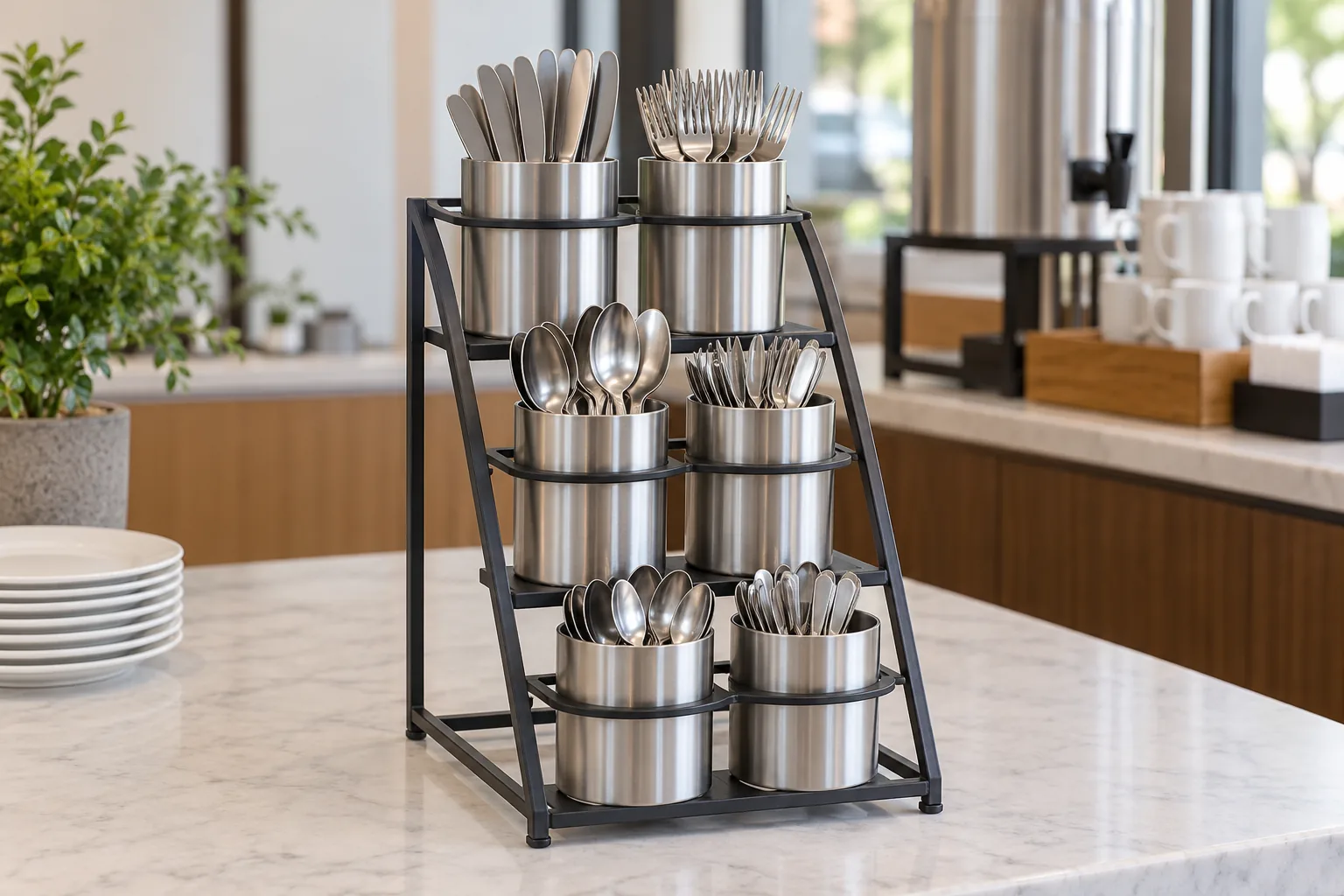
For procurement, the metal flatware cylinder display specification starts with the exact reference parts and intended arrangement. A metal flatware cylinder display specification should identify the frame and every cylinder as separate controlled components, then show how each cylinder seats and can be removed in the assembled arrangement. A catalog image can make a frame look complete even when its cylinders are purchased separately. Importers should therefore review the exact pair, not infer fit from a shared product name or similar outside diameter.
This guide focuses on a non-heated countertop display that holds removable utensil cylinders. It does not establish a safe load, food-contact status, hygiene outcome, dishwasher suitability or a particular Koitor product capability. The practical goal is to reduce ambiguity in a complete-SKU quote and make sample approval repeatable across all intended positions.
Why treat the frame and cylinders as separate SKUs?
Supplier catalogs show why the distinction matters. Cal-Mil lists a Luxe three-cylinder display and states that the cylinders are sold separately. Its separate three-cylinder holder listing identifies specific cylinder item numbers, and its solid stainless flatware cylinder is itself a separately listed component. These are examples of one supplier’s catalog architecture, not evidence that every display uses the same parts or that a third-party cylinder will fit. Confirm the current item and drawing with the seller before ordering.
For a distributor, “one display” can mean a metal frame alone, a frame with a specified set of cylinders, or a bundle whose cylinders are optional. Those configurations affect the quote, SKU master, carton contents, replacement orders, web images and customer expectations. If a listing photo shows filled cylinders but the sellable SKU excludes them, the omission can become a returns or service issue even when the frame itself matches its drawing.
Write the commercial scope as a component list. Give each item a supplier, part number or internal identifier, drawing revision, quantity per finished assortment, material description as confirmed by its supplier, and packaging responsibility. State whether the set is sold as a single retail unit or as multiple individually orderable components. If cylinders may be substituted, name the approved alternatives rather than using a generic phrase such as “fits standard inserts.”
A buyer already evaluating a standalone utensil crock has a different question: usable opening, depth, dividers and counter footprint. This paired-frame topic is narrower. It concerns the contact between a removable cylinder and an elevated support, the handling path through neighboring positions, and whether replenishment can happen without dismantling the display. Keep those decisions separate so that a general container review does not obscure the interface.
What should the buyer measure on the actual cylinder?
Start with the geometry that affects the interface, not just the cylinder’s headline width. Request a controlled drawing or measure a production-intent sample for the outside body profile, rim diameter, rim shape, height, taper, bottom shape and any rolled, flared or beaded edge. Record the measurement method and the point at which each dimension is taken. A cylinder with a broad rim and one with a narrow rolled edge may share a nominal outside diameter while contacting a frame differently.
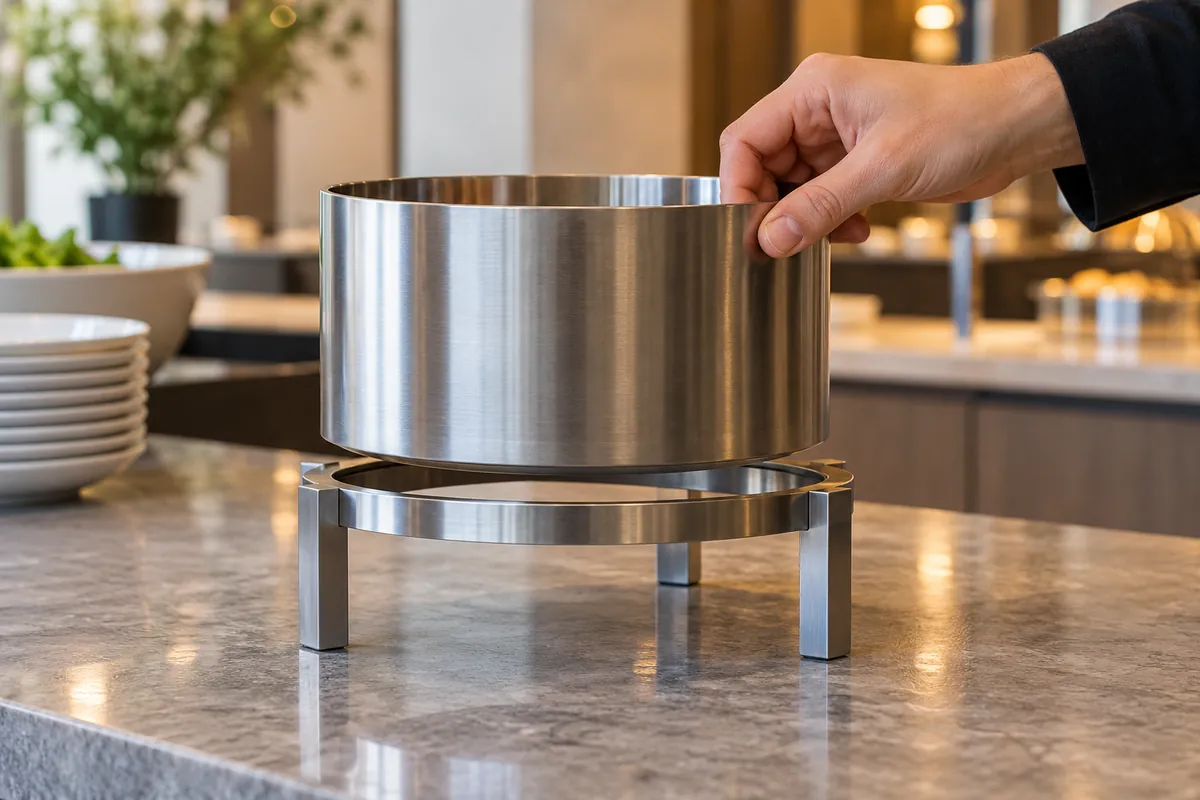
The frame’s support opening or ring should be described in relation to the cylinder. Ask which surface carries the cylinder, where it is located, whether the cylinder is centered by a separate stop, and how much lateral movement is intended. A support that relies on the rim needs the rim to remain above the support in the intended orientation. A body-supported design needs enough clearance to accept body variation without binding. Do not invent a universal tolerance: establish the acceptance dimensions from the controlled drawing, the sample and the buyer’s intended supplier process.
Review more than one cylinder if the display has several positions or sizes. Measure each insert and each frame location that will be sold. The frame may appear symmetrical, but bend, weld or assembly variation can make positions differ. Record whether the cylinder may rotate, whether orientation matters, and whether any decorative rim, handle or seam must face away from an adjacent component.
A usable interface matrix can contain:
| Comprobar | Buyer records | Sample decision |
|---|---|---|
| Cylinder identity | Supplier, item, revision and material description | Is the supplied component the approved one? |
| Body and rim | Measurement points, outside profile and edge form | Does the intended support contact the correct surface? |
| Frame seat | Opening, ring or ledge geometry and drawing revision | Is the cylinder supported and located as designed? |
| Position | Frame level, cell or orientation | Has every position been tried with its assigned insert? |
| Movement | Observed clearance and permitted movement | Does movement match the approved design intent? |
| Service path | Lift direction and hand access | Can the insert be removed with the rest of the display occupied? |
This table is a documentation aid, not a performance test. The buyer and supplier must agree on numeric limits and any test method for the specific product. A photograph is useful for recording orientation, but it cannot replace dimensional evidence or a signed sample record.
How should every position and removal path be approved?
A loose insert placed on a workbench proves very little about access in a populated display. Assemble the frame using the production-intent parts, fill every position with the intended cylinders, and use representative flatware only where it helps reproduce the shape and handling. Then lift each cylinder out and return it while the neighboring positions remain occupied.
Observe the full hand path. Does the operator grasp the rim, body or a designated lift point? Can fingers reach the insert without scraping against another cylinder or a frame rail? Does the cylinder need to tilt before clearing a support? If so, does the tilt path hit the next level, a table surface, nearby condiment wells or a divider? Does a filled cylinder have a different center of mass or handling envelope from an empty one? Record what is actually observed; do not convert a successful single trial into a general load or durability claim.
Use a repeatable sample sequence:
- Match the frame and cylinder identifiers to their drawings and revisions.
- Confirm that each sample is the material, finish and edge condition intended for sale.
- Assemble the frame in the approved orientation and tighten only the specified hardware.
- Seat each cylinder in its assigned location and photograph the contact points.
- Check that it is not visibly perched on an unintended edge or trapped by a neighboring part.
- Repeat placement and removal from every intended user approach.
- Test the same path with neighboring cylinders occupied.
- Add intended utensils if the buyer expects the insert to be handled while filled.
- Record interference, rocking, rubbing, sharp contact, unexpected rotation or a difficult grip.
- Sign the exact frame-and-cylinder combination, including any accepted exception.
Define the buyer’s handling requirement before the sample review. If cleaning or replenishment requires removing an insert, specify whether the entire display remains on the counter, whether it can be moved, and whether another person is expected to stabilize it. Do not assert that a design is hygienic or easy to clean based only on open spacing in a photograph. Ask the responsible supplier for component-specific care instructions, especially when the frame and insert come from different sources or use different materials and finishes.
For replacement planning, keep the frame and insert identifiers linked in the product data. If a cylinder is discontinued, a substitute should go through the same interface review. “Same diameter” does not prove equal rim thickness, body taper, height or removal clearance. Maintain a change record so the accepted substitution does not silently become the new default for every market.
Which finish, edge and assembly details belong in the review?
Contact zones deserve attention because they can be hidden after assembly. Check the support ring, ledge, stops, welds, fastener heads and edges around the cylinder opening. Note whether an insert touches a visible cosmetic face, whether the contact could scratch either part during normal placement, and whether an edge or seam creates an awkward cleaning or handling point. The supplier should state which surfaces receive a finish and how any masked or assembled areas are treated. Avoid extrapolating corrosion resistance or care from one component’s appearance.
For a fabricated metal frame, a drawing may call for cutting, punching, bending, joining, polishing, finishing and assembly steps. The chosen design determines which process details require review. A tight support opening might be sensitive to forming variation; a welded ring may have a local joint that affects roundness; a coated surface may change the effective clearance. These are engineering considerations to discuss on the actual design, not proof that a particular defect is present or that one manufacturing method is always superior.
Inspect whether fasteners or frame members obstruct the insert’s intended path. If the display ships assembled, the buyer should confirm that the cylinder can be removed without disassembly. If it ships flat-packed, review assembly order, hardware identification, instructions and the effect of final tightening on opening alignment. Approve the finished arrangement after assembly rather than relying only on a component drawing.
Sample notes should distinguish an observed condition from an acceptance rule. “The third cylinder rubbed the adjacent rim during removal in the approved orientation” is actionable. “The display is unstable” requires the buyer to identify the setup, surface, fill state, handling and threshold that define instability. A qualified load or stability check, where necessary, should use a written configuration and method. Do not assume a metal thickness, a weight or a visually heavy frame proves suitability.
How do packaging and assortment decisions affect replenishment?
A paired product can arrive as one display carton, a frame carton plus nested inserts, or multiple replacement units. The quote and packing list should spell out which components are included, their quantities, protective materials, orientation and any assembly required. If a cylinder can rub against the frame in transit, define how the parts are separated and how a buyer will inspect the surfaces after unpacking. An image of a packed sample and a written component count make the expectation easier to audit.
For a family of displays, map every frame revision to every approved cylinder. A buyer can use one row per finished SKU and include:
- Saleable SKU and market label.
- Frame part number and drawing revision.
- Cylinder supplier, part number, material description and revision.
- Number of cylinders per display and their assigned positions.
- Approved orientation and visible-face requirements.
- Assembly and removal instructions.
- Replacement component compatibility status.
- Carton configuration and responsible packer.
- Approved sample date and sign-off owner.
- Any component that is expressly excluded from the frame-only SKU.
This is particularly important when photography, marketplace content and purchase orders are created by different teams. Keep the product image and the bill of materials aligned. If the cylinders are optional, the product page should show the frame-only scope clearly and identify the matching insert set. If a complete set is intended, the quotation and final inspection need to count every component.
Before a repeat order, verify whether any component, finish, supplier, drawing or packing method changed. A small change to a rim profile or coating can affect seating or removal even if the part number was not updated correctly. Compare the approved sample and current production documents, then re-run the relevant interface checks when the change touches a fit-critical dimension or service path.
What should an importer put in the RFQ?
Send the supplier a complete input package rather than asking for a generic cylinder display price. Include a frame drawing, cylinder drawing or physical sample, intended number of positions, cylinder assignment, finish reference, assembly scope, packed configuration and target sales SKU. Identify the surfaces that must remain visible and any buyer-specific appearance criteria. If the supplier is expected to fabricate only the metal frame, say which insert is third-party supplied and who is responsible for controlling its dimensions.
Ask for a quotation response that separates the frame from optional cylinders and states the basis for compatibility. Request current controlled drawings, sample timing, revision control, order quantity assumptions and packaging details through the supplier’s ordinary commercial process. The buyer should agree what constitutes a sample approval and which changes require renewed approval. Do not treat an unverified catalog photo or a general statement such as “standard size” as an engineering specification.
For teams comparing an OEM source, Koitor’s pages on Fabricación de estanterías metálicas a medida y Accesorios de almacenamiento doméstico OEM provide company context for metal-component discussions. Those pages do not establish that Koitor currently sells flatware-cylinder displays or the cylinders themselves. A buyer can share a drawing and insert sample through the contact page to discuss whether the metal frame portion fits a supported manufacturing scope.
Does one published pairing guarantee a replacement fit?
No. A catalog pairing is evidence about the named components offered by that supplier, not proof that another cylinder will fit. Even within a product family, confirm the exact item numbers, revision and current drawing. If the catalog page conflicts with a dimension elsewhere on that page, do not choose whichever number suits the buyer’s concept. Ask the seller for a controlled drawing or measure and approve a production-intent sample.
The same limit applies to care and performance. A supplier’s care note for a frame, insert or catalog family should not automatically be transferred to another material or finish. A successful sample fit does not prove a load rating, long-term wear, food-contact compliance, dishwasher performance or field life. Those are separate claims requiring evidence for the exact component and intended use.
A practical approval package therefore links three things: the commercial BOM, the interface drawing and the physical paired sample. It records where each cylinder goes, what surface supports it, how an operator removes and refills it, and which variants have been approved. When any of those facts changes, the buyer can identify the exact row to revisit instead of reopening the entire assortment.

Source basis: Cal-Mil Luxe three-cylinder vertical display, Item 3010-55, Cal-Mil 3-cylinder flatware holder and separately specified cylinders, y Cal-Mil solid stainless flatware cylinder, Item 1017-SOLID. Catalog facts are limited to those named supplier items and may change; the checklist above is buyer guidance, not Koitor test data.
Keep the metal flatware cylinder display specification tied to the named sample, drawing revision and included components.
Reviewing a Metal Cylinder Display Frame?
Share the frame drawing, insert samples, position map, finish reference, packaging scope and sample criteria for a bounded metal-component feasibility discussion.
OEM / MARCA BLANCA
Convierte esta guía de abastecimiento en un resumen del producto
Indícanos el producto que deseas, el tamaño, el acabado, la cantidad del pedido y los requisitos de embalaje. Tu equipo recibirá un análisis práctico de la viabilidad de fabricación antes de recibir el presupuesto.

 English
 Español
 Português
 Français
 Deutsch
 العربية