
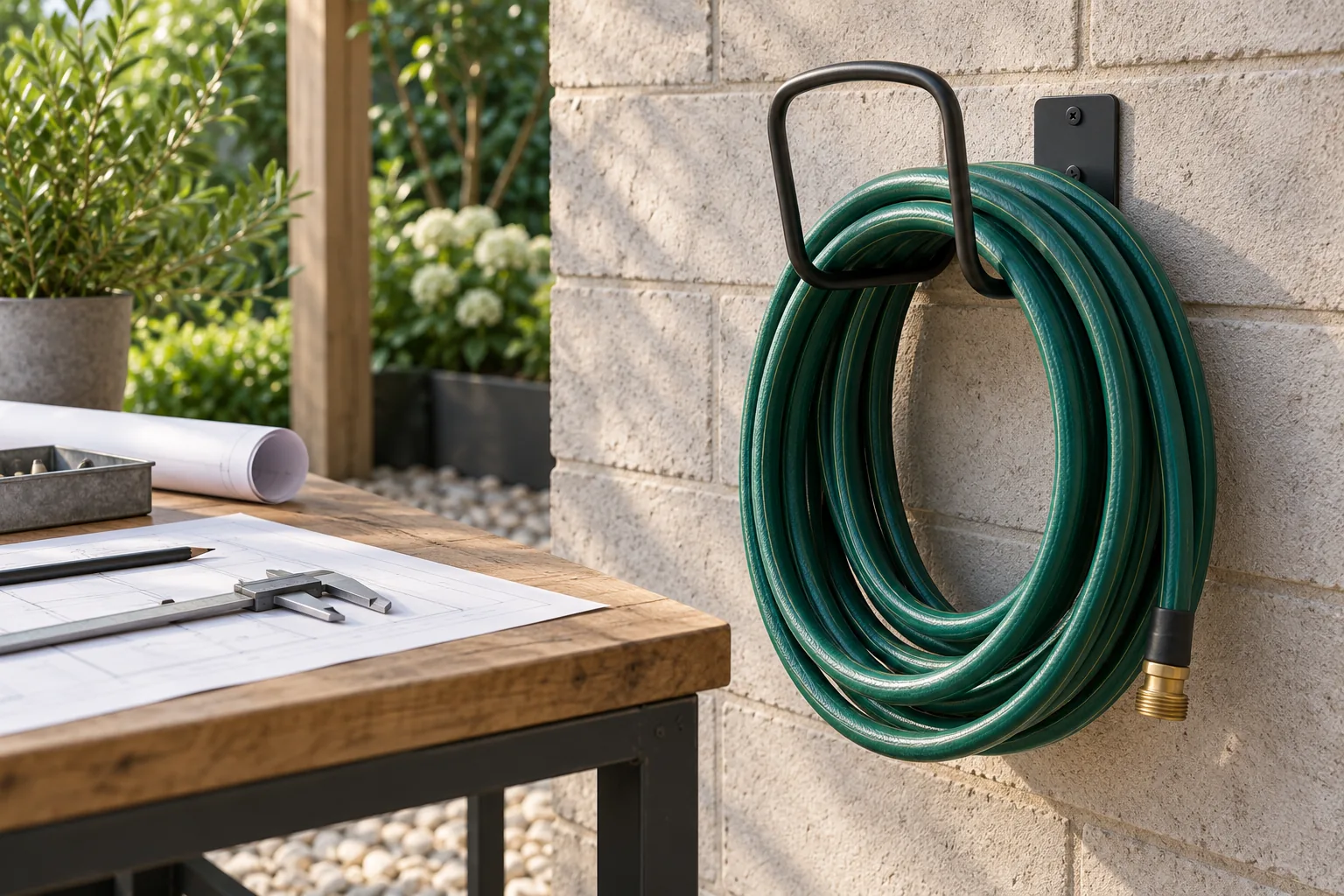
A garden hose holder supplier specification should describe the hose, the holder’s usable geometry, the mounting interface, the finish and the included hardware kit. It should tie those details to one controlled drawing, quotation and approved sample. The phrase “holds 100 feet” is not enough by itself: capacity depends on the holder model and the hose diameter, flexibility and winding path used to establish that figure. A buyer should ask the supplier to state the assumptions behind any capacity statement and approve the intended hose-holder pair together.
This guide focuses on a simple wall-mounted metal hanger, not a hose reel, automatic rewind unit, irrigation fitting or watering tool. Public product listings show why model-level details matter. Kärcher lists separate capacities for different hose diameters along with bolt spacing, dimensions and supplied screws and dowels for one hanger model. A Grainger-listed steel hanger ties its capacity to a 5/8-inch inside-diameter hose, gives its own dimensions and mounting-hole details, and states that fasteners are not included. These are examples of product-specific specifications, not universal values or recommendations for another design. See Kärcher’s hose hanger specifications y Grainger’s listed steel hose hanger.
Koitor’s experience with metal storage hardware may provide useful manufacturing context for a buyer discussing formed or welded metal parts. This article does not claim that Koitor currently manufactures garden hose holders, hose reels, garden products or fasteners. Any project-specific capability, material, finish, packaging and validation plan should be confirmed directly before an RFQ is treated as accepted.
Start with the product definition, not just “hose holder”
Buyers and suppliers may use “hose holder,” “hose hanger” and “hose reel” loosely, but these terms can describe different mechanisms. A simple hanger holds a hose that the user wraps around a formed or welded support. A reel stores hose on a rotating drum; some models include a crank, swivel, enclosure or rewind feature. A freestanding stand uses a different support and stability concept from a bracket fixed to a wall. These product types do not share one capacity, installation interface or assembly sequence.
Put a product-type statement at the top of the RFQ: for example, “open wall-mounted hanger for manual hose winding; no reel, crank, rewind mechanism, hose or connector included.” Then list optional features separately, such as an accessory ledge, nozzle holder, decorative cover or removable component. This prevents a quote comparison from mixing a basic metal bracket with a more complex reel assembly.
Also identify who owns the system around the hanger. The buyer may supply the hose, screws, anchors, labels, retail carton or installation leaflet. The factory may quote only the metal part. A quote that silently assumes different included items can look cheaper while representing a different SKU. List every included and excluded component, plus the supplier responsible for providing it.
Give the supplier the actual hose range
“Fits a standard garden hose” does not identify one physical input. State the hose construction and range that the product must store: inside diameter, outside diameter where known, length, stiffness or wall construction if relevant, and any connector or accessory that must remain accessible. If the buyer has several target hose types, identify the largest or least flexible reference configuration the product must accommodate and ask the supplier to confirm whether that assumption controls the quote.
Capacity should be tied to a named model and a described hose. The outside diameter affects how much hose occupies the available winding space. A stiff hose may resist a tight wrap; a softer hose may settle differently. Hose length, winding path, the holder’s projection from the wall and any side lips all influence how the coil sits. A product listing that states capacity for one diameter does not establish the same capacity for a larger or stiffer hose.
Ask the supplier to define how any capacity value was determined. Was a hose physically wound onto the sample? Which hose size and length were used? Was the coil arranged in a particular direction or pattern? Does the figure describe geometric fit only, or does it also include a separately defined structural evaluation? If no supported capacity figure exists, use a practical fit statement based on the approved reference hose rather than inventing a number for marketing copy.
Where multiple hose types matter, put the requirement in a simple matrix: reference hose identifier, length, inside and outside diameter if available, construction, winding condition and result expected. Keep the source hose or a clearly identified equivalent with the sample record. This turns “works with our range” into something both sides can review. It also helps the buyer distinguish a poor fit from a mismatch between the original brief and a later replacement hose.
Define the usable holder geometry
The drawing should show more than overall height and width. Identify the surface that carries the coil, the clear opening, usable wrap width, projection from the mounting plane, end or side retention features, bend radii, edge treatment and any accessory space. These dimensions affect whether the reference hose can be placed on the holder without being pinched, blocked by a wall or pushed off an edge.
For a bent-wire form, give the controlling wire diameter and the locations where the hose contacts the product. For a sheet, tube or mixed construction, identify material form, wall thickness where relevant, joint locations and cosmetic faces. Do not treat a single thickness as a universal quality measure. The selected section and shape, unsupported span, joint design, material and mounting arrangement all affect how the product behaves. Buyers should specify the geometry that matters to fit and request the supplier’s review where a drawing leaves manufacturing questions unresolved.
Mark critical dimensions rather than applying tight tolerances to every feature. For example, the mounting-hole center distance and usable wrap width may be essential to the buyer’s fixture or reference hose, while a hidden return may tolerate a wider range. State the measurement datum and method, then agree how the first sample will be checked. A tolerance without a datum can still leave two people measuring different points.
The buyer should also make the intended wall clearance visible. A hose may fit on the hanger in free space but contact a wall, decorative cover or adjacent accessory after mounting. A side-view drawing can show projection and the intended coil envelope. If the holder is designed for a corner, post or other non-flat surface, show that interface explicitly rather than assuming a flat wall.

Specify the mounting plate and hardware kit separately
Describe the mounting interface as a product feature: plate outline, hole count, hole-center distances, hole or slot dimensions, slot direction, access for a driver, and any required clearance behind the plate. If the design can be mounted in more than one orientation, show which positions are approved. A hole pattern that looks simple in a rendering can conflict with the holder body, a tool path or the buyer’s display or installation space.
List the fasteners that are included, if any, by part type and quantity. Screws and anchors are not interchangeable descriptions. The appropriate fixing depends on the substrate and the installation conditions, which may be unknown to the product importer. The product drawing and packaging can identify the supplied kit and its intended scope, but they should not imply that one generic anchor is suitable for every wall. The installer or responsible product team must select and communicate the applicable fixing guidance for the target use.
When a buyer needs a prepacked kit, show whether fasteners are bagged separately, attached to a backing card or placed loose in the carton. Record the bag label, quantity, finish and SKU relationship. For multiple holder variants, identify which kit goes with each part number. A missing screw or an incorrect hole pattern is a product-definition or pack-out discrepancy; it should not be resolved by assuming the user will source a substitute.
Ask the supplier to flag any feature that may be difficult to form, weld, finish or assemble. A mounting hole too close to a bend, an inaccessible cosmetic surface, a joint exposed to view or a slot that is difficult to deburr can change the proposed construction. The buyer should receive a clear marked-up drawing or written change request before the quote or sample is approved.
Match outdoor finish expectations to the real exposure
“Outdoor finish” is not a complete finish specification. Tell the supplier where the product is expected to be used: covered or directly exposed, subject to frequent wetting, near a coast, or cleaned with particular products. Describe the visible color and appearance the buyer needs, the relevant surfaces, and any known packaging or handling contact that could mark them. These details help the supplier identify questions about substrate, pretreatment, coating, edges, drainage and packing without promising a universal service life.
Name the finish system only when the buyer has a defined requirement and the supplier can confirm it. If the purchasing team is comparing painted steel, coated steel or stainless construction, compare the complete specification and the evidence offered for that product and environment. A material name or finish label alone does not establish corrosion resistance in every climate. Likewise, a test result should be tied to a sample, method, preparation and agreed acceptance criteria; a test duration by itself is not a guaranteed number of years outdoors.
For sample review, inspect the declared finish on the visible faces, edges, bends and weld areas. Record color reference or approved visual standard, gloss or texture if controlled, and which surfaces may show a process mark. Do not use a smooth-looking sample as proof of coating adhesion or long-term corrosion behavior. If the buyer needs a laboratory test or a field exposure evaluation, specify the method and acceptance plan separately and confirm who is responsible for carrying it out.
Compare quotes and approve the sample on the same assumptions
Use a quote sheet that keeps the product identity and scope visible. A garden hose holder supplier specification should make it easy to compare the same construction, hose reference, finish, mounting pattern, kit, package and quantity. At minimum, request the supplier’s drawing revision, construction and material declaration, finish description, dimensions, mounting pattern, hose assumptions, included hardware, package configuration, quantity tier, sample plan and stated exclusions. Ask the supplier to list any substitutions or assumptions instead of embedding them in a short description.
| Campo «Solicitud de presupuesto» | Supplier response to record | Sample or document check |
|---|---|---|
| Hose reference | Length, diameter, construction and fit assumption | Named hose or recorded equivalent is used for fit review |
| Holder geometry | Critical clearances, wrap width, projection and material form | Agreed dimensions measured from stated datums |
| Mount and kit | Hole pattern, included components and exclusions | Plate, fastener count and pack contents match the drawing |
| Finish and pack | Declared finish, environment assumption and SKU pack | Visual standard, label, insert and carton revision checked |
This is especially important when one quote appears to include a higher hose capacity, a more substantial mounting plate or a complete hardware kit. Ask what changed in the construction or scope. A larger claim could reflect a different tested hose, a different model, an accessory set, or simply a different way of describing the usable space. The number should not be compared until the reference hose and evaluation basis match.
For a private-label program, link artwork, carton copy and part identification to the same product revision. If a buyer needs a capacity statement on a carton or online listing, approve the exact wording against the named reference hose and any evidence supporting it. Avoid absolute statements such as “fits all hoses” unless the buyer has defined and verified the entire supported range.
Approve a sample against a recorded checklist
The sample review should confirm both the part and the records that describe it. Use a controlled checklist with these items:
- Confirm the sample part number, drawing revision, finish and supplied kit match the quotation.
- Measure the agreed mounting-hole centers, plate envelope and critical holder dimensions from the stated datums.
- Use the named reference hose or a recorded equivalent to check how it winds, sits and clears the wall and any accessory feature.
- Observe whether the hose is pinched, blocked, difficult to place or able to slip from the intended support under the defined fit check.
- Inspect edges, bends, joints, visible surfaces and finish against the approved visual sample or written criteria.
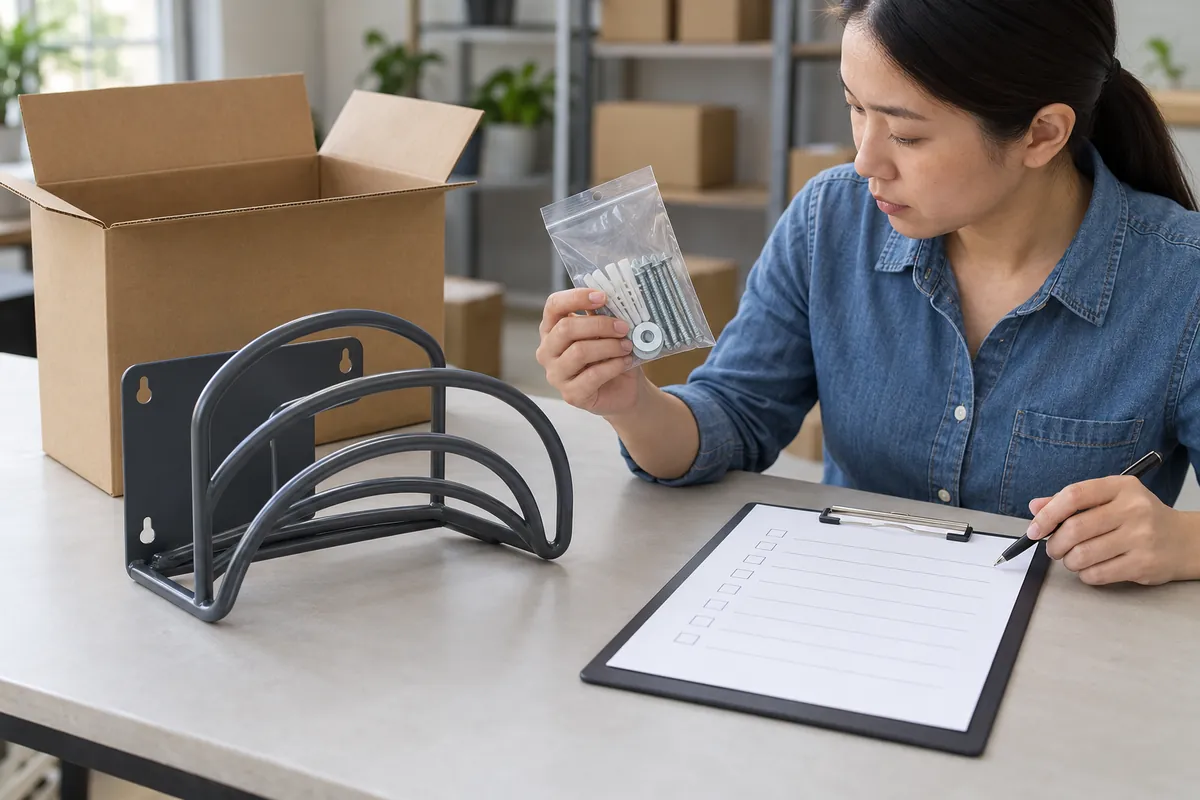
- Count and identify the included screws, anchors, washers, bags, inserts and printed materials.
- Photograph the product, measurement points, reference hose label and pack contents, and link the records to the sample revision.
- Record unresolved points as open actions; do not turn a fit approval into an unrecorded structural or outdoor-performance claim.
A sample can confirm the observed part against a limited set of acceptance checks. It does not prove that every production unit will match, that every hose will fit, that an installed wall fixing is suitable, or that the finish will withstand an unspecified environment. If the buyer requires load, corrosion, coating or packaging tests, define the specimen, method, conditioning, acceptance limit and reporting responsibility as separate controls. One test cannot stand in for all these questions.
Control changes between sample and reorder
After approval, retain the signed or otherwise controlled drawing and a clear sample reference. The record should identify the product revision, hose assumptions, dimensions checked, finish reference, included kit, package artwork and unresolved limitations. If a supplier proposes a change to wire or sheet thickness, bend geometry, joint position, coating, hole size, fastener or packaging, ask which approved features may be affected and whether a revised sample is needed.
Reorders should repeat the same identity checks before purchase order release. A small change can shift the coil envelope or tool access even if the product still resembles the approved sample. A replacement hose can also change the fit requirement. If the buyer intends to expand the supported hose range, update the brief and review the holder and sample against the new reference rather than treating the old approval as universal.
For distributors with several colors, mounting options or retail packs, maintain a variant table that maps each SKU to its drawing, finish, kit, label and carton. This helps purchasing, quality, warehouse and customer-service teams refer to one product definition. It also makes a claim or receiving discrepancy easier to investigate because the buyer can compare the delivered configuration with the agreed revision.
A practical RFQ summary
Before sending the request, the importer can summarize the project in a short brief:
- Product type: simple manual wall hanger, reel, or another defined mechanism.
- Intended hose: identifier, length, inside/outside diameter where available, construction and reference sample.
- Required fit: usable wrap width, projection, clearances and any accessory space.
- Construction: drawing revision, material form, critical sections, joints and visible faces.
- Mounting interface: plate outline, hole pattern, orientation, access and kit scope.
- Finish: target environment, appearance reference, declared system and any agreed evidence plan.
- Package: variant/SKU, included hardware, bag and carton configuration, labels and artwork revision.
- Sample acceptance: measurements, reference hose fit, finish observations, pack-out check, photos and sign-off owner.
- Quote assumptions: quantity, exclusions, substitutions and any capability questions still to confirm.
The strongest supplier conversation starts with these decision inputs, not with an unsupported demand for “heavy duty” or a copied capacity number. If the team is also evaluating broader metal-storage capabilities, Koitor’s metal storage rack manufacturing overview provides adjacent context; it is not a confirmation of garden-product capability. For a specific project, buyers can Ponte en contacto con Koitor with a drawing, reference sample and target quantity so the exact scope can be reviewed.
The practical takeaway is simple: define the hose, holder, mount, finish, kit and revision together. Ask the supplier to state its assumptions, then approve a sample against the same inputs. This garden hose holder supplier specification approach produces a more comparable quote and a clearer reorder record while keeping capacity, installation and outdoor-performance claims tied to evidence for the actual product.
Reviewing a Metal Storage Product Brief?
Share the drawing, reference sample and target quantity. Koitor can discuss confirmed metal storage product scope; garden-product capability and project requirements should be confirmed for each inquiry.
OEM / MARCA BLANCA
Convierte esta guía de abastecimiento en un resumen del producto
Indícanos el producto que deseas, el tamaño, el acabado, la cantidad del pedido y los requisitos de embalaje. Tu equipo recibirá un análisis práctico de la viabilidad de fabricación antes de recibir el presupuesto.



 English
 Español
 Português
 Français
 Deutsch
 العربية