

A useful serving tray specification separates the tray’s outside dimensions from its usable deck and the space occupied by its handles. Buyers sourcing metal serving trays should state those dimensions and handling needs in a controlled sample brief. Buyers also need to define what will be carried, how a person will grip the tray, and which surface interfaces matter. A tray can match the catalog length and width but still have too little usable deck, crowded handles or a liner that addresses only one of two different slipping questions.
The first slip interface is between the tray surface and the cups, dishes or service items placed on it. The second is between the tray’s underside and the table or support where it is set down. A non-slip surface on top does not automatically stop the tray itself from moving on a table. These should be specified and evaluated as separate product functions.
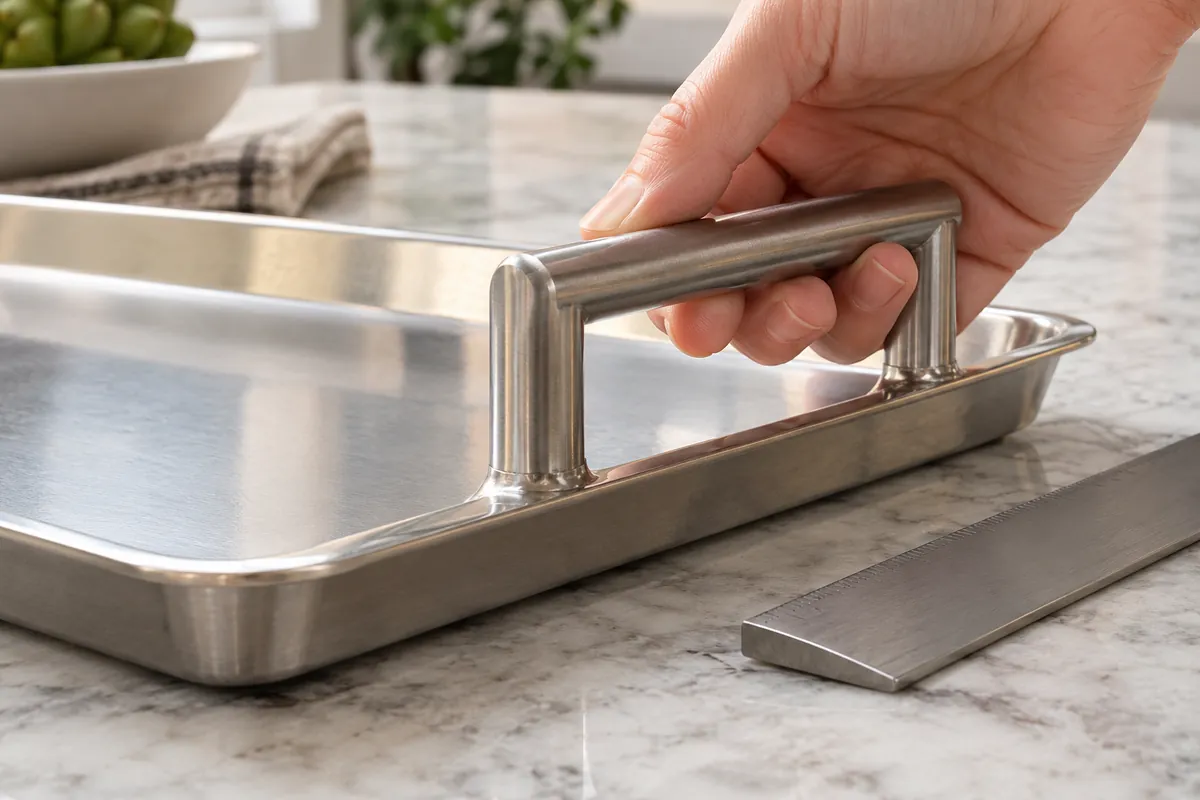
For metal serving trays, record the usable deck and handle envelope separately from outside dimensions. If the assortment includes multiple sizes, specify which metal serving trays were sampled and what changed between versions. Recheck any liner, handle or foot revision on the production-representative metal serving trays before release.
Draw the usable deck separately from the outside size
A tray’s outside length and width describe its overall envelope. The usable deck is the area where the intended service items can sit without contacting raised edges, a handle, a joint, a liner seam or another obstruction. Ask the supplier to dimension both. If the tray has a rim, recessed center or raised handle, identify how its projections are measured and what part of the internal area is actually available.
Start by arranging a representative set of cups, glasses, plates, dishes or condiment containers on a table. Use the items or dimensions expected for the target market and retail positioning. Mark the intended spacing and reach area. Then compare the loaded layout with the tray’s actual inner dimensions, edge profile, corner radius, raised lip and any non-slip insert. Do not infer how many items fit from a lifestyle photo with no dimensions.
A simple drawing can show outside length and width, inside deck length and width, usable flat area, rim height, corner radius, handle envelope and finger opening. If the user is expected to lift the tray while loaded, mark the clearance between the handle and the deck contents. Two trays with the same outside size can offer different working layouts if one has an inward-sloping wall or a handle that extends across the deck.
| Buyer field | What to mark or record | Why it affects the sample decision |
|---|---|---|
| Outside envelope | Overall length, width and height, including attached handles | Controls carton fit and product storage, but does not prove usable area |
| Usable deck | Flat or functional inner area after rims, joints and liners | Shows whether the intended service set fits without crowding |
| Rim and edge | Rim height, profile, rolled or folded edge, corner form | Affects item containment, cleaning access and hand contact |
| Handle opening | Clear width and height, grip depth and nearest deck obstruction | Determines whether fingers fit with the tray loaded |
| Handle location | Integral, attached or recessed; distance from tray edges | Affects the carry posture and the loaded balance point |
| Underside support | Feet, pads or other contact points and their layout | Addresses the separate tray-to-table interface |
| Surface treatment | Metal finish, liner material and attachment | Must match intended care and the claim evidence |
The buyer should distinguish deck space from hand space. A handle may not reduce the tray’s outer area, but its opening can be too shallow for the intended grip or obstructed by a high rim. Conversely, a wide opening might fit a hand but leave too little surface to maintain a comfortable carrying position. The product brief should show both the hand envelope and the planned load.
Do not treat a tray’s nominal outside area as a usable capacity rating. Any capacity or load claim needs its own defined method and evidence. A sample layout can verify whether a representative set physically fits; it does not by itself establish safe carrying load, ergonomic suitability or performance under every user’s handling.
Specify the handle-to-deck connection and grip
Handles may be formed as part of the tray body, welded or otherwise attached, or created by a separate component. Those constructions have different visual joints, grip openings and inspection points. The buyer should identify which design is being quoted and ask for a drawing that shows the handle section, attachment location, joint detail and the area where the hand will contact it.
Review the loaded carrying position rather than the empty product alone. Place representative items on the usable deck and observe the hand opening, tray angle and contact points. Do not make a broad ergonomic claim from one informal test. Instead, record the specific observations the buyer cares about: whether fingers have the agreed clearance, whether the hand touches a sharp or visually sensitive edge, whether a dish collides with the grip area, and whether the handle joint remains aligned in the approved sample.
If handles are attached, define the visible and functional acceptance points for the joint. That might include location, gap, alignment, edge condition, finish continuity and an agreed inspection method. The standard must fit the actual design and intended claim. A visual inspection can detect an obvious gap or misalignment, but it does not prove the handle’s load capacity. A quantified load requirement requires a separately defined test setup, sample conditioning and acceptance criterion established by the responsible technical parties.
When a handle is integral, assess the transition between the grip and tray wall, including any narrow radius or edge that the hand can touch. When a handle is a separate part, confirm whether a cover, liner or fastener changes after assembly. Freeze the handle material, finish and attachment revision with the tray body so later sourcing changes do not silently alter the sample.
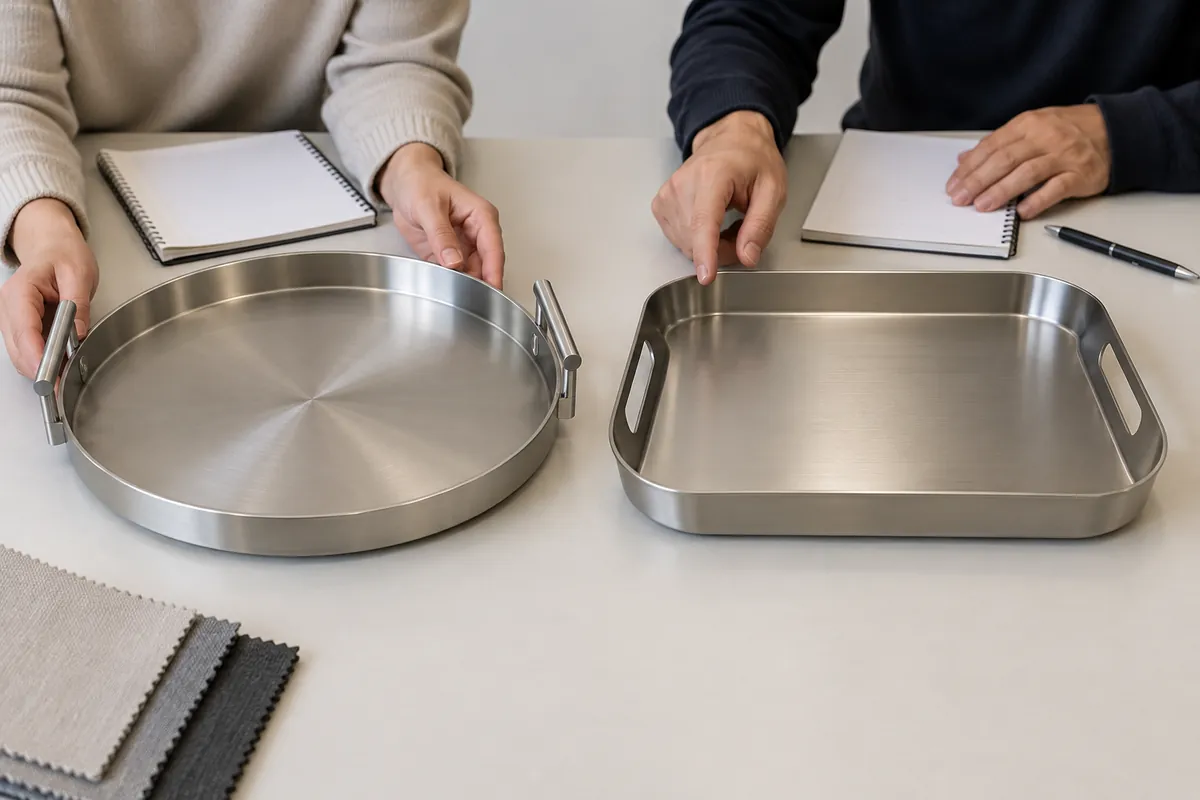
Separate tray-to-load grip from tray-to-table grip
The phrase “non-slip tray” can mean that items are less likely to slide on the tray, that the tray is less likely to move on a support surface, or both. These are different interfaces. A top liner may increase grip between glasses and the deck but say nothing about the tray’s underside. Feet or an underside coating may affect how the tray rests on a table without changing movement of cups on its top surface.
The buyer should define each claim separately:
- Load-to-tray: What items are expected, what deck or liner they contact, and what movement the claim addresses.
- Tray-to-table: Which underside components contact the supporting surface and what surface type is relevant.
- Carry condition: Whether the claim is about movement while the user carries the tray or only while items rest on it.
- Care state: Whether the interface is evaluated clean, wet, dry, or after a defined care process.
- Configuration: Whether a liner, removable insert, coating or foot is installed in the exact sample being reviewed.
A product example helps show why these distinctions matter. Blomus describes its PEGOS tray as a stainless-steel, plastic and silicone construction with a silicone surface intended to help prevent glasses and dishes from sliding while served. The product page also provides model-specific care information. Those details concern that named tray; they do not establish underside grip, carry performance or a similar result for a metal OEM tray. Vollrath separately sells a plastic non-skid foodservice tray with its own molded surface. That is another construction and use context, not a transferable claim for a metal design.
Do not copy a friction coefficient or “no slip” statement from a different material or model. If a grip claim matters, ask the supplier or qualified evaluator what was measured, on which surface, with what load, under what conditions and with what pass criterion. If no such evidence exists, narrow the wording to verifiable construction details, such as “silicone-lined deck,” rather than promising a result that has not been established.
Include cleaning, finish and removable-part scope
A serving tray may combine metal with silicone, plastic, paint or another component. The cleaning instructions should match all parts of the finished assembly, including any insert, handle cover, feet or attached liner. Do not infer dishwasher suitability from the word “stainless,” and do not apply one supplier’s care instructions to another tray. Record the approved cleaning method and any limitations from the responsible product suppliers.
If a liner is removable, specify how it seats, how it is removed and whether it can be reinstalled in the same orientation. Check for trapped food or moisture only if that is part of the design review and the intended product use. The buyer should separately review hygiene, food-contact and regulatory requirements with the appropriate specialist where relevant; handle and deck fit review is not a food-contact approval.
The finish should be assessed under the intended lighting and sample reference. A polished surface, brushed texture, painted finish or colored insert can affect how fingerprints, scratches or water marks appear, but those are visual and care observations. Avoid promising “scratch-proof,” “stain-proof” or “dishwasher-safe” unless the exact claim is supported for the exact product and method.
The package and instructions should also preserve the assembly details. If the tray arrives with a removable surface pad, a protective film, a care card or accessories, ensure the sample and approved retail set are identical. Note which parts can be removed for cleaning and whether any part should be replaced by the user. Tie the instructions to the correct model and revision.
Approve a representative sample and control the revision
A sample review should use the same tray construction and components planned for the purchase order. If a buyer receives an unfinished prototype with no final liner or handle cover, it may still support some dimensional checks, but it cannot be considered the final reviewed assembly. Record what differs and leave the affected observations open.
A repeatable review can follow this sequence:
- Confirm the tray body, handle and liner revisions against the marked drawing.
- Measure overall dimensions and usable deck dimensions from the stated datums.
- Arrange the representative item set on the tray and photograph the intended layout.
- Check clearance around handles, rims, corners and hand openings.
- Inspect the handle-to-body joint and any visible fasteners or covers.
- Evaluate the tray-to-load and tray-to-table interfaces as separate questions.
- Review care and cleaning instructions for every material in the assembly.
- Record what the sample did and did not demonstrate.
- Approve the exact package contents, label wording and catalog dimensions.
- State which changes trigger a new sample or claim review.
Use the approval sheet to record model, BOM and drawing revisions; the representative load layout; the outside and usable dimensions; handle and joint observations; surface-interface claims; care instructions; and the approving owner. If a supplier later changes the handle attachment, liner material, deck texture or underside feet, compare the revision with the approved evidence before release.
Packaging should protect the rim, handle and finish without obscuring the product’s usable dimensions or leaving loose components missing from the retail unit. The carton must also correspond to the item shown in the listing. If trays are nested for shipment, confirm that the approved sample and packaging plan do not create a different finish or handle-contact condition. These are packaging and presentation checks, not a transit-damage test unless a separate test is defined.
Koitor’s approved capabilities support discussion of metal dimensions, finish, assembly, drawings, samples and packaging within its documented scope. The company does not currently claim serving-tray production, complex handle casting, food-contact certification or performance testing for non-slip or carrying claims. For a project-specific metal part or assembly question, buyers can review Koitor’s OEM home-storage hardware information o contact the project team.
Importer checklist for tray RFQ and sample approval
Before approving a metal tray SKU, make sure the project record answers:
- What is the tray’s outside envelope, and what is the separately measured usable deck?
- Which cups, glasses, plates or service items define the representative layout?
- How much hand clearance is required at the handle opening and near the rim?
- Is the handle integral, attached or covered, and what revision is approved?
- Which joint, edge and alignment conditions are visible acceptance criteria?
- Does the top surface include a liner, and who supplies the material evidence?
- What contacts the table on the underside: feet, pads or tray body?
- Are tray-to-load grip and tray-to-table grip documented separately?
- Which surfaces and care conditions are included in any performance wording?
- Does the final sample match the production BOM and package contents?
- Are cleaning and use instructions valid for every component?
- Are load, stability, ergonomic or food-contact claims assigned to a qualified reviewer?
- What supplier, finish, handle, liner or package changes trigger reapproval?
If the buyer cannot supply a representative item layout, use dimensioned substitutes and label them as assumptions. If the sample is not production-intent, mark the observations that remain unapproved. The RFQ should make open issues visible instead of treating “looks right” as evidence for dimensions, grip, load or care.
Frequently asked questions about serving tray specifications
Do the tray dimensions include the handles?
They may or may not, depending on the supplier’s drawing convention. Ask for the overall envelope and the deck dimensions separately, with each measurement datum shown. Confirm whether a handle projects beyond the body or occupies part of the usable area.
Does a non-slip tray surface stop the tray from sliding on a table?
Not necessarily. A top surface addresses the tray-to-load interface, while the underside contacts the table. Specify and evaluate each separately.
Can every stainless serving tray go in a dishwasher?
No universal care statement follows from the word “stainless.” A tray may include finishes, liners, plastics, silicone or attached handles with different supplier instructions. Follow the model-specific care guidance for the complete assembly.
Does a heavier tray establish a better carrying result?
No. Weight alone does not establish balance, hand clearance, attachment quality or user suitability. Review the exact loaded tray and request separate evidence for any defined load or carrying claim.
Does a silicone liner prove that glasses cannot slide?
No. A liner’s presence is a construction fact, while a no-slip claim requires a defined product, load, surface and test basis. Do not generalize a result from another model.
Does a sample layout prove the tray’s load capacity?
No. The layout shows that the intended items fit in the reviewed configuration. Load capacity requires a separate requirement and suitable evidence.
Manufacturer examples and related context
- blomus PEGOS serving tray — A named stainless-steel, plastic and silicone tray with a described non-slip surface and model-specific care instructions.
- Vollrath Traex non-skid tray — A foodservice tray example with its own molded non-skid surface and product construction.
- Tramontina Quadrata stainless-steel tray with handles — A named tray model that emphasizes its handle configuration and dimensions.
These products are examples of varied constructions, not evidence that one handle, liner or cleaning instruction applies to another model. Keep product-specific dimensions and performance within the source model’s scope.
Approve the Deck, Handle and Carry Setup Together
Share the tray drawing, representative item layout, handle details and intended surface claims for a bounded review of documented metal-product facts. Performance, food-contact and cleaning claims need separate supplier evidence and qualified review.
OEM / MARCA BLANCA
Convierte esta guía de abastecimiento en un resumen del producto
Indícanos el producto que deseas, el tamaño, el acabado, la cantidad del pedido y los requisitos de embalaje. Tu equipo recibirá un análisis práctico de la viabilidad de fabricación antes de recibir el presupuesto.

 English
 Español
 Português
 Français
 Deutsch
 العربية