

The short answer
Metal shoehorn quality control should separate three questions: does the finished shape behave as intended under the buyer’s agreed use conditions; are the contact edges and surface acceptable; and does the blade work with the representative shoes in the target assortment? A single impression such as “sturdy,” a material label, or a sample that looks polished cannot answer all three.
Before approving a production-intent sample, identify its drawing and revision, length, blade profile, grip, material declaration, finish, and packaging. Agree how deformation will be observed, which edges and surfaces will be inspected, and what shoe interface represents intended use. Record the method and result for the actual sample rather than inventing a universal force, thickness, or pass threshold.
The goal is a repeatable buyer-supplier decision, not a claim that one review proves long-term service life, ergonomic suitability, or performance for every user. If a requirement depends on a specialized safety, accessibility, or medical use, the responsible product designer and qualified specialists must define and substantiate it.
Identify the product and its functional interfaces
Freeze the actual configuration
A shoehorn can be a short spoon-shaped tool, a long handle with a formed blade, a one-piece metal part, or an assembly with a separate grip, loop, coating, rivet, or other component. Those variations affect what a buyer needs to approve. Do not assess an image or an informal showroom sample as though it were automatically identical to the item that will ship.
Create a simple identity record for the evaluation sample. Include the SKU or project reference, drawing number and revision, overall length, blade width and outline, section or formed profile, handle geometry, hole or hanging feature, joint construction if present, declared substrate or grade, finish/color, and the date or lot that identifies the sample. Link the review to photos and a copy of the drawing. When a buyer’s product uses a custom grip or multiple finishes, identify those separately.
This record prevents a common sourcing problem: feedback is given on one configuration, while the later quotation, pre-production sample, or shipment reflects another. A change from a flat blade to a more curved profile, a different handle transition, a revised opening, or a new coating can affect fit, appearance, or handling. Whether it changes deformation behavior depends on the actual geometry and material; it should be evaluated, not presumed.
Separate components and responsibility
Ask who makes the metal blank or formed part, who performs edge finishing, who applies the coating, and who assembles any grip or hanging feature. The finished-product supplier may source components from several businesses. The buyer should know which supplier owns each specification and who will notify the team about substitutions.
A “stainless” or “steel” description alone is not a complete material specification. Ask the supplier to identify the material designation and supporting purchasing or traceability records appropriate to the order. Do not infer grade, corrosion performance, strength, or forming history from appearance or from a magnet check. If a coating is part of the approved design, record the color and finish reference, relevant surfaces, and visual acceptance criteria separately from the substrate.
Evaluate deformation without inventing a universal test
A metal shoehorn quality control plan should define the review setup before anyone compares samples or describes a product as sturdy.
Define the observation before applying force
A long handle and formed blade behave as a system. Length, section, curvature, edge returns, material, and the point where a user applies force can all affect observed movement. This means a single thickness number cannot, by itself, define whether every shoehorn is acceptable. Nor does a heavier feel establish how a specific item will perform.
For the buyer’s actual model, agree on a controlled review with the responsible supplier or qualified product engineer. The written method should identify the sample revision, support or fixture, point and direction of application, the intended motion, how force or displacement will be controlled if measured, and what observations will be recorded. If the buyer has no validated method, ask the supplier to propose one for review. Do not label a home-made setup as a recognized standard or present an arbitrary force as a universal shoehorn requirement.
The purpose is to make comparisons meaningful. If two samples are compared, hold the setup and observation method constant. If a production-intent specimen is reviewed by a test provider, keep the test article, apparatus, setup, and result record with the approval file. A cycle or force number without this context is difficult to interpret and may not represent the intended product or use.
Distinguish movement from damage
During an agreed review, note whether the blade or handle moves elastically and returns to its original profile, retains a permanent set, develops a crease or local distortion, cracks, separates at a joint, or shows finish damage. These are observations, not automatic diagnoses of the root cause. A photograph may show where a part changed, but it usually cannot establish whether the cause was material, geometry, forming, assembly, an unusual load, or another factor.
Describe what was observed and where. Record the orientation, support points, contact point, applied direction, and the sample’s starting and final condition. If the test stops early, a part is adjusted, or a sample is excluded, preserve that event in the report. Do not describe a sample as having passed a durability or lifetime evaluation if the review was only an informal demonstration.
The IKEA OMTÄNKSAM product page lists a steel shoehorn with epoxy powder coating and an 80 cm length. Its review section includes both reports of bending or snapping and positive use feedback. That mixed, model-specific evidence illustrates why a product page description or selected review cannot establish prevalence, cause, or the behavior of another design. It is a buyer question signal, not an engineering test report.
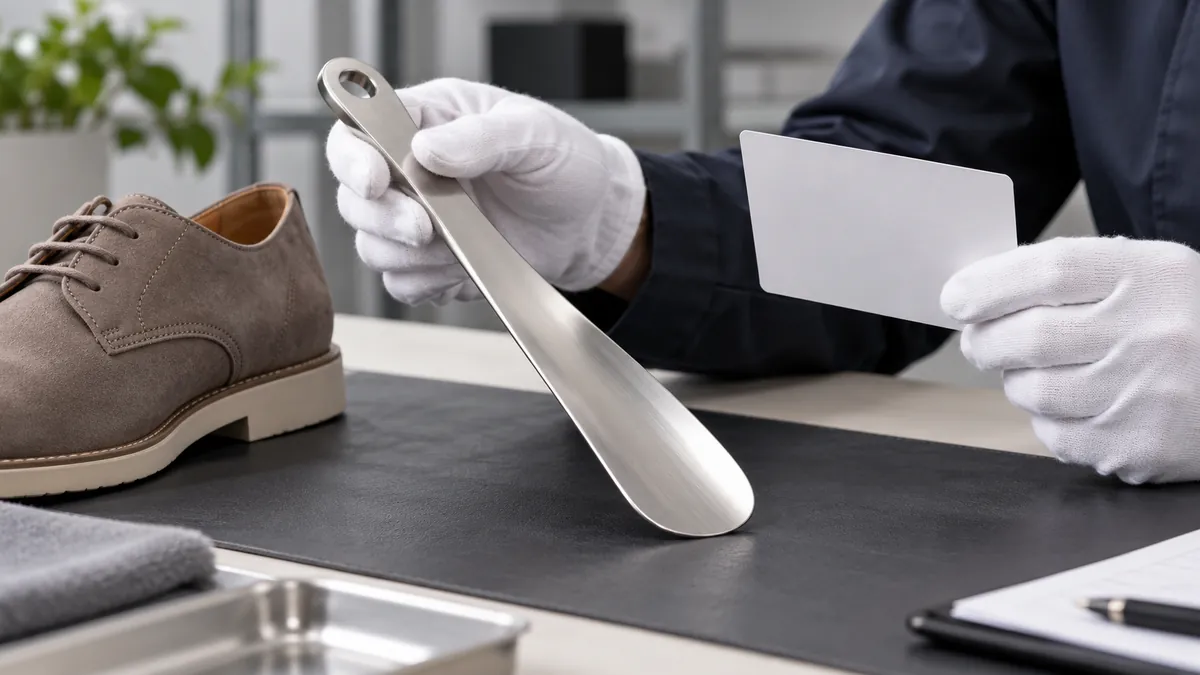
The image is illustrative. It does not show a validated force setup or a test result.
Inspect edges, joints, and finish as separate acceptance items
The perimeter of the formed blade is a direct product-contact feature. Inspect the whole edge under consistent light and identify the relevant surfaces and locations on the drawing or sample photos. Look for burrs, sharp transitions, rough or inconsistent finishing, coating chips, visible cracks, snags, or uneven edges. The acceptable condition should be agreed for the product and its intended market; avoid replacing that decision with vague language such as “smooth enough.”
Use a safe, controlled inspection method selected by the buyer and supplier. Do not run bare fingers along an edge, ask an untrained operator to touch a potentially sharp surface, or use clothing or skin as a makeshift test fixture. If the buyer specifies a probe, material coupon, or other method, document which one, how it is used, and the acceptance criteria. Never imply that one simple visual check proves the product is safe for every user or use condition.
Inspect transitions as well as the outer perimeter: the blade-to-handle shoulder, bends, folded returns, punched holes, hanging loops, welds, rivets, and grip attachments if present. These features can create local appearance or snag concerns. A smooth-looking broad face does not prove that a hole edge or the underside of a formed lip is finished to the same standard. Check the surfaces that can contact a shoe, sock, packaging, or another product during storage and use.
For coated products, review coverage at edges, holes, bends, and contact zones as well as color and gloss on broad faces. Note visible chips, pinholes, scratches, bare areas, uneven texture, or handling marks against approved samples or buyer-defined visual references. Appearance does not prove coating adhesion or corrosion performance. If a technical coating test is required, the buyer should specify the method, specimen, conditioning, and acceptance basis with qualified support. Do not import a generic test or threshold from another product without confirming that it applies.
For joined construction, record the joint type and visible condition, including distortion, gaps, excessive finishing marks, or damage to adjacent surfaces. If the design is one piece, focus on the formed regions and transitions. The applicable checks depend on the actual construction; a shoehorn does not automatically require a weld inspection simply because it is metal.
A useful adjacent example is the inspection of openings and cut edges on a punched metal pegboard panel. The specific geometry differs, but the buyer principle is similar: identify the exact edge or opening, inspect the finished feature, and agree the acceptance record for that product instead of relying on a generic “deburring completed” statement.
Check the shoe interface and intended assortment
A blade can look well formed and still be a poor fit for the shoes buyers intend to sell it with. The blade outline, width, curvature, leading edge, handle length, and angle affect how it meets the heel area. Buyers should select representative shoes from the target assortment, including meaningful variation in heel counter shape, opening, lining, and size range. The actual sample and shoe set should be identified in the review record.
This is a fit check, not a medical or ergonomic certification. Confirm that the product can be positioned and used as described in the intended product information without damaging representative shoes or catching on their surfaces. If the assortment includes unusual footwear, such as narrow openings or delicate linings, decide whether the product is suitable for that segment or whether the range needs a different design. Do not infer suitability for limited mobility, rehabilitation, or a therapeutic purpose from length alone.
Write down what the reviewer actually did and observed. For example, record the shoe model or type, the shoehorn orientation, whether the blade entered the opening as expected, whether the profile contacted the relevant heel area, and whether any snagging, slipping, or visible damage occurred. These observations should not be converted into a universal guarantee. If multiple reviewers or users are involved, describe their role and keep subjective comfort feedback distinct from dimensional or functional checks.
The shoehorn should also be assessed alongside its packaging. Check whether the finished edge, coating, handle, and hanging feature can be scratched, bent, or rubbed during normal pack-out and transit. Review separation from other metal parts, protective sleeves or wraps, inserts, carton arrangement, and the unboxing condition. The exact risk depends on the pack and transport route. Ask for a representative packed sample or documented pack review when appearance is commercially important; do not assume that a visually acceptable loose sample proves that the shipped product will arrive unchanged.
Importers already evaluating footwear storage products may find a separate guide to wet-shoe rack and drip-tray sample checks useful. It covers another product decision and does not replace a shoehorn’s own contact, edge, or deformation review.
Make sample approval reproducible through production
Build a compact approval record
A practical sample approval sheet can capture the following information without pretending that one method fits every design:
| Record field | What the buyer should capture |
|---|---|
| Product identity | SKU, drawing and revision, sample date or lot, supplier, and configuration |
| Geometry | Length, blade outline, width, formed profile, handle transition, hole or loop, and any grip |
| Material y acabado | Declared material, supporting identification records, finish/color reference, and surfaces covered |
| Deformation review | Agreed setup, support, application point/direction, measurement if used, observation, and sample condition |
| Edge and surface review | Inspected locations, lighting or method, burr/roughness/coating observations, and disposition |
| Shoe interface | Representative footwear, orientation, observed fit/contact, snag or damage observations, and limits |
| Embalaje | Pack configuration, protective separation, sample photos, and arrival condition if evaluated |
| Decision and changes | Accept/revise/reject decision, open items, owner, date, and changes requiring re-review |
The buyer and supplier should choose the appropriate fields for the product. If no numeric threshold is supported, use a clear descriptive criterion or request engineering input rather than inventing a number. Where measurement is appropriate, state the instrument or method and the drawing feature it applies to. Separate what was inspected from what the inspection can prove.
Tie the approved sample to the purchase order
Approval should identify which physical sample, drawing revision, finish reference, and packaging configuration govern the order. Keep representative photos and any review notes with the specification. A golden sample or pre-production sample can help align expectations, but it does not by itself guarantee that every production unit will match. The buyer still needs suitable incoming or in-process controls based on the product’s commercial risk.
Define how substitutions will be handled. A change to material source or designation, blade geometry, forming sequence, edge-finishing process, coating, grip attachment, supplier, or protective packaging may require a comparison sample or renewed review. The required response depends on the change and its effect. Agree who must notify whom, what evidence is needed, and who has authority to approve the change before shipment.
Avoid broad instructions such as “same as approved sample” when the sample has not been identified or the relevant features remain subjective. Instead, translate the buyer’s decision into observable requirements: which profile is accepted, which edges are critical, which surfaces must retain their finish, which shoe types were checked, and what record should accompany the first production lot. The more specific the critical feature, the easier it is to resolve a disagreement fairly.

Use a revision-identified sample and drawing; the illustration contains no measured result or acceptance claim.
Buyer checklist and common questions
Before placing the order, confirm that the team has:
- Identified the sample, SKU, drawing revision, material declaration, finish, and packaging.
- Reviewed the whole blade profile, handle transition, edges, holes, joints, and contact surfaces.
- Agreed how any deformation comparison will be conducted and recorded.
- Distinguished elastic movement, permanent change, fracture, and finish damage as separate observations.
- Checked the actual product with representative shoes from the intended assortment.
- Avoided claiming ergonomic, medical, lifetime, or universal performance from a limited sample review.
- Defined the finished-edge and appearance criteria without relying on unsafe touch checks.
- Linked approval to the production specification, change notification, and follow-up inspection plan.
- Kept a record of deviations, repair or adjustment, reviewer, and disposition.
- Reviewed the representative packed product if transit damage or retail presentation matters.
Consistent metal shoehorn quality control depends on connecting each observation to an identified sample, drawing revision, and agreed acceptance record.
Does metal mean a shoehorn cannot bend?
No. “Metal” is not enough information to predict the behavior of a particular design. Length, section, formed profile, material, support, contact location, and direction all matter. Review the actual configuration and use conditions. Do not promise that a metal product is immune to permanent deformation or breakage.
Can the buyer specify one thickness for every metal shoehorn?
Not responsibly without the design, material, geometry, process, and intended use. A dimension may be a useful control when tied to a specific drawing feature, but it is not a universal quality score. Agree the relevant geometry and performance evidence with the product designer and supplier.
Does a polished surface prove that the edge is acceptable?
No. A broad face can look smooth while a hole, underside, bend, or blade perimeter has a different condition. Inspect the identified contact edges and transitions using a safe, agreed method, and record findings separately from face appearance.
Does an approved sample prove long-term durability?
No. Sample approval establishes that the identified sample met the agreed review at that time. It does not prove service life, all-lot consistency, or suitability for every user. Production controls and any formal testing must be defined separately for the product and claim.
Koitor capability and sourcing scope
Koitor’s documented expertise supports discussion of metal forming, finishing, assembly, and drawing or sample development for bathroom and home-storage hardware. That transferable manufacturing knowledge can help a buyer frame questions about geometry, finish, and approval records. It does not establish that Koitor currently manufactures metal shoehorns, owns specialized shoehorn tooling, provides ergonomic certification, or operates a shoehorn durability test service. Those capabilities must be confirmed with the responsible supplier and product team.
For supported metal home-storage requirements, buyers can review Koitor’s OEM home-storage hardware manufacturing profile. For any adjacent product, provide the actual drawing or sample, material and finish expectations, target quantity, inspection questions, and packaging context so the responsible team can assess scope. You can Ponte en contacto con Koitor for a feasibility discussion about work within its confirmed product scope.
Sources and evidence limits
- IKEA OMTÄNKSAM shoehorn product page: Product details and customer reviews are specific to that listed model; reviews are not a controlled test or prevalence study.
- Zhongshan Biaoqi stainless steel metal shoehorn page: Manufacturer product description, not independent verification; unsupported performance statements are not adopted.
- Merhein shoehorn sourcing page: Existing B2B coverage was reviewed for topic overlap. Its generic dimensions, material recommendations, pressure language, and sourcing claims are not treated as standards or Koitor facts.
This guide proposes a conditional buyer-supplier review framework. It does not set a universal force, thickness, edge, coating, service-life, accessibility, or medical threshold. Define and validate any formal product requirement with qualified personnel for the actual design and intended market.
Discuss a Metal Hardware Project Within Koitor’s Confirmed Scope
Koitor works with buyers on custom metal bathroom and home-storage hardware from drawings or physical samples. Share the approved revision, metal-part requirements, finish, target quantity, and packaging concept for a feasibility discussion. Current shoehorn production, shoehorn tooling, ergonomic assessment, and shoehorn durability testing are not confirmed capabilities; those requirements must be qualified with the responsible product supplier and specialist.
OEM / MARCA BLANCA
Convierte esta guía de abastecimiento en un resumen del producto
Indícanos el producto que deseas, el tamaño, el acabado, la cantidad del pedido y los requisitos de embalaje. Tu equipo recibirá un análisis práctico de la viabilidad de fabricación antes de recibir el presupuesto.

 English
 Español
 Português
 Français
 Deutsch
 العربية