

Nesting side tables should be specified by the individual tables and by each arrangement the maker documents for that exact set. For assortment teams comparing nesting side tables, the model code and revision should stay beside every approved arrangement. Record separate use, any partly nested arrangement, the fully stowed arrangement, and the dimensions or drawing that apply to each one. Keep those use configurations distinct from the way the set is packed for shipment. The name “nesting” and a lifestyle photograph do not establish that every orientation, combination, or dimension is approved.
For an importer, the useful deliverable is a configuration schedule tied to a set code, revision, sample, and supplier evidence. It lets product, sourcing, and catalog teams use the same description when comparing quotations and approving product information. It also makes unknown arrangements visible instead of silently treating an attractive photograph as a specification.
What does a nesting-table configuration mean to an assortment buyer?
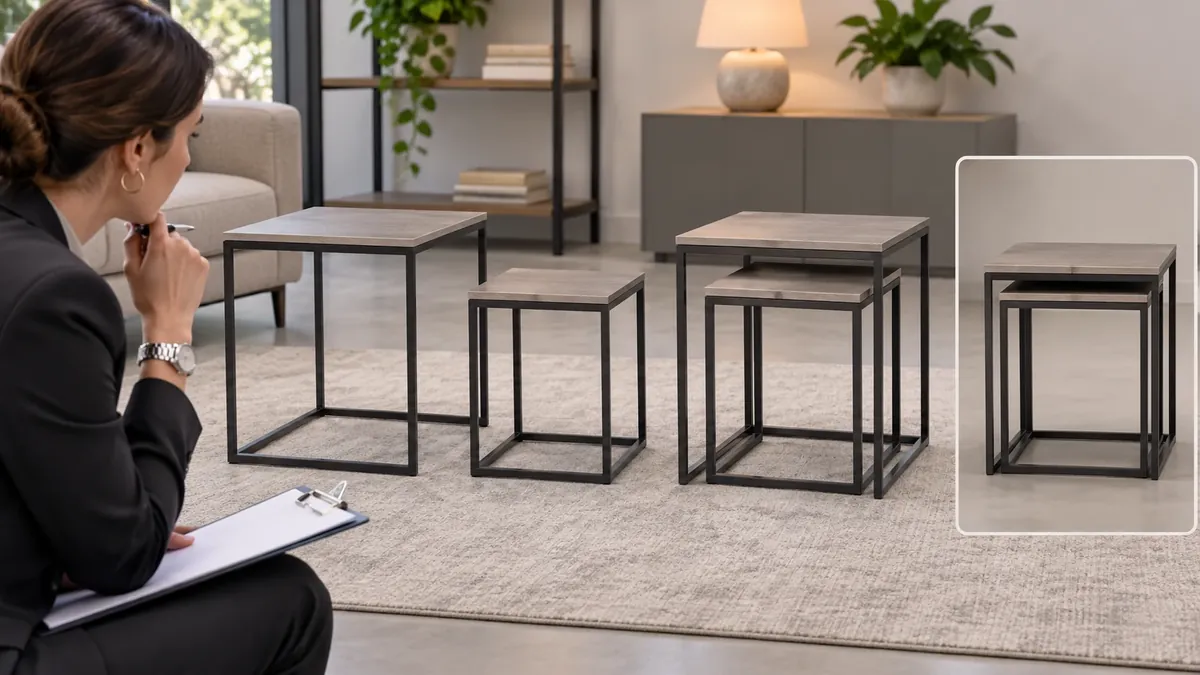
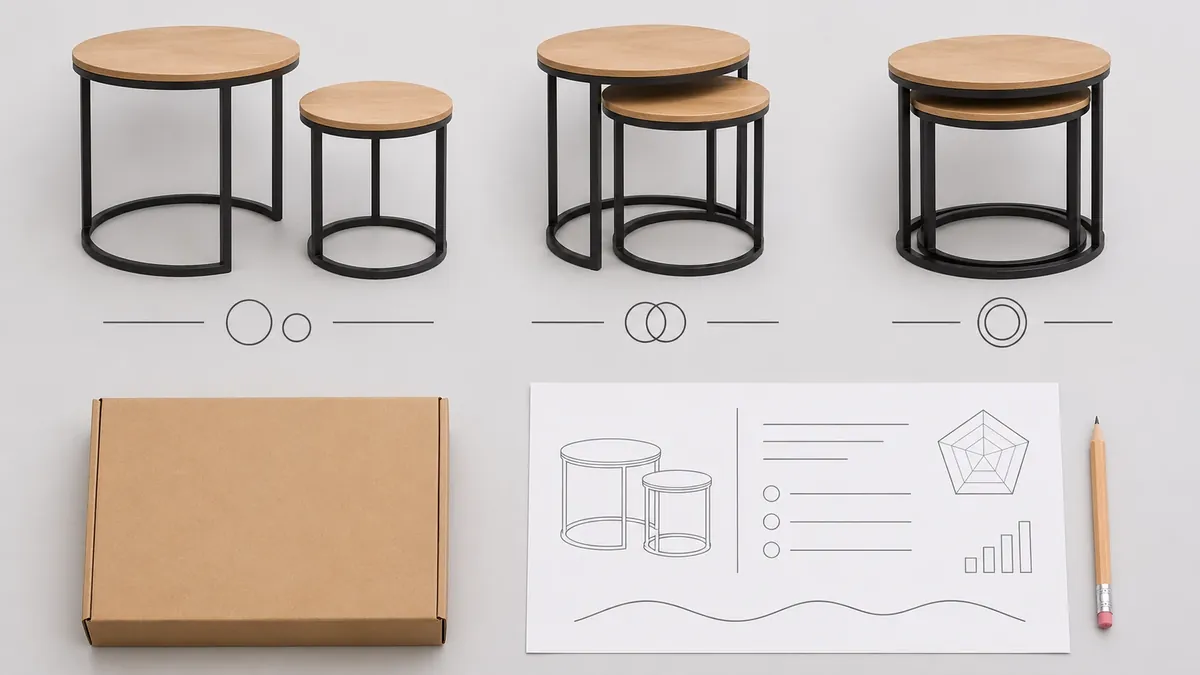
A configuration is a defined relationship between the individual tables at a particular point of use. A set may be used with the units apart, with one partly under or alongside another, or with the smaller unit pushed farther in for storage. Which of those arrangements applies depends on the exact product family and the maker’s documentation. Do not assume that every product sold as a nesting set supports all three.
The distinction is practical in assortment development. One supplier’s listing may describe how a set can be used, while another provides only the dimensions of each individual table. Both records may be accurate yet still describe different information. The buyer needs to know which arrangement the quoted dimensions represent and which arrangements the seller actually offers. When comparing nesting side tables from two sources, compare the same documented use state before treating their dimensions as equivalent.
The word “nesting” can also describe how articles fit together for transport or storage. In this guide, “use configuration” means a permitted arrangement during normal product use or home storage. “Transport packout” means the way the goods are prepared in their shipping package. The two may differ. A set that can be pushed together in a room might ship disassembled, with parts separated by protective material, or in another approved arrangement. The product name alone does not settle that question.
IKEA’s product descriptions illustrate why configurations should be tied to an identified set. Its SONHULT page describes the named pair as usable separately, partly together, or pushed together, and describes switching which legs go on which top for that particular model. Its LACK page describes separate use and placing the smaller table under the larger one for that different set. Those maker descriptions support recording model-specific arrangements; they do not establish that unrelated table sets share the same geometry, interchangeable components, or performance.
Treat each source statement as scoped to its model and revision. A product-family description can help buyers understand what the maker claims, but a buyer still needs the current quote, drawing, sample, and approved product data for the item being sourced. If the source does not state a combined dimension, do not estimate one from a styled room photograph. If it does not state that parts are interchangeable, do not infer that from a shared product-family label.
Which use arrangements should the buyer record?
Start with the exact set identity, then list only arrangements the responsible supplier documents or the buyer’s technical reviewer approves. A simple schedule can distinguish a supported configuration from a question that remains open.
| Configuration record | What the buyer identifies | Documentación que hay que solicitar | Status to record |
|---|---|---|---|
| Individual units | Each table’s code, revision, and stated dimensions | Current product drawing, specification, or controlled sample | Confirmed / unresolved |
| Separate use | Which unit is placed independently and whether the set is sold as a coordinated pair | Maker’s model description or approved product data | Offered / not offered / unresolved |
| Partly nested use | The named orientation and which parts overlap | Model-specific drawing, instruction, or signed sample record | Confirmed / not confirmed |
| Stowed use | The exact arrangement the maker calls nested or pushed together | Model-specific description and any stated envelope | Confirmed / not confirmed |
| Transport packout | The shipping configuration, disassembly state, and included parts | Quotation, packing specification, or approved pack sample | Separately confirmed / unresolved |
The schedule should use the maker’s exact terms alongside plain-language descriptions. If a source calls an arrangement “partly together,” preserve that wording and describe the associated model. Do not silently replace it with “fully nested,” because the more familiar phrase may imply a different relationship. When the source says “smaller under larger,” keep the stated direction attached to that specific model.
The following sample form can be adapted for an RFQ or product-data review. Its fields are a proposed buyer aid, not a Koitor procedure or an industry standard.
| Campo | Buyer entry |
|---|---|
| Set code and revision | Supplier model, drawing revision, and sample label |
| Component identities | Larger unit, smaller unit, tops, frames, and supplied accessories as identified by the supplier |
| Arrangement name | Supplier’s exact term plus the buyer’s controlled plain-language description |
| Referenced evidence | Drawing number, dated product document, sample approval, or written supplier response |
| Stated envelope | Dimensions for that arrangement only, copied from current source evidence |
| Included components | Parts included in the quoted sale unit, with any separately sold items identified |
| Transport packout | Carton configuration and disassembly state, confirmed separately from use arrangements |
| Verification status | Confirmed, not offered, or unresolved; include reviewer and date |
| Open question owner | Supplier, product engineering, packaging, or buyer representative responsible for resolution |
Do not fill a blank dimension by measuring a marketing image. Perspective, camera position, styling, and hidden component relationships can make a photograph misleading as a measuring source. If the combined envelope matters to a catalog, shelf, merchandising plan, or customer promise, ask the supplier for the value and its reference arrangement. Keep a dimension labeled “unknown” until a controlled source supplies it.
How should buyers compare the separate and nested arrangements?
Compare like with like. An individual-table dimension should not be compared with the combined footprint of two tables. A fully stowed footprint should not be assumed to describe the partially overlapping arrangement shown in a product page. The buyer should identify the measurement subject, the arrangement, and the source before using a number in a quotation comparison or listing.
For each dimension, record whether it refers to one unit, the entire set in a named arrangement, or the packaged goods. Preserve the maker’s units and any orientation labels. If a supplier provides a top width for one table and another provides an overall set envelope, the values are not directly comparable until both suppliers identify the same measurement subject.
Here is a hypothetical comparison. Supplier A documents separate placement and a specific partly nested arrangement, with an overall envelope for each. Supplier B lists each table’s individual dimensions and says only that the smaller unit can be stored under the larger one. A buyer should not conclude that the configurations are equivalent based on the product name. The buyer should request the missing arrangement reference and comparable dimensions, then record whether the answer resolves the product-data need. This example is not a report about any actual supplier.
If a set has several possible placements, do not assume that all are approved or practical. The product team can choose which arrangement matters for its target assortment and ask the maker to confirm that exact state. Other orientations can remain outside the approved product description. A schedule helps prevent a creative merchandising image from becoming an unsupported compatibility statement.
Dimensions also need revision control. If a supplier changes a top, frame, leg, or assembly detail, an earlier arrangement drawing may no longer describe the revised set. The buyer should identify which document and sample version informed approval. When the product code changes, ask whether the published arrangement and its dimensions still apply instead of carrying forward an old product-data field by habit.
Do not infer functional performance from a configuration record. A dimensioned drawing can identify a relationship and an envelope, but it does not by itself establish load capacity, stability, tip resistance, surface durability, or user safety. Those matters require relevant product-specific evidence and review. The buyer can keep the configuration approval and the performance validation in separate records so that neither is mistaken for the other.
The reviewer should state what “approved” means in the sample note. Approval may mean that the product team accepts the wording and drawing reference for one named arrangement. It does not automatically approve a new market claim, a different surface finish, a revised frame, or a packaging configuration that was not included in the sample review. Recording this scope makes later handoffs clearer when product information is reused by sales, merchandising, and logistics teams.
Why must use configuration stay separate from shipping packout?
The arrangement that saves room during use or storage does not automatically define how the product should be shipped. The set may require assembly, separation, protection between surfaces, or other packaging decisions. Those depend on the actual construction and packing plan. A buyer should request a distinct packout description rather than treating the stowed arrangement as a freight specification.
Keep four subjects separate in the product file:
- Use configuration: the supported relationship between the units during ordinary use.
- Stowed configuration: the arrangement the maker documents when the set is put away.
- Packout configuration: how the parts are prepared inside the shipment package.
- Carton data: the verified outer package dimensions, weight basis, and packing revision supplied for logistics or product data.
These records answer different questions. A compact stowed arrangement does not prove a compact carton. A carton arrangement does not prove that a product can be used in the same relationship. A packing diagram may show parts nested for protection or space, but it should not be treated as a user instruction unless the maker approves it for that purpose.
For a related but different decision, Koitor’s slide-under metal side-table clearance guide addresses one table’s base entry, top clearance, and reach around a sofa or bed. That is a different decision from how two units in a set are positioned relative to one another. The shared category does not make the buyer questions interchangeable; use each guide only for its stated scope.
Do not transfer the single-table clearance criteria to a set’s combined footprint. If an assortment contains both product types, preserve separate product records and request the evidence that applies to each exact model. This prevents a shared “side table” category from collapsing distinct dimensions and decisions into one generic specification.
Ask the packaging supplier or responsible product supplier to state which pack revision applies to the quotation. If the packout includes the tables disassembled, specify the included components and identify where assembly information is controlled. Do not claim freight savings, damage prevention, scratch resistance, or reduced carton volume unless current product-specific packing evidence supports the statement.
What sourcing errors can a configuration schedule prevent?
A schedule cannot guarantee a successful product or replace engineering review, but it can expose incomplete assumptions before the buyer approves a sample or publishes a product description. The most common avoidable errors are record errors: mixing arrangement dimensions, treating a photograph as a specification, or carrying a configuration statement across models without evidence.
Comparing different measurement subjects. One offer may state the width of a single top; another may provide a combined footprint. Put the unit and configuration beside every number. If the supplier did not state the measurement subject, request clarification before ranking offers.
Assuming the category name defines all possible arrangements. “Nesting table” can describe a class of products rather than a universal interface. Ask which particular arrangements apply to the model code and retain the maker’s response.
Treating a lifestyle image as technical proof. A styled image may show one arrangement, but it may not identify the product revision, exact component relationship, or measurement basis. Use the image to formulate a question, then resolve it with controlled documentation or sample approval.
Using a stowed arrangement as the shipping plan. The two records serve different purposes. Confirm packout and carton information separately with the responsible supplier.
Assuming separate table sets can be mixed. Similar finishes, product names, or dimensions do not establish that units from unrelated sets can be combined. Do not tell a customer that a separately sourced table will nest with the approved product unless the responsible maker confirms that pairing.
Copying details between models. A product page for one family can explain the kind of information a buyer should seek, but it cannot prove the arrangement, materials, dimensions, or interchangeable components of another family. Keep examples attributed and model-specific.
Publishing unconfirmed product claims. Product copy should say only what the current maker evidence supports. If a particular configuration has not been confirmed, omit it or label it accurately as subject to confirmation. Do not promise stability, capacity, scratch performance, safety, or universal fit on the basis of a configuration description.
What should an importer ask before quotation and sample approval?
The buyer should provide a precise product reference and ask questions that the responsible supplier can answer. A useful request does not need to become a long questionnaire. It needs enough information to connect the proposed arrangements to the actual set, drawing, sample, and quote.
Before quotation, provide the set concept or current product reference, target market, proposed assortment, desired finish, required product-data fields, quantity range, and any relevant drawing or controlled sample. Identify whether the buyer needs separate use, a partly nested arrangement, a stowed state, or more than one. The buyer should not ask a supplier to infer the intended configuration from an unannotated room photograph.
Ask the supplier to confirm:
- Which exact models and revisions are included in the proposed set?
- Which use arrangements are documented for those models?
- Which dimensions apply to each named arrangement?
- What components and accessories are included in the quoted sale unit?
- Which arrangements, if any, are not offered or remain unconfirmed?
- What current drawing, product document, or sample record supports each answer?
- What is the separately approved transport packout and carton revision?
- Which product or revision changes require renewed buyer approval?
At sample review, label each unit and retain its relationship to the supplier’s model code. Record whether the review answered only an arrangement question or also assessed a separate requirement. A sample review might confirm that two identified units can be placed in a supplier-documented arrangement. It does not establish that other tables fit, that the set meets an unspecified load, or that performance remains unchanged over time.
When a field remains unanswered, give it an owner and a next step. The state can be “awaiting supplier drawing,” “not part of this assortment,” or “requires product-engineering decision.” A clear hold is more reliable than a blank cell that may later be interpreted as approval. After a decision, update the relevant document and retain the date and revision.
How can Koitor support a related metal-frame project?
Koitor Hardware is a family-owned factory and specialized OEM manufacturer for bathroom and home-storage metal hardware. The company’s approved positioning supports project discussions involving confirmed metal components, drawings or physical samples, finish requirements, assembly, packaging, and quantity. It does not establish that Koitor manufactures nesting tables, furniture tops, complete furniture sets, or the specific systems shown in third-party examples.
For a project that includes an in-scope metal storage component, a buyer can share the lawful drawing or sample, identify the intended interface, describe the finish and packaging requirements, and state the expected quantity. Koitor can first confirm whether the requested product falls within the verified project scope. The OEM home-storage hardware overview provides broader context; it is not a catalog of every adjacent metal product.
Any furniture structural, mixed-material, load, tip, stability, safety, or regulatory decision should remain with the qualified party responsible for the exact product and target market. A metal manufacturing discussion cannot replace a complete product-system review. Do not infer a capability from a third-party table that happens to use a metal frame.
Buyer checklist before approving nesting side-table product data
- The set code, revision, and included units are identified.
- The maker’s exact names for the supported arrangements are preserved.
- Each stated dimension is tied to one named unit or configuration.
- No missing measurement was estimated from a photograph.
- The partly nested and stowed arrangements are confirmed separately where relevant.
- The product description does not imply that unrelated sets are interchangeable.
- The shipping packout is recorded separately from normal use or stowage.
- The packing revision and included components match the quotation.
- Sample approval records the specific question answered and the product revision reviewed.
- Load, stability, finish, scratch, safety, and durability claims have their own relevant evidence.
- Open decisions have a named owner and are not presented as confirmed facts.
- Changes to the model, drawing, supplier, or included components trigger a scoped review.
Preguntas frecuentes
Does “nesting” mean the smaller table is completely hidden?
Not necessarily. The term does not define a universal geometry. Use the named maker’s description and current model evidence to identify the actual arrangement. Do not infer full concealment or a particular overlap from a category label.
Do individual table dimensions tell me the combined footprint?
No. Individual dimensions describe individual units unless the supplier explicitly states that a value applies to a combined arrangement. Request the overall envelope for the specific arrangement if the value is needed for product data or assortment planning.
Can tables from different sets be combined?
Do not assume so. Similar appearance or a shared category term does not prove compatibility. Ask the responsible supplier to confirm the exact model pairing and preserve the evidence with the product record.
Is the stowed arrangement the same as the shipping packout?
Not automatically. The product may ship disassembled, protected, or arranged differently. Confirm packout and carton information as a separate part of the quotation or packaging specification.
Does a documented arrangement prove load or stability performance?
No. A configuration description identifies a use relationship. It does not establish a load rating, stability, tip resistance, scratch performance, or safety. Those claims require separate evidence relevant to the exact product and test conditions.
Discuss a Confirmed Metal Home-Storage Project
If your project includes an in-scope metal bathroom or home-storage component, send Koitor the relevant drawing or physical sample, finish requirement, packaging scope, target market, and expected quantity. Koitor can first confirm the project’s manufacturing scope and discuss the next step. Furniture-set capability and product-system performance must be confirmed for the specific project.
OEM / MARCA BLANCA
Convierte esta guía de abastecimiento en un resumen del producto
Indícanos el producto que deseas, el tamaño, el acabado, la cantidad del pedido y los requisitos de embalaje. Tu equipo recibirá un análisis práctico de la viabilidad de fabricación antes de recibir el presupuesto.
 English
 Español
 Português
 Français
 Deutsch
 العربية