
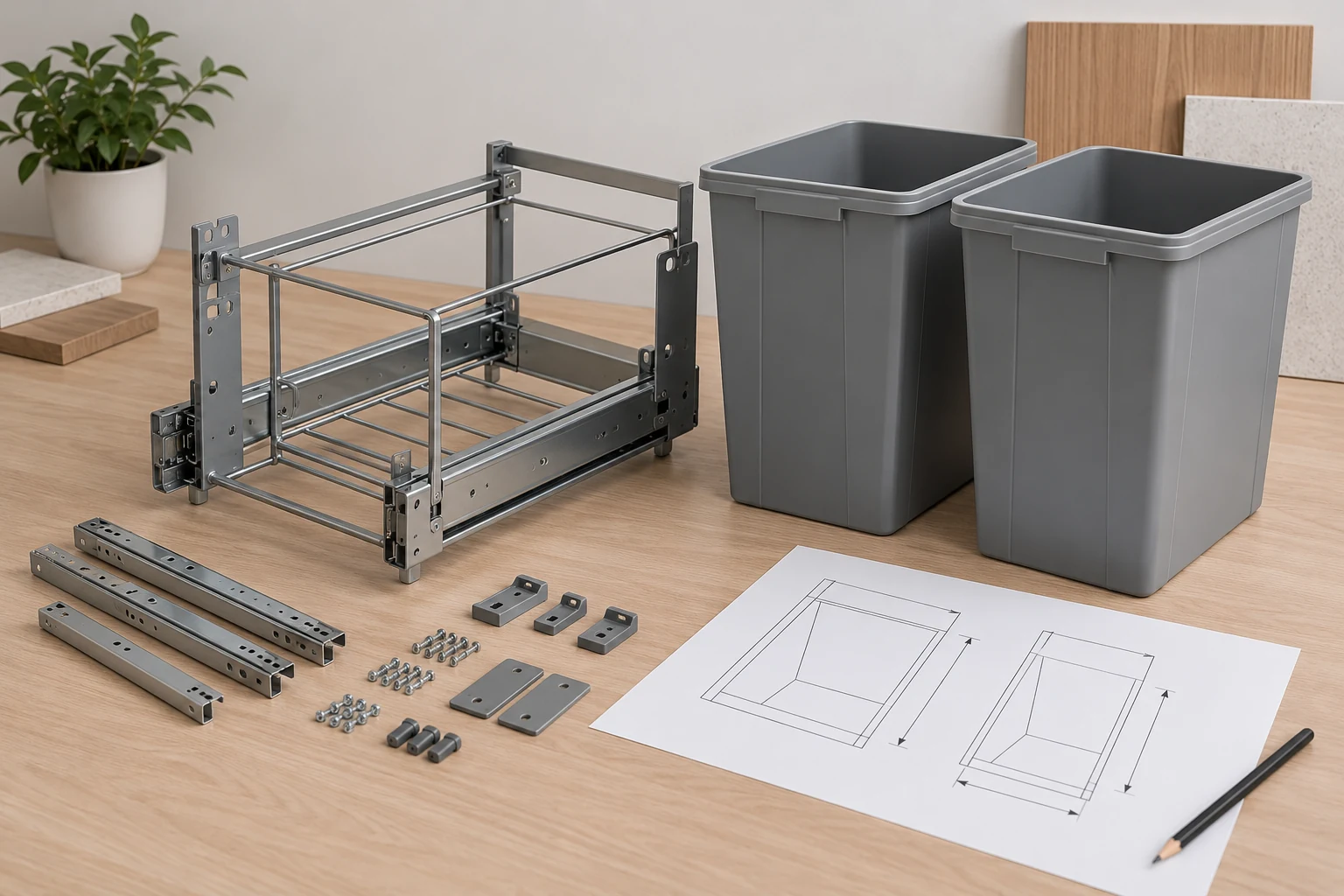
Para un pull out recycling bin cabinet program, importers should map each cabinet variant to the exact frame, bin set, included components and sample revision before approving a SKU. A cabinet’s nominal outside width does not identify the usable opening or the supplier’s frame interface. Ask suppliers to state which measurement points define compatibility, then check the actual bin/frame configuration against a buyer-provided cabinet reference and the planned assortment.
Why is nominal cabinet width not enough to define a SKU?
Kitchen-storage systems use several dimensions that can be confused in a short product listing: cabinet module width, internal cabinet width, clear opening, frame envelope, bin outer dimensions and the space required by the moving assembly. Those values answer different questions. A module label is not automatically the same as the opening available to a frame, and the frame width is not the same as the outer width of each bin.
A product family may also offer multiple mounting architectures. A frame can attach to the cabinet bottom, side, door or another supplier-defined interface; some products use a separate runner, while another system may integrate components differently. Bin count, shape, handles, rims, lids and dividers can change the configuration. The importer needs the supplier’s drawing for each SKU rather than an assumption that similarly named systems share a measurement rule.
Official product documentation illustrates this variation. Emuca publishes different cabinet requirements for different recycling-bin products and configurations, while Hettich’s product documentation identifies frames, bins and runners as model-specific parts. These pages are not a universal cabinet standard. They show why a buyer should request the exact measurement points and component combination for the selected SKU. Compare Emuca’s product specifications y Hettich’s waste-collecting systems brochure as model-specific examples only.
The objective is not to find a single number that works for every cabinet. It is to make the supplier and buyer use the same measurement definitions for each configuration in the assortment. An importer planning a pull out recycling bin cabinet range should treat each cabinet/frame/bin combination as a separately identified configuration until the matrix shows which parts can be shared.
How should an importer build a cabinet-width, frame and bin matrix?
Start with the importer’s target cabinet family and the supplier’s offered system variants. For each planned SKU, create one line that connects the cabinet reference, frame, runner or mounting parts, bin count, bin models and pack contents. The matrix should distinguish the buyer’s cabinet module designation from the supplier’s minimum internal or clear-opening dimensions. If the cabinet manufacturer uses a named family or drawing revision, record it alongside the measurement rather than relying on the family name alone.
For every row, ask the supplier to mark which dimensions control selection and how those dimensions are measured. The table can capture cabinet module, minimum clear width, available internal depth and height, frame outer envelope, bin outer dimensions, number of bins, and the moving parts or interface that require clearance. These fields are not interchangeable; leave a field marked “supplier to confirm” until a drawing provides it. Do not infer a cabinet measurement from a photograph or copy a different model’s minimum opening.
A useful matrix also separates commercial SKU differences from engineering differences. Two variants may use the same frame but different bin sets; another may change the frame or runner to suit a different cabinet family. That difference affects quotation, purchase-order coding, replacement parts and reorder control. Ask suppliers to assign a unique model or option code to each actual configuration and state whether the bins are sold together with the frame or supplied as separate components.
| Variant field | Buyer record | Supplier evidence to request |
|---|---|---|
| Cabinet reference | Cabinet family, module designation and drawing revision | Measurement points and model-specific minimum opening |
| Frame and interface | Frame model, mounting architecture and revision | Dimensioned frame drawing and identified runner or attachment parts |
| Bin set | Count, model, outer dimensions, rim and handle features | Bin identifiers and fit relationship to the named frame |
| Included parts | Bins, frame, runner, lid, door bracket, fasteners, divider and options | Bill of materials marking included, optional and separately ordered items |
| Sample and pack | Sample ID, pack version, labels and carton contents | Sample configuration and production-intent pack list |
This matrix is a purchasing control, not a universal cabinet chart. The buyer should preserve unconfirmed fields and resolve them before quotation comparison or sample release.
Which measurements and component details belong in the RFQ?
Send a cabinet reference drawing or provide measurements taken at clearly named points. The request should distinguish the outer module designation from the internal opening available to the system. Where relevant to the selected design, include clear width, internal depth and height, obstructions, door or side interfaces, and the space available through the assembly’s movement. The supplier should identify which dimensions are required for the specific frame and what reference surfaces were used.
Describe the bins by their actual product identifiers and geometry. Record quantity, outer width and depth, height, rim or lid arrangement, handles, divider position and intended liner fit only where those details affect the chosen SKU. Capacity labels alone do not establish physical fit. If the assortment allows the buyer to select alternate containers, ask for the allowed frame/bin combinations and identify each combination as its own option or SKU. Do not treat a similar-looking bin as interchangeable until the frame interface, removal path and pack details are confirmed.
The RFQ should say whether the system is manual or door-linked, bottom-mounted or side-mounted, or uses another defined supplier architecture. This is an identification of the product configuration, not a recommendation about cabinet installation. List the exact parts included in the quoted package and any components the cabinet maker or importer supplies separately. For a frame system, the runner, brackets, stops, screws, bins, lids and accessories should not be assumed included merely because they appear in a catalogue image.
Ask for a dimensioned drawing, a current bill of materials and a clear product data sheet that reference the same model code and revision. If the supplier’s quotation, drawing and sample identify different variants, pause approval until the mismatch is reconciled. This is especially important when several frame widths, bin counts or mounting versions share similar product names.
How should buyers approve frame and bin fit on a sample?
Review the complete configuration that the buyer intends to order. Match the sample frame to the approved model code, bin identifiers, component list and drawing revision. Check whether each bin sits in the intended frame position, whether handles and rims interfere with adjacent parts, and whether the agreed bins can be removed along the supplier-defined path. Record any mismatch against the drawing instead of treating a sample that “looks close” as evidence for every variant.
Use a representative cabinet opening, a dimensioned mock-up or an agreed fixture as the buyer’s reference. The buyer and supplier should record what the fixture represents and which dimensions were checked. The goal is to confirm that the quoted system and reference dimensions correspond; this does not provide household installation steps or establish compatibility with all cabinetry. If a cabinet drawing changes, determine whether the frame or bin variant needs to be reviewed again.
A sample note should identify the SKU, sample date, supplier, frame and bin models, drawing revision, cabinet reference, fit observations, open corrections and approval decision. Keep photos of the sample with labels or a measurement sheet where useful. If the sample is revised, replace or annotate the record so later reviewers can distinguish an approved configuration from an earlier prototype.
Lid height, lid travel and bin-removal clearance are related but separate interface questions. Koitor’s existing pull-out waste-bin lid clearance guide covers those details. This K1097 guide focuses on matching cabinet variants to the frame and bin set; it does not provide a second lid-design or lid-clearance treatment.
How should the buyer control BOM, packaging and reorders?
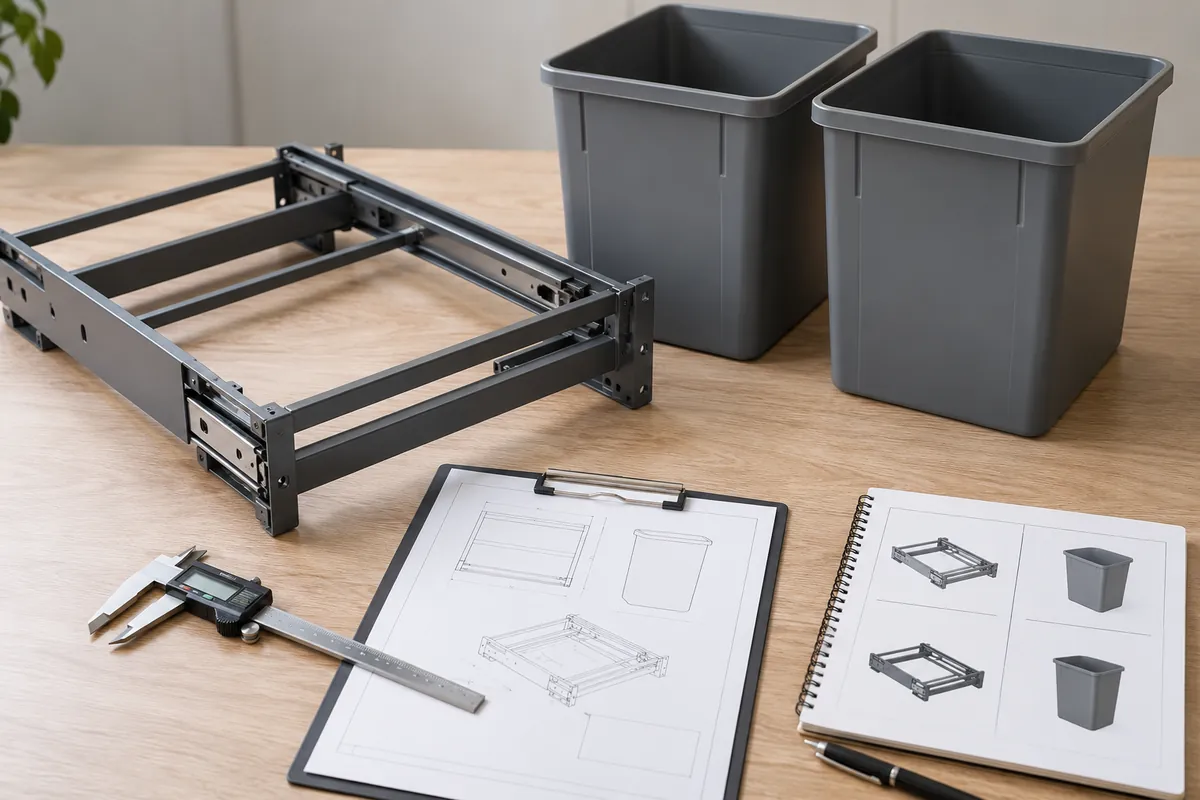
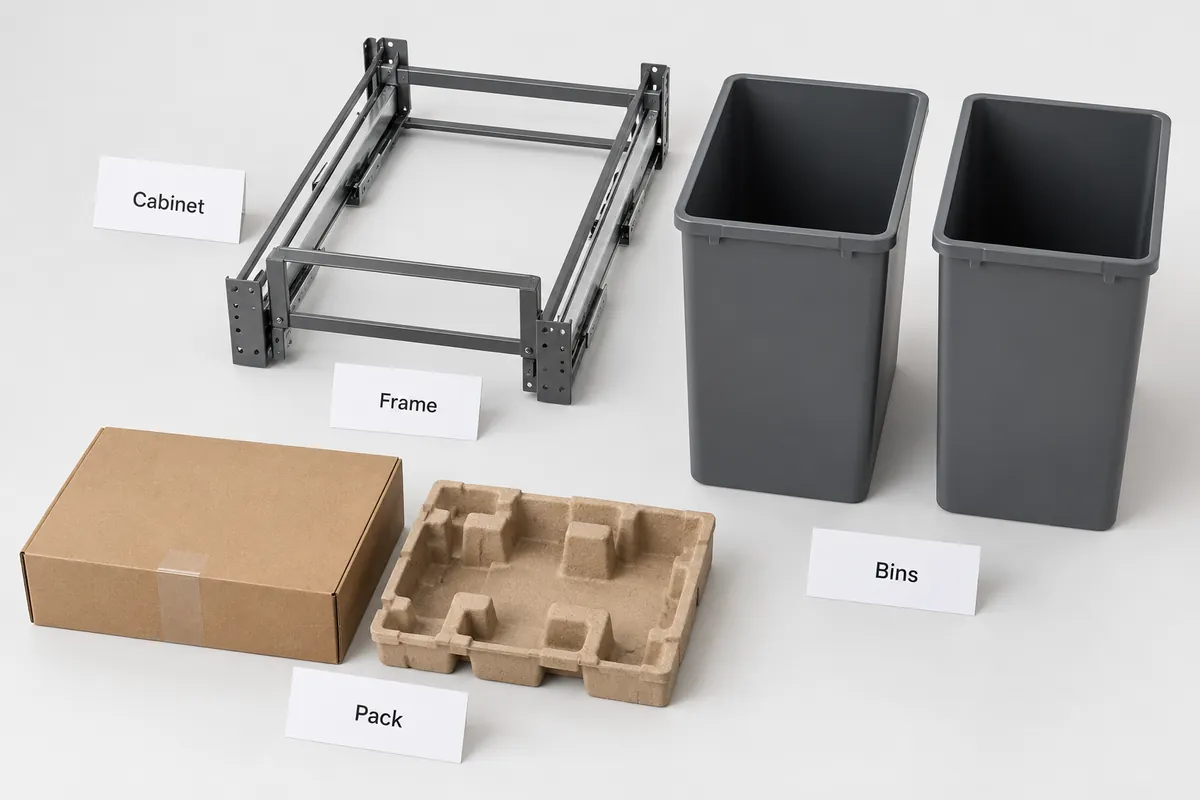
A complete system may include components from different sources or product families. Make responsibility visible in the bill of materials: identify the frame, runner, bins, lids, door or cabinet brackets, fasteners, dividers and packaging inserts. Mark which supplier provides each item, which items are optional, and which parts may be ordered as replacements. If one supplier supplies a frame while another supplies bins or a cabinet interface, agree who confirms the compatibility evidence and who updates the drawing when a component changes.
The retail package should name the correct bin count and model combination. Ask the supplier to confirm how loose parts are identified and protected, whether the cartons differ among variants, and how the product code appears on each carton or label. This helps warehouse teams distinguish a one-bin version from a two-bin version and reduces the chance of a replacement component being ordered against the wrong frame. Packaging layout and labels should match the approved product configuration; a product photo alone cannot establish what is in the box.
Before a reorder, compare the proposed production version with the approved sample and records. For a pull out recycling bin cabinet SKU, check the frame and bin codes together so a replacement bin or supplier substitution does not silently change the approved pairing. A change in frame dimensions, runner, bin geometry, material, supplier, label or carton may affect the matrix and the compatibility wording. Ask for a change notice and decide whether the buyer needs an updated drawing, a new sample, or additional evidence. A controlled change record helps preserve the original approval basis and makes later substitutions easier to review.
Common purchasing mistakes include:
- Using a nominal cabinet width as the only fit field.
- Mixing frame width, internal opening and bin size in one unlabeled dimension.
- Comparing quotations that include different bins, runners, lids or mounting parts.
- Assuming a published dimension for one product applies to another supplier’s model.
- Approving a frame sample without the intended bin set or cabinet reference.
- Using capacity as a substitute for outer dimensions and interface checks.
- Leaving separate-order components and replacement-bin options undefined.
- Updating the product, label or carton without revising the approved SKU record.
The importer’s pre-approval checklist should therefore include:
- Cabinet family, module designation and measurement reference.
- Supplier-defined clear-opening requirements for each selected model.
- Frame, runner or attachment architecture and model revision.
- Bin count, bin model, outer envelope and exact frame/bin pairing.
- Included, optional and separately purchased components.
- Sample ID, cabinet reference, fit notes and approval status.
- Retail pack contents, SKU labels and carton version.
- A documented process for design, supplier and reorder changes.
What can a specialized OEM factory contribute to this project?
Koitor Hardware is a family-owned factory and specialized OEM manufacturer focused on bathroom and home-storage hardware. Its approved profile supports general sourcing discussion about metal-product drawings, samples, assembly interfaces and packaging. It does not confirm current manufacture of complete recycling-bin systems, molded bins, drawer runners, odor-control products or cabinet-specific assemblies.
For a product that falls within a factory’s confirmed metalworking scope, a drawing or physical sample can help clarify dimensions, joints, finish, component interfaces and pack-out. A small-scale production factory may be a useful discussion partner for a product trial or an OEM development brief when the design and quantity fit its verified capabilities. The actual frame, slide, cabinet interface and polymer components still need to be assigned to responsible suppliers and confirmed for the project. The buyer should not infer that one general metal hardware capability covers every part of a pull-out system.
For current Koitor capabilities, begin with the company’s custom metal storage rack information. To discuss a new project, share the cabinet reference, frame and bin requirements, target quantity, drawings and packaging needs through the contact page. Any proposed system should be reviewed against verified production scope before the buyer presents Koitor as its source.
Preguntas frecuentes
Does nominal cabinet width identify a compatible recycling-bin frame?
Not by itself. The supplier should define the minimum opening or other cabinet dimensions for the exact model, identify the reference points, and provide a drawing for the selected frame and bin set.
Should the bin and frame be approved as separate samples?
They can be identified separately for inspection, but the buyer should also confirm the exact pair as a complete configuration. Record their model codes and revisions together so future orders preserve the approved combination.
Can a buyer mix bins from different suppliers?
Only after the intended frame/bin interface, dimensions, removal path and responsibility for compatibility have been documented and checked for that exact combination. A matching capacity label or similar product image does not prove interchangeability.
Does this guide establish a standard cabinet width or recycling rule?
No. Product dimensions vary by model, and recycling rules vary by market and local program. This article covers sourcing and product configuration; buyers should confirm any local sorting or compliance requirements from the relevant authority.
Does Koitor currently supply complete pull-out recycling systems?
The approved company information does not establish current production of complete waste-bin systems, plastic bins or runners. A new request requires a scope review; no complete-system supply claim should be made without verification.
Discuss a Metal Storage Project Brief
Planning a new storage hardware SKU?
Share the buyer specification, drawings or sample, target quantity and packaging requirements. Koitor can first review whether the request fits its verified manufacturing scope.
OEM / MARCA BLANCA
Convierte esta guía de abastecimiento en un resumen del producto
Indícanos el producto que deseas, el tamaño, el acabado, la cantidad del pedido y los requisitos de embalaje. Tu equipo recibirá un análisis práctico de la viabilidad de fabricación antes de recibir el presupuesto.
 English
 Español
 Português
 Français
 Deutsch
 العربية