

Para un recessed vs surface mount medicine cabinet comparison, an importer should first separate the cabinet’s outside dimensions from its wall-opening dimensions, then record the flange, body projection, door swing, clearances and included mounting parts for the exact model. A product listing can show a familiar overall width and height while omitting the opening needed for a recessed version or the projection that matters for a surface-mounted unit. These fields are model-specific. A supplier quote, drawing, sample and pack should all identify the same configuration before the buyer releases the SKU.
This is a product-specification guide for importers and private-label teams, not an installation manual. It does not assume that Koitor currently makes mirror cabinets, glass assemblies or electrical products.
What Does “Recessed vs Surface Mount Medicine Cabinet” Mean for a Buyer?
The mount type changes both the cabinet form and the measurements the buyer must compare. A recessed cabinet is designed to sit within a wall cavity; a surface-mounted cabinet attaches outside the wall and projects into the room. Some models offer more than one mounting option, but dual-mount availability does not mean that every size, kit or trim detail works in both configurations.
A buyer selecting a recessed model needs the cabinet’s overall size and the specified wall-opening or rough-in dimensions as separate fields. The opening describes the space for that model’s recessed body; it is not the visible outside size of the cabinet. The buyer may also need to capture the flange or frame that covers the edge around the opening, depending on the product design. The drawing should identify which measurement is controlled, where it is taken and what revision it applies to.
For a surface-mounted version, the outside body depth and door projection become especially visible. A side panel or finish kit may be part of the design or an optional component. That affects the quoted configuration, product appearance and what the retail pack must contain. It is not enough to ask for the cabinet width and height if the buyer also needs a particular projection or an included side-finish set.
A current Kohler mirrored-cabinet guide describes surface-mount, recessed and dual-mount choices and discusses measuring the space and door swing. Use it as product-selection context, not as a universal dimension standard or installation instruction. The manufacturer’s Rangaire model 1456 specification sheet gives one concrete example: it lists a 17¼ × 32 inch overall cabinet and a 14 × 24 × 3½ inch wall opening. Those values apply to that model only; they show why an RFQ must keep overall and opening dimensions distinct.
A useful assortment brief therefore identifies whether the buyer is comparing recessed, surface-mounted or dual-mount versions, and then states which configuration is in scope for the SKU. If several versions are offered, treat them as separate product revisions until their body, mounting parts, finish and packaging have been compared.
In a recessed vs surface mount medicine cabinet comparison, the buyer should make each configuration a separate line item whenever the body, trim or included mounting kit changes.
Which Dimensions Belong in the Same RFQ?
A dimension table should name each reference plainly. Buyers should avoid a single “size” field that mixes the exterior cabinet, recessed body and visible trim.
| Drawing or quote field | What the buyer should record |
|---|---|
| Overall width and height | Outside dimensions of the assembled cabinet, including any defined frame or flange |
| Cabinet-body depth | Depth of the box itself, measured to the drawing’s stated datums |
| Recessed wall opening | Width, height and depth required for the exact recessed model; keep it separate from overall size |
| Flange or frame coverage | Width and perimeter coverage where the cabinet meets the wall, if applicable |
| Surface projection | How far the installed cabinet or door assembly extends from the intended wall plane, using an agreed reference |
| Door swing and handing | Opening direction, reversible options, and any model-specific swing angle in the specification |
| Door and nearby-object clearance | The clearance requirement stated for the model and intended layout; do not turn an example into a universal value |
| Shelf usable space | Shelf depth, adjustment positions and clear opening, if these affect the buyer’s storage assortment |
| Mounting kit | Included components, optional conversion/side kits and the responsible supplier for each part |
The words “rough-in,” “wall opening” and “recess opening” can appear in manufacturer documents, but the buyer should preserve the original term and drawing callout instead of assuming every supplier uses them identically. Put the controlling drawing dimension beside the term. If the buyer uses millimeters for the retail range while a source sheet is in inches, show the conversion and retain the original source value to avoid rounding conflicts.
When comparing offers, ask each supplier to fill the same schedule. If a field is not applicable, request a clear “not applicable” rather than a blank. If a supplier proposes a different opening, flange or surface kit, record it as a deviation and compare the resulting SKU—not just the quoted price.
Conceptual drawing review; dimensions are not shown and the illustration is not a Koitor product.
How Does Each Mounting Architecture Change the Product Brief?
A recessed configuration prioritizes the cabinet body and the opening it occupies. The buyer’s drawing should identify body width, height and depth, the wall-opening reference, the flange or border, and whether the frame overlaps the opening. If a category includes different body depths, state which product revision the quote addresses. Do not accept the visible mirror size as a substitute for cabinet size.
A surface-mounted configuration needs a different comparison. Record the overall body depth, visible side treatment, door projection and the mounting interface that belongs to the product. If optional side panels or a trim kit are sold separately, list them as line items so the buyer can compare the same finished presentation. Confirm whether all required parts are included in the price, sample and retail pack.
A dual-mount model should be checked in both intended configurations if both are part of the program. The buyer should ask the manufacturer which components change between modes, whether a conversion kit is needed, and which drawing and instructions apply to each version. A catalogue label that says “recessed or surface” is not enough to establish that both options are included in one carton or that one sample demonstrates both.
The source instructions should be matched to the exact model and market. For example, the Kohler medicine-cabinet instructions refer to model-specific clearance and mounting details. Buyers can request the corresponding product instructions and drawing as supplier evidence; this article does not reproduce the document’s installation steps or recommend any anchor, wall cut or electrical work.
What Should the Door and Interior Configuration Record?
The front door and interior can influence the usable dimensions and the buyer’s sample decision even when the outside size remains unchanged. Include the number and type of doors, hinge side or reversible-hand option, opening angle where specified, door overlay, catch, shelf count and shelf adjustment positions in the product record.
Door swing should be reviewed against the intended configuration and the buyer’s own product layout. A door can occupy space beyond the cabinet body as it opens. Record the model’s stated swing and the buyer’s required clearance, but do not infer that a particular model will fit a bathroom layout without a project-specific review. A product brochure may present several swing choices; the buyer should confirm which one applies to the quoted SKU.
For shelves, define the arrangement the retail product promises: fixed or adjustable, count, material, usable depth and the positions available. If a shelf is removed or moved in a sample, note the changed revision. Do not advertise a generic storage capacity based only on the cabinet’s exterior size.
Mirror and glass details belong in the supplier’s specification and evidence request. Capture the mirror configuration, edges, frame, backing and any special features that materially change the product. Do not infer glass safety, backing durability, electrical compliance or bathroom suitability from a product photograph or from a general cabinet category. If LED lighting, outlets, demisters or other electrical features are considered, treat those as separate technical and market-compliance scopes with their own approved evidence.
How Should Buyers Review a Representative Sample?
The sample review should compare a physical model with a controlled drawing revision. Before approval, mark the chosen mount type and check the outside dimensions, body depth, flange coverage, opening reference for recessed versions, surface projection, door handing, door swing and included components.
A buyer can organize the review as a record with four columns: requirement, sample or document checked, result, and follow-up. Use separate entries for:
- model name, revision and the configuration under review;
- overall width, height and depth;
- wall-opening dimensions for the recessed version;
- flange or frame coverage and visible side finish;
- door count, hinge side, swing and obstacle-clearance requirement;
- shelf count, shelf position and usable opening;
- finish references and visible faces;
- mounting components, optional kits and instructions included;
- packaging, protective materials, carton identification and retail label.
Compare the quote, drawing, physical sample and product data side by side. If a supplier changes the body, door, hinge, side kit, finish or mounting components after approval, ask which checks need to be repeated. A sample can confirm the particular configuration examined; it does not prove electrical performance, wall suitability, long-term corrosion resistance or other untested claims.
Keep the buyer’s reference sample and the supplier’s approved sample linked to the same model and drawing revision. If an assortment has both recessed and surface-mounted SKUs, record them independently. A common product family name does not make the two product forms interchangeable for purchase-order or inspection purposes.

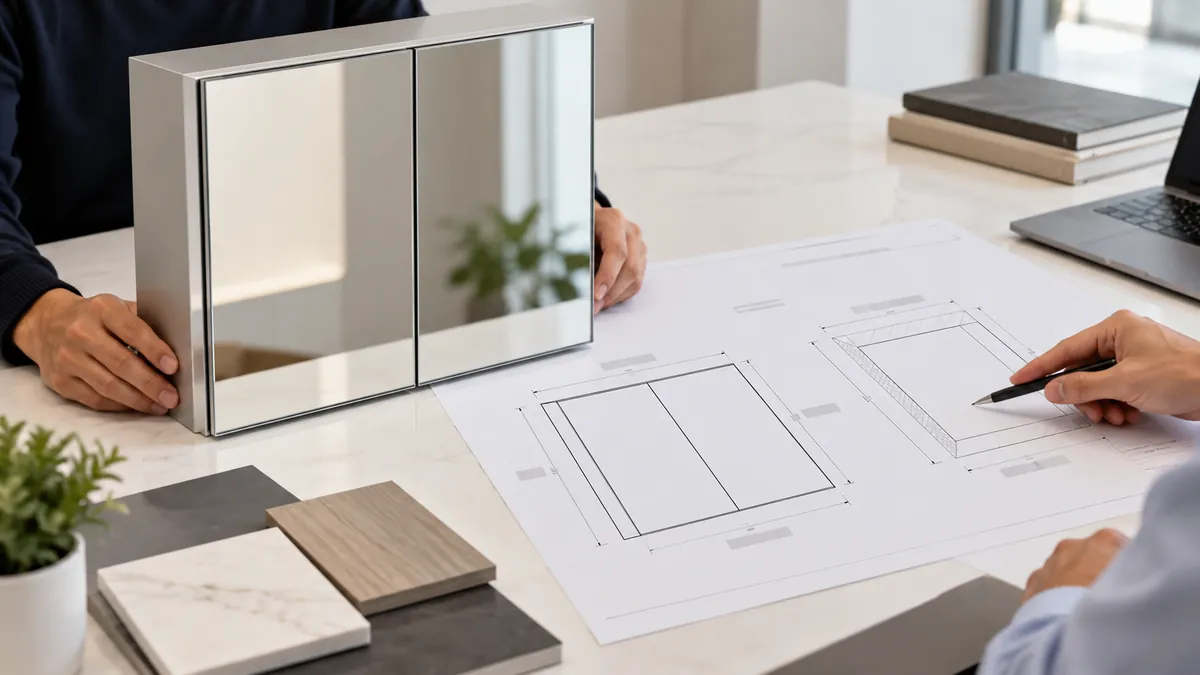
Conceptual buyer-review scene only; it does not represent an installation test, safety approval or Koitor product.
What Should a Distributor Confirm About Packaging and SKU Setup?
Packaging must protect the specific cabinet configuration and make its included parts traceable. A surface-mount kit, side panels, shelf supports, loose shelves or instructions can be easy to confuse when several versions share similar artwork. Put the model identifier, mount type, finish, door handing and included kit on the product data that the buyer controls.
During the pack review, confirm which components ship inside the carton, how loose parts are separated from the mirror and cabinet surfaces, and how the buyer distinguishes a recessed-only item from a dual-mount version. If different SKUs use the same outside carton, verify that the labels and barcode data still identify the right configuration. Review the pack sample with the actual approved cabinet and included components; a photo of a similar model is not a substitute.
Packaging checks should match the sales channel and the buyer’s own distribution plan. If a project requires a specific drop, compression or other packaging test, define the method, sample, acceptance criteria and party responsible. Do not say that stronger packaging or one test guarantees damage-free transport.
The buyer’s item file should connect the product specification to the pack: model code, finish, mounting type, door handing, shelf arrangement, included hardware, package contents and label revision. If any one of those fields changes, make the update visible in the buyer’s SKU record and agree whether a new sample or artwork approval is required.
Preguntas frecuentes
Is a recessed medicine cabinet smaller than a surface-mounted cabinet?
There is no universal size relationship. Each product has its own body, opening, flange and projection dimensions. Compare the exact model drawings rather than relying on the mounting label or visible mirror width.
Can a dual-mount cabinet always be installed either way?
No. Dual-mount options, kits and instructions depend on the model. Ask for the product-specific specification sheet and confirm which components are included for each configuration.
Should an importer use wall-opening dimensions as the cabinet size?
No. Keep overall cabinet size and recessed opening dimensions in separate fields. A manufacturer specification may provide both, and one should not replace the other.
What should be approved before ordering a mirror-cabinet sample?
Lock the mounting type, dimensional references, flange or side treatment, door configuration, shelves, finish, included kits and pack contents. Then tie the sample record to a drawing revision and model identifier.
Discuss a Bathroom Hardware Project with Koitor
Koitor Hardware is a family-owned custom metal hardware manufacturer focused on bathroom and home-storage products. The available company profile supports drawing and sample discussions for confirmed scope; it does not confirm a mirror-cabinet SKU or glass and electrical assembly capability. See the fabricante de accesorios de baño a medida page for the stated product scope, then contact the team with the specific drawing, mount type, dimensions and packaging requirements.
Review a Bathroom Product Specification
Share the intended configuration, dimensioned drawing, finish direction, target quantity and packaging scope. Product-category capability should be confirmed before sampling.
OEM / MARCA BLANCA
Convierte esta guía de abastecimiento en un resumen del producto
Indícanos el producto que deseas, el tamaño, el acabado, la cantidad del pedido y los requisitos de embalaje. Tu equipo recibirá un análisis práctico de la viabilidad de fabricación antes de recibir el presupuesto.


 English
 Español
 Português
 Français
 Deutsch
 العربية