
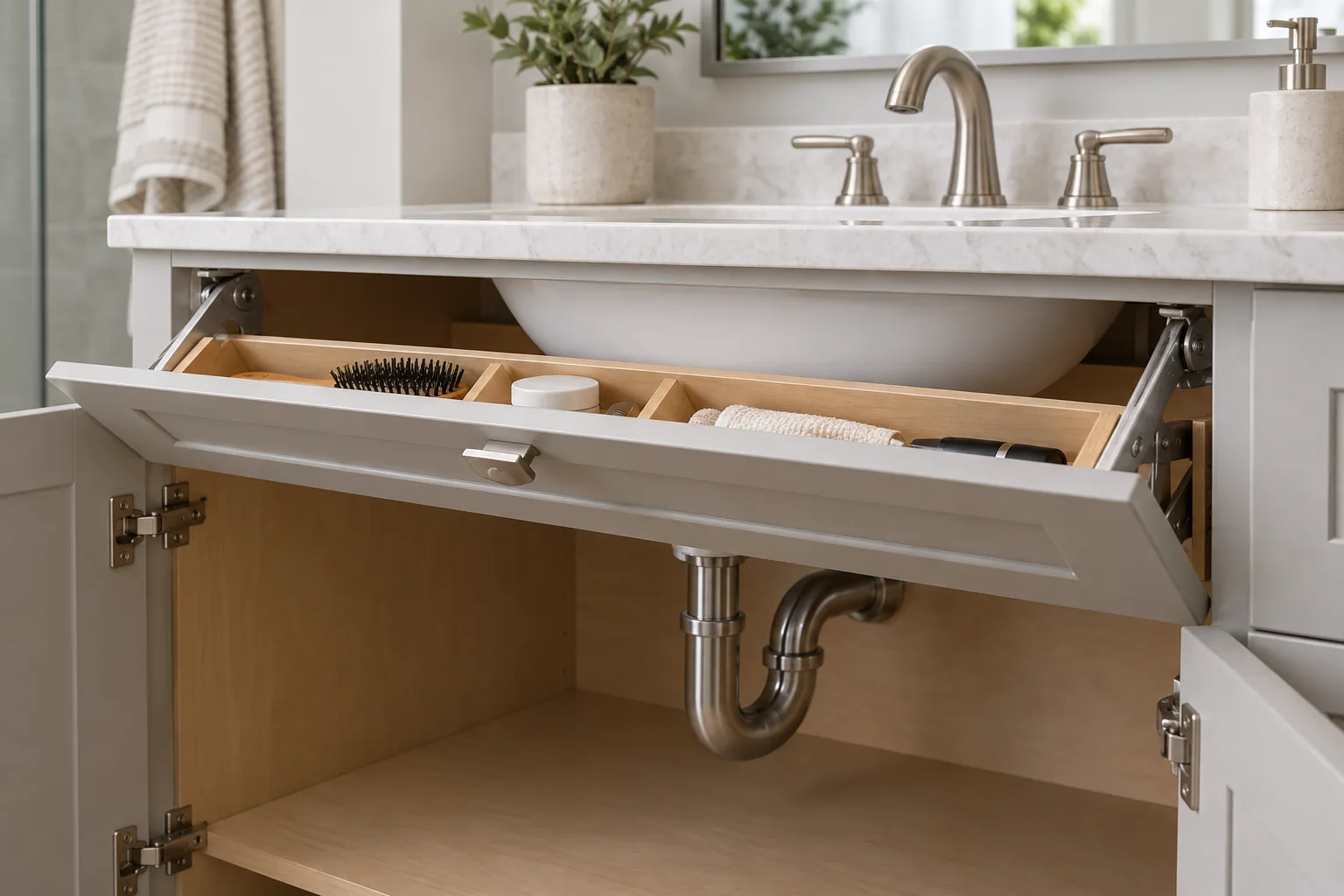
When specifying sink front tip out tray clearance, check the complete closed and tilted envelope against the sink bowl, false front, hinge, and nearby cabinet parts. A compact tray may be intended for a narrow space, but the product label or nominal sink-base width does not prove that the selected model will fit a particular cabinet. Confirm the actual geometry with the component supplier’s drawing and an assembled sample in a representative cabinet.
What clearance question should the buyer answer?
A sink-base false front is a panel that may look like a drawer front without operating as a conventional drawer. A tip-out tray uses that front as an access interface so a small storage area can be reached by tilting the panel. The sourcing question is whether the chosen tray and movement can occupy the available space without colliding with the sink bowl, plumbing, cabinet frame, or adjacent doors and drawers.
This is not answered by measuring only the cabinet’s outside width. The bowl may extend into the cabinet volume, the false front may be shallow, and the pivot or support hardware may need space that is not visible when the panel is closed. A tray that appears to fit in a product photograph can still interfere during movement. Buyers need to compare two states: the closed envelope and the opened or tilted envelope.
The manufacturer reference for sink-base tip-out trays describes slim variants for restricted space near a sink. That establishes the product-planning issue, not a universal clearance dimension or compatibility rule. For sink front tip out tray clearance, ask the selected supplier to state which cabinet measurements and obstructions its model requires, then confirm them on the actual configuration.
Which cabinet measurements belong in the RFQ?
Start with a section or side view of the cabinet and a front view showing the false front. Mark the sink bowl’s lowest and widest intrusion, the panel thickness, the hinge or pivot location, and any frame or rail near the opening. Include plumbing, pipes, disposal equipment, or fixed shelves only if they occupy the area relevant to the tray’s path. Distinguish measurements already verified on a physical cabinet from estimated or design-stage dimensions.
Ask the supplier to name its measurement datums. “Cabinet width” might mean outside carcass width, opening width, or a product-specific nominal size. Record the supplier’s exact convention and ask for a marked drawing showing the tray position when closed and tilted. If dimensions are unavailable, request the minimum information needed to select a model instead of filling gaps with assumptions.
| Input | What to mark or request | Por qué es importante |
|---|---|---|
| False front | Width, height, thickness, attachment, and whether it is fixed or moving | Defines the access panel and the available attachment interface |
| Sink bowl | Side and underside envelope at the tray location | The bowl can occupy space behind the front that is hidden in a face view |
| Cabinet opening | Clear opening and frame or rail positions | Affects access and where hardware can be installed |
| Moving envelope | Supplier drawing in closed and tilted positions | Reveals possible interference through the motion, not only at rest |
| Nearby objects | Verified pipes, shelf edges, hinges, drawers, or disposal equipment | Identifies obstructions that change the usable space |
| Model reference | Supplier, exact model, revision, instructions, and sample identity | Keeps the quote, test assembly, order, and received component aligned |
No universal depth, angle, or minimum clearance should be inferred from another supplier’s catalog. If the supplier publishes a specific compatibility table, preserve the version and its stated cabinet conditions. Ask whether the table applies to the exact selected model and whether any exclusions exist.
Which design options should suppliers compare?
The first comparison is between a nonfunctional or fixed false front and a front that operates a small tip-out storage tray. The fixed approach avoids introducing tray movement, but it does not provide that access function. A tip-out configuration may use the available front area, but it adds an interface and movement path that must be checked against the sink and cabinet geometry. These are different buyer outcomes, not simply different levels of quality.
Where a supplier offers more than one tray profile or mounting arrangement, compare the documented model options rather than assuming a “slim” label implies a specific fit. Check the closed depth, open envelope, attachment position, required false-front construction, and installation sequence as stated for each model. If a different tray depth or shape is proposed, request the revised drawing and sample before approving the substitution.
| Configuration to review | Pregunta del comprador | Documentación que hay que solicitar |
|---|---|---|
| Fixed false front | Is storage access required, or is the panel decorative only? | Cabinet drawing and confirmation that no tray function is expected |
| Tip-out tray option A | Does its closed and tilted envelope clear this sink and cabinet? | Current model drawing, installation instructions, and representative sample |
| Alternate compact profile | What geometry or mounting detail changes relative to option A? | Marked comparison showing changed interfaces and clearance conditions |
| Supplier-proposed substitute | Does it preserve the specified access and installation requirements? | Model identity, revision, deviation list, and written fit confirmation |
Compare offers using the same cabinet data and require suppliers to list missing information. A quotation based on assumptions should be labeled conditional. Do not treat a lower price, a shorter part description, or a similar appearance as evidence of equivalent fit. If the false front itself is supplied by another party, clarify who owns panel preparation and who verifies the assembled interface.
How should the open and closed envelope be reviewed?
The closed envelope is the space occupied when the front and tray are in their normal resting position. The opened envelope is the space occupied across the full intended tilt movement. The supplier’s model drawing should make those states understandable, but the drawing still needs to correspond to the actual cabinet opening, bowl position, panel, and mounting arrangement.
Review the path in sequence. Confirm where the tray is mounted, what moves with the false front, whether a stop or support is part of the purchased assembly, and where the tray comes to rest when open. Then compare the assembly with fixed objects in the cabinet. If the bowl or a pipe blocks the path, identify whether the issue is a model mismatch, a cabinet variation, or an installation assumption. Do not resolve the discrepancy by casually bending, trimming, or relocating a part unless the responsible supplier approves that change.
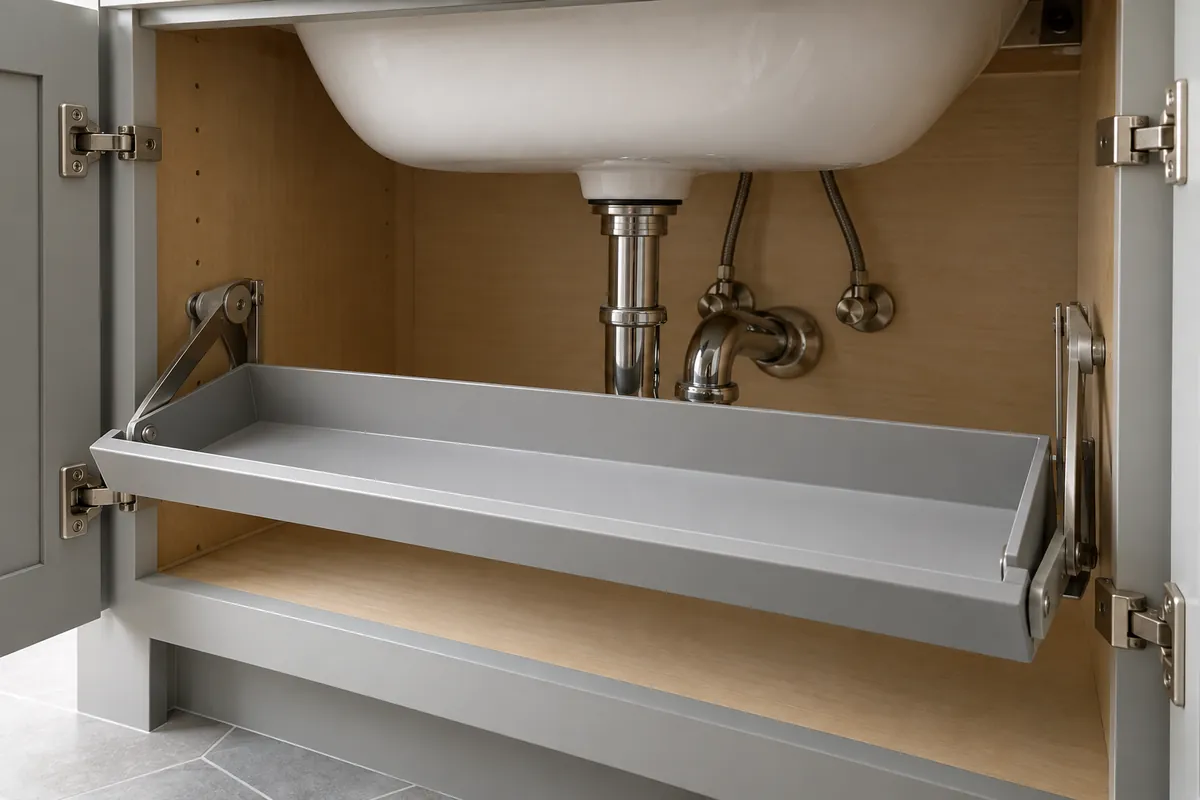
An image or line drawing can help explain the interface, but it is not itself fit evidence. If the product is still at concept stage, ask the cabinet designer and component supplier to agree on the measurement datums and expected movement. Keep the limits visible: a rendering can communicate intent, while only the specified component and representative construction can confirm the reviewed fit.
What should the assembled sample demonstrate?
The sample must match the quoted component and cabinet assumptions. Verify supplier, model, revision, tray shape, hardware, and instructions before assembly. Record whether the sample uses the intended false front and mounting interface. If a substitute fastener, hinge, panel, or cabinet mock-up is used, identify it rather than allowing the sample to appear more representative than it is.
Install the sample in a representative cabinet or a fixture that reproduces the relevant surfaces and clearances. Observe the front while closed, through the full intended tilt, and at the open position. Check whether the tray or hardware touches the bowl, frame, plumbing, or adjacent parts. Confirm that the tray can be accessed as intended and that the assembly can be returned to its resting position without a collision. Do not infer long-term reliability or a load rating from this fit review.
Record what was observed, the cabinet conditions, the installation sequence, and any accepted deviation. Photograph the front and side views at the positions that matter. If there is interference, stop and ask the supplier for a corrected model or a documented cabinet-side change. A sample approval should name the exact revision and should not be treated as approval of every sink base in a product range.
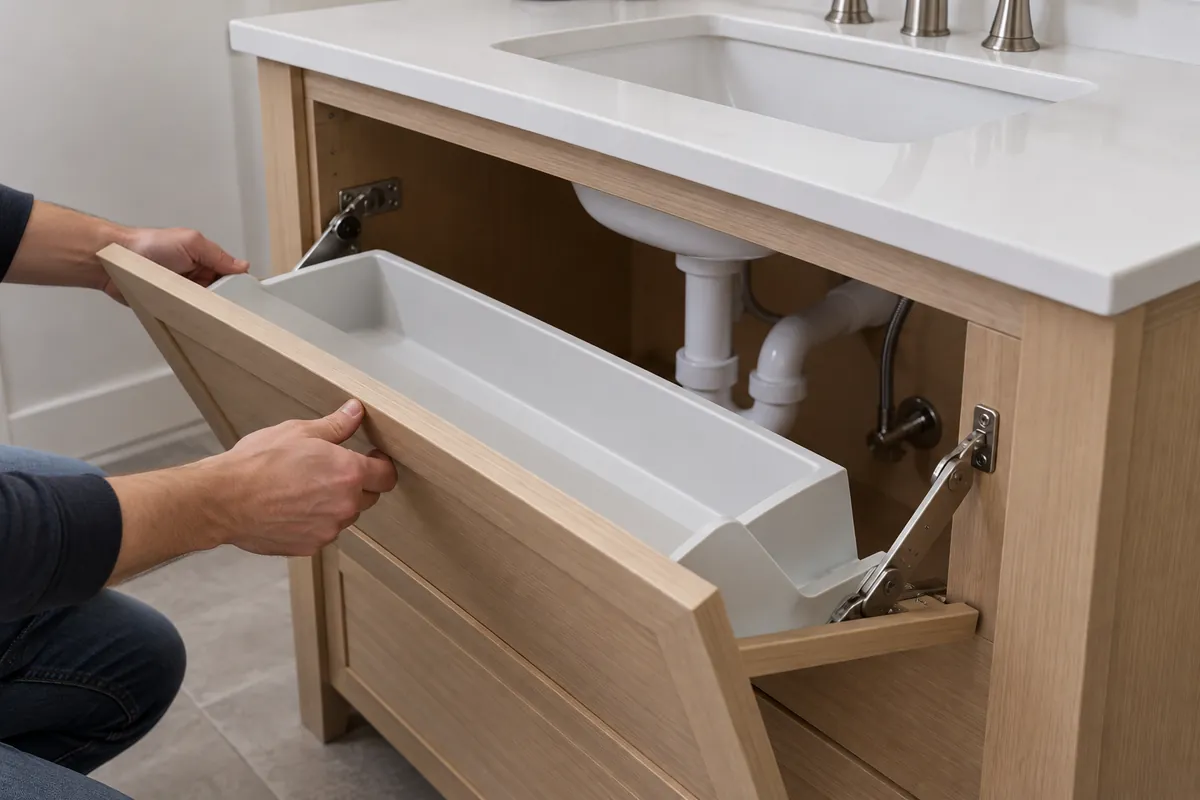
The approval record should identify who accepts the cabinet dimensions, who confirms the component fit, and who authorizes production. Where the product is private-label, tie the approved model to the SKU, instructions, product images, and carton identification. That traceability reduces the chance that an approved sample is later replaced by a visually similar but geometrically different component.
What changes should trigger another fit review?
Revisit fit when the bowl shape or position changes, a false-front size or attachment changes, the cabinet frame is revised, the plumbing layout moves, or the purchased component’s model or revision changes. A new cabinet supplier can also introduce differences even when the sales dimensions look the same. Ask the relevant suppliers whether the existing approval remains applicable and document the answer.
Distinguish a material or finish change from a geometric change, but do not assume the former is irrelevant. A coating or finish might alter a mating interface; whether it matters depends on the specific drawing and tolerance. The component supplier should identify the conditions that affect installation. For a changed geometry, request a marked drawing and recheck the complete movement envelope before production.
Repeat the review when an agreed deviation is introduced, such as moving the pivot, changing the false front, or altering a support. Record who approved the deviation, which model it affects, and whether product photography or installation instructions need revision. If a change cannot be evaluated with the original cabinet fixture, update the fixture or use a representative assembly before accepting it.
For multi-model assortments, maintain a fit matrix rather than a single generic statement. List the cabinet variant, bowl or obstruction conditions, component model, tested revision, and approval status. Mark untested combinations as unverified. This is more useful than promising that a tray fits a broad class of sink cabinets when the underlying geometry has not been checked.
What sourcing mistakes are avoidable?
Do not approve based only on the outside cabinet width. Do not inspect only the closed position. Do not assume that “compact” or “slim” means universally compatible. Do not accept a sample without confirming the model and revision against the quotation. Each shortcut removes one of the pieces of evidence needed to compare a component with its cabinet interface.
Avoid mixing responsibility between the cabinet maker and the tray supplier. The cabinet party should verify cabinet geometry; the component supplier should identify its own model conditions and instructions; the buyer should approve the final combination and record deviations. If Koitor supplies a metal basket or other storage part in a broader assortment, the buyer can clarify that metal component’s interface separately. Koitor is not represented here as the manufacturer or testing authority for a specialist tip-out mechanism.
When requesting an alternate, state the required access function and provide the same side view used for the original model. Ask the supplier to identify what changed and what remains unverified. A substitute can be acceptable if it meets the agreed requirements, but the approval should be based on evidence rather than a similar photo or an informal assurance.
Buyers can review Koitor’s OEM home-storage hardware y Fabricación de estanterías de almacenamiento a medida para cocinas pages for related metal-product sourcing scope. If a project combines a purchased cabinet fitting with a metal storage component, submit the relevant drawing or sample and define each party’s review responsibility through Página de contacto de Koitor.
Preguntas frecuentes
Is sink front tip out tray clearance determined by the sink-base width?
No. Outside width does not show the bowl’s intrusion, false-front construction, frame, plumbing, or movement path. Use supplier-defined measurements and check the assembly in a representative cabinet.
Should the tray fit be checked only when closed?
No. A tray may clear the sink when closed but collide during tilting. Review the complete supplier-defined movement and the final open position.
Can a slim tray fit any sink cabinet?
No universal compatibility should be assumed. A slim product family may address restricted space, but the selected model still has specific mounting, panel, and clearance requirements.
What if the sink bowl position is not final?
Mark the cabinet measurements as provisional and identify who owns the final verification. Do not release the component selection as confirmed until the relevant geometry is fixed or formally accepted as an assumption.
Does an assembled sample prove load capacity?
No. A fit sample demonstrates the configuration and movement actually reviewed. Any load or performance claim requires separate supplier evidence and a defined method and condition.
What should be recorded after sample approval?
Record the component model and revision, cabinet drawing, measurement datums, assembly sequence, observations, photographs, deviations, and approving parties. Link those records to the SKU and order documents.
Who should confirm a cabinet-side change?
The cabinet owner should confirm cabinet geometry, and the component supplier should confirm its product conditions and installation guidance. The buyer should approve the assembled interface and any commercial deviation.
When should a fit review be repeated?
Repeat it when the bowl, panel, cabinet frame, mounting arrangement, component revision, or any condition affecting the movement envelope changes.
What should be sent for an initial supplier review?
Provide a front and side view, the sink bowl position, the false-front construction, known obstructions, intended movement, and the supplier’s current model if one has been selected.
How should an importer handle an unknown clearance?
List it as an open item and ask for the supplier’s measurement definition or a representative fit check. Do not convert an unknown into a guessed dimension in the purchase order.
Clarify a sink-base storage interface
Send the cabinet view, component drawing or sample, and any related metal-product interface so the sourcing scope can be reviewed clearly.
Clarify the sink-base interface
Share the sink-bowl and false-front views, selected tray model, and relevant metal-product drawing or sample.
OEM / MARCA BLANCA
Convierte esta guía de abastecimiento en un resumen del producto
Indícanos el producto que deseas, el tamaño, el acabado, la cantidad del pedido y los requisitos de embalaje. Tu equipo recibirá un análisis práctico de la viabilidad de fabricación antes de recibir el presupuesto.


 English
 Español
 Português
 Français
 Deutsch
 العربية