
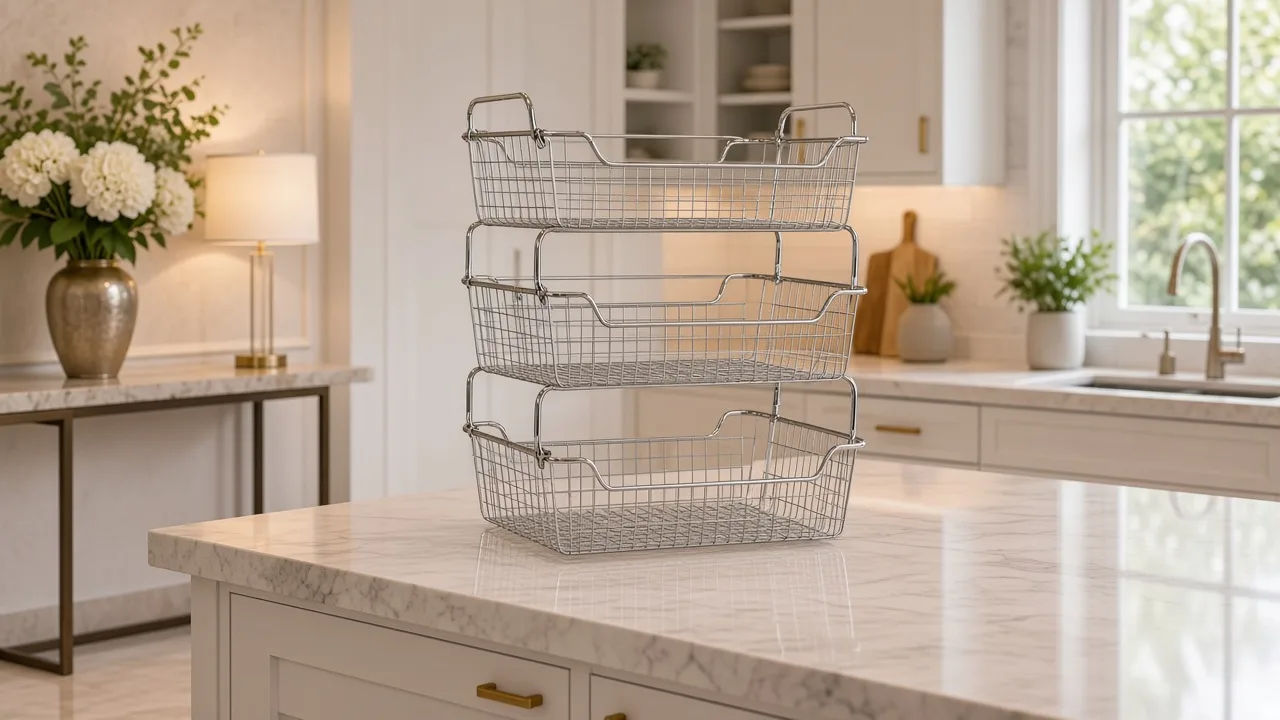
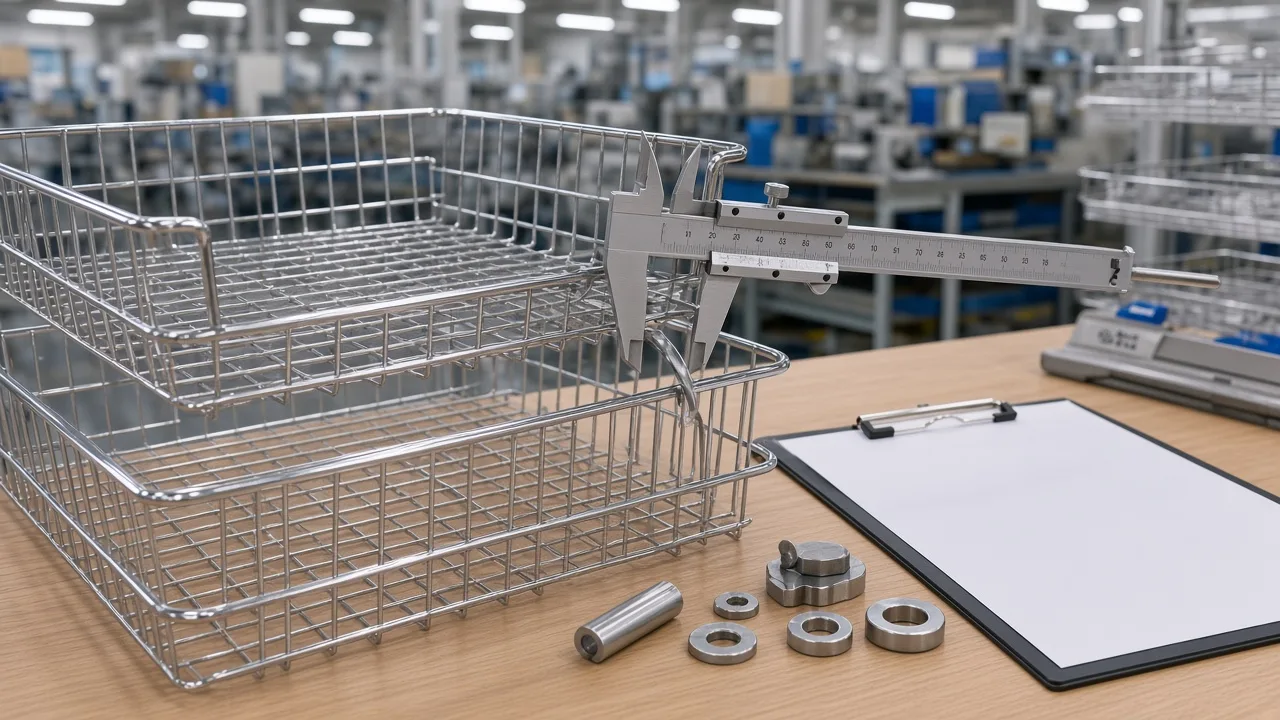
Buyers who treat stackable wire basket interlock as a marketing adjective inherit wobble, tip events, and “bent in use” returns that often start as uncontrolled hook gaps and engagement depth. This article freezes RFQ and IQC language for wire basket rim/hook interlocks used in kitchen and bath storage—finished-part gauges, stack stability, abrasion at contact points, and lot interchangeability—without rewriting export packaging defect catalogs.
It deliberately differs from wire basket packaging export posts that focus on nesting abrasion, carton ECT, and desiccant. Those remain packaging neighbors. This page is the functional interlock fit layer for after the carton is opened. Photos are generic. Koitor Hardware supports wire storage programs from Jiangmen, China, with practical stack-fit specification language for importers and private-label teams.
In this guide
- Why Stackable Wire Basket Interlock Specs Beat Vague Nest Claims
- How to Freeze Stackable Wire Basket Interlock CTQs
- 8 Proven Fit Checks for Stackable Wire Basket Interlock
- Accept, Rework, or Reject: Interlock Disposition
- RFQ Checklist Language for Hooks, Gaps, and Stack Load
- Preguntas frecuentes
- Send Your Spec
Why Stackable Wire Basket Interlock Specs Beat Vague Nest Claims
Buyers who write “stackable” without freezing stackable wire basket interlock geometry inherit wobble, tip-over complaints, and returns that look like weld failures but start as uncontrolled hook gaps.
Nesting for freight density is not the same as interlocking for consumer stacking. Packaging playbooks optimize cube and abrasion. This page freezes functional interlock CTQs for use after unboxing.
Chrome and powder wire baskets amplify tolerance stack-ups. Wire diameter, rim radius, hook height, and powder film all change engagement. Vague drawings leave stackable wire basket interlock to tribal knowledge on the line.
Differentiate from shoe-rack connector guides and countertop shelf alignment posts: those cover different SKU families. Here the product is wire baskets with rim/hook interlock for kitchen and bath storage.
Freezing stackable wire basket interlock early reduces “they stacked fine in the sample” disputes when mass wire lots drift 0.5 mm on hook opening.
How to Freeze Stackable Wire Basket Interlock CTQs
Start every stackable wire basket interlock RFQ with: hook style (formed wire hook, tab, or sleeve), engagement depth min, lateral play max, stack height rating, and side-load test mass.
Add wire diameter and rim OD tolerances after powder or plating. Finish film changes fit; measure finished parts, not raw wire only.
Define go/no-go gauges for hook opening and engagement depth. Calipers alone invite inspector variation.
Require a three-high stack photo and a timed side-load video on first article. Paper dimensions without a stack test miss real wobble.
Link pack-out separately: nesting for export may intentionally leave interlocks unprotected. See wire basket packaging export defects for carton/abrasion language—do not mix those CTQs into interlock fit.
Process neighbors for forming and welding live in wire basket manufacturing CTQs. Handle attachment design is covered in wire basket handle attachment design.
8 Proven Fit Checks for Stackable Wire Basket Interlock
These eight checks form a practical stackable wire basket interlock IQC spine.
Measure finished opening against drawing. Powder build or plating can close gaps and bind stackable wire basket interlock.
Minimum engagement depth prevents pop-off when users lift the upper basket. Record min mm.
Max lateral deflection under defined push force. Excess play feels cheap and tips.
If baskets are rectangular, freeze which short side leads so stacks cannot assemble 90° off when hooks are asymmetric.
Out-of-round rims create one tight and one loose corner. Check after welding and finishing.
Apply rated side mass or force; stack must not unlock. Document method.
Interlock contact should not scrape finish to bare steel after N assemble/disassemble cycles you define.
Upper from lot A must interlock with lower from lot B inside the same stackable wire basket interlock window. Dual molds without gauge control fail here.
Accept when gauges pass, three-high stack is stable under side-load, and finish at contact points meets abrasion rules for this interlock program.
Rework may include rim re-form or selective weld dressing only if finish can be restored and gauges re-pass. Do not “persuade” hooks with hammers on finished goods.
Reject when engagement depth fails, lateral play exceeds max, stacks unlock under rated load, or finish is bare at contacts after cycle test.
Separate packaging crush defects from interlock geometry defects. A bent rim from carton drop is not an interlock design fail.
This interlock program RFQ blanks: hook style ______. Opening width ______ ± ______. Engagement depth min ______. Lateral play max at 3-high ______. Side-load ______ N or kg. Cycle abrasion N=______. Gauge IDs ______.
Cite transport stacking standards only when you also specify pallet compression; functional interlock is a product CTQ. For distribution tests, buyers often reference ASTM D4169 distribution cycles and ISTA 3A for parcel—keep those in packaging annexes.
First-article pack: dimension report, gauge photos, three-high video, abrasion cycle note, and signed this interlock program disposition.
Consumer instructions should show correct this interlock program orientation with a simple diagram; returns often come from reverse stacking on asymmetric hooks.
Powder programs need post-coat gauges; chrome programs need post-plate gauges. Never qualify only in raw wire.
Accept, Rework, or Reject: Interlock Disposition
RFQ Checklist Language for Hooks, Gaps, and Stack Load
Tolerance stack: wire diam + bend springback + weld pull + finish film. Budget all four in the this interlock program drawing notes.
If SKUs share hooks across sizes, freeze a compatibility matrix so 20 cm baskets do not claim stack with 30 cm rims.
Retail photography should show true engagement, not baskets merely resting. Misleading photos create false this interlock program expectations.
Train IQC to reject “hand fit feels OK” without gauges. Feel is not a CTQ.
Dual-source plants must exchange physical gauge sets for this interlock program, not only PDF drawings.
Track interlock PPM separately from weld PPM on scorecards.
Change control: any rim OD, wire diam, or hook die change triggers re-FA for this interlock program.
Hotel and dorm programs may need higher side-load ratings than home kitchen SKUs—freeze channel-specific ratings.
Edge protectors in cartons can bend hooks if oversized; coordinate pack and this interlock program teams.
Sample rooms should keep a gold stack of three approved baskets sealed for comparison.
When users complain of squeak, check finish at contact before redesigning this interlock program geometry.
Avoid sharp hook tips that cut PE bags or fingers; add tip radius CTQ.
For matte black stacks, abrasion shows as shiny rub marks—include visual acceptance photos in the this interlock program annex.
Document maximum recommended stack height in IFU and on carton to limit misuse claims.
If interlocks double as carry handles, add load CTQs for lift, not only stack. Keep lift separate from this interlock program stack language.
Audit fixtures that hold baskets during welding; fixture wear silently opens hook gaps over months.
Keep a fail library of unlocked stacks for training on this interlock program disposition.
Seasonal capacity spikes need gauge capacity too—do not skip interlock checks when weld lines rush.
Carton compression language, when packaging annexes are paired with stack claims, can reference ASTM D642 separately from functional interlock gauges.
Write change-control so chemistry, tooling, or bake edits cannot ship without a signed first-article pack.
Keep a sealed master and a working reference; replace working references on a calendar before they scuff into false fails.
Train inspectors with photo boards of borderline cases so two shifts grade the same way on Monday and Friday.
Separate cosmetic AQL language from method CTQs on the disposition sheet so teams do not waive the wrong gate.
Dual-source programs must exchange physical masters and gauges, not only PDF drawings, before the second plant ships.
Remote approvals need overnighted coupons or sealed masters; video calls under mixed room light are not lot release.
Scorecards should track finish or fit PPM separately from weld PPM so capital goes to the line that actually fails.
Packaging teams must not create scuffs that receiving later blames on finish or adhesion—align PE and separator notes.
First-article packages without photos, instrument IDs, and signatures create “we thought it was approved” disputes.
Seasonal rush cannot skip method checks; gauge capacity and lab time belong in the capacity plan with weld hours.
Field returns should trigger a method audit checklist, not only a supplier email, when the same fail repeats.
Marketing photography should use the same lighting mood as acceptance masters so catalogs do not oversell finish.

Label cartons with max stack height for filled and empty states so warehouse teams do not exceed design loads. Keep owners named on the same page as the numeric CTQ.
Vibration during ocean freight can walk units out of engagement; ISTA sequences should include stacked configurations. Keep owners named on the same page as the numeric CTQ.
Document whether interlocks are reversible or orientation-locked; wrong-way stacks create store injury risk. Keep owners named on the same page as the numeric CTQ.
Retail planograms assume predictable height per stack; publish that height with tolerance so fixtures stay level. Keep owners named on the same page as the numeric CTQ.
Reject soft-tool samples that only clip once; production wear will open the window further. Keep owners named on the same page as the numeric CTQ.
Train IQC to measure engagement after coating, not only after welding, because powder changes fit. Keep owners named on the same page as the numeric CTQ.
Dual-source plants must share go/no-go gauges for the interlock, not only CAD files. Keep owners named on the same page as the numeric CTQ.
Customer IFUs should show correct stack direction with icons; text alone fails in multilingual stores. Keep owners named on the same page as the numeric CTQ.
Field returns for “won’t stack” often trace to bent rim wire from drop tests—include that check in CAPA. Keep owners named on the same page as the numeric CTQ.
Separate cosmetic AQL from functional interlock CTQs so buyers do not waive a safety fit for a scratch. Keep owners named on the same page as the numeric CTQ.
Seasonal promotions that overfill baskets change center of gravity; validate loaded stacks, not empty ones only. Keep owners named on the same page as the numeric CTQ.
Photograph fail modes: partial engagement, rock, and jam, so suppliers grade the same defects. Keep owners named on the same page as the numeric CTQ.
Keep a golden sample of a three-high stack sealed for disputes that arrive months after the PO. Keep owners named on the same page as the numeric CTQ.
Change-control on hook tip radius needs PPAP-style packs; tiny radius shifts kill retail stackability. Keep owners named on the same page as the numeric CTQ.
Warehouse SOPs should ban standing on stacked baskets; misuse claims belong in IFU and scorecards. Keep owners named on the same page as the numeric CTQ.
Define interlock engagement depth and rock angle on the drawing, not only in a marketing photo of stacked units. Keep owners named on the same page as the numeric CTQ.
Require cycle tests for stack/unstack that match retail reset frequency, not a single demo stack in the showroom. Keep owners named on the same page as the numeric CTQ.
Wire diameter and mesh pitch interact with hook geometry; freeze both before tooling soft jaws for the interlock. Keep owners named on the same page as the numeric CTQ.
Coat thickness on male/female features must stay inside a window or stacks bind after cure. Keep owners named on the same page as the numeric CTQ.
Ship nested sets with separators that protect hooks; crushed interlocks become returns labeled as weld defects. Keep owners named on the same page as the numeric CTQ.
Label cartons with max stack height for filled and empty states so warehouse teams do not exceed design loads. Keep owners named on the same page as the numeric CTQ.
Vibration during ocean freight can walk units out of engagement; ISTA sequences should include stacked configurations. Keep owners named on the same page as the numeric CTQ.
Document whether interlocks are reversible or orientation-locked; wrong-way stacks create store injury risk. Keep owners named on the same page as the numeric CTQ.
Retail planograms assume predictable height per stack; publish that height with tolerance so fixtures stay level. Keep owners named on the same page as the numeric CTQ.
Reject soft-tool samples that only clip once; production wear will open the window further. Keep owners named on the same page as the numeric CTQ.
Train IQC to measure engagement after coating, not only after welding, because powder changes fit. Keep owners named on the same page as the numeric CTQ.
Dual-source plants must share go/no-go gauges for the interlock, not only CAD files. Keep owners named on the same page as the numeric CTQ.
Customer IFUs should show correct stack direction with icons; text alone fails in multilingual stores. Keep owners named on the same page as the numeric CTQ.
FAQ: Stackable Wire Basket Interlock
Is nesting the same as interlocking?
No. Nesting saves freight. This interlock program is functional engagement for consumer stacking.
How many baskets high should we test?
Test at the maximum height you claim in IFU/marketing, commonly three for home SKUs.
Do powder and chrome share gauges?
Share nominal geometry, but qualify finished parts; film thickness differs.
What external standards help?
Use product gauges for interlock; use ASTM D4169 / ISTA for distribution packaging annexes.
Can we approve by photo only?
No. Require gauges plus a three-high stack video for this interlock program FA.
Send Your Stackable Wire Basket Interlock Spec for Review
If you are freezing this interlock program for a private-label program, send hook sketches, stack height claims, and finish notes. We can help turn them into gauge-ready IQC language before mass PO.
Contact Koitor Hardware via the contact page or email simon@koitorhardware.com. Factory support is based in Jiangmen, China.
OEM / MARCA BLANCA
Convierte esta guía de abastecimiento en un resumen del producto
Indícanos el producto que deseas, el tamaño, el acabado, la cantidad del pedido y los requisitos de embalaje. Tu equipo recibirá un análisis práctico de la viabilidad de fabricación antes de recibir el presupuesto.
 English
 Español
 Português
 Français
 Deutsch
 العربية