

Stainless steel welding filler grade selection should begin with the exact parent materials, joint design, service conditions and applicable welding procedure—not with a filler label copied from a similar-looking product. Buyers should ask the supplier to identify both materials at the joint, propose the filler and procedure basis, describe the finished appearance requirements and retain consumable traceability appropriate to the order. A filler designation by itself does not prove the completed joint is suitable for the product.
What information does the buyer need before choosing filler?
Identify the base materials on both sides of the joint. If a frame combines tube, wire, sheet or a bought-in fitting, do not assume every component has the same grade. The drawing, material declaration or purchase specification should identify each parent material or state which information the supplier must confirm before welding.
Next define the joint and product function. A small decorative weld in a towel frame may have different acceptance needs from a joint that carries load or affects alignment. State whether the joint is visible, whether it will be polished or coated, and what finished appearance is expected. If the weld contributes to the product’s structural performance, identify the relevant complete-product requirements and who validates them.
Record the service environment and any constraints that matter to the design. The selection discussion may depend on corrosion exposure, temperature, cleaning, contact with other materials or downstream finishing. Buyers should not assume that one filler is universally appropriate for every stainless grade or bathroom environment. A qualified welding engineer or supplier should evaluate the specific material pair and procedure.
If material identity is uncertain, resolve it before approving a filler choice. A consumable recommendation based on a guessed parent grade is not a controlled engineering decision. Where the purchase risk warrants it, buyers can request supplier material records or independent verification from a qualified provider. Koitor should not be represented as an accredited lab or as providing a test service unless that capability is specifically established.
Why does parent-metal pairing matter?
Filler selection depends on the combination of parent materials and the intended joint. When both sides are the same known material, the supplier can evaluate the relevant filler and welding procedure against that pairing. When materials differ, the decision is more specific: a filler appropriate for one side alone may not address dilution, compatibility, service or fabrication considerations for the combined joint.
TWI’s technical guidance on welding austenitic stainless steel describes how parent material and welding procedure influence filler considerations. It is useful background for an OEM buyer, but it does not replace an approved design, qualified procedure or project-specific engineering decision. The buyer should ask the responsible welding supplier to explain the basis for its proposal.
| Pregunta del comprador | Why it affects selection | Documentación que hay que solicitar |
|---|---|---|
| What is each parent material? | The joint can involve different grades or forms | Drawing, material declaration or traceable records |
| Are materials dissimilar? | A mixed pair may require a distinct engineering review | Supplier’s documented material-pair assessment |
| What is the joint’s function? | Decorative and functional requirements differ | Drawing, assembly purpose and acceptance criteria |
| Will the weld be visible or finished? | Appearance and post-weld operations may affect the choice | Approved sample and finish standard |
| What service conditions apply? | Exposure and use influence the design requirements | Buyer-defined environment and product specification |
| Which procedure is used? | Filler is only one element of the welding process | Applicable procedure/qualification evidence when required |
| How is the consumable controlled? | A correct proposal must be used consistently | Purchase record, identification and change control |
Do not treat a table or online chart as a substitute for the governing design and procedure. Charts can help frame questions, but they may not cover the exact product form, joint or service conditions. A supplier should state any assumptions and identify when an engineering review or procedure qualification is needed.
For stainless steel welding filler grade selection, buyers can request a short written rationale that names the parent-metal pair, proposed filler classification, process and any assumptions about the joint. The response should identify which technical owner approved the proposal and what document controls production. That gives procurement a way to compare supplier responses without selecting a consumable based only on a familiar designation. If the supplier cannot confirm the material identity or applicable procedure, keep that as an open approval item rather than treating the quotation as technical acceptance.
What should appear in the RFQ and drawing package?
The RFQ should identify joint location, geometry, parent materials, visible faces, downstream finish, functional role and drawing revision. Include a section view or assembly detail when the weld is difficult to interpret from the overall product drawing. If the buyer has a required filler or procedure, cite its controlled specification and revision; if not, ask the supplier to propose one and explain the basis.
Avoid specifying a filler grade without confirming that the proposed base materials and process match it. Equally, avoid leaving the supplier to infer that a generic “stainless filler” is acceptable. A concise requirement can say that the supplier must document proposed filler classification, parent-metal assumptions, welding process and any approval needed before production. The buyer can then review that proposal with the relevant technical owner.
The package should distinguish weld quality from cosmetic finish. Define whether visible welds are blended or left with a specified appearance, where polishing is allowed, and what surface must be protected during finishing. If the finished product will be plated or coated, the overall process sequence should be discussed with the responsible supplier. Do not assume that an attractive sample proves the process is qualified or repeatable.
Appearance review should specify representative viewing distance and identify the product faces visible after assembly. If polishing removes material or changes the joint profile, the buyer should review the final assembly and any functional requirement that depends on the weld. The approved sample must show the actual downstream finish, since a pre-finish weld coupon cannot demonstrate the final visual condition. Keep appearance acceptance separate from any procedure or structural qualification record.
For assemblies with several joints, identify which ones are critical and whether they share the same material pair and procedure. A supplier may use different settings or consumables for different geometry; the buyer should request records aligned with the actual production plan rather than a single generic declaration.
How should the completed joint be evaluated?
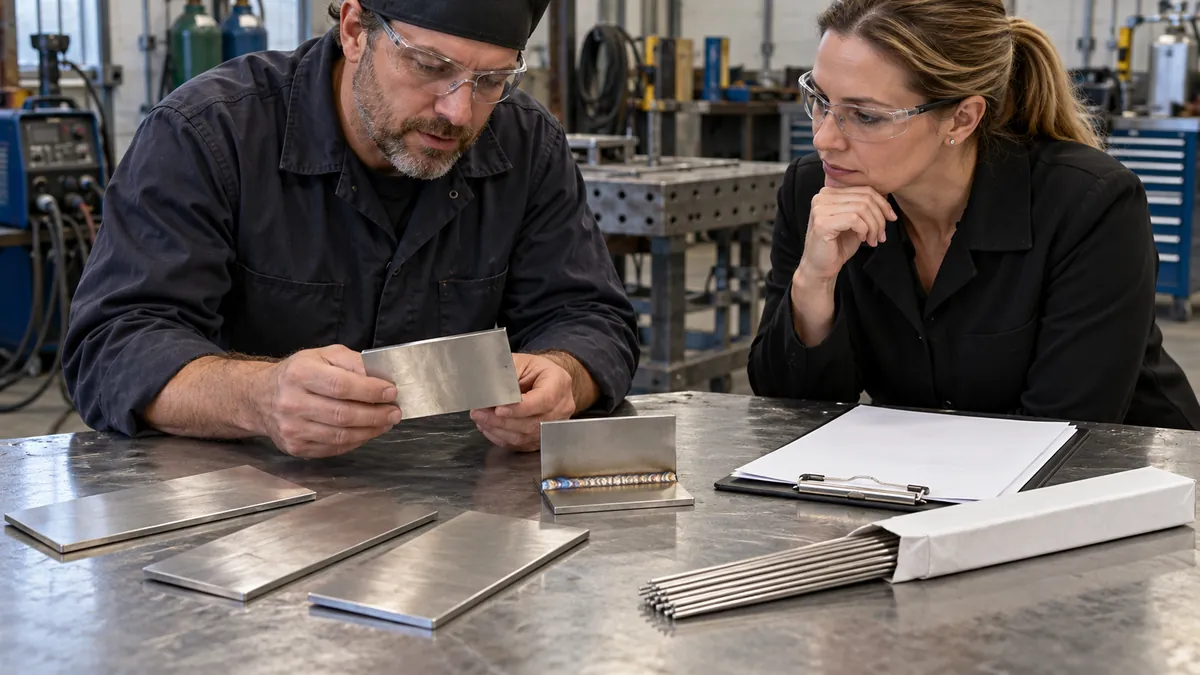
Start with the buyer’s requirement and the joint’s function. A visual examination can review surface appearance against an approved sample or defined criteria, but it does not prove every internal property. If the design has functional or structural requirements, engineering should specify an appropriate validation method for the complete joint or assembly.
A production-intent sample should use the planned materials, joint geometry, welding route and downstream finishing steps. Record the sample’s revision and identify any provisional element. Inspect fit and alignment in the complete frame. If a joint is polished, coated or otherwise finished after welding, review the final condition as well as the pre-finish stage where that distinction matters.
Do not prescribe a universal weld size, acceptance limit or test result without support from the product design and applicable specification. The buyer can ask the supplier which inspection method is appropriate and what it can establish. If a special examination is required, agree who performs it, which sample is tested, the acceptance criteria and how the report connects to the production lot.
If a defect occurs, preserve the part and record its location, lot, material pair, finish and discovery stage. Avoid immediately grinding or reworking the joint before photographs and supplier review. The corrective-action process should separate observed facts from possible causes and show how any proposed cause will be verified.
What consumable traceability should buyers request?
Traceability needs depend on the project, contract and quality system. Buyers should define the information required to connect the approved procedure and filler to production without assuming a laboratory certificate or a particular documentation format is automatically included. Ask who controls consumable purchasing, identification, storage and issue to the work area where relevant.
A supplier record may identify the proposed filler classification, manufacturer or source, lot information when applicable, and the approved welding instruction. The buyer should clarify whether records are provided per lot, retained by the supplier or submitted with shipment. The requirements should be proportionate to the product risk and stated in the RFQ or quality agreement.
Change control matters. If the supplier changes a parent material, filler source, welding process, joint geometry or finishing sequence, determine whether review or reapproval is required. The approved sample and drawing revision should remain linked to the procedure and consumable definition. A verbal “equivalent” substitution should not silently change a critical joint.
In ongoing programs, stainless steel welding filler grade selection should be reviewed when the design or supply chain changes, not only at initial sourcing. A new fitting, wire diameter, tube wall, supplier or finish can alter the joint context. Ask the supplier to flag changes that affect the approved welding instruction, and retain the current approved record with the order revision. If a deviation is accepted for one lot, state its scope and expiry so the exception does not become an undocumented permanent substitution.
A practical checklist:
- – Identify both parent materials at each relevant joint.
- – Show joint geometry, location and assembly revision.
- – State whether the weld is visible, finished or functionally critical.
- – Describe service conditions and intended product use.
- – Request a documented filler and procedure proposal if not buyer-specified.
- – Clarify assumptions and any need for engineering or procedure qualification.
- – Approve a production-intent sample in final assembly and finish condition.
- – Define inspection method and its limits.
- – Agree consumable identity and traceability records.
- – Require review of material, filler, process and design changes.
How can supplier responsibility be made clear?
The commercial supplier should identify which welding operation it performs and which operation is subcontracted. If multiple suppliers contribute material, welding, polishing or coating, map the handoffs and define who owns the drawing interpretation, approval sample, inspection records and corrective action. This avoids a situation where each party attributes an issue to another process without a shared evidence trail.
The buyer can ask the supplier to explain how parent material and filler selection are reviewed before production and how the approved definition reaches operators and inspectors. The response should be project-specific. A general capability statement is not proof that a particular grade pair, joint or product has been qualified.
For an OEM program, keep the welding requirement connected to the product drawing, approved sample, supplier route and order revision. If changes are made to reduce cost or improve appearance, review whether they affect the joint or downstream finish. Document the decision and any additional validation needed.

How can Koitor support the review?
Koitor is a family-owned bathroom and home-storage hardware manufacturer with practical metal fabrication, joining, finishing, assembly and buyer drawing/sample communication experience. The company should only be described as providing the operations included in the actual project scope. This article does not claim Koitor owns a particular welding machine, maintains a certified welding laboratory or qualifies every material combination.
For a buyer discussion, share the assembly drawing, parent material information, visible-finish requirements, intended service and any applicable welding specification. Ask the supplier to identify which joints it controls directly and what evidence it can provide. Where the decision requires specialist welding engineering, procedure qualification or independent testing, confirm the appropriate responsible provider.
Preguntas frecuentes
Can a buyer choose filler from the stainless grade name alone?
Does a matching filler label guarantee a sound joint?
Do dissimilar stainless grades always require a different filler?
Can a visual sample verify the welding procedure?
What should happen if the supplier changes filler source?
For related supplier context, see Koitor’s custom metal storage basket manufacturing page y OEM home-storage hardware information. To discuss an assembly drawing or sourcing requirement, Ponte en contacto con Koitor. For technical background, read TWI’s guidance on welding austenitic stainless steel.
Clarify a Stainless Weld Requirement
Share the parent materials, joint drawing, service conditions and finish requirements so the proposed filler and supplier evidence can be reviewed for the actual assembly.
OEM / MARCA BLANCA
Convierte esta guía de abastecimiento en un resumen del producto
Indícanos el producto que deseas, el tamaño, el acabado, la cantidad del pedido y los requisitos de embalaje. Tu equipo recibirá un análisis práctico de la viabilidad de fabricación antes de recibir el presupuesto.

 English
 Español
 Português
 Français
 Deutsch
 العربية