

A listing or install sheet can print a standard coat hook height only after the hanging program and the height datum are named. The program is a residential entry or mudroom hook, or a hospitality or project coat hook, not a bathroom robe hook. The datum is a named reference surface, usually the finished floor, plus a named point on the hook, such as the tip or the backplate center.
Bathroom robe-hook height belongs on the live robe-hook height file. Toilet-partition coat-hook bumper checks belong on that neighboring file. A standing coat rack is a different product and a different height question. None of those decisions is this wall-mounted coat-hook datum, and none should be rewritten as one.
This guide is for importers, distributors, and private-label teams approving published-height wording for wall-mounted coat hooks and hook rails. Koitor Hardware is a family-owned China OEM manufacturer of custom metal bathroom and home storage hardware. Adjacent hook and storage OEM pages already sit in that published library. That fact is not a claim that Koitor currently manufactures a named coat-hook SKU, and it is not a claim that a Koitor inch chart exists.
Send the hook drawing, the hanging program, the intended market, and any project rule the sheet must mention. We can review the wording and the named datum. We will not issue a universal height, a load rating, or an accessibility or building-code determination.
What does a standard coat hook height file actually freeze?
It freezes the hanging program and the measuring point that a printed figure, if one is required, must use. It does not freeze a bathroom robe-hook height, a standing-rack height, a wet-load claim, or an unofficial internet inch chart presented as a factory rule.
Searchers often ask for a standard coat hook height because they want a single number for an entry hall, a school project, or a hospitality corridor. That demand is real. For an importer, the usable decision is whether a listing or an install sheet may print a height at all, and which program and datum that figure is allowed to assume.
A wall-mounted hook or hook rail and a freestanding coat rack do not share a datum, even when the hook shape looks similar. If the sheet does not say which product is in the carton, a standard-height line will be applied to the wrong job. This file is not a standing-rack specification, and it is not a product listing.
A bathroom robe hook is also a different program. The live robe-hook height file already owns that bathroom datum. This coat-hook file may say that bathroom robe-hook numbers stay on that file. It should not reprint those numbers, and it should not reuse them on an entry or hospitality hook.
A fabricante de accesorios de baño a medida can review whether a published-height sentence and a named datum stay together. Matching a metal finish or a hook shape to a collection is not the same as inventing a default inch chart, a load rating, or an accessibility conclusion. If you are screening this line, bring the intended program and the measuring point with the drawing.
A published “standard height” claim is only as complete as the named program, the named datum, and, if a figure is required, a cited project or official source and edition. If the artwork shows a number and the source line is blank, the sheet has already failed, even if the hook photographs well.
This file can precede an RFQ. It should not be turned into a catalog page, a bathroom robe-hook chart, a standing-rack guide, or a code opinion. Those jobs already have, or should keep, their own files.
Which hanging program and measuring point must be named first?
Name the program first: residential entry or mudroom, or hospitality or project coat hook. Then name the datum: the reference surface and the point on the hook. Do not start with an unofficial inch chart, and do not start with a bathroom robe-hook number.
A residential entry or mudroom program is a wall-mounted hook or hook rail used in a dwelling entry, not in a wet bathroom as a robe hook. The sheet should say so in plain language. “Coat hook” alone is not a complete program line if the room and the use are left unnamed.
A hospitality or project program may be specified by a brand standard, a project drawing, or an official source the buyer must follow. The sheet should say which of those governs the figure, and it should cite the source and edition if a number is printed. A project rule is not a Koitor standard, and it is not an excuse to invent a number when the source has not been supplied.
The measuring point must be unambiguous. Finished floor to hook tip is not the same measurement as finished floor to backplate center, or finished floor to the top of a hook rail. If the sheet prints a figure without naming the point, two installers can “comply” and still hang the hook in different places.
The reference surface must also be named. Finished floor is the usual surface for a wall-mounted coat hook, but only if the sheet says so. Do not let a sketch imply a surface that the text does not name, and do not invent a millimetre offset as a factory rule.
Do not treat a standing rack, a hall tree, or a coat tree as a fourth program on this page. Those are furniture products. Sample and construction checks for a freestanding metal coat rack already have a live neighbor, the freestanding metal coat rack importer sample checks file. Point standing-rack questions there. Do not print a furniture height on a wall-hook sheet.
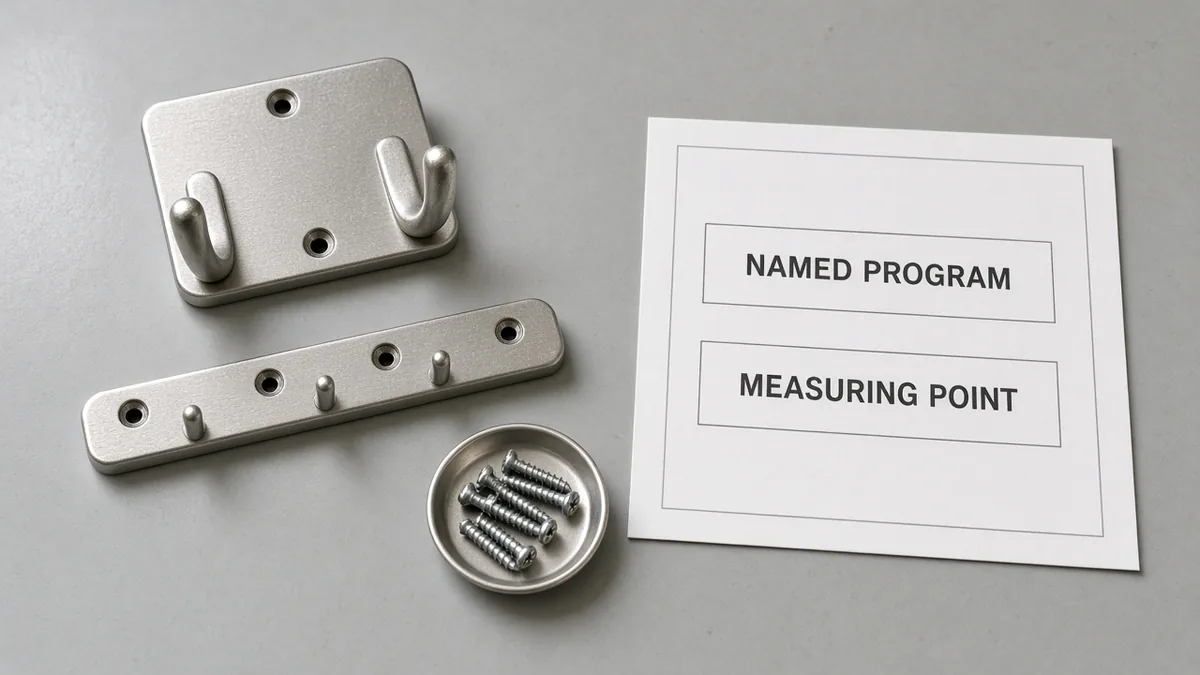
Double hooks, hook rails, and single hooks can share a program and still need a stated measuring point. A rail has more than one tip. Say whether the datum is the lowest tip, a nominated tip, or the rail centerline. Do not let a rail photograph imply a single-hook measurement, or the reverse.
Children’s entry hooks, staff coat hooks, and public corridor hooks are still program-and-datum questions, not a reason to invent a Koitor age chart. If a project names a required figure for one of those uses, cite that project. If it does not, keep the field named and leave the value blank.
A accesorios de baño de marca propia review is useful when the same finish family is being extended from a bathroom hook into an entry hook. Finish matching is not datum matching. A bathroom robe-hook height must not travel with the finish onto an entry SKU.
When may a figure be printed, and what must it cite?
A figure may be printed only after the program and the datum are named, and only if the figure is taken from a cited project rule or an official source and edition the buyer has authorized. A figure without a source is not a standard. It is an unsourced number on a carton.
Unofficial internet charts, retailer blogs, and forum averages are demand evidence. They show that buyers want a number. They are not a Koitor standard, and they are not an official source. Do not copy those inches onto an install sheet because they are familiar.
Accessibility commentary, including commentary built around grab-bar height, is also not this page’s target and not a source to borrow. An ADA or building-code determination is a project and qualified-professional question. This file may say that such a determination is out of scope. It should not issue one, and it should not reprint a grab-bar number as a coat-hook height.
| Program or claim | What must be named | When a figure may be printed | What this row is not |
|---|---|---|---|
| Residential entry or mudroom hook | That the program is a wall-mounted entry or mudroom coat hook, plus the reference surface and the point on the hook | Only if a cited project or official source and edition supplies the figure | A bathroom robe-hook chart, or an unofficial internet average |
| Hospitality or project coat hook | The project or brand program, and the datum the project uses | Only if the project rule or official source is cited on the sheet | A Koitor hospitality standard invented to fill a blank |
| Hook rail or double hook | Which point on the rail or which hook is the measuring point | The same citation rule as the program that uses the rail | A single-hook number copied onto a rail without naming the point |
| Bathroom robe hook | That this height question belongs on the live robe-hook height file | Not on this coat-hook sheet | A reused bathroom number printed as a standard coat hook height |
| Freestanding coat rack or hall tree | That the product is furniture, not a wall-mounted hook | Not on this wall-hook sheet; use the standing-rack neighbor | A wall-hook datum rewritten as furniture height |
Projection, spacing, and wet-load claims stay off this table. Those live robe-hook or partition files, when they are neighbors, should keep those decisions. This datum file may name a hook rail that is actually packed. It should not reprint a projection or load sentence to justify a height.
Do not fill a blank height field with a plant default. Until a cited source exists, keep the field named and leave the value blank. A blank field is safer than a familiar number that no one can defend.
Why are unofficial inch charts and accessibility commentary not a factory standard?
They are demand evidence and third-party commentary. Buyers search for a standard coat hook height because they want a number they can print. Quote those charts only as proof that the program and the datum must be named before any figure is used. Do not copy the inches, and do not treat a blog table as a Koitor rule.
A third-party official source may be cited when the buyer has authorized that source and edition. Label the citation clearly. It is not a Koitor standard, and it is not a substitute for the program line. If the edition changes and the carton does not, the figure is already stale.
Brand-navigational phrases, including phrases built around another company’s hook model, are not this page’s target. Describe the hardware in program and datum terms. Do not borrow a competitor’s height chart, or that chart’s search volume, as a Koitor standard.
Towel-hook height is also off this page, and it must stay off the bathroom robe-hook file unless it is separately validated. Do not borrow that volume, and do not invent a towel-hook number to sit beside a coat-hook sentence.
Which neighboring hook files should stay out of this sentence?
Bathroom robe-hook height stays on the live standard-robe-hook-height file. That href is not in the official lock-copy list used for this draft, so the file is named here in prose only. Do not invent an address for it, and do not reprint its bathroom chart as a coat-hook answer.
Robe-hook first install, double-robe-hook spacing, robe-hook projection, and robe-hook wet-load claims are also neighboring bathroom files, named here in prose only when they are missing from the lock copy. This entry and hospitality datum file should not absorb those bathroom decisions.
Toilet-partition coat-hook bumper checks stay on that partition file, again named in prose only if the lock copy omits the href. A partition bumper hook is a different product interface. Do not fold partition bumper geometry into this wall-hook datum.
Standing-rack sample checks stay on the live freestanding metal coat rack file already linked above. First-install kit questions for a wall hook, if they arise, are a packing question, not a reason to invent a height. This page freezes the datum, not a screw map and not a load test.
Grab-bar height and other accessibility queries are out of scope. They are a different product and a different regulatory question. Do not borrow their volume, and do not print a grab-bar figure as a coat-hook height.
What should be checked before a listing prints a standard height?
Check the program line, the measuring point, the product scope, and the source citation before any standard-height sentence is printed. If a figure is required and the source is missing, the sentence is not ready, even if the hook photographs well.

- Name the hanging program in plain language: residential entry or mudroom, or hospitality or project coat hook, before any height sentence is printed.
- Name the datum: the reference surface, usually the finished floor if that is the agreed surface, and the point on the hook, such as tip or backplate center.
- If the product is a hook rail or a double hook, say which tip, which hook, or which rail point is the measuring point.
- If a figure is required, cite a project rule or an official source and edition; do not fill a blank with an unofficial internet chart or a plant default.
- Keep the product limited to a wall-mounted hook or hook rail; do not let a standing rack, hall tree, or coat tree inherit this datum.
- Keep bathroom robe-hook height on the live robe-hook height file; do not reprint those numbers, and do not reuse them on an entry hook.
- Keep partition bumper checks, robe-hook projection, spacing, and wet-load claims on their neighboring files.
- Keep standing-rack questions on the live freestanding coat-rack file.
- Do not print an ADA, building-code, or grab-bar conclusion, and do not borrow accessibility volume.
- Do not invent an inch or millimetre chart, a load rating, or a current named Koitor hook SKU.
- Revise the standard-height line whenever the program, the datum, or the cited source changes.
Translations on a bilingual carton should follow the same named fields. A source citation that appears only in one language is not a citation in the other market. Review both languages against the same program and datum before the standard-height line is translated.
Incoming sample checks can use a simple artwork-to-drawing comparison: read the program line, the measuring point, and the source line, then confirm that no unsourced number has been added. That check is not a hang trial and not a load test. It only asks whether the published height can be believed.
If a later order adds an entry hook beside a bathroom robe hook in the same finish, treat the height field as a new field, not as a sticker change. The program, the datum, and the allowed source may all change. A bathroom robe-hook figure left on an entry carton will be believed, and it will be wrong.
The same discipline applies when a wall-hook program later adds a standing-rack offering, or the reverse. The hook shape may look familiar. The product is a new product. Reprint the program and datum fields, or point the rack to its own file, before the carton reuses an old standard-height line.
If the buyer does not yet have a project rule or an official source, the honest sheet names the program and the datum and leaves the figure blank, or it omits a numeric claim entirely. That is not a weaker sheet. It is a sheet that does not invent a standard.
Market-to-market wording should be checked as carefully as the figure. A hospitality program written for one region is not automatically a residential entry program in another region, even when the hook looks the same. Name the market with the program, and do not let a translated “standard height” line invent a new number that the source file never authorized.
Artwork sketches must follow the same datum discipline. A side elevation that implies a height without naming the point on the hook will be measured from whichever point is convenient on site. If the sketch is only a placement reminder, say so, and keep unsourced numerals off the sketch. The photograph in this article follows that rule: the labels name the program and the measuring point, and they do not print a figure.
Finish, projection, and hook count can change without changing the datum, and the datum can change without changing the finish. Treat those as separate fields. A new projection or a new double-hook body is not, by itself, a license to reuse an old height sentence, and a new height source is not a license to change the packed hook without a kit review.
Preguntas frecuentes
Can the listing print a standard coat hook height as a single number?
Only after the hanging program and the measuring point are named, and only if the figure is taken from a cited project or official source and edition. A familiar internet number is not a substitute for that citation. This article does not supply a Koitor inch chart.
Can the bathroom robe-hook height be reused on an entry coat hook?
No. Bathroom robe-hook height sits on the live robe-hook height file. This coat-hook file may point there by name. It should not reprint those numbers, and it should not treat a shared finish as a shared datum.
Does a hook rail need a different height file?
No. A rail is still a wall-mounted coat-hook program, but the measuring point must be named. Say whether the datum is a nominated tip, the lowest tip, or the rail centerline. Do not copy a single-hook figure onto a rail without that point.
What if the buyer asks for an ADA or building-code height?
That determination stays with the project and a qualified professional. This file may exclude it. It should not issue a regulatory conclusion, and it should not borrow grab-bar height as a coat-hook standard.
Where do standing coat racks belong?
On the live freestanding metal coat rack file, not on this wall-hook datum. A hall tree or coat tree is furniture. Do not print a furniture height on a wall-mounted hook sheet.
Does Koitor currently offer a named coat-hook catalog SKU or a factory height chart?
This article does not assert a current named production SKU, and it does not claim that Koitor publishes a universal height. Adjacent hook and storage OEM pages already sit in the published library. If you are screening this line, send the intended program, measuring point, and any project rule for review of wording and datum scope.
Trabaja con Koitor Hardware
Need a coat-hook height datum reviewed?
Send Koitor the hook drawing, the hanging program (entry, hospitality, or project), the intended market, and any project rule the sheet must mention. Our team can review the wording and the named datum, without issuing a universal height, a load rating, or an ADA determination. MOQ can start from about 100 pcs depending on the product; samples usually take 5-7 working days after details are confirmed; bulk production usually takes 4-6 weeks depending on the project.
OEM / MARCA BLANCA
Convierte esta guía de abastecimiento en un resumen del producto
Indícanos el producto que deseas, el tamaño, el acabado, la cantidad del pedido y los requisitos de embalaje. Tu equipo recibirá un análisis práctico de la viabilidad de fabricación antes de recibir el presupuesto.
 English
 Español
 Português
 Français
 Deutsch
 العربية