
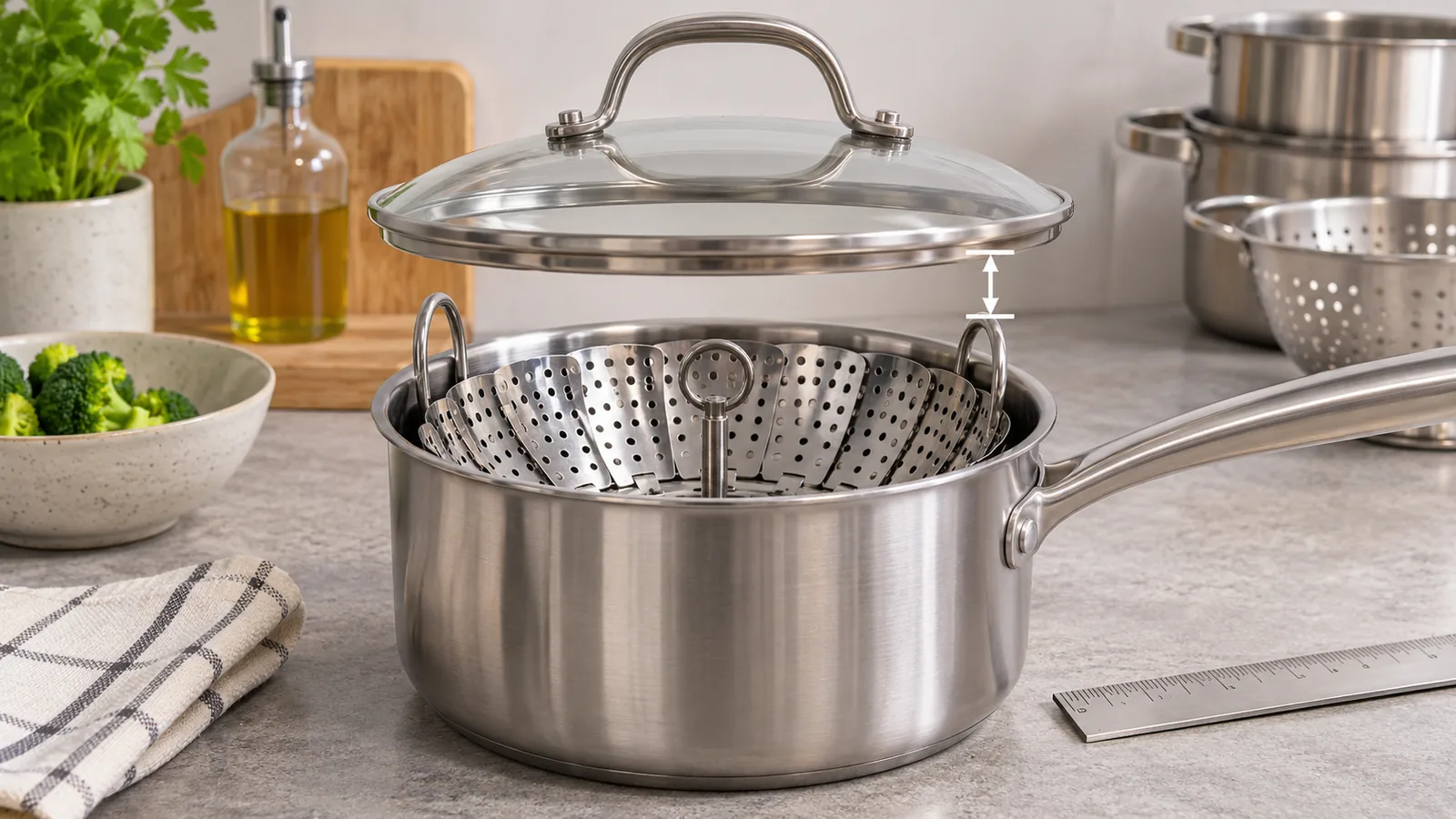
Steamer basket pot lid clearance should be specified as two related but separate interfaces: whether the basket or insert fits the intended pot system, and whether the chosen handle, knob, or frame position allows the intended lid to sit as the maker describes. A nominal diameter alone cannot establish either result. Importers should identify the pot reference, basket architecture, measurement datums, handle state, and lid configuration, then verify the exact combination using supplier documentation and a representative sample.
The procurement question is not simply “What size steamer basket is this?” A category may include a basket that rests on the pot rim, a perforated insert, a collapsible insert, a handled basket, or a model designed for a particular pot range. Some designs are offered with an extended handle; others have a central lifting feature or separate lid. A product-family brochure may show related parts together without proving they are included in one SKU or that every basket is compatible with every pot in the range. Quote and approve the actual system.
Here, steamer basket pot lid clearance refers to the exact buyer decision and product scope described in this guide. The phrase steamer basket pot lid clearance remains tied to the named model, evidence, and limitations above.
What does steamer basket pot fit mean?
Pot fit describes the physical relationship between the insert and the receiving cookware. Depending on the architecture, the buyer may need to verify inside diameter, rim support, bottom clearance, basket depth, pot wall taper, side handles, and the way the insert is removed. The measurement basis matters. A maker may publish the outside diameter of a basket, the maximum collapsed diameter, or the nominal pot size it is intended for. Those figures are not interchangeable unless the source defines them.
Start by identifying the exact cookware reference. If the steamer is sold as part of a pot series, record the manufacturer’s model numbers and any stated compatible models. If it is presented as a universal or adjustable insert, ask how the maker defines the range and which interface is adjustable. Do not infer a pot-size range by measuring a photograph or by assuming a round insert will fit any round vessel. Rim shape, taper, handles, and interior features can change the usable envelope.
A supplier’s product page can provide useful maker-declared features, but it is not a dimensional inspection of the importer’s target pot. A named series may state a size or handle feature that applies only to that model. The buyer should request a controlled drawing or a written dimension basis for the offered SKU, particularly when the product is intended to mate with a separately sourced pot. If the pot reference is proprietary or changes by market, identify it by model and revision in the RFQ.
| Fit interface | What to measure or identify | What not to assume |
|---|---|---|
| Pot opening | Inner rim diameter, shape, and relevant reference model | That a nominal capacity predicts the opening |
| Insert support | Rim contact, resting flange, feet, or other maker-described support | That similar outside diameters create stable support |
| Cuerpo de la cesta | Maximum outside envelope, depth, and any adjustable state | That one published diameter describes every position |
| Pot interior | Taper, shoulders, handles, and obstructions | That a circular plan view captures the full interface |
| Removal feature | Handle, central lift, tab, or included accessory | That visible clearance equals comfortable or safe handling |
The buyer should turn the relevant rows into model-specific requirements rather than copy the table as a universal standard. Where the supplier has no defined datum, mark it as unresolved and request clarification.
Why lid clearance is a separate question
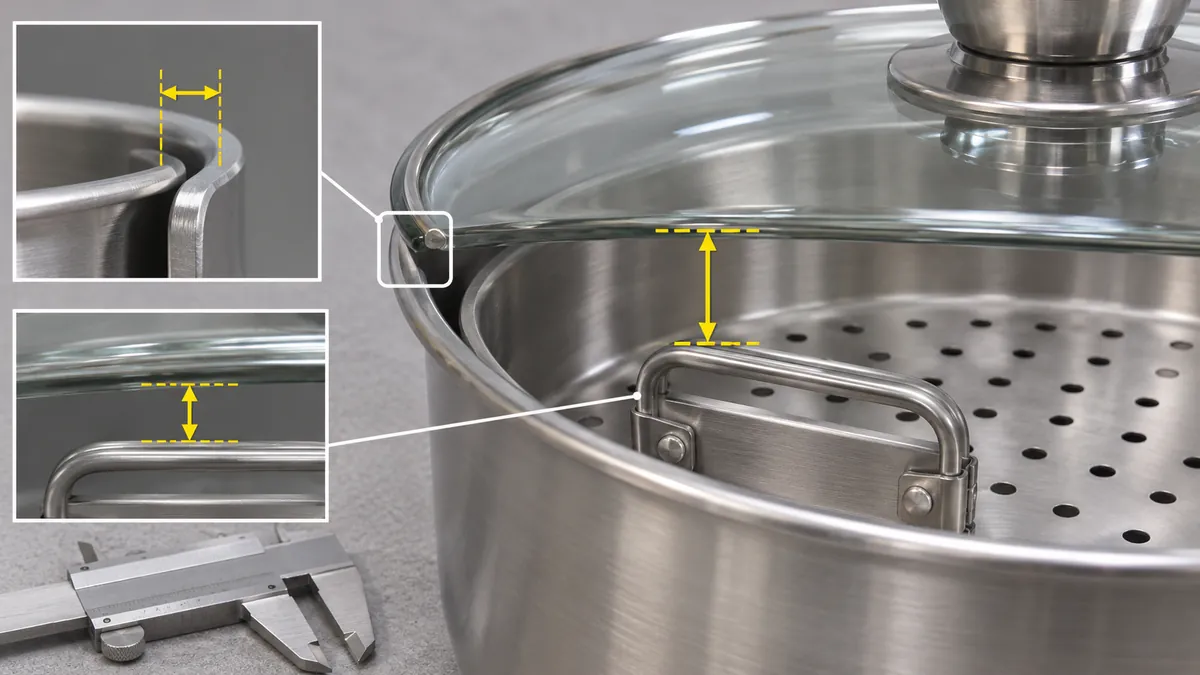
Lid clearance is the relationship between the loaded or installed insert, its handle or lifting feature, the pot rim, and the lid in the intended configuration. A basket can fit inside a pot and still interfere with a lid. A lid may fit the pot when empty but contact a handle or central knob when the insert is installed. Alternatively, the design may intentionally leave the lid partly raised or require the lid to be removed. The product maker’s instructions govern what arrangement is intended.
Record handle state as well as handle height. A folding handle may lie flat for storage but stand upright when used. A long side handle may project over the cookware rim. A central knob can sit above the lid plane. The question should state whether the comparison is made with the handle raised, folded, removed, or in another maker-specified position. A single measurement taken in the wrong state can make the sample appear compatible when the intended setup is not.
Do not assume that a small visible gap is enough, or that the lid should seal in every steamer configuration. Product descriptions may present a lid as an accessory, an optional component, or part of a cookware set. Confirm the exact lid model and whether the supplier’s stated use is with lid on, lid off, or a specified position. Avoid inventing steam-flow, temperature, food-safety, or cooking-performance claims from a fit observation.
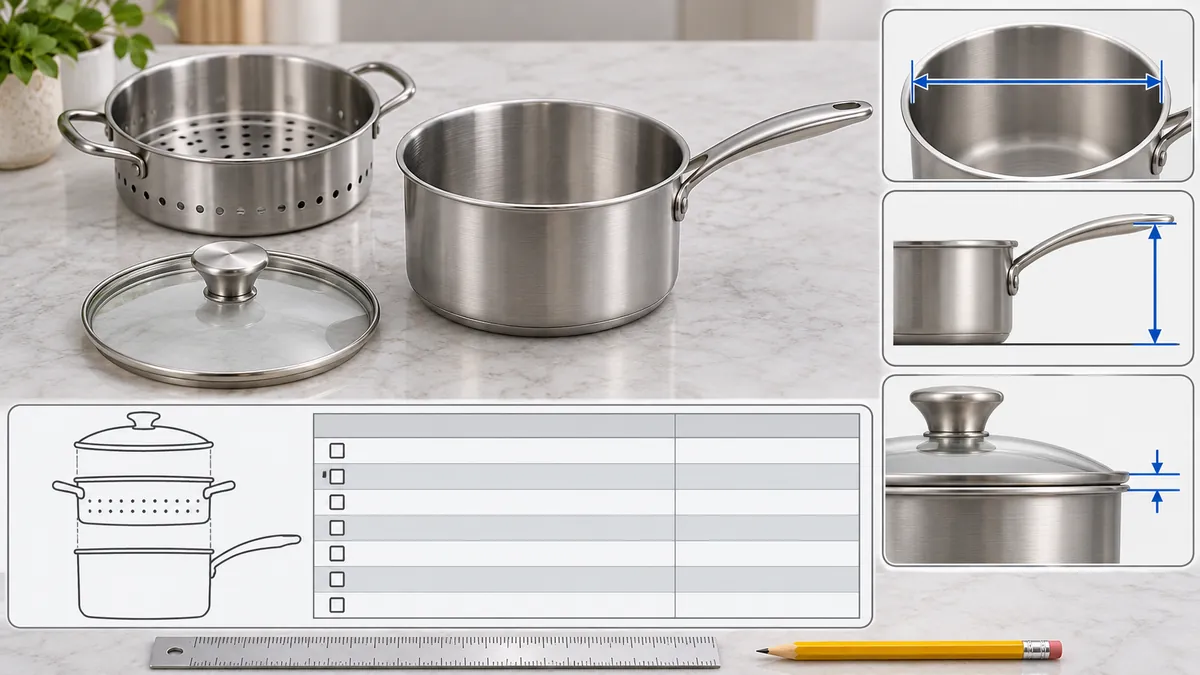
The following conceptual image illustrates the two interfaces. It is not a dimensioned drawing or proof that a particular basket fits a particular pot.
Create a comparable RFQ for basket and pot combinations
For a comparable quotation, send the supplier the target pot reference, relevant drawings or physical sample, and the intended lid and handle configuration. Ask the supplier to identify the offered basket model and the dimensions it uses to state fit. Where multiple pot models are relevant, list them separately; one successful combination does not automatically qualify all products in a family.
The RFQ can specify:
- Target pot manufacturer, model, revision, and receiving interface.
- Basket or insert architecture and exact supplier code.
- Outside and support dimensions, with the measurement locations defined.
- Intended handle position during use and storage.
- Exact lid or cover code and whether it is included or separately sourced.
- Clear statement of the configuration to be demonstrated in the sample review.
- Included parts, accessories, packaging, and user instructions.
- Any market-specific product claim requiring substantiation by the responsible supplier.
- Open fit questions, responsible reviewer, and approval date.
Avoid shorthand like “fits 20 cm pots” unless the supplier and buyer define how the size is measured and which interface the number refers to. Nominal capacity, top diameter, bottom diameter, and the insert’s maximum span describe different properties. If a supplier uses a cookware-series label, keep the label with the named models rather than treating it as a universal dimension.
For a distributor comparing offers, normalize scope before comparing price. One offer may include basket, lid, and accessory; another may supply an insert only. One may be an adjustable model with a stated range; another may be fixed. Request the bill of materials and pack count. An attractive unit cost can be misleading if the buyer must source an unquoted lid or adapter separately.
How to inspect a sample without overclaiming
Use the exact pot, insert, handle, and lid references identified in the RFQ. First confirm sample identity and compare the sample with the drawing or product description. Then place the insert according to the maker’s instructions, observe its support interface, and check the stated handle position and lid arrangement. Record contact, interference, and any missing parts. If the supplier offers several variants, mark each sample independently; a fit result from one model should not be transferred to another.
The buyer should agree what counts as acceptable before the inspection. For example, the requirement may be that an insert rests on a specified rim, does not contact named side handles, and permits the approved lid to reach the stated position. Such requirements should be project-specific and reviewed by the product owner. Do not introduce an undocumented force, clearance, or safety tolerance after seeing the sample and then treat it as a contractual failure.
A visual sample check is useful for obvious fit and scope issues, but it is not a thermal test, cooking trial, food-contact evaluation, or proof of long-term service. If the supplier advertises oven use, dishwasher suitability, steam performance, or another claim, ask for evidence scoped to the exact model and the target market. A separate Koitor guide discusses the limits of oven-safe claims for cooling racks; that framework is relevant to evidence discipline but does not qualify a steamer basket.
Keep an approval record with photos from repeatable views: basket alone, pot interface, handle in intended state, and the lid configuration. Note the model, date, drawing revision, and person who approved the sample. If a changed handle, rim, insert size, lid, or coating is introduced later, ask the supplier whether the previous fit review still applies. The buyer should re-evaluate the changed interface rather than assume it is immaterial.
Common mistakes that create fit disputes
Using capacity as a substitute for dimensions. A pot’s capacity does not reveal its inside rim profile or insert support location. Request the actual relevant dimensions and reference model.
Checking the basket but not the pot system. An insert can be within its own drawing limits and still fail to match the target cookware. Identify the receiving pot and lid before approving the SKU.
Measuring the handle in the wrong state. A foldable or removable handle can occupy different envelopes. State whether fit is evaluated in storage or use position.
Treating a family brochure as a kit list. Related cookware may be shown together even when sold separately. Confirm the order code, included items, and packaging scope.
Assuming “universal” means every pot. The supplier may intend a bounded set of models or a defined adjustment range. Ask for the actual range and exclusions.
Turning a sample observation into a performance claim. A lid that appears to sit in one setup does not prove cooking performance, safety, or all-model compatibility. Keep claims within documented evidence.
Ignoring revision control. A pot, basket, handle, or lid can change independently. Link approval to the exact models and revisions in the buyer’s file.
Buyer decision table for assortment planning
When the category includes more than one steamer format, make the product-role distinction visible to merchandising, purchasing, and customer-service teams. A fixed basket, a collapsible insert, and a handled pot-series insert may solve different problems and require different fit data. Do not combine them under one generic size label if the included cookware, handle position, or storage architecture differs.
| Assortment question | Acción del comprador | Record to keep |
|---|---|---|
| Is the basket tied to a named pot series? | Confirm model list from the maker | Dated compatibility statement |
| Does it adjust or collapse? | Identify the defined use and storage states | Dimensional drawing for each state |
| Is the handle clear of the lid? | Review the specified use state with the exact lid | Sample photos and approval note |
| Are parts shared across variants? | Ask whether codes and revisions are common | Controlled BOM or supplier confirmation |
| Who owns the claim? | Identify the responsible supplier and reviewer | Evidence, scope, and approved copy |
For private-label development, align the product name and image with the actual configuration. If the package depicts a lid but the lid is not included, the artwork can create a scope mismatch. If the product description claims compatibility with a pot series, the listing should identify which models are covered and avoid implying a broader range than the maker supports.
Product-family and change-control questions
When the buyer expects to reorder, ask what controls the basket and pot interface over time. The question is not merely whether the initial sample fits. It is whether later purchases retain the same model identity, drawing revision, handle shape, finish, included parts, and compatible lid reference. The supplier may use a product code, drawing, or controlled catalogue description; retain whichever reference actually governs the offer.
If the supplier proposes a substitute, compare the receiving interface and complete use configuration again. A similar basket diameter may have different taper, support rim, feet, or handle position. A different lid may have a changed rim or knob. A substitution can therefore require a new sample review even if the product family name remains unchanged. Define in the order terms which changes require notification and approval.
The buyer should keep component procurement and finished-set procurement distinct. A replacement insert may be sold without a lid or pot, while a cookware set may include both. A buyer should not assume an insert code means a complete cooking system. If multiple suppliers provide the parts, identify who verifies their interface and who owns the combined-product statement. A component supplier’s dimensional declaration does not automatically certify the assembled system.
For a buyer’s internal records, the minimum useful change note identifies the affected SKU, the old and proposed models, changed interface, expected effect on fit, sample status, claim review, and approval owner. When no change is made, record that the supplier confirmed the current model rather than relying on a verbal recollection. These controls make future reorders easier to compare and help customer-service teams identify which pot a customer actually owns.
Decide what “compatible” means for the buyer
Compatibility needs an observable boundary. A buyer might require the insert to rest on a named pot rim without using a separate adapter. Another brief may allow a supported insert within a stated diameter range, or may require the lid to remain usable with the basket installed. Write the intended condition in plain language and ask the supplier to respond against it. Avoid using “compatible” as a stand-alone pass criterion because different parties may mean storage fit, physical insertion, support, lid closure, or a complete cooking arrangement.
If the range includes multiple pots, build a matrix instead of asking for a blanket statement. List each pot model in rows and each insert variant in columns. Mark the maker-confirmed pairings, the combinations checked with a sample, and the combinations not reviewed. Do not fill untested cells based on a shared series label. A matrix makes scope and omissions visible to purchasing and customer service and can be updated when one pot or insert changes.
The product team should also decide whether a compatibility list is a product claim or an internal selection aid. If it appears in package artwork, online listings, or a sales catalogue, the wording needs a responsible owner and current evidence. If it is used only in a buyer’s internal assortment file, it still needs the model identity and source date so the claim does not become public copy later without review.
For a private-label range, consider the buyer’s returns and support process. If customers are likely to own different cookware models, the product page should tell them how the fit reference is defined and which models are confirmed. Avoid implying that all products with a certain capacity or nominal diameter will fit. Customer-service teams should have access to the same compatibility matrix that product and purchasing approved, and should know how to escalate an unlisted pot model rather than improvising a fit answer.
Distinguish dimensional checking from use validation
Dimensional inspection can confirm that a sample’s measured dimensions match an agreed drawing within the defined measurement method. It cannot alone show that the product performs correctly in every cookware combination or that the claimed cooking use is appropriate. The buyer should describe what evidence is needed for the specific decision: a drawing review for dimensional alignment, a sample fit check for a named pair, or separate qualified testing for a performance or regulatory statement.
The sample setup should be repeatable. Use the actual pot, basket, lid, and handle state. Place the parts as directed by the maker, record the sequence, and photograph the points of support and any interference. If a measurement is taken, include the instrument, datum, and product condition. A measurement without a defined location can create false precision and disagreement between supplier and buyer.
Do not treat a lid resting in one position as proof of sealing, steam behavior, or safe operation. Do not infer that a raised handle is cool to touch or that a particular gap is adequate for every cooking method. Those are separate claims that require the responsible maker’s instructions and, where necessary, appropriate test evidence. The purpose of the sourcing check is to make the combination and unknowns clear, not to replace cookware engineering or cooking validation.
When a sample fails the agreed fit condition, record the exact observed interface and avoid vague feedback such as “basket too big.” The issue might concern outer rim diameter, support height, pot taper, handle projection, or lid geometry. A specific observation helps the supplier identify whether the change belongs to the insert, cookware, accessory, or package contents. It also reduces the chance that a correction to one interface creates a new issue elsewhere.
Preguntas frecuentes
Does a 20-centimeter steamer fit every 20-centimeter pot?
Not necessarily. The quoted number may refer to a nominal category or a particular dimension. Fit depends on the maker’s measurement basis, the pot’s inner profile, support interface, and the insert architecture. Confirm the exact models or drawings.
Can a basket fit a pot but still prevent the lid from closing?
Yes. Pot fit and lid clearance are separate interfaces. A handle, central knob, basket rim, or cover geometry can interfere in a particular use state. Review the exact configuration and follow the maker’s instructions.
Should importers request a universal cookware fit claim?
Only if the supplier defines and substantiates the covered range. A single sample or nominal diameter does not support a universal claim. List named compatible models or the supplier’s controlled fit range and preserve exclusions.
Are the basket and lid always sold together?
No. Product-family pages and images may show items that are optional or separately sold. Confirm the exact order code, bill of materials, pack list, and quote.
Does this article establish that Koitor manufactures steamer baskets?
No. The guide addresses adjacent kitchenware sourcing. Koitor’s confirmed scope remains bathroom and home-storage metal hardware, and steamer-basket capability is not established.
Sources
- Contacto steamer basket category — maker category and model-specific dimensions/features.
- OXO Kitchen Gadgets 2024 brochure — dated product-brochure examples of handle and product configurations.
- Koitor expandable dish rack fit guide — separate owner for sliding dish-rack adjustment and retention.
- Koitor cooling-rack oven-use evidence guide — claim-scope discipline only; it does not qualify cookware inserts.
Trabaja con Koitor Hardware
Discuss a confirmed metal hardware scope
Share the drawing or physical sample, target application, metal-component requirements, and intended order range. Koitor will first confirm whether the product fits its established bathroom and home-storage manufacturing capabilities.
OEM / MARCA BLANCA
Convierte esta guía de abastecimiento en un resumen del producto
Indícanos el producto que deseas, el tamaño, el acabado, la cantidad del pedido y los requisitos de embalaje. Tu equipo recibirá un análisis práctico de la viabilidad de fabricación antes de recibir el presupuesto.


 English
 Español
 Português
 Français
 Deutsch
 العربية