

The supply chain vs logistics distinction is one of scope: a supply chain is the broader network and set of activities that connect sourcing, conversion or production, and distribution. Logistics focuses on planning and managing the movement, handling and storage of goods and related information within that broader network, including relevant forward and reverse flows. In practice, company teams and service providers may use the terms differently, so importers should define the actual decisions, responsibilities and handoffs instead of relying on a department name. For a metal bathroom or home-storage product, choosing a component or approving a drawing is a different decision from booking a pickup or arranging warehouse handling, even when both affect the same order.

What is the difference between a supply chain and logistics?
The supply chain describes the wider network that connects organizations, activities and resources involved in getting a product from inputs to the user. Logistics is a related function concerned with planning and controlling the movement, handling and storage of goods and associated information. Logistics is part of the practical work that makes a supply network operate, but a logistics booking does not automatically control every sourcing, engineering, production or commercial decision.
The distinction is about scope, not importance. A shipment can depend on a supplier’s production readiness, a buyer’s approval, a warehouse slot, a carrier’s capacity and the consignee’s receiving plan. Logistics activities connect several of those steps. The wider supply chain also includes choices such as which supplier is engaged, which specification governs, how a product is made, how changes are approved and how a distribution network is organized. Some businesses combine these responsibilities in one department; others assign them to separate teams or outside providers.
For a current industry explanation, DHL’s logistics overview places logistics activities in relation to sourcing, conversion and distribution. It is one provider’s explanatory source, not a contract definition for every organization; actual scope still comes from assigned work and agreements.
Definitions vary across organizations and service offerings. One provider may use “supply chain” to describe a broad bundle of services, while a buyer may use it to mean the full network of suppliers and operations. Another provider may specialize in transport, customs coordination, warehousing or visibility tools. The title on a business card does not establish authority over the whole chain. A buyer should ask what the party actually controls, what it only arranges and which decisions remain with the buyer or manufacturer.
| Term | Useful working meaning | Example in a hardware order | What the term alone does not prove |
|---|---|---|---|
| Supply chain | Wider network and connected activities from inputs through conversion and distribution | Material sources, hardware manufacturer, packaging supplier, warehouse and receiving operation | That one company owns or controls every party and decision |
| Logistics | Planning and managing movement, handling, storage and related information | Pickup, consolidation, storage, shipment status and delivery handoff | That the logistics provider approves product design or manufacturing changes |
| Supply chain management | Coordination of broader network activities and relationships | Aligning approved specification, order timing, production readiness and distribution plan | A universal organization chart or identical responsibility boundary |
| Logistics management | Managing relevant goods and information flows within the network | Coordinating transport, handling, storage and receiving information | That logistics means transportation alone |
The supply chain vs logistics labels help organize a conversation, but they are not a contract. The purchase order, service agreement, product specification and project communications define actual obligations and authority. If a buyer needs to know who owns an approval or a delivery decision, the documents and named decision makers matter more than a broad label.
Which decisions belong to the wider supply chain?
Supply-chain decisions can include supplier selection, product specification, production planning, component sourcing, change control, quality evidence, packaging coordination, inventory strategy and distribution relationships. Which decisions sit with which organization depends on the project. A factory may be responsible for making an approved product and confirming its own production status, while the buyer selects the design, authorizes revisions and appoints a separate transport or warehouse provider.
Consider a hypothetical order for a metal shower basket and towel bar. Before production, the buyer and manufacturer may need to clarify the drawing revision, dimensions, finish, supplied components, sample approval and packaging expectations. Those decisions affect the product and the terms on which it is made. A separate freight partner might later coordinate pickup, consolidate cartons from multiple suppliers, store freight or provide status updates. That logistics work connects the order to downstream movement, but it does not by itself approve a hole change, substitute a metal grade or decide that a sample revision is acceptable for mass production.
This boundary matters because a buyer can confuse visibility with control. A tracking screen may show a shipment milestone without proving that the product met a drawing. A warehouse receiving report may count cartons without confirming every component inside. A delivery appointment may be booked without changing the supplier’s production commitment. Each record can be useful, but it answers a different question.
For every important activity, assign four things: the person or organization responsible for performing it, the person authorized to approve it, the evidence that records completion and the escalation path when it is late or incomplete. A simple responsibility table can expose gaps before they affect an order.
| Activity | Responsible party to identify | Approval or decision owner | Evidence to agree in advance |
|---|---|---|---|
| Drawing and product revision | Product team and relevant manufacturer | Buyer or named engineering approver | Controlled drawing, revision history and written approval |
| Material and component sourcing | Contracted supplier or manufacturer, as specified | Buyer when the purchase specification requires approval | Purchase specification, supplier declaration or agreed records |
| Production readiness | Manufacturer for its own production status | Buyer for any required pre-production release | Approved sample, production schedule or release record |
| Shipment pickup and transport | Appointed logistics provider or carrier | Buyer or authorized logistics coordinator | Booking, pickup record and transport documents |
| Warehouse receiving | Named warehouse or consignee | Inventory owner or receiving team | Carton count, condition record and discrepancy process |
The table is a planning aid rather than a universal responsibility matrix. A contract may assign tasks differently. Its purpose is to prompt specific questions before a shipment is moving: who will take the action, who can authorize a change and what record will show what actually happened?
Does logistics mean transportation only?
No. Logistics can include planning, handling, storage and coordination of information associated with goods, as well as transport. The exact service scope depends on the provider and agreement. A buyer should ask whether the quoted service includes pickup, consolidation, warehousing, shipment visibility, delivery scheduling, returns handling or only a defined transport leg.
Why do buyers confuse logistics with the whole supply chain?
The terms overlap in everyday conversation because goods move through connected stages and people often describe a shipment problem as a “supply chain issue.” A delayed truck can affect production or retail availability, but the cause may sit upstream in purchasing, supplier readiness, a quality hold, incomplete documents or warehouse capacity. Naming the whole problem “logistics” can hide the source; calling every coordination issue “supply chain” can be too broad to assign action.
The fastest way to clarify the issue is to describe the event and the decision required. Instead of saying “the supply chain is delayed,” identify whether the order is awaiting a drawing approval, a supplier completion notice, a pickup slot, a consolidation decision, an import-document handoff or a receiving appointment. Then identify the owner of that step. This language reduces the chance that multiple parties assume someone else is acting.
Common sources of confusion include:
- Provider names that describe a service bundle. A provider may market supply-chain services while handling only a contracted portion of the buyer’s network.
- A single dashboard showing multiple milestones. Visibility can combine supplier and carrier data, but a dashboard does not make its operator responsible for every milestone.
- One team performing several roles. A buyer’s sourcing team may coordinate purchase orders, production follow-up and freight, but the activities remain distinct.
- The same event affecting several functions. A packaging change can alter carton dimensions, warehouse handling and freight planning. The parties need to coordinate, while the decision authority still needs to be explicit.
- Unclear use of “management.” Supply-chain management is a broad coordination concept; logistics management concerns a related set of flows and storage activities. Actual job scopes differ.
When comparing proposals, ask providers to map the service in plain language. Which origins and destinations are covered? Who selects or approves carriers? Who books storage? Who handles a discrepancy? Does the provider transmit status only, or can it authorize a change? What is outside the service? These questions are more useful than assuming that a label includes every related task.
How should importers map product and shipment responsibilities?
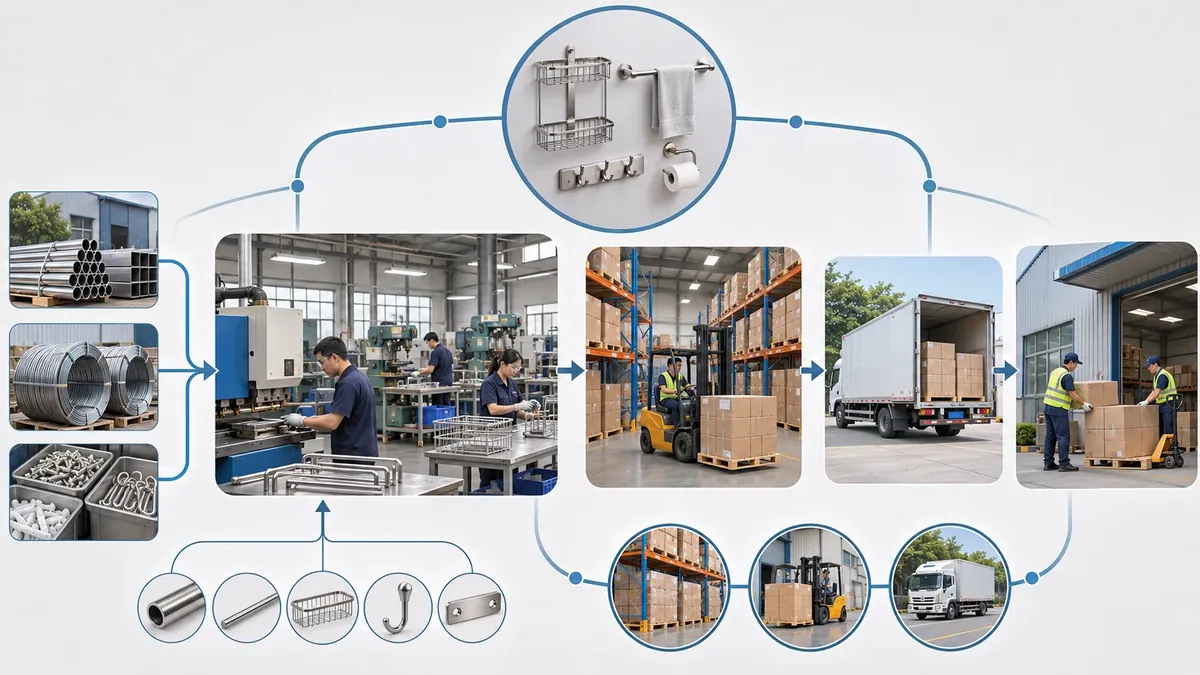
Importers can separate product decisions from movement and storage decisions while mapping the handoffs between them. Start with the approved product and purchase order, then trace the information and physical goods through the named organizations. At each handoff, identify the trigger, the accountable party, required evidence and the person who can release the next step.
For example, an importer of custom metal bathroom hardware may need to coordinate with a factory on the controlled drawing and packaging specification. If several suppliers contribute products, the buyer or an appointed consolidation provider may align pickup windows. A warehouse may count cartons and record visible damage. A carrier may transport the goods. The importer then reconciles the received items against purchase orders and shipping records. The product specification remains a separate reference throughout; a shipment milestone is not a substitute for product acceptance.
A practical handoff map can include:
- Specification release: identify the current drawing, bill of materials or purchase specification and who approved it.
- Supplier commitment: record which organization supplies each product or component and what production evidence it will provide.
- Readiness notice: agree what “ready” means, who confirms it and what open quality or packaging issues must be resolved first.
- Pickup and consolidation: identify the coordinator, suppliers included, carton information and cutoff for changes.
- Transport and storage: record the contracted legs, handling requirements, expected milestones and responsible service providers.
- Receiving: define how quantity, carton condition and discrepancies are recorded, and who receives the information.
- Reconciliation and follow-up: compare actual receipt to the order and pack-out records, then route product or shipment issues to the party able to investigate them.
For multi-supplier freight, the shipment consolidation guide addresses readiness information buyers should collect before combining pickups. For downstream quantities and order status, the in-transit inventory and open purchase-order guide explains the records buyers may reconcile. These resources cover specific operational tasks; they do not redefine the broader supply-chain relationship.
What should a buyer ask a logistics provider?
Ask the provider to define its scope, authority, information inputs, service boundaries and exception process. The point is not to force every provider into one definition. It is to understand the specific tasks being purchased and how the provider’s work connects to suppliers, warehouses and the buyer’s own team.
Useful questions include:
- Which transportation legs, pickup points and delivery locations are included?
- Does the service cover consolidation, temporary storage, handling, delivery scheduling or returns, and under what terms?
- Which information must the buyer or supplier provide before a booking is accepted?
- Who can approve route, carrier, packaging or appointment changes?
- How are missing cartons, visible damage, late readiness or documentation discrepancies reported?
- Which milestones come from the provider, and which depend on supplier or third-party updates?
- What service records will be available to the buyer after each handoff?
- Which responsibilities remain with the buyer, product supplier or consignee?
Answers should be recorded in the agreement, operating instructions or order-specific communication. A verbal description can be useful during planning, but buyers should make the final scope easy for each party to reference. If the provider cannot authorize a design or production decision, state who can. If the provider only transmits supplier data, clarify who verifies it.
How does a China OEM factory fit into the network?
A China OEM factory can be one production node in a buyer’s wider supply chain. Its role should be described through the product and service it has actually agreed to provide. Koitor Hardware is a family-owned custom metal hardware factory focused on bathroom and home-storage products. Its relevant work can include reviewing an approved drawing or sample, discussing metal construction and finish, manufacturing within confirmed project scope, assembly and packaging preparation. The factory should not be described as the buyer’s carrier, freight forwarder, warehouse operator or supply-chain consultant unless a separate verified agreement establishes such a role.
That boundary helps buyers route questions. A drawing revision or sample comparison belongs with the product and manufacturing decision makers. A pickup booking belongs with the appointed logistics coordinator. A warehouse discrepancy belongs with the receiving party and inventory owner. Some issues cross those boundaries: if carton dimensions change, the product supplier needs to provide accurate pack-out information and the logistics party may need to revise the booking. Coordination does not erase the need for a named decision owner.
For a custom project, provide the factory with the current drawing or physical sample, target dimensions, finish expectations, required supplied components, sample approval process, packaging instructions and any buyer inspection criteria. For logistics planning, separately provide confirmed carton dimensions, gross and net weights where available, quantities, pickup readiness and destination requirements to the party handling shipment. Do not ask one party to infer information another party controls.
If the buyer needs a project-specific review of a metal product, it can share the drawing, sample and unresolved requirement with a qualified manufacturer. The review should remain within the product and manufacturing facts that are available. A factory’s ability to discuss a product does not by itself establish customs authority, transport capacity, service levels or control over an external provider.
What mistakes should importers avoid?
A practical supply chain vs logistics review begins by treating scope labels as prompts for questions, not proof that a party owns every connected activity. A buyer can prevent that problem by documenting scope and handoffs. Other common errors include:
- Assuming the provider’s name defines its authority. Confirm each service and decision in its agreement.
- Using a shipment status as product approval. “Picked up” and “delivered” are logistics milestones; they do not establish material, finish, dimensions or assembly acceptance.
- Treating a ready date as a pickup date. Production completion, quality release, packaging readiness and carrier collection can be separate events.
- Failing to define data ownership. A carrier may show a milestone but rely on a supplier, warehouse or customer for the underlying update.
- Mixing responsibility with visibility. Receiving a copy of a report does not necessarily make its recipient responsible for investigating or approving the event.
- Making a change through the wrong channel. A freight booking change should not silently revise a product drawing, and a drawing change should be communicated to the parties affected by packaging and transport.
- Skipping an exception owner. Define who acts when a supplier misses readiness, a pickup fails, cartons differ from the ASN or visible damage is found.
The buyer should also distinguish observed evidence from assumptions. If a carton count differs, record the received quantity and packaging condition before concluding why. If a shipment is late, collect the relevant supplier and carrier milestones before assigning a cause. If a product has a defect, preserve the sample or photographs and compare them with the approved specification. A clear record helps the responsible party investigate without turning a timing or handling event into an unsupported product claim.
Buyer checklist for supply-chain and logistics scope
Before issuing a purchase order or shipment instruction, check the following:
- Name the supplier and service provider for each product, component, transport leg, storage step and receiving location.
- Record the approved product specification and the authority for each revision.
- Define the evidence required for production readiness, product release, pickup and receiving.
- Confirm whether consolidation, storage, handling, shipment visibility and delivery scheduling are included in the logistics scope.
- Identify who may authorize changes to bookings, product requirements, cartons or delivery appointments.
- Provide accurate quantities, carton dimensions and other required booking data from the party that controls them.
- Define how the team reports delays, missing cartons, damage, discrepancies and open quality issues.
- Set a named owner and response path for every exception.
- Keep shipment milestones, manufacturing records and incoming product acceptance as separate records that can be reconciled.
- Reconfirm roles when the supplier base, delivery plan or order configuration changes.
Preguntas frecuentes
Is logistics only transportation?
No. Logistics can cover planning, handling, storage and coordination of information associated with goods, in addition to transport. The exact scope depends on the service agreement and operating arrangement.
Does a logistics provider manage the entire supply chain?
Not automatically. A provider may support a defined part of the network or offer a broader contracted service. The buyer should confirm which activities, decisions and exceptions the provider owns and which remain with suppliers or the buyer.
Does booking a shipment approve a drawing or production change?
No. A transport booking concerns the movement plan. Product drawings and manufacturing revisions need approval from the authority named in the product and purchase documents. If a product change affects carton size or readiness, communicate the approved change to the logistics party as a separate handoff.
Can supply-chain and logistics responsibilities sit in one team?
Yes. An organization may assign multiple related activities to one team or provider. The activities still have distinct evidence and decision points, so written scope remains useful.
What should an importer do when a delivery is late?
Identify the delayed milestone, collect the supplier, warehouse and carrier records relevant to that step, and route the issue to the party responsible for acting. Avoid assigning a cause until the available records support it.
How should an importer work with a China OEM manufacturer?
Share controlled product drawings or samples, component and finish requirements, approval steps and packaging expectations with the manufacturer. Give shipment and warehouse instructions to the appointed logistics and receiving parties, while coordinating any approved product or packaging changes across them.
Trabaja con Koitor Hardware
Koitor Hardware is a family-owned custom metal bathroom and home-storage hardware factory. For a product or packaging question, share the drawing or sample, the confirmed component and finish requirements, and the unresolved project decision. Koitor can review whether the metal hardware request fits its current OEM scope; transport and logistics responsibilities must be confirmed with the appointed providers.
Review a Hardware Sourcing Requirement
Share the drawing or sample, confirmed product and packaging requirements, and the open manufacturing question. Koitor can review whether the metal hardware project fits its current OEM scope.
OEM / MARCA BLANCA
Convierte esta guía de abastecimiento en un resumen del producto
Indícanos el producto que deseas, el tamaño, el acabado, la cantidad del pedido y los requisitos de embalaje. Tu equipo recibirá un análisis práctico de la viabilidad de fabricación antes de recibir el presupuesto.


 English
 Español
 Português
 Français
 Deutsch
 العربية