
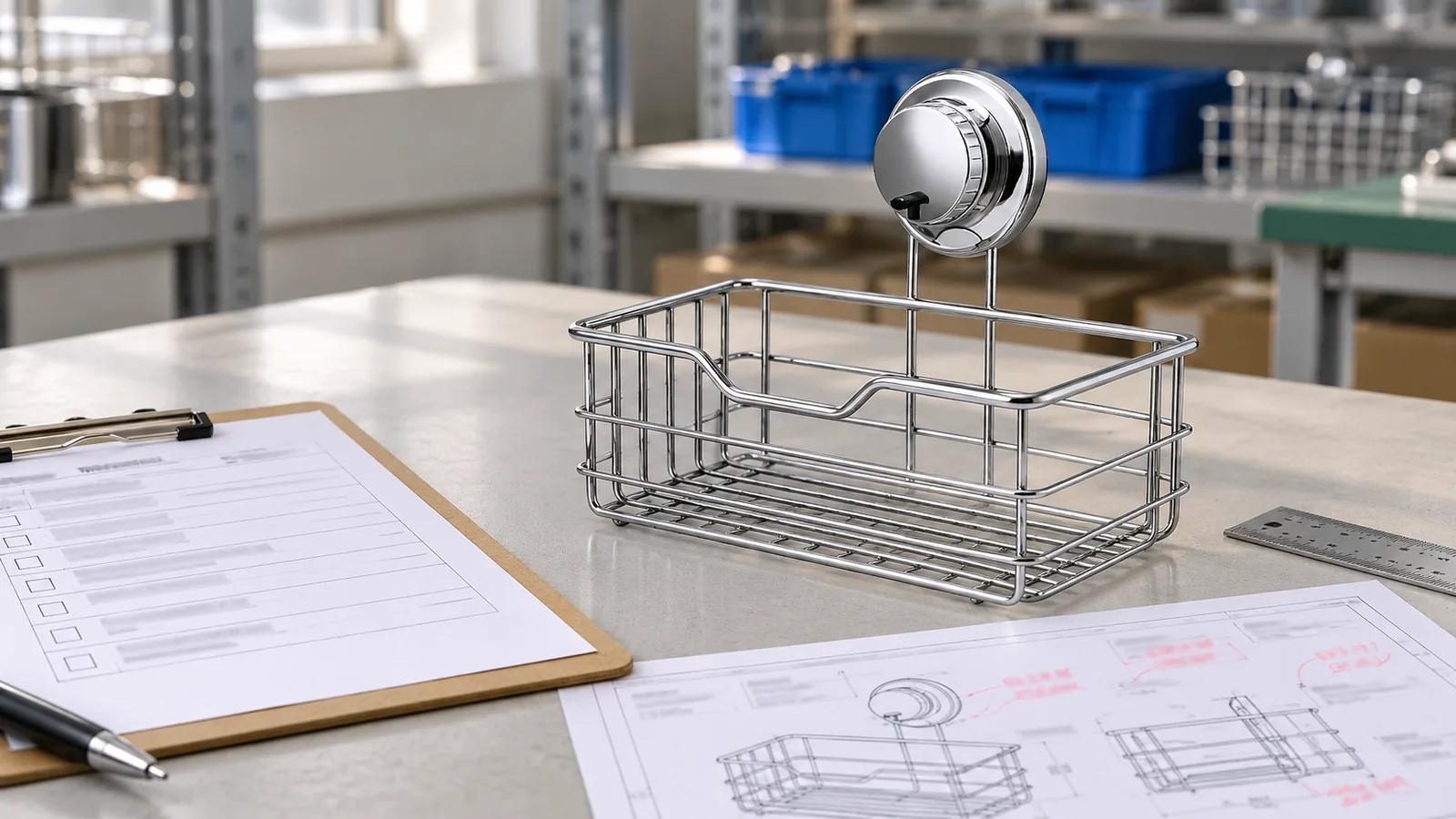
A search for “factory audit China” is only a starting point for a buyer evaluating a metal bathroom or home-storage hardware supplier. The useful question is whether the named site can control the operations that matter to a particular product revision—and whether records connect those controls to that SKU. A technical factory audit China buyers commission should therefore follow the product route, not stop at a tidy workshop or a folder of certificates. It can reveal evidence and gaps in site-level processes; it cannot guarantee that every later order will match an approved sample or pass a shipment inspection.
What can a technical factory audit tell a hardware buyer?
A technical audit can help a buyer assess whether responsibilities, instructions, equipment or fixtures, measurement methods, records, and corrective actions are defined for the operations in scope. It is a structured review against agreed criteria, using evidence that can be checked. The audit’s conclusion is only as useful as its objective, criteria, sample, time window, site coverage, and access to records.
For a metal storage product, the audit should connect three things:
- The commercial identity: the legal supplier, the actual production location, any other location involved, and the person responsible for the product.
- The product identity: SKU or model, drawing revision, approved sample, finish, packaging version, and the order or production period being considered.
- The process evidence: the applicable operations, who controls them, what requirements they follow, what records show, and which steps are performed by another site or subcontractor.
That link is the difference between a facility tour and a buyer decision. A supplier may demonstrate one welding station, for example, while the quoted item uses a different joint or is finished elsewhere. A certificate may describe a management system’s scope, but it does not by itself show that a specific wire basket’s dimensions, weld positions, finish, or carton configuration are controlled as agreed.
The current ISO 19011:2026 guidance for auditing management systems provides a framework for audit principles, programs, and audit conduct. ISO describes it as guidance; it does not itself confer certification. A buyer can use its concepts—defined scope, criteria, verifiable evidence, and recorded findings—without claiming that ISO 19011 prescribes a universal factory checklist or certifies a supplier.
How should buyers scope a factory audit China review?
Treat the phrase “factory audit China” as a search label, not a complete audit scope. Before booking a review, write a one-page brief stating the decision you need to make, the product and revision, the site, the operations to include, the time period, the records to sample, and the exclusions. If the supplier proposes a different location, process, or sample, record that change before the audit rather than quietly treating it as covered.
A practical brief should answer:
- Objetivo: Is this a first supplier qualification, a follow-up to a corrective action, a review before sampling, or a check before a larger order? Each purpose calls for different evidence.
- Criteria: Which drawing, purchase specification, packaging specification, approved sample, buyer procedure, or applicable system requirement will be used as the reference? Avoid vague criteria such as “good quality.”
- Scope boundary: Which address, building, department, shift, process, product family, and date range are included? Name any operation performed at a separate location or by an outside provider.
- Access: Which records, staff, work areas, and samples can be reviewed? What must be redacted or kept confidential? What happens if requested evidence is unavailable?
- Output: Require a record of the evidence sampled, findings, limitations, photographs if authorized, and corrective-action owner and due date. An overall rating without its basis is hard to act on.
A broad supplier-quality audit China request can otherwise expand into unrelated company-wide questions while missing a product’s actual failure risks. Keep the scope proportional: a simple welded wire rack may need a different process map than a multi-part bathroom organizer combining formed sheet, wire, coated components, purchased fasteners, and a separate packaging supplier. The “factory” is not automatically one address or one integrated route.
The scope also needs a stop rule. If the named site cannot show the relevant operation or the buyer’s specified evidence, record that as an unresolved scope limitation or finding. Do not infer that another department, a supplier’s presentation, or a previous audit covered it. If the production route changes after review, decide whether that change requires targeted follow-up.
Which metal-hardware process evidence should buyers trace?
Start with the actual product route and ask what proof would show that each critical requirement is controlled. The route varies by design, material, finish, and supplier arrangement; the stages below are prompts, not claims that every supplier performs every operation in-house.
| Product route stage | Pregunta del comprador | Useful evidence to sample | What the evidence does not prove by itself |
|---|---|---|---|
| Material receipt and identification | Can the material or purchased component be connected to the specified grade, dimension, finish, or lot? | Purchase or receiving record, supplier identification, lot label, material documentation where required, and the method used to preserve identity after cutting | A document without a link to the actual lot does not prove the part used in the order |
| Drawing and revision control | Is the current approved revision available where the work is planned and inspected? | Controlled drawing, revision history, order/specification, approval record, and a check that obsolete copies are removed or marked | A correct file in an office does not prove an operator or inspector used it |
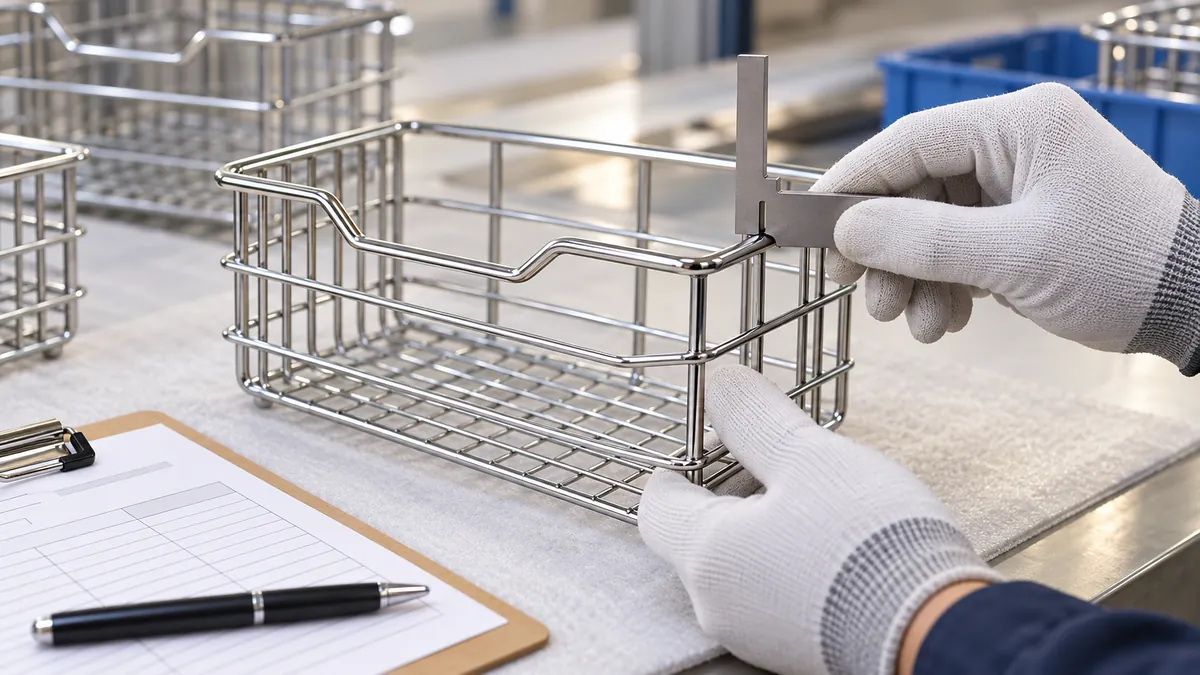
| Cutting, punching, bending, or forming | Are critical dimensions, bend locations, hole positions, and visual faces defined and checked? | Work instruction or setup reference, fixture or gauge identification, measurement record, and a sample comparison to the drawing | One measurement cannot establish process capability or long-run consistency |
| Joining and welding, if applicable | Are joint locations, fit-up, appearance criteria, and rework rules clear for this product? | Approved sample or visual criteria, work instruction, fixture reference, nonconformance/rework record, and inspection method | A clean-looking weld does not alone establish strength, corrosion behavior, or hidden joint quality |
| Grinding, polishing, coating, plating, or other finish, if applicable | Are cosmetic areas, pretreatment/finish requirements, masking or clearance needs, and acceptance criteria defined? | Finish specification, approved appearance reference, process or supplier record, inspection lighting/method, and a record of rejected or reworked pieces | Appearance alone does not prove coating thickness, adhesion, corrosion life, or process chemistry |
| Assembly and purchased components | Are the correct mounting parts, hardware, orientation, and torque or assembly method specified where relevant? | Component list, incoming checks, assembly instruction, sample build record, and fit/function inspection | A component list does not prove the component used in a particular unit |
| Inspection and packaging | Are the buyer’s critical dimensions, functional checks, protective materials, labels, and carton configuration verified? | Inspection plan, measurement record, packing standard, approved pack sample, SKU/carton identification, and correction history | A process audit is not a substitute for inspecting a defined shipment lot |
Choose a few product-specific characteristics that can materially affect fit, appearance, function, safety, or delivery condition. For a wire basket these might include width and depth, position of the wall attachment, clearance between rails, weld location on a visible face, or separation materials that protect a finish in transit. For a tube towel rack, the important evidence may instead concern hole spacing, joint alignment, assembly fit, and carton protection. The buyer’s approved specification—not a generic list—determines what matters.
How can a buyer test whether records match the SKU?
Use a trace exercise rather than accepting a stack of documents. Select a recent production record or sample under an agreed sampling approach, then move in both directions: from the finished item back to its drawing, materials, route, inspection, and packing; and from a controlled requirement forward to the record showing how it was checked. A gap in either direction is useful information. It does not automatically prove a defect, but it shows where the buyer needs clarification or a stronger control.
A simple worksheet can use one row for each critical requirement:
Requirement → responsible operation → control or method → record sampled → result → limitation or follow-up.
For example, if the drawing calls out the distance between mounting points, identify where that distance is created, whether a fixture or gauge is used, which revision defines it, and how the result is recorded. If a surface appearance is important, identify the agreed viewing condition and reference sample, then ask how nonconforming pieces are separated. If a finish or component is sourced elsewhere, capture the handoff, supplier identity, specification, incoming check, and trace link. Do not assume an outside step is either uncontrolled or automatically acceptable; follow the evidence to the party responsible.
The sample should include ordinary records as well as the best-prepared example. Ask how a rejected piece is identified, contained, dispositioned, and kept from being mixed back into approved stock. Review a change record if the design, finish, material source, fixture, or work instruction has changed. A process may have been adequate before a change but not yet validated afterward. Record whether the evidence represents the exact product, a demonstrably equivalent family, or only a general system practice.
Keep sample size and inference honest. A short audit samples evidence; it does not establish a statistical process capability unless that analysis was specifically designed and supported by sufficient data. One good part is not proof of every part. One missing record may be a documentation gap, a control gap, or a scope/access limitation; determine which before assigning a severity.
How should findings affect a supplier decision?
A useful report separates what was observed from what the buyer concludes. For each finding, record the criterion, objective evidence, affected product or process, risk to the buyer’s requirement, and whether the issue is isolated or may affect multiple orders. Then assign a response proportionate to the evidence: clarify a record, correct a controlled document, demonstrate a process step, contain affected stock, revise the sample, or arrange a focused follow-up review.
A finding should be specific enough for the supplier to respond. “Quality is poor” is not actionable. “The work area showed revision C while the purchase specification and approved sample reference revision D; no record was available to establish which revision governed the sampled order” states an observation and its limitation without guessing at the finished product. Likewise, if a coating vendor’s current lot record is outside the audit site, report the unreviewed handoff instead of writing that the process is controlled or uncontrolled without evidence.
A practical risk lens is:
- Critical to the product decision: a requirement affecting fit, assembly, attachment, corrosion exposure, sharp edges, or a buyer-defined safety concern has no demonstrated control or an unresolved deviation. Define containment and an approval gate before proceeding.
- Material but containable: the process exists but its record, revision link, or acceptance rule is incomplete. Specify what evidence closes the gap and by when.
- Improvement or scope note: a record or work practice could be clearer, but evidence does not show a direct failure of the agreed requirement. Track it without overstating its impact.
These are buyer-management categories, not a universal audit rating scale. Agree on definitions before the audit if the result will determine supplier approval. A corrective-action response should identify root cause, containment, responsible owner, target date, verification evidence, and whether other products or revisions need review. Closing a finding means confirming the agreed action; it does not erase the original evidence or prove unrelated processes.
Do not let a high-level score obscure exclusions. Put locations not visited, records not made available, sampling limits, unobserved shifts, and outsourced operations in the report’s conclusion. If these exclusions touch a critical process, either narrow the decision or arrange another review. A supplier can be promising while still requiring a sample gate or order-specific inspection.
How does a factory audit differ from a visit, social audit, or inspection?
A factory visit helps a buyer understand the site, people, product fit, and communication. It may be informal and exploratory. A technical audit has a defined scope and criteria, samples evidence, and records findings. Koitor’s factory visit checklist for bathroom hardware buyers helps structure an on-site visit. A separate guide to handling a supplier request to change a third-party inspection booking addresses an order-specific inspection decision. Neither replaces an SKU-specific process review.
A supplier or management-system audit also differs from first-article approval and shipment inspection. An audit evaluates controls at a site and over a defined sample and period. A first-article inspection checks a sample against a drawing or agreed requirements before bulk production. A pre-shipment inspection examines a defined lot at a later point. The checks may complement one another, but none should be presented as proof of the other.
A 2025 retailer supplier-quality manual illustrates one buyer’s separation of supplier qualification, pre-production work, and pre-shipment release; its requirements are specific to that retailer and are not universal rules for all importers. The useful general lesson is to name the decision each review supports. If a buyer needs confidence in a batch, schedule an order-specific inspection using the buyer’s sampling plan and acceptance criteria. If the buyer needs confidence that a process is repeatable, review its controls and records. If the buyer needs both, plan both.
What should buyers prepare before commissioning an audit?
Before an audit, prepare a short evidence request that the supplier can review in advance. Keep sensitive commercial information limited to authorized participants, and agree how photographs, drawings, prices, customer identities, and production records may be handled. A useful request is specific enough to prevent a generic presentation but focused enough to finish in the available time.

- [ ] Confirm the contracting entity and exact site address; list separate or outsourced operations.
- [ ] Identify SKU, product family, drawing revision, finish, approved sample, packaging, and relevant order dates.
- [ ] State the buyer’s objective, product requirements, applicable criteria, audit date range, and intended decision.
- [ ] Mark critical characteristics and the operation where each one is created or checked.
- [ ] Request representative records for receiving, revision control, setup, inspection, nonconformance, rework, change control, and packing where applicable.
- [ ] Agree how records will be sampled, who can view them, what can be copied, and what will remain confidential.
- [ ] Ask the supplier to identify missing records and off-site steps before the review.
- [ ] Require a report that distinguishes evidence, finding, limitation, corrective action, owner, due date, and closure proof.
- [ ] Plan separate sample approval or pre-shipment inspection if those decisions are also needed.
This preparation makes a factory quality audit China buyers can use more focused: the reviewer can follow an actual hardware route instead of spending the time collecting generic company statements. For a custom order, include the buyer’s drawing and packaging requirements early. A family-owned custom metal hardware manufacturer such as Koitor can discuss drawing or sample review, product structure, finishing, assembly, and packaging choices as part of OEM development; that conversation is not a third-party audit or an independent audit result.
Preguntas frecuentes
Does ISO 19011 certify a supplier?
No. ISO 19011:2026 gives guidance on auditing management systems. It does not itself issue a supplier certificate or certify that a particular product, site, process, or order meets a buyer’s requirements. Confirm the scope, issuer, validity, and relevance of any separate certificate you are shown.
Can a factory audit guarantee bulk quality?
No. An audit is a time-bound, evidence-sampling exercise. It can identify whether defined controls and records are present and how they operate within the stated scope. Product-specific sample approval, change control, incoming checks, production monitoring, and shipment-lot inspection may still be needed according to the buyer’s risk and requirements.
Should buyers hire a third-party auditor?
That depends on independence, technical competence, access, the decision at stake, and the buyer’s available resources. A third party can add independent review, but the scope and criteria still need to be product-specific. A generic report may leave a buyer’s critical hardware questions unanswered, and the buyer remains responsible for deciding what evidence is sufficient.
What should be done if a key process is outsourced?
Name the outside operation and supplier, define the product and requirement that pass through it, and request evidence at the handoff: approved specification, lot or revision identity, acceptance method, nonconformance handling, and change notification as relevant. Decide whether the audit scope should include that site or whether a documented and verified handoff is sufficient for the buyer’s risk. Do not imply that an unvisited site was audited.
Review the Product Route Before Your OEM Order
Share the product drawing or sample, revision, finish and packaging requirements with Koitor Hardware to discuss manufacturing questions for a custom bathroom or home-storage hardware program. A supplier discussion does not replace an independent audit or your order inspection plan.
OEM / MARCA BLANCA
Convierte esta guía de abastecimiento en un resumen del producto
Indícanos el producto que deseas, el tamaño, el acabado, la cantidad del pedido y los requisitos de embalaje. Tu equipo recibirá un análisis práctico de la viabilidad de fabricación antes de recibir el presupuesto.
 English
 Español
 Português
 Français
 Deutsch
 العربية