
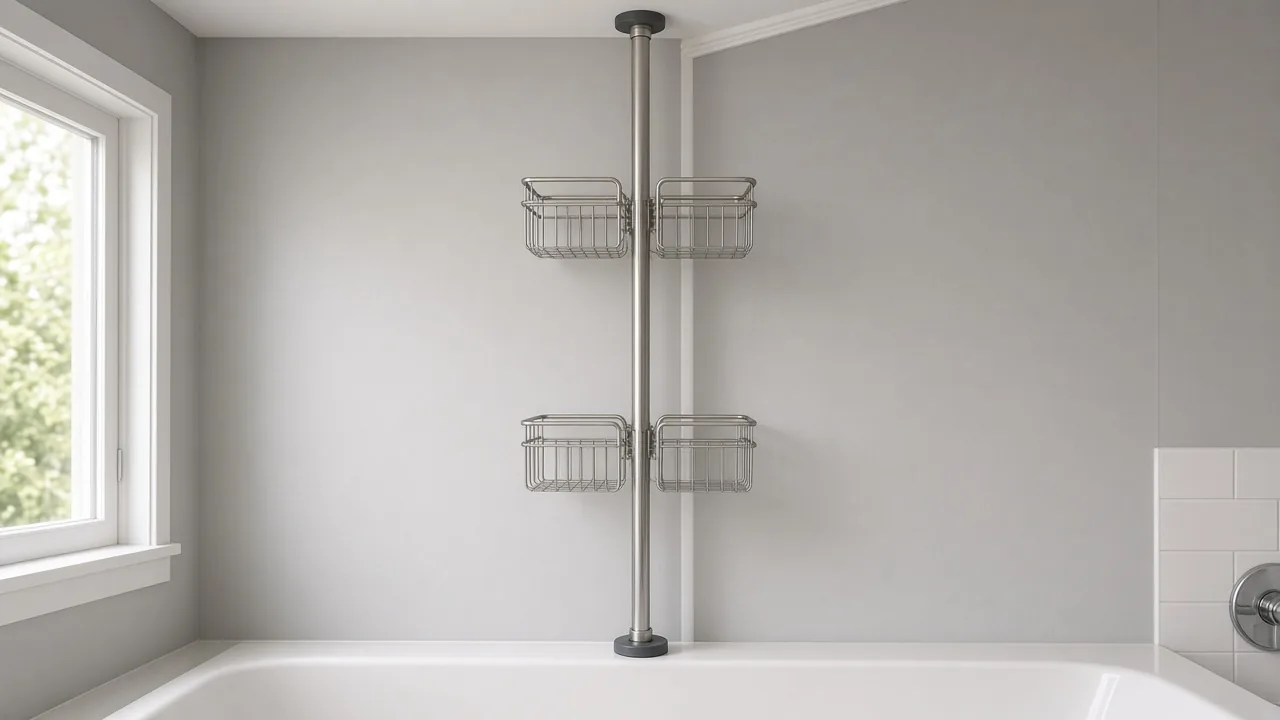
A height range that fits the room does not prove a no-slip or no-mark claim. Tension pole shower caddy slipping and ceiling marks are driven by the foot pads, the contact area, the preload or lock that is actually in the SKU, and the named ceiling or tub-ledge finish.
Freeze those items, and the excluded surfaces, before artwork says the pole will stay put or will not mark the paint. A sample install on one glossy tile is not a file for every ceiling type.
This guide is for importers, distributors, and private-label teams writing a tension-pole shower caddy specification. It is not a suction-cup claim kit, and it is not a height-range measurement page. Koitor Hardware, a family-owned China OEM manufacturer of bathroom and home-storage metal hardware, can review a pad and preload brief with a drawing or a sample; the buyer still has to name the claim and the excluded finishes.
Why a correct height range does not stop tension pole shower caddy slipping
Height tells you whether the pole can reach the ceiling and the ledge. It does not tell you whether the pads will walk, imprint, or scratch once the baskets are loaded and the room is steamy. Those are different decisions, and they need different evidence.
Tension-pole height-range specification is the right neighbor when you are freezing fit endpoints and section combinations. Use that file for the closed length, the open length, and how the sections stack. Do not treat a passed height sample as a no-slip approval.
Slip usually starts at a pad that is too small, too hard, or too smooth for the finish, or at a preload that relaxes after a steam cycle. A mark usually starts at a soft pad left under load on a fresh or textured ceiling, or at a hard pad that scuffs a tub ledge. Both can happen on a pole that is within the printed height range.
Do not borrow a suction-cup hold or surface-compatibility plan and paste it onto a tension pole. The physics are different: a tension pole lives on compressive preload and pad friction, not on a cup vacuum. If a listing mixes “no-drill” language across suction and tension SKUs, split the files before photography.
Worked example: a buyer approves a 2,400 to 2,800 millimetre range on a kitchen-ceiling mock-up, then ships a lifestyle photo that says “will not slip.” The first retail returns come from glossy painted ceilings where the top pad walks a few millimetres each shower. The height was never the defect.
Worked example: the same SKU is installed under a heavily textured ceiling. The pole does not walk, but it leaves a circular imprint after a week. The listing still says “will not mark.” The pad compound and the excluded texture were never written.
If the RFQ only says “rubber feet, standard,” the factory can change pad diameter, hardness, or the top-versus-bottom pair without a formal change notice. Write the pad as a controlled part, not as a free accessory in the carton.
Which pad, contact area, and preload items belong in the RFQ?
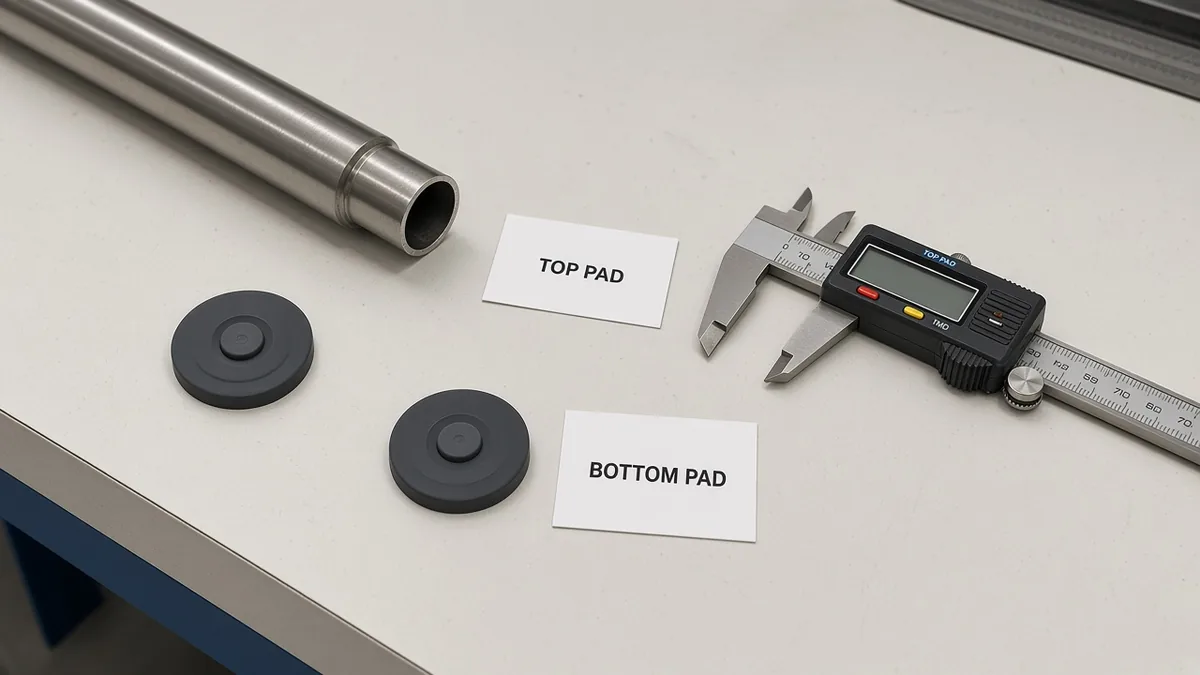
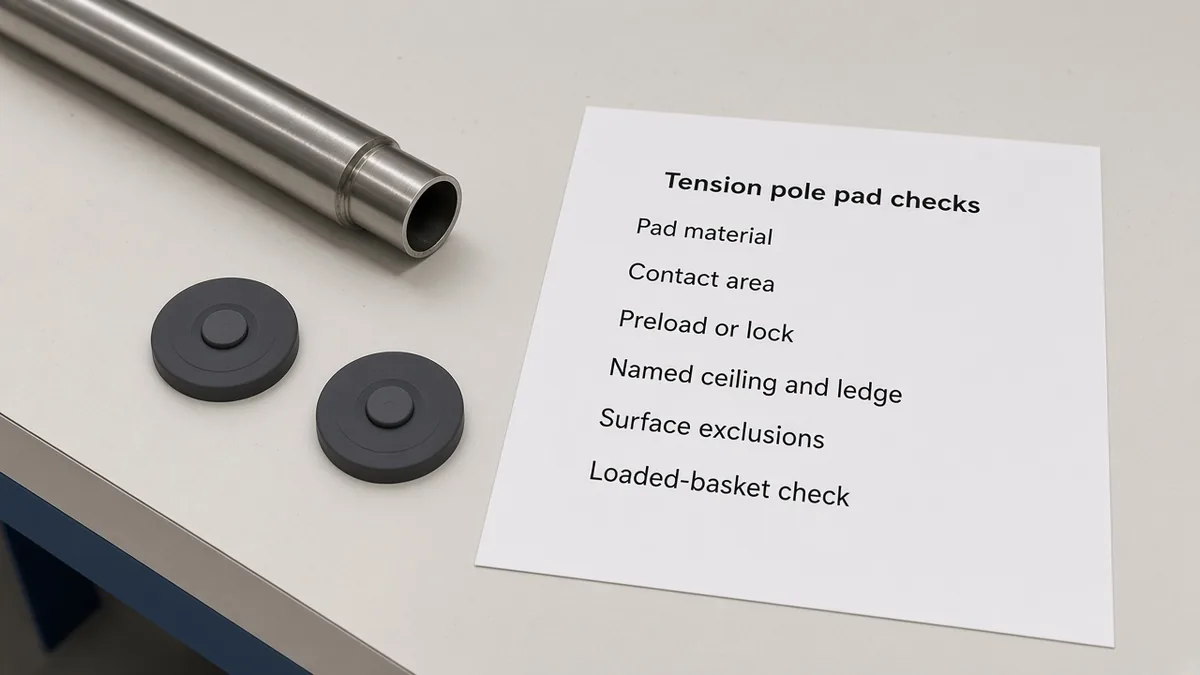
Name the top pad and the bottom pad separately when they differ. Many tension poles use a wider ceiling pad and a smaller or harder ledge pad. If the drawing shows one pad part number for both ends, say so. If the ends differ, give each end a part identity, a contact-face diameter or length, and a material family.
Contact area should be measured on the finished pad as it sits on a flat plate, not only as a cut blank before molding. A deep hollow or a hard center button can shrink the real contact patch. Record the method: pad on a plate, loaded by the agreed preload, outline of the patch, then a simple area or diameter note. Keep that measurement method out of any sampling-plan sentence.
Hardness, if you need it, should be cited as a method such as ASTM D2240, not as an invented Shore value for Koitor or for “typical poles.” Shore hardness for rubber hardware pads is a method neighbor. Use it when you agree a hardness method and a project value; do not copy a number from that page into this file, and do not invent one here.
Preload or lock must describe what the SKU actually has. A spring-only pole, a twist lock, a pin lock, and a locking collar are different products. Write how the installer sets the pole, whether a later twist is required, and whether the lock is in the carton. A photo of a tight pole is not a preload method.
Pad retention belongs in the same RFQ block. A pad that slips off the pole end after a few removals will be reported as a fall, even if the first install felt tight. Freeze how the pad is retained: friction boss, threaded insert, bonded face, or a captive washer. Trial a few on-and-off cycles on the sample, and write what you will reject if the pad comes off in the hand.
Do not invent a Newton or kilogram preload as a Koitor rating. If a project needs a force value, agree the instrument, the fixture, and the number in the project file after a sample, and keep that number out of artwork until it is written that way. A qualitative instruction such as “compress until the lock engages, then confirm the baskets do not walk on the named finishes” is safer than a made-up load.
Finish on the pole end can change how the pad sits. A sharp tube burr will cut a pad. A thick powder coat can shrink the boss that holds the pad. Inspect the pad seat on a finished pole, not only on a bare-tube prototype.
Custom shower caddy manufacturing can quote a tension-pole SKU, but only if the inquiry lists the pads, the lock, and the intended claim. A request that only says “adjustable pole caddy, rubber feet” is not yet a slip or mark file.
Which ceiling and ledge finishes should be named or excluded?
Name the finishes you will allow, and name the finishes you will exclude, in the same table. A claim that is silent on the surface is a claim about every ceiling and every tub ledge the shopper can imagine.
Typical in-scope surfaces for a careful file are hard, sound, and relatively flat: set painted drywall that is no longer soft, a smooth painted ceiling in good condition, a glazed ceramic tile, a sound acrylic or enamel tub ledge, or another finish the sample actually used. Typical exclusions are fresh paint, loose texture, popcorn or heavy stipple, peeling coatings, uneven stone, wet soap scum left as the only interface, and any surface the pad cannot sit on fully.
Those lists are examples of how to write a file, not a Koitor universal approval. Your list should follow the samples you actually ran. If you did not test a textured ceiling, do not imply the pole is safe on it.
Top and bottom finishes can differ in the same bathroom. A pole can have a painted ceiling at the top and a glossy tub ledge at the bottom. Write both ends. A sample that only used two painted boards in a conference room does not represent that pair.
Wet versus dry matters. A pad that holds on a dry ledge can walk after a shower, especially if oil, soap, or conditioner reaches the contact face. If the claim will be used in a wet bathroom, the sample check should include a wet ledge and a wet or steamy ceiling, not only a dry install.
Artwork should follow the table. If textured ceilings are excluded, the listing and the carton should say so in plain language. A lifestyle photo shot under a perfectly smooth set ceiling, with no exclusion line, will be read as a general no-mark promise.
| Claim or part | What to freeze | What a sample should show | What to keep off artwork until then |
|---|---|---|---|
| Height fit | Closed and open length, section combination | The pole reaches the named endpoints without stacking a non-approved section | A height range presented as a no-slip promise |
| Top pad | Material family, contact face, retention, and whether it differs from the bottom pad | The pad stays on the pole and sits flat on the named ceiling finish | “Will not mark any ceiling” |
| Bottom pad | Material family, contact face, retention, and ledge compatibility | The pad does not scratch or walk on the named ledge | “Safe on all tubs” |
| Preload or lock | The mechanism that is actually in the SKU, and how it is set | The lock or spring setting used in the check is the one in the carton | “Stays tight forever” or a made-up force rating |
| Named surfaces | Allowed ceilings and ledges, plus exclusions | At least one wet check on each allowed pair you will claim | A silent claim that covers untested texture or fresh paint |
| Loaded baskets | The bottle or weight condition used in the slip check, named, not invented as a rating | The pole does not walk under that condition on the named finishes | “Holds any load” or a Newton value not in the file |
What sample checks should run with a named loaded basket?
Write a loaded-basket condition in words the factory can repeat: the baskets used, the bottles or other items placed in them, and whether the bottles are full. Do not turn that condition into a printed kilogram rating on the carton. The point is to see whether the pole walks or the pads mark after a realistic load, not to invent a capacity badge.
Run the check on each allowed ceiling and ledge pair you intend to claim, or clearly limit the claim to the pairs you ran. Include a dry install and a wet or post-shower check if the product will live in a steamy bathroom. Look for walk-off, rotation, pad imprint, ledge scuff, and pad detachment.
A steam cycle can relax a spring or wet a painted ceiling. If you will sell into bathrooms with long hot showers, include a wait after steam, then re-check whether the pole has moved or the pad has printed. You do not need a laboratory chamber to do this; you need a written method and a named room or booth.
Measure movement in a simple way: a pencil tick on tape at the pad edge, or a photo with a ruler in the frame, before and after the check. Keep the method out of any AQL sentence. Sampling plans, if used, belong in a separate clause and can follow a scheme such as ISO 2859-1 once the accept and reject definitions exist. The measurement is not the sampling plan.
If the pole walks on an allowed finish under the named load, the no-slip line is not ready. Change the pad, the area, the preload, or the claim. Do not “pass” the sample on appearance of the baskets alone.
If a ceiling shows an imprint that does not recover after an agreed wait, treat that as a mark result on that finish. A temporary compression on a very soft texture may be enough to exclude the texture, even if the imprint later fades.
Record the installer. A strong installer who leans hard on the lock is not the same as a retail customer following the card. The sample should use the instruction you will ship, not a factory shortcut.
What wording should stay off artwork until the file is complete?
Keep “will not slip,” “never slips,” “will not mark,” and “safe on any ceiling” off the listing, the carton, and the lifestyle photo until the pad, preload, and surface table exist and the named checks have been run. Advertising claims need a reasonable basis before they are made; the U.S. FTC Policy Statement Regarding Advertising Substantiation is a useful reminder of that duty, not a Koitor test report.
Height language can stay if it is only about fit: the pole adjusts between named endpoints. Do not let a height line do the work of a slip line. “Fits ceilings from A to B” is not the same sentence as “will not slip on those ceilings.”
Do not print a load rating, a Newton value, or a slogan that the pole will not rust to paper over a missing pad file. Rust and coating claims belong in their own evidence files. This page only asks whether the pole stays put and whether the pads mark the named finishes.
If you must ship a first listing before every exclusion is photographed, use modest language: name the finishes you checked, and tell the shopper to avoid the finishes you have not checked. Silence is not modest. Silence is read as a general promise.
Instruction cards should match the RFQ. If the lock must be re-checked after the first week, say so. If pads are wear parts, say whether replacements are available and which part numbers they are. A card that only says “install tightly” will not save a no-mark claim.
Photography should show the actual pads and the actual lock. A retouched ceiling with no pad visible, or a pole cropped so the bottom pad is hidden, is a poor basis for a claim review. Keep one install photo that shows both ends.
Buyer checklist for tension-pole pad and mark claims
Use this list before a no-slip or no-mark line is approved for a tension-pole shower caddy.
- Separate the height-range file from the pad, preload, and surface file; a fit pass is not a slip pass.
- Give the top pad and the bottom pad their own identities when they differ, including contact face and retention.
- Write how contact area will be checked on the finished pad under the agreed setting, as a measurement method, not as a sampling plan.
- Name the preload or lock that ships in the SKU, and use that same setting in the sample check.
- Do not invent a Shore value or a Newton preload; if a project needs a hardness method, name ASTM D2240 and agree the value in the project file.
- List allowed ceiling and ledge finishes, and list exclusions such as fresh paint or heavy texture when they were not checked.
- Run a named loaded-basket check, including a wet or post-steam look if the product will live in a steamy bathroom.
- Watch for walk-off, imprint, ledge scuff, and pad detachment, and write what happens if any of those appear.
- Keep will-not-slip and will-not-mark language off artwork until the checks and the surface table exist.
- Do not paste a suction-cup hold plan onto a tension pole, and do not treat this file as a rust claim file.
Koitor can review a tension-pole pad brief as part of Fabricación de organizadores de ducha a medida or a general OEM inquiry. Send the drawing or the sample, the intended listing sentence, the pad callouts, and the surface table.
Small-batch customization is possible depending on the product. MOQ can start from 100 pcs depending on the product, samples usually take 5–7 working days after details are confirmed, and bulk production usually takes 4–6 weeks depending on the project. Those are careful planning figures, not a guarantee for every lock or pad change.
A family-owned factory can hold a pad tool, a lock setting, and a retained sample, but it cannot honestly promise that every later ceiling paint will behave. The buyer still owns the claim and the exclusions.
Incoming lots should include a look at the pads, not only at the baskets. A later pad vendor, a later color of the same rubber, or a later boss diameter can reopen tension pole shower caddy slipping even when the wire baskets look unchanged. Tick the pad part and the retention on incoming photos.
Spare pads in a service pack should match the sealed identities. A “universal foot” tossed into a later carton is a new part. Treat it as a change.
If a distributor asks for a larger basket on the same pole, rerun the loaded-basket check. The pads and the lock were approved under the first basket condition. A heavier or deeper basket is a new condition, not a free copy of the first claim.
Retail sets that combine a tension pole with hanging accessories on the same photograph should still keep this file focused on the pole feet. An accessory hook that bends is a different decision and should not be used to prove the pads.
Warehouse storage can oval a soft pad if poles are stacked on the feet. If pads arrive out of round, they will not sit as the first article sat. Write a pack note that protects the pad faces, and inspect them on arrival, not only after a customer installs the pole.
A second factory or a second pad molder does not inherit the first claim. Overlay the contact face, repeat the wet check on the named finishes, and reopen artwork if the pad changed. Memory of the first sample is not a gauge.
When the height file, the pad identities, the preload or lock, the surface table, and the named loaded-basket checks are written, a no-slip or no-mark sentence can be considered. If the file only says “rubber feet included,” tension pole shower caddy slipping is still an open claim.
Field complaints often arrive as “the pole fell” with no photo of the ceiling. Ask for the finish, the age of the paint, whether the lock was reset, and a photo of both pads. Many apparent product failures are excluded textures or a lock that was never set. The complaint still tells you whether the instruction and the exclusion list are visible enough for a shopper to use.
A category team may want one SKU for painted ceilings and one for rental units with heavy texture. That is an architecture choice. It is cleaner to sell two pad options, or to exclude texture in one listing, than to stretch one pad across both claims.
Do not use a felt pad, a silicone cap, and a hard TPE foot as if they were interchangeable “rubber feet.” They mark and slip in different ways. If a supplier offers a running change to a cheaper foot, treat it as a new pad identity and a new check, not as a cost reduction inside the same claim.
Color of the pad can hide scuff evidence in a photo. A black pad on a white ledge shows scuff better than a white pad on a white ledge. For a mark check, look at the finish, not only at the pad. Wipe the ledge and look under raking light.
If the pole will be sold with optional extra shelves, list the heaviest approved shelf set in the loaded-basket condition, or state that extra shelves are outside the checked condition. Optional shelves added later are a common way a careful first article is undone in the field.
Export packaging should keep pads from being crushed or stained by oil from other parts. A pad that arrives flat on one side will not match the contact-area method you wrote. Incoming can include a simple sit-down check of both pads on a plate before a lot is released to stores.
Translation of the instruction card is not a new method, but a redrawn diagram that changes the lock setting is a new method. Compare diagrams when a language version is added, just as you would compare a pad from a new molder.
Preguntas frecuentes
If the height range is correct, can I still print that the pole will not slip?
Not on height evidence alone. Height is a fit claim. A no-slip line needs the pads, the preload or lock, the named surfaces, and a loaded-basket check on those surfaces.
Do the top and bottom pads have to be the same part?
Only if they truly are the same part. If the ceiling pad is wider or softer than the ledge pad, give each end its own identity and check both finishes.
Can I use a suction-cup hold test for a tension pole?
No. The mounting physics are different. Keep a suction claim file on its own products, and write a pad and preload file for the tension pole.
What if I do not have a hardness instrument?
You can still freeze pad identity, contact area, retention, and a slip or mark check. If you later add a hardness method, name it, agree a project value, and do not invent a Koitor Shore number in the listing.
Should a textured ceiling be included in a general no-mark claim?
Only if you checked that texture and accept the imprint risk. If you did not, exclude it in the table and on the artwork.
What should a first sample include?
The finished pole with both pads, the lock or spring as shipped, the instruction, and a short surface table. A basket beauty shot without the pads is not a slip sample.
Trabaja con Koitor Hardware
Need a tension-pole pad and surface brief reviewed?
Send Koitor the drawing or sample, the intended no-slip or no-mark sentence, and the ceiling and ledge list. Our team can review the pad, lock, and small-batch OEM options before quotation.
OEM / MARCA BLANCA
Convierte esta guía de abastecimiento en un resumen del producto
Indícanos el producto que deseas, el tamaño, el acabado, la cantidad del pedido y los requisitos de embalaje. Tu equipo recibirá un análisis práctico de la viabilidad de fabricación antes de recibir el presupuesto.


 English
 Español
 Português
 Français
 Deutsch
 العربية