

For custom bathroom and home-storage hardware, tooling amortization per unit price is a quote structure—not a saving by itself. Compare it with a separate upfront tooling charge using the same product revision, tooling scope, order quantity and commercial assumptions. The useful question is not which line looks smaller, but what total amount is payable, when cash leaves the business, how the recovery quantity is defined, and what happens if orders stop or change. Ask for both models in writing before approving tooling or locking a unit price.
What are the two tooling quote structures?
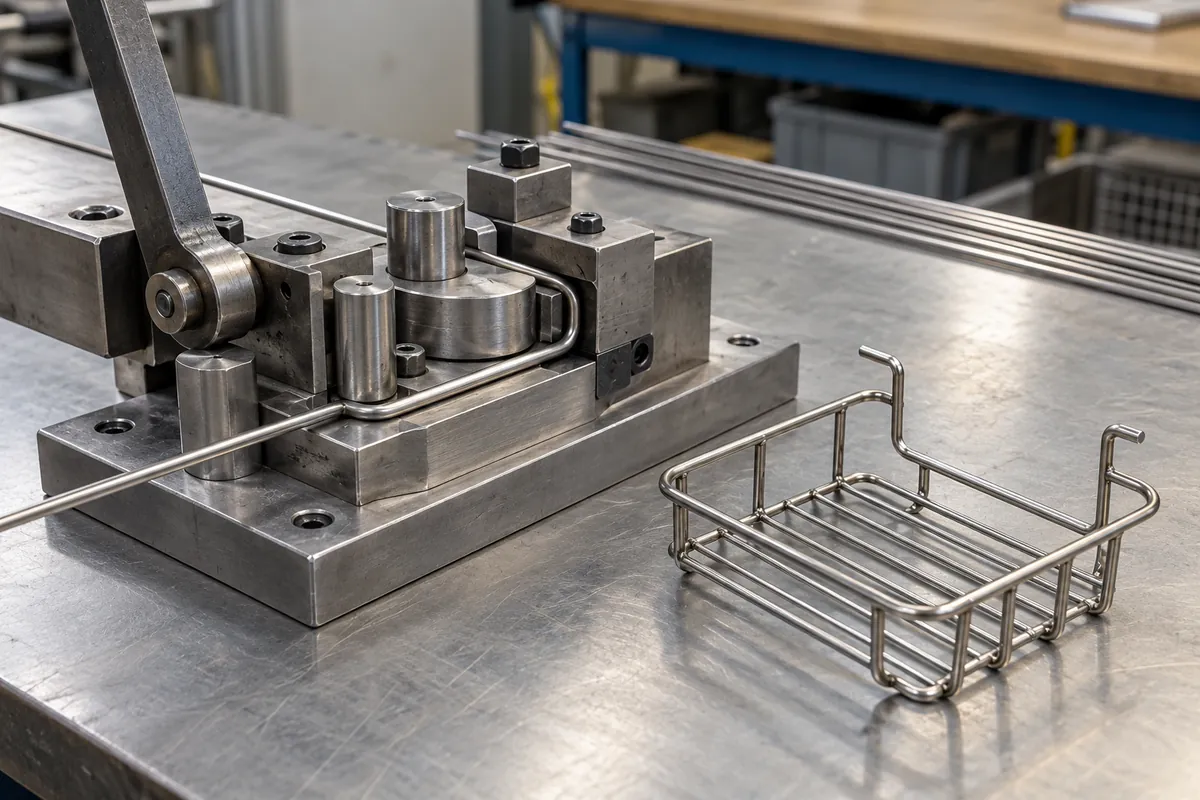
A separate tooling charge places the development or production tool as a one-time line item, apart from the recurring part price. Depending on the project, “tooling” may refer to a dedicated forming die, stamping die, bending fixture, welding jig, checking fixture or another project-specific item. The quote should name the tool or work scope instead of using one vague label. It should also clarify what is included: design, manufacture, tryout, adjustments, maintenance or replacement are not automatically the same cost.
With amortization, some or all of a tooling amount is recovered through a unit-price component across a stated quantity of production units. The buyer may see a single piece price or a separate tooling-recovery line attached to each unit. Either way, the denominator matters. “Amortized” does not tell the buyer whether recovery is based on the forecast, an order minimum, cumulative accepted units, shipped units, or a capped number of pieces. Those details must be written down. When modeling tooling amortization per unit price, show the recovery term separately even if the supplier prints only one combined piece-price figure.
A hybrid model is also possible: an initial payment followed by a per-unit recovery, or a milestone payment with a later price adjustment. The terminology varies between suppliers. Do not assume the commercial label alone defines when the buyer pays, what happens to the tool, or whether the unit price changes after recovery. Ask the supplier to show the arithmetic and schedule explicitly.
These are quote structures, not universal recommendations. A low-volume trial and a stable multi-order program may have different cash and risk priorities. The right comparison depends on the buyer’s actual demand confidence, product revision plan and contract terms. A stamping supplier’s tooling-cost overview illustrates how die scope and production volume shape a tooling discussion; stamping examples should not be treated as prices or break-even rules for wire-basket fixtures or other products.
Normalize the quote before comparing the models
The comparison is meaningful only if the two quotes describe the same scope. Start with the exact product revision and configuration: dimensions, material, wire or tube specification, finish, joining and assembly details, mounting components, pack-out and inspection basis. A supplier may quote different geometry, finish or packaging under what appears to be the same product name. Correct that mismatch before analyzing tooling.
Next, identify what the supplier means by tooling. Ask for the tool name, the operation it supports, whether it is dedicated to the buyer’s product, the estimated scope of work and any recurring maintenance or modification charges. For a metal basket, a welding jig and a forming die do different jobs; an amount covering one cannot be compared with a package covering several without a scope breakdown.
Separate recurring and non-recurring costs where possible. Unit price may include material, forming, welding, finishing, assembly, inspection and packaging, while tooling is a development or production setup cost. A quote can combine costs for convenience, but the buyer still needs enough detail to understand which items recur and which are recovered once. That distinction is useful when comparing suppliers and forecasting repeat orders.
Finally, confirm the commercial basis: currency, minimum order quantity, order lot, delivery term, quoted validity, packing assumptions and payment milestones. Match these assumptions across both models. For product context, see Koitor’s page on Fabricación a medida de accesorios de baño. The manufacturing page describes product-development scope; this article focuses on tooling-recovery calculations and the consequences when actual volume differs from forecast.
How does amortization change total cost and cash timing?
Consider an illustrative example only: a buyer receives one quote with a separate tooling amount of $1,200 and a unit price of $12.00, and another quote that embeds the same assumed $1,200 recovery across 1,000 units, adding $1.20 per unit to a $12.00 recurring base. If exactly 1,000 eligible units are ordered and every other assumption is identical, both models produce the same arithmetic total of $13,200 before other commercial costs. The example is not a Koitor quote, price benchmark or recommendation; real tooling amounts and unit costs depend on the product and supplier scope.
The difference becomes visible when the order quantity changes. At 300 units, the separate-fee model totals $4,800 under those assumptions, while an embedded $1.20 recovery on each ordered unit totals $3,960 if the supplier charges no minimum recovery or shortfall amount. That apparent difference does not prove the amortized model is cheaper. The quote could specify a minimum recovery, a forecast commitment, a remaining balance or another adjustment. If it does, the calculation changes. The buyer must clarify before relying on the lower first-order cash outlay.
At 1,500 units, if the unit-price recovery stops exactly after the stated first 1,000 eligible pieces, the illustrative total is $19,200: $18,000 for recurring production and $1,200 for tooling recovery. If the price continues to include the recovery on all 1,500 units, the total becomes $19,800. Both arithmetic cases are internally consistent; only the written quote or agreement determines which applies. The buyer should not assume an automatic price step-down, refund or transfer of an unused recovery balance.
This is why total-cost comparison should be paired with a cash-timing view. A separate fee may require more cash before sample approval or production; amortization may spread payments over shipments but may include a higher piece price. Payment schedules can also use milestones. Record the trigger and amount for each event, the evidence required, the responsible party and any exception. Do not treat the payment structure as a guarantee about ownership or legal rights.
What quantity and price-change assumptions should buyers put in writing?
The recovery denominator should be explicit. Ask whether it is a fixed number of units, the first order’s quantity, a forecast across multiple orders, or cumulative units actually produced, accepted or shipped. “We will spread tooling over expected volume” leaves too much open. A forecast can differ from a purchase commitment, and each party may interpret “volume” differently.
Clarify how variants count. A change in size, finish, mounting arrangement or product family may require a different tool, a modification or no change at all; that depends on the actual design and process. Do not assume several SKUs can share the same tooling-recovery pool. List the part numbers and revisions that are eligible, and identify who determines whether a change affects the tool or price.
State what happens if actual order volume falls short, an order is cancelled, the buyer pauses the program, or the product is discontinued. Is the remaining amount due, carried forward, waived, or subject to a new agreement? Do not presume any answer is standard. The result is commercial and contract-dependent. For material commitments, have qualified counsel review the contract language for the applicable jurisdiction.
Also document the claimed end point. If the quote says the unit price will decrease after recovery, specify the unit price before and after, the quantity or event that triggers the change, and how the buyer will see it on the next purchase order or invoice. If there is no price change, ask whether the embedded amount is simply a costing assumption or a continuing charge. Never infer the answer from a supplier’s verbal shorthand.
Physical tooling possession, ownership, permitted use, maintenance and release are related but separate questions. Paying an upfront fee does not, by itself, establish every legal or operational right. A per-unit recovery model does not automatically determine who controls a tool either. Record those terms separately in the commercial agreement and seek legal review where needed; this article is not legal advice.
What makes a fair side-by-side comparison?
Build a small scenario table from the supplier’s written assumptions. Use a low, expected and high volume that reflect your own planning—not a volume selected to make one quote look better. For every scenario, show recurring unit cost, separate tooling or embedded recovery, any minimum commitment, cash due before production, and the point at which a price change is supposed to occur.
| Comparison field | Separate tooling charge | Amortized recovery |
|---|---|---|
| Tooling scope | Identify the tool and included work | Identify the same tool and included work |
| Recovery basis | One-time amount and payment trigger | Amount per unit and eligible quantity |
| Volume scenario | Apply the same forecast and actual-order case | Apply the same forecast and actual-order case |
| Shortfall or cancellation | Record whether any balance remains due | Record minimum, carry-forward or reconciliation rule |
| Unit price after recovery | State recurring price and when it applies | State whether the price changes and what triggers it |
| Tool control terms | Document separately from the price | Document separately from the price |

The table should expose unknowns, not hide them behind a single total. If a supplier cannot yet confirm the tool scope or production revision, flag the line as provisional and ask what information is needed. A scenario model is only as reliable as its inputs; illustrative arithmetic is not a binding quotation.
A buyer can also compare net present value or financing implications for a larger program, but that introduces assumptions about timing, discount rate, taxes and accounting treatment. Those questions belong with the buyer’s finance team. For an ordinary sourcing review, a clear schedule of amounts, trigger dates, quantities and price changes is often enough to identify commercial differences without presenting a financial model as investment advice.
Common mistakes in tooling-price discussions
The first mistake is choosing the supplier with the lowest visible unit price. If tooling, finishing, inspection or packaging is omitted, the apparently cheaper quote may have a different scope. Request a like-for-like comparison before ranking offers.
The second is treating a forecast as a commitment. A supplier may base amortization on an annual or lifetime volume that the buyer has not promised to purchase. Ask whether the quantity is a planning estimate or an enforceable minimum, and document the consequence if orders do not reach it.
The third is assuming that amortization means ownership transfers after the last recovery unit. Cost recovery and tool rights are not interchangeable. Clarify ownership, identification, storage, maintenance, use restrictions, release and transfer separately, with legal review when necessary.
The fourth is forgetting product changes. A drawing revision, different finish, new size or altered weld location can affect tooling, fixtures, setup and inspection. Ask how the supplier will price a change and whether previously recovered tooling is affected. The effect is design-specific; do not promise that a revision will be free or require a new die without a technical review.
The fifth is comparing one supplier’s upfront price with another supplier’s amortized unit price without converting both to the same quantities and cash dates. Make the assumptions visible. If one supplier includes maintenance or multiple variants and another does not, show the difference rather than forcing the numbers into a false equivalence.
How should an RFQ or purchase order record the model?
Ask each supplier to return the same fields. Identify the tool or fixture, the operation it supports, the product and drawing revision, one-time amount if any, the recurring unit price, the recovery amount per unit if any, and the quantity denominator. Ask which units count toward recovery and whether the price changes after the threshold.
Add the shortfall and change rules: what happens if volume is below forecast, production is paused, an order is cancelled or a design revision changes the tooling scope? Include any minimum recovery amount or carry-forward logic. If the supplier cannot answer until a sample or engineering review, mark it open and assign a due date rather than inserting a buyer assumption into the purchase order.
The order record should tie the model to a named version of the quote and the released product revision. Store the supplier’s calculation, the buyer’s approved quantity scenario, payment milestone dates and the person authorized to approve changes. When a revised quote arrives, preserve the prior version and compare exactly what changed. This makes a later invoice review much easier than relying on meeting notes or an old spreadsheet.
For a custom metal product, tooling economics sit beside engineering feasibility. A cost model cannot decide whether a bend, weld, clearance or finish is manufacturable. Koitor Hardware is a family-owned custom metal hardware factory focused on bathroom and home-storage products; buyers can provide drawings or physical samples for project-specific review. No standard tooling price, recovery model or payment term is implied by that capability.
Buyer checklist before approving tooling
- Confirm both quotes describe the same product, revision, finish, packaging and inspection scope.
- Name every tool or fixture included and the work covered by its cost.
- Separate recurring production price from one-time development and tooling items.
- Define the recovery denominator and which quantities count.
- Compare low, expected and high order volumes using consistent assumptions.
- Record cash due dates, milestones and evidence triggers.
- Clarify shortfall, cancellation, pause, discontinuation and change-of-design treatment.
- State whether and when unit pricing changes after recovery.
- Keep physical tool control and legal ownership terms separate from pricing.
- Ask finance or legal advisers to review specialized accounting or contract questions.
- Preserve the approved quote version with the purchase order and product revision.
Preguntas frecuentes
Is tooling amortization always cheaper than paying upfront?
No. It changes how the amount is allocated and when it is paid. Compare total cost at realistic order quantities, any minimum recovery, price steps and cash timing. The written supplier terms determine the result.
What does tooling amortization per unit price mean?
It usually means a tooling amount is recovered through a stated charge included in each eligible unit price. The buyer should verify the amount per unit, the number and type of units included, the recovery end point and what happens if actual orders differ.
Should a buyer pay tooling upfront?
There is no universal answer. A separate payment can make the tooling cost visible, while an amortized model may spread payment. Consider cash flow, committed volume, product revisions and written tool-control terms. Get commercial and legal advice for contract-specific issues.
Does a paid tooling fee prove the buyer owns the tool?
Not necessarily. Rights depend on the agreement and applicable law. Identify ownership, possession, use, maintenance and release terms separately and have counsel review important arrangements.
What if the product changes after tooling is approved?
The effect depends on which feature changes and how the tool or fixture is used. Request a written engineering review that identifies affected operations, cost, timing and whether the existing recovery schedule changes before approving the revision.
Can Koitor confirm a standard tooling amortization policy?
This article does not state a standard Koitor fee or payment policy. Buyers should share the product drawing, sample, expected quantities and required production scope so the applicable project quotation can be reviewed directly.
Planning a Custom Metal Hardware Project?
Send Koitor your product drawing or sample, target order range, finish direction and packaging concept. Our team can review manufacturing scope for bathroom and home-storage hardware; no standard tooling fee, amortization model or payment policy is implied. Ask for project-specific assumptions before authorizing development.
OEM / MARCA BLANCA
Convierte esta guía de abastecimiento en un resumen del producto
Indícanos el producto que deseas, el tamaño, el acabado, la cantidad del pedido y los requisitos de embalaje. Tu equipo recibirá un análisis práctico de la viabilidad de fabricación antes de recibir el presupuesto.


 English
 Español
 Português
 Français
 Deutsch
 العربية