
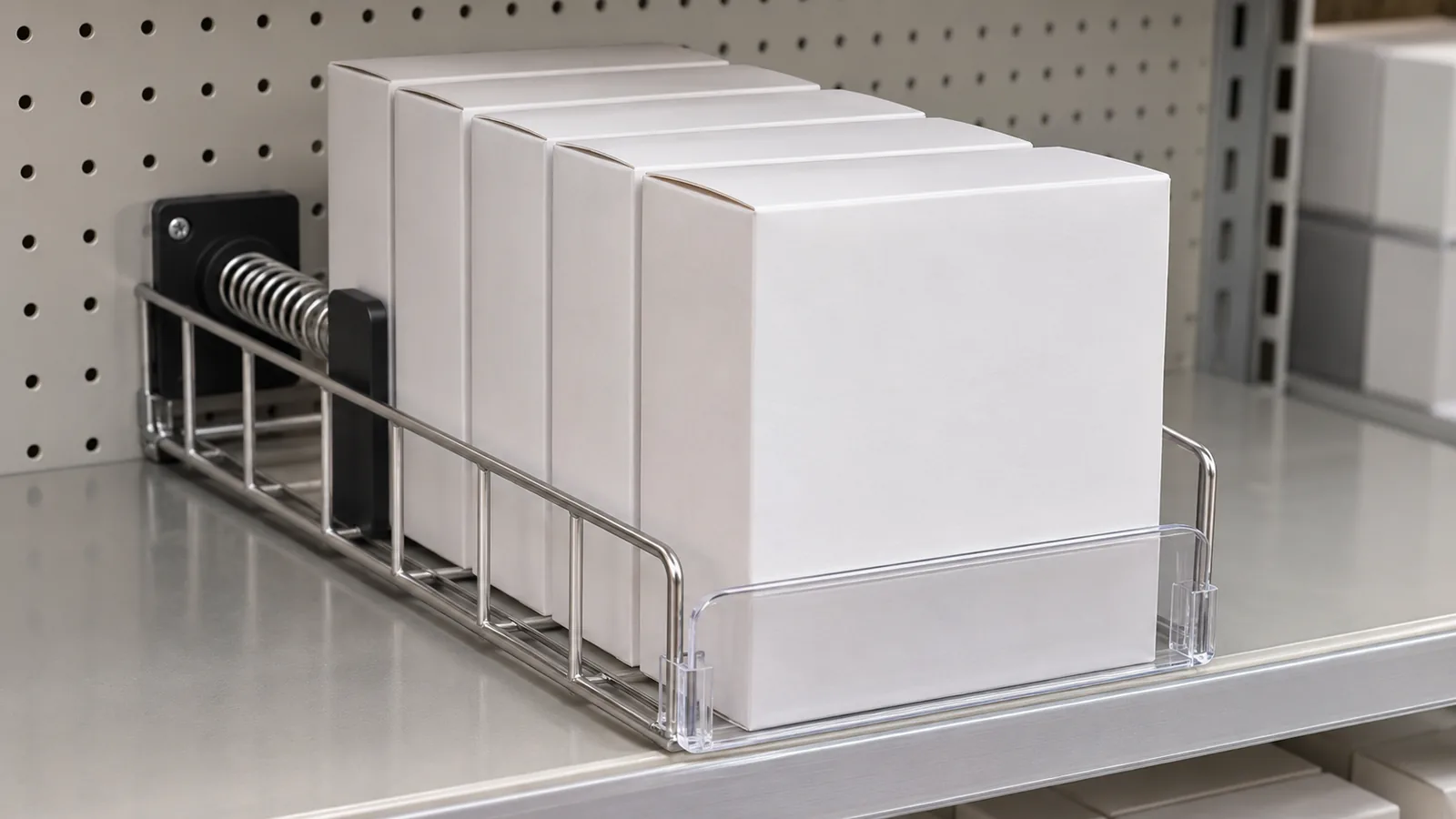
A buyer sourcing a wire pusher tray should approve the metal lane, front stop, pusher assembly and actual merchandise together. Tray width and depth alone do not define whether a product rests, advances, remains presented at the front or can be replenished as intended. Supplier catalogs can list different front and pusher combinations for nominally similar tray sizes. The package itself is therefore a reference part, not a detail to finalize after the fixture has been ordered.
This guide is for retail-fixture importers, housewares buyers, merchandising teams and private-label product managers. It is a sourcing and sample-approval framework, not a pusher mechanism design manual. A specialist supplier must define the exact feed components, safe refill method, operating instructions and any performance criteria. This article does not prescribe spring force, feed speed, package-compression limits, shelf loading, cycle life or instructions for adjusting a spring.
Separate Lane Dimensions From the Complete Feed Configuration
A lane that fits within a shelf width is not necessarily an approved feed system. The complete configuration may include a wire tray or divider, a front stop, a pusher or paddle, a spring, a mounting interface and a specified package orientation. Each part has an identity and may be supplied by a different company. The buyer should compare the full BOM rather than a single measurement.
An actual HL Display product page for a named wire pusher tray lists model-specific dimensions, alternative front configurations and spring codes. Its catalog rows include configurations with equal listed width and depth but different front codes. Another HL Display product family lists its own tray, front and pusher choices. Those details support a buyer question about complete variant identity; they do not establish that parts from the two families are interchangeable or that a particular spring suits unreviewed merchandise. See the maker’s WP3CB-MH wire tray information and its separate MU-MAX2 tray family. Confirm current drawings and compatibility with the supplier.
A quotation should identify:
- Tray model and revision.
- Lane width and depth as defined by the supplier’s drawing.
- Divider or sidewall configuration.
- Front stop code and position.
- Pusher, paddle or housing identity.
- Spring code, if applicable, without translating it into an unsupported force value.
- Shelf, rail, crossbar or other mounting interface.
- Package SKU and revision used in the compatibility review.
- Included and excluded components.
- Supplier-provided assembly and refill instructions.
A buyer who receives only lane dimensions should ask what else is needed to complete the quote. The answer may include a package sample, front style, mounting reference or specialist-selected pusher module. Record those requirements rather than guessing. If a catalog shows several fronts for one tray, do not assume the front is a cosmetic option. It can be a distinct configuration that changes how the package meets the front of the lane.
The same caution applies to spring labels. A model code is an identifier, not a publicly defined force rating unless the supplier says so. Do not decode a spring by appearance or apply a code from a neighboring tray row. Request written confirmation for the complete model and package combination.
Identify the Actual Package and Its Orientation
The package can vary in shape, base, contact face, material and stiffness. It may be a box, bag, pouch, foil pack or another retail format. The broad category does not tell the buyer how it contacts the tray or pusher. Record a named product or controlled sample and specify which face points toward the shopper and which side rests on the lane.
A package reference should include:
- Product SKU, packaging revision and source.
- Width, depth and height from controlled data, with measurement source.
- Base shape and any folds, seams, flaps or projecting edges that affect contact.
- Orientation in the lane.
- Whether each unit is boxed, bagged, wrapped or otherwise packaged.
- How many units are represented in the sample arrangement.
- Whether the package is full size, an empty mock-up or an engineering sample.
- Any other approved package variants intended for the same tray.
These fields help a supplier understand the item being presented, but they do not authorize the buyer to create a feed mechanism setting. The mechanism supplier should choose or approve the pusher configuration using its own method. If the package changes after approval, the buyer should ask whether the previous configuration still applies. A same-size package can have a different front face, base, seam or surface, so nominal dimensions alone may not preserve the original review.
If several products share one retail lane, choose representative references and tell the supplier what each represents. Do not say one sample covers the whole family unless the responsible supplier confirms that conclusion. A package with a wide base and a soft bag can behave differently from a rigid box, but this article does not predict a particular outcome. It treats those package types as reasons to seek a supplier review, not as tested performance results.
| Package information | Buyer record | Supplier question |
|---|---|---|
| Exact SKU | Maker, item number and packaging revision | Is this the package used to select the quoted feed parts? |
| Contact geometry | Base, edges, seams and face orientation | Which surfaces are intended to contact the lane and pusher? |
| Variant range | Size, material or pack changes | Which specific variants have been reviewed? |
| Refill state | Full, partly stocked or another agreed condition | Which state should be represented during supplier demonstration? |
| Front presentation | Intended shopper-facing face and position | Which front stop and package orientation are quoted? |
This record helps merchandising and procurement teams preserve the same assumptions. If the package artwork changes but its physical construction remains the same, the buyer can ask whether the change is relevant. If the package substrate, dimensions or base changes, the supplier should determine whether the feed review must be repeated. Do not make that decision from artwork alone.
Approve the Front Stop and Pusher as a Pair
The front stop retains or presents the leading item in the way the supplier defines. The pusher or paddle assembly acts behind the goods. Both should be identified in the quotation and sample. A front change can be a configuration change even when lane dimensions remain constant, and a pusher variant should not be selected solely by visual similarity.
Ask the supplier to show:
- Which front code or design is paired with the tray.
- The named pusher, paddle, housing or spring component.
- Which part contacts the package in the intended arrangement.
- Whether the mounting interface is built into the tray or supplied separately.
- Which variant is used for the nominated merchandise and orientation.
- Which combinations are excluded or still under review.
- How the buyer can identify replacement parts in a future reorder.
The supplier’s parts list and the sample should agree. If the tray arrives with an unmarked spring or a front that differs from the drawing, pause the approval and request identification. Do not assume the sample is a valid substitute simply because it appears to advance a package. The supplier should state which model and revision were demonstrated.
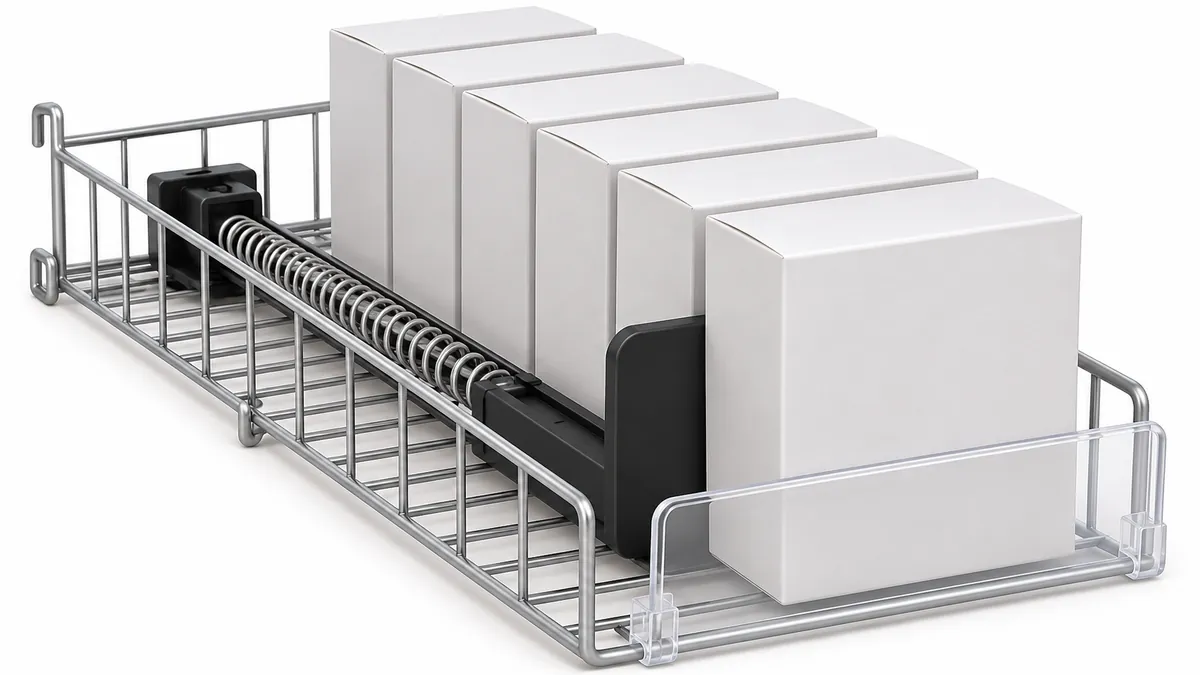
A product photo can obscure the pusher behind the leading goods. Request a component view or supplier explanation if the quotation does not make the parts legible. However, a photo alone is not a substitute for the supplier’s controlled model references. The buyer should not create a new mechanism design, copy a proprietary release feature, or reverse engineer spring codes from the article’s images.
Distinguish Restock, Full, Partial, and Last-Item States
The package arrangement changes as a lane is filled and replenished. A buyer should ask the specialist supplier which states it expects to review for the quoted configuration. The supplier may provide a model-specific instruction for loading or restraining a pusher during restock. Do not adapt instructions from a dated flyer or a different product family. The research pack’s historic crossbar flyer describes a particular mechanism architecture, but it is not current operating guidance for every tray.
A safe procurement record can distinguish:
- The unstocked tray and component set.
- The supplier-demonstrated loading or refill state.
- The full arrangement, if the supplier confirms how it should be represented.
- A partial-stock observation, if included in the approved review.
- The final-item condition, if the supplier specifically evaluates it.
- The approved front position and package orientation.
- The instruction version and the party that demonstrated it.
- What the buyer did not evaluate.
These are documentation states, not instructions for manipulating a spring. Do not compress, release, re-tension, remove or lock a spring unless the current supplier instructions explicitly call for that action and assign it to the appropriate person. If a component is loaded or moves unexpectedly, stop and ask the supplier for direction.
A sample may be visually reviewed with packages present, but the buyer should avoid translating that observation into broad claims about no crushing, reliable feeding, reduced labor or product protection. HL Display’s marketing may describe benefits for its particular products; the research pack excludes transferring those claims to Koitor or treating them as a generic result. A supplier performance statement should be tied to its named system, method and conditions.
If the retailer wants an acceptance criterion, the technical owner should define it and the supplier should confirm how it will be assessed. Do not invent a minimum clearance, pusher force, feed speed, maximum package compression, test-cycle count or shelf-load rating. An empty tray moving freely does not establish how the system behaves with the intended goods, and a sample that presents one package does not automatically validate all SKU variants.
Review Mounting Scope and Replacement Responsibility
Some trays mount on a shelf, wire crossbar or another fixture. The buyer should identify the host system and ask the supplier to confirm the exact interface. Do not assume a tray fits every shelf or crossbar because it appears to hang or rest on one in a photograph. A different mounting family may use clips or a separate attachment design.
The research pack includes a Siffron product example describing an adjustable tray and removable shelf clips. That is an alternate product architecture, not proof of a universal mounting interface or a wire-tray compatibility rule. Keep the product family and supplier responsible for each mounting statement.
For a multi-supplier project, assign the owners:
| Decision area | Likely owner to confirm | Buyer record |
|---|---|---|
| Package construction and revision | Brand/package supplier | SKU, drawing, sample and change notice |
| Tray, divider and front | Fixture supplier | Model, revision, BOM and installation scope |
| Pusher/spring assembly | Specialist mechanism supplier | Exact module identity and instructions |
| Shelf or crossbar interface | Retail-fixture designer and tray supplier | Host reference and approved attachment |
| Product performance claim | Responsible product supplier and brand owner | Exact claim, test or source, model and conditions |
| Retail layout | Retailer or project owner | Site configuration and review boundary |
The importer coordinates the record; it does not automatically become the engineering authority for every part. If a supplier purchases its spring or paddle from another company, ask who controls substitution and how replacement parts are identified. Keep those purchased components on the BOM. A component name such as “spring pusher” is not enough to guarantee interchangeability.
Build a SKU Matrix and Change-Control Process
For each sales SKU, list the tray and feed assembly separately enough that buyers can identify the configuration. Include lane dimensions, model/revision, front code, pusher and spring references, mounting style, package reference and included parts. If the same lane serves more than one package, list each confirmed package pairing as a separate row. Mark unresolved combinations instead of implying that all goods fit.
Change triggers can include a new package size or construction, changed front stop, revised spring code, altered pusher geometry, different tray depth, a new mounting clip or a supplier substitution. Ask the supplier which changes require a new sample or drawing review. Record the response, the new revision and the approver. Update product photography and listings when the visible front or package orientation changes.
Compare variants by exact part identity, not by dimensions alone
The manufacturer example in the research pack makes a practical comparison point: a named wire tray offers front alternatives, and its product table distinguishes some configurations that share listed width and depth but use different front codes. A separate product family has its own tray, front and pusher options. The buyer should not decide from those catalog examples that one front is better, that the parts interchange, or that a given package is suitable. Instead, quote the exact tray and front references, then ask the maker to map the nominated package and pusher to that combination.
A comparison sheet can place one supplier configuration on each row and retain the model identifiers exactly as written. Columns can include tray family, lane dimensions, divider, front code, pusher, spring identifier, mounting interface, package SKU, package orientation, included parts and source document. If two rows differ only in front code, record that difference explicitly and ask the supplier whether the front changes any other approved element. Do not infer a replacement relationship from similar appearance or shared dimensions.
For an assortment with several package sizes, make the bag or box SKU a key in the matrix. That allows a buyer to see whether a package has a confirmed feed configuration, whether it is still pending review, or whether the supplier excludes it. A blank cell should remain blank until someone answers it. The matrix is not a testing standard and does not create performance evidence; it is a configuration control that prevents a quotation from being understood more broadly than the supplier stated.
A sample record should also note the review boundary. For example, the buyer may have checked a package on a fixture placed on a workbench, without the retailer’s shelf, full stock arrangement or operating instructions. That can be a preliminary product-fit review, but it is not full system approval. State what remains pending. This makes the next phase clear to the retailer or project owner without overstating the sample result.
Purchasing can compare two quotations with the same width and depth using this matrix:
- Do both include the same tray and divider?
- Does each use the same front stop?
- Are the pusher and spring model references identical or explicitly confirmed as alternatives?
- Does the mounting interface match the same host fixture?
- Is the package SKU and orientation the same?
- Are refill and replacement components included?
- Does one quote exclude an adapter or instruction that the other includes?
- Are all performance statements tied to a source and model?
This comparison reduces false equivalence. Similar dimensions are only one part of the procurement decision. The buyer should compare complete configuration and scope, then seek supplier clarification where rows do not match.
Keep receiving and service records aligned
When the goods arrive, the receiving team should be able to verify model labels and the components listed in the purchase order. If the carton contains a different front or pusher code, the difference should be resolved with the supplier before it is treated as an approved substitute. A warehouse photograph, carton label or supplier packing list can help identify the shipment, but it does not independently establish feed performance.
Service teams also need a replacement path. Ask the supplier how to order a front, divider, tray or purchased pusher component for the exact model and revision. If it cannot identify the part by a stable reference, record that limitation in the spare-parts plan. A replacement should not be chosen merely because a spring or front looks similar. The supplier must confirm the actual combination and any applicable instruction updates.
This alignment matters when merchandising updates packaging or when a retailer moves the tray to a different shelf interface. Make the change visible in the product record and request supplier review if the package or mount falls outside the approved scope. It is better to preserve an unresolved status than to let a fulfillment substitution become an undocumented new configuration.

Record unresolved parts as explicit procurement actions
If the supplier cannot yet confirm the front, pusher, package or shelf interface, list that item as an open action with an owner and response date. Avoid changing the status to approved just because the rest of the tray is dimensionally acceptable. The quotation can remain provisional while the supplier identifies a complete configuration. Once answered, attach the revised drawing or written confirmation to the purchase record so a later buyer can see which model and package were covered.
This simple decision log also helps when a retailer asks for a fast substitute. The team can check whether the proposed replacement is already in the approved matrix or needs supplier confirmation. That makes the difference between an evidence-based substitution and a guess based on the product’s name.
Buyer Questions Before Ordering
Does a lane with the right width and depth prove package compatibility? No. The front, pusher, mounting interface and actual package can vary.
Can a spring code be converted into a force value? Not unless the supplier provides an explicit specification for that model. A code is an identifier, not a generic rating.
Can one pusher tray cover boxes, bags and foil packs? Only if the responsible supplier confirms the exact package configurations. Product categories alone do not establish compatible feed behavior.
Can a buyer use a refill instruction from a similar model? No. Follow current instructions for the exact model and ask the supplier to clarify any missing step.
Does a sample that presents one item prove the package will never crush or jam? No. It is an observation under the sample and conditions shown. Broader performance claims require defined evidence.
Can Koitor be assumed to supply the complete feed assembly? No. Current pusher, spring and complete tray capabilities are unconfirmed. Any inquiry must define the metal component scope and purchased parts separately.
A Complete Feed Configuration for the Purchase Order
Before ordering, identify the package SKU and orientation, match it to the exact tray, front and pusher references, confirm mounting and included components, and request current supplier instructions for setup and replenishment. Keep the sample and BOM together, record which stock states were reviewed, and list exclusions or unapproved package variants. Ask the specialist supplier to define any quantitative acceptance criteria or performance evidence.
A wire pusher tray is best specified as a revision-controlled package-feed combination, not as a tray size alone. This helps the importer compare quotations and manage packaging changes while leaving spring design and feed claims with the responsible supplier. For adjacent metal display and storage questions, see Koitor’s wire display basket buyer guide and its OEM home-storage hardware information. If considering a metal tray or support component, share a controlled drawing and the bought-in mechanism scope through the contact page for a feasibility discussion; current complete pusher-tray manufacture is not confirmed.
Trabaja con Koitor Hardware
Discuss an Adjacent Metal Hardware Scope
Koitor’s confirmed focus is bathroom and home-storage metal hardware. For an adjacent product, share a controlled drawing, representative sample and any bought-in component scope so the team can assess whether the request fits its confirmed capabilities. This review does not imply that the complete product is currently manufactured.
OEM / MARCA BLANCA
Convierte esta guía de abastecimiento en un resumen del producto
Indícanos el producto que deseas, el tamaño, el acabado, la cantidad del pedido y los requisitos de embalaje. Tu equipo recibirá un análisis práctico de la viabilidad de fabricación antes de recibir el presupuesto.
 English
 Español
 Português
 Français
 Deutsch
 العربية