

304 vs 430 stainless steel is a comparison between austenitic and ferritic families, not a universal quality ranking. ## What Is the Difference Between 304 and 430?
The first distinction is family. 304 is commonly identified as an austenitic chromium-nickel grade. 430 is a ferritic chromium grade. This is not merely a small suffix change within the same composition family. The families differ in structure and typical alloying, and their behavior depends on the specific product form, condition and environment.
Both can be legitimate stainless-steel choices for appropriate applications. A buyer should not start from the assumption that 430 is fake, or that 304 is always the correct choice. The intended component, exposure, fabrication route, finish and customer requirement determine which grade is acceptable. A grade comparison is a decision framework, not a blanket approval.
| Question de l'acheteur | 304 | 430 | What still needs confirmation |
|---|---|---|---|
| Family | Austenitic chromium-nickel | Ferritic chromium | Exact grade and product specification |
| Nickel context | Nickel is an intentional characteristic alloying element | Much lower nickel than 304; do not assume literal zero from shorthand | Actual supplied material specification and evidence |
| Magnetic response | Can become magnetic with cold work; response is condition-dependent | Commonly magnetic | Magnetism does not identify or certify grade |
| Service suitability | Common general-purpose option, still environment-dependent | Can suit some less aggressive indoor conditions; limitations matter | Exposure, cleaning, wet time, finish and component design |
| Fabrication | Depends on grade, form and process | Depends on grade, form and process | Actual forming, joining and finishing requirements |
The table is qualitative and intentionally avoids a universal corrosion or forming ranking. A specific 430 sheet guide describes service in mildly aggressive conditions with limited wet time and excludes water immersion for that supplied guidance; this is source-specific and should not be generalized into approval of all 430 products. Use the exact material supplier’s current information and project requirements.

304 Vs 430 Stainless Steel: Compare the Actual Service Environment
“Bathroom use” is not one exposure condition. A component in a relatively dry interior, a frequently wet shower zone and a coastal or chemically cleaned environment may face different moisture, salts and cleaning agents. The part’s geometry can also affect how water drains or remains on a surface. Describe where the hardware will be used and how it will be cleaned instead of choosing a grade based only on the room name.
430 can be appropriate for some applications with milder exposure and limited wet time according to a supplier’s published guidance. That same guidance excludes immersion for the particular flat-product information reviewed. It does not establish a universal service envelope for all 430 sheet, wire, tube, finishes or component designs. Do not turn the supplier’s conditions into a blanket guarantee.
304 is a commonly used austenitic grade and may be selected for a broad range of applications, but it is not immune to every corrosion mechanism. Exposure, surface condition, deposits, chloride conditions, cleaning and fabrication influence performance. A buyer should not rely on the grade number alone to promise a service life or approve continuous immersion.
Make the exposure description concrete. State whether the part is normally dry, intermittently splashed, frequently wet, exposed to cleaning chemicals or expected to remain immersed. Note how water drains from the design and whether joints or folded edges can retain moisture. This description does not predict a result by itself, but it gives the material supplier a meaningful condition to evaluate rather than a vague label such as “bathroom grade.”
Cleaning practice belongs in the same discussion. The grade comparison does not evaluate every cleaner, concentration, temperature or contact duration. If a user or distributor intends a particular cleaning routine, document it and obtain guidance for the specified material and finish. Do not state that a product is compatible with all cleaners because it uses a stainless grade.
The component’s finish and fabrication history also matter to the buyer’s review. A formed or welded item is not identical to a flat unworked sample. The reviewed 430 source addresses flat-product information and should not be extended automatically to wire, tube or every finished assembly. Ask whether the quoted material form and condition correspond to the item being made.
The International Molybdenum Association’s ferritic overview places common 430 corrosion resistance just below 304 in the context discussed, while noting wide variation across the ferritic family. That comparative description does not mean every ferritic grade is inferior to every austenitic grade, nor does it establish that 304 always wins in every environment. Use the exact alloy, component and exposure evidence.
Composition Shorthand Is Not a Material Certificate
Some descriptions call 430 “nickel-free.” Treat that as shorthand for its low-nickel positioning relative to typical austenitic chromium-nickel grades, not as proof that every supplied sample contains exactly zero nickel. One published supplier typical-composition row for 430 includes a nonzero nickel value. It is a supplier’s typical row, not a measured result from Koitor material, a universal nominal value or a certificate for a particular lot.
| Evidence statement | What can reasonably be said | What it does not prove |
|---|---|---|
| A marketing page says “nickel-free” | It signals a low-nickel positioning or shorthand | Literal zero nickel in every batch or sample |
| A supplier publishes a typical composition row | That supplier publishes a typical value for its stated product context | The chemistry of the delivered lot or another product form |
| A material certificate identifies a grade/lot | It provides the evidence stated in that document | Conditions not covered by the certificate or unverified claims |
| A finished sample looks similar | The surfaces look alike under the observed conditions | Alloy family, grade, corrosion performance or traceability |
Do not reproduce a supplier’s full normative composition table as if it were a current specification. Confirm the material standard, form and certificate required by the buyer, then compare the document to the ordered item and lot. Do not infer Koitor’s current stock or a particular grade offering from general educational information.
Why a Magnet Is Not a Reliable Grade Test
430 is commonly magnetic, but magnetism is not a unique signature for 430. Cold-worked 304 can show magnetic response, and other stainless families, including duplex grades, may also be magnetic. Conversely, the strength of attraction can depend on the sample shape, condition, magnet and test setup. A simple magnet check cannot certify 304 versus 430.
The Australian Stainless Steel Development Association’s grade-confirmation guidance cautions against treating visual inspection or magnet response as conclusive grade identification. Use the actual material documents and an appropriate qualified verification route when grade identity is critical. This article does not provide chemical spot-test procedures or instrument-operation instructions.
A magnet can be a preliminary observation in a discussion, but report it accurately: “magnetic response observed,” not “confirmed 430.” Do not reject or approve a delivered lot based solely on the magnet. Record the sample, product form and evidence used, and ask the supplier for the material traceability required by the purchase order.
It is also useful to distinguish three questions: what grade was ordered, what material was delivered, and how a finished component behaves in use. A magnet addresses none of these conclusively. A paperwork review can help link the delivered lot to a declared grade; a service decision needs the environment and product context; and a test, if required, must be chosen by the responsible qualified process. Do not let a simple field check be described as a full material verification method.
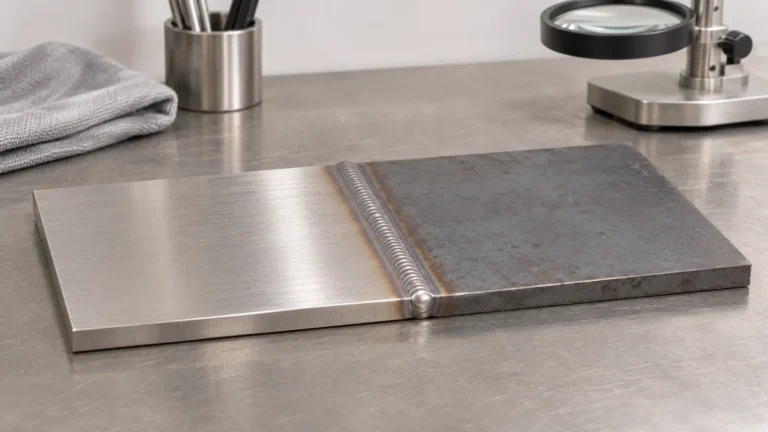
Visual color and surface reflectivity are similarly limited. Polishing or brushing can change appearance, and coatings can further mask the base metal. A photographed sample cannot reveal chemistry. For supplier comparison, use photos for finish discussion and material documents for the identity evidence they actually provide.
Similar Finishes Do Not Reveal the Alloy Family
Brushed, polished or coated samples can look similar even when the underlying alloy families differ. Surface finish is a separate product attribute from grade. A visual comparison can help review appearance, but it does not establish chemistry or service performance.
When finish matters, specify the intended appearance and acceptance method separately from the grade. Confirm what surface is evaluated, under what lighting or inspection condition the buyer expects it, and how the finished part is handled. Do not assume a grade automatically yields a particular color, reflectivity or scratch resistance.
Manufacturing operations can influence the finished appearance. Forming, welding, polishing and coating should be reviewed against the exact material and component design. A general grade comparison does not provide a universal fabrication rule. For deep-drawing implications, see our focused guide to 430 versus 304 stainless steel in deep drawing. For 430-specific welding considerations, see ferritic 430 weld grain growth and toughness.
Build a Product-Level Material Decision
For a bathroom or home-storage component, the buyer can structure the decision as follows:
- Identify the part, its product form and the exact material grade currently specified.
- Describe the service location, wetting frequency, cleaning agents and any immersion or chloride exposure.
- State the required finish and whether it is applied before or after fabrication.
- List forming, welding, polishing and assembly needs that affect the part.
- Decide whether a proposed grade substitution is acceptable and what document or sample evidence is required.
- Compare supplier quotations against the same drawing, form, finish and evidence level.
This sequence does not declare which grade wins. It helps prevent a buyer from comparing one grade in a finished sample against another in an unspecified raw form. It also separates a material substitution decision from a price conversation. Current market prices, surcharges and a specific supplier quote are outside this article and should be obtained for the actual order date and specification.
If the item is a component within a larger assembly, consider interfaces as well as the individual sheet or wire. Fasteners, welds, coatings and contact with other materials may affect the project review. This article does not make a galvanic-corrosion prediction or a compatibility finding for a particular mixed-material assembly. Provide the complete relevant drawing and obtain product-specific advice when interactions matter.
For repeat orders, keep the grade and form in the approved drawing and purchase documentation. If the buyer changes from sheet to wire, from one finish to another, or from an indoor use to a more exposed environment, review whether the original material decision still applies. A change in product form or exposure should be documented, not hidden under an unchanged “stainless” description.
For a substitution request, ask the supplier to state the exact proposed grade, product form, applicable specification and available lot documentation. Confirm whether the change affects fabrication, finish or acceptance requirements. A verbal statement that a material is “equivalent” is not enough when the buyer’s drawing names a specific grade. The responsible product engineer or buyer must approve the change under the project’s controls.
Our general stainless steel grades guide maps broader families. The 304 versus 201 finish-stack guide covers a distinct comparison and finish-selection context. This article keeps its focus on the 304/430 pairing and the evidence needed to compare them.
Common Claims to Avoid
“430 contains absolutely no nickel”
Do not turn shorthand into a literal analytical guarantee. A published supplier typical row includes a nonzero nickel value, and it applies to that supplier’s stated context.
“304 is always corrosion-proof”
Stainless steel performance depends on environment, design, finish and exposure. No grade label makes every condition harmless.
“Any ferritic steel is worse than any austenitic steel”
Family-level generalizations conceal meaningful differences between grades. Compare the exact alloy and service facts.
“A magnet confirms 430”
Other conditions and grades can also produce magnetic response. Use required material evidence, not a magnet as a certificate.
“The samples look the same, so the grade is the same”
Appearance does not identify alloy chemistry. Keep visual finish approval separate from material traceability.
“430 always cracks during forming”
That blanket claim is rejected by the reviewed evidence. Formability depends on the grade, product form, condition, geometry and process. See the dedicated deep-drawing article for its narrower question.
“A certificate proves every use condition”
A material document supports only what it identifies and declares. It does not automatically prove corrosion life, finished-part performance or compliance with unrelated claims.
“A cheaper grade is a direct substitution”
Any substitution must be evaluated against the actual design, exposure, fabrication and buyer acceptance. Do not infer suitability from a price difference.

What an Importer Should Put in the Material Specification
Write the required grade and product form on the drawing or purchase specification. Add the intended service conditions, finish, fabrication and documentation expectations. If a substitute is being considered, require a written proposal with its exact identity and the reasons it could serve the application. Do not silently convert a stated 304 requirement into 430 based only on a lower quote or a supplier’s shorthand.
If the supplier provides a material certificate, read what it actually covers: grade designation, heat or lot reference, product form and declared chemistry or properties as applicable. Check that the delivered goods and paperwork remain linked. This article does not prescribe a certification scheme or laboratory test, and it does not claim that any one document proves every service characteristic.
Be precise about the level of evidence requested. A product data page may describe a supplier’s typical material; a purchase certificate may identify a specific heat or lot. These documents serve different purposes. If the buyer requires lot-level traceability, state that requirement before order placement and agree how the paperwork will be associated with the delivered material. Do not accept an unrelated generic brochure as if it identifies the actual shipment.
When reviewing a substitution, ask whether the proposed evidence matches the material form and finish used in production. A sheet document does not automatically describe wire or tube. If a finished part includes forming or welding, preserve that process context in the discussion. The relevant technical owner can confirm what additional evidence is needed; this article does not prescribe analytical procedures or numerical acceptance thresholds.
Keep the customer’s end-use and any required declarations distinct from the alloy name. A grade designation alone does not prove compliance with every food-contact, allergy, environmental or regulatory claim. Do not make those claims unless the applicable requirements and supporting documents have been confirmed for the exact product and market.
For finished goods, keep the material record associated with the part or production lot according to the buyer’s traceability process. Avoid attaching a certificate from an unrelated sample or earlier order. If the supplied form changes from sheet to wire or tube, confirm that the specification and evidence apply to that form rather than assuming a sheet data page covers all forms.
Related buyer guidance: Ferritic Stainless Ridging Roping Formed Surface for Hardware Buyers.
Related buyer guidance: Austenitic Stainless Delayed Cracking Deep Drawing for Hardware Buyers.
When service conditions are uncertain, hold the material decision open and request the missing information. A supplier’s general page cannot fill in the user’s cleaner, wet-time or immersion conditions. Document the actual use, compare it with the source’s stated limits and get a product-specific review before approving a substitution. This keeps a general grade comparison from turning into an unsupported service-life promise.
Foire aux questions
Primary material references include Thyssenkrupp Materials UK’s 304/430 comparison, Austral Wright’s 430 product data, the IMOA ferritic stainless overview, et ASSDA’s grade-confirmation guidance. Supplier values and conditions remain specific to their stated product context.
For repeat supply, retain the approved material designation and evidence path with the relevant drawing revision. If a supplier proposes a different grade or form, record the change for review before production rather than changing the description after delivery.
Is 304 always better than 430?
No universal ranking applies to every product and environment. Compare the exact grade, product form, exposure, fabrication and buyer requirement. 430 can suit some less aggressive conditions; 304 is not immune to every corrosion mechanism.
Is 430 stainless steel nickel-free?
It is commonly described as very low in nickel relative to 304, but do not treat that shorthand as proof of exactly zero nickel in every sample. One supplier’s typical 430 row includes a nonzero value. Check the actual specification and documentation.
Can a magnet distinguish 304 from 430?
No. 430 is commonly magnetic, but cold-worked 304 and other stainless families can also show magnetic response. Magnetism alone does not verify grade.
Can I use 430 in a bathroom?
The room label alone is not enough. Exposure, wet time, cleaning, immersion, design and finish matter. Review the exact material supplier’s guidance and the product requirements; do not treat this article as a service-life guarantee.
Do 304 and 430 look different?
Not reliably. A similar finish can make samples appear alike. Appearance review is separate from material identity and traceability.
Does 430 always crack when formed?
No blanket claim is supported here. Forming depends on exact grade, product form, condition, geometry and process. The dedicated deep-drawing article addresses its specific application.
What should I request when considering a grade substitution?
Ask for the exact proposed grade and product form, the applicable material documentation, and an explanation of the service and fabrication implications against the buyer’s drawing. Obtain approval through the responsible project process.
Can I compare supplier quotes by grade name alone?
No. Align product form, finish, dimensions, service condition, documentation and approved substitution status before comparing prices.
Does the same grade number mean identical finished performance?
Not on its own. Compare the actual product form, condition, processing, finish and service requirements.
Also confirm that the referenced grade and specification are current for the order.
Keep the document reference with the purchase record.
Do not detach it from the ordered lot.
Retain the approved specification revision too.
Review the Material Against the Actual Component
For a custom metal bathroom or home-storage product, provide the drawing or sample, exact grade requirement, surface finish and service environment. Koitor is a family-owned custom metal hardware factory with approved metal fabrication, welding and finishing scope. This article does not claim a particular 430 product, test result, laboratory capability or substitute approval. Visit the OEM home storage hardware page or the contact page to discuss a specific product requirement.
How does 304 vs 430 stainless steel fit the exact product and buyer decision?
Use the model-specific drawing and evidence described above; this guide does not create a universal specification.
Review a Stainless Material Requirement
Share the relevant product drawing or sample, intended use, material or finish requirements, and target quantity. Koitor can review the manufacturing scope for custom bathroom and home-storage hardware based on the information provided.
Fabrication pour compte de tiers / Marque de distributeur
Transformez ce guide d'approvisionnement en cahier des charges
Indiquez-nous le produit souhaité, ses dimensions, sa finition, la quantité commandée et vos exigences en matière d'emballage. Votre équipe recevra une analyse pratique de la faisabilité de la fabrication avant l'établissement du devis.


 English
 Español
 Português
 Français
 Deutsch
 العربية