A suction cup vacuum indicator mechanism is worth considering only when an OEM buyer can define what state it signals, how that state relates to the approved suction assembly, and what evidence will support the retail instructions. A visible cue can help a user notice a change, but its appearance alone cannot prove that a bathroom basket is safe on every wall or under every load. Start with the existing product drawing and physical sample, set a decision rule for the proposed cue, then commission a separate prototype and compare its behavior with the unchanged baseline product.
What decision is an indicator supposed to help the buyer make?
The first decision is whether the feature solves a specific installation or after-sales problem. A buyer might want a cue that helps an installer recognize an incomplete mounting step, or a cue that prompts a later inspection. Those are different requirements. The product brief should state who reads the cue, at what distance, under what bathroom lighting, and what action the user should take. “Add a vacuum indicator” is too vague for a factory to design or price responsibly.
In this article, an indicator means a proposed visual feature that changes or becomes visible as some part of the mounting system changes state. That definition does not mean it measures pressure, certifies holding strength, or exists on Koitor’s current products. Some documented suction-device concepts use a moving marker or display linked to the mount; the link between a visible marker and a useful warning depends on the particular design and its validation. A separate technical example cannot establish the geometry or behavior of Koitor hardware.
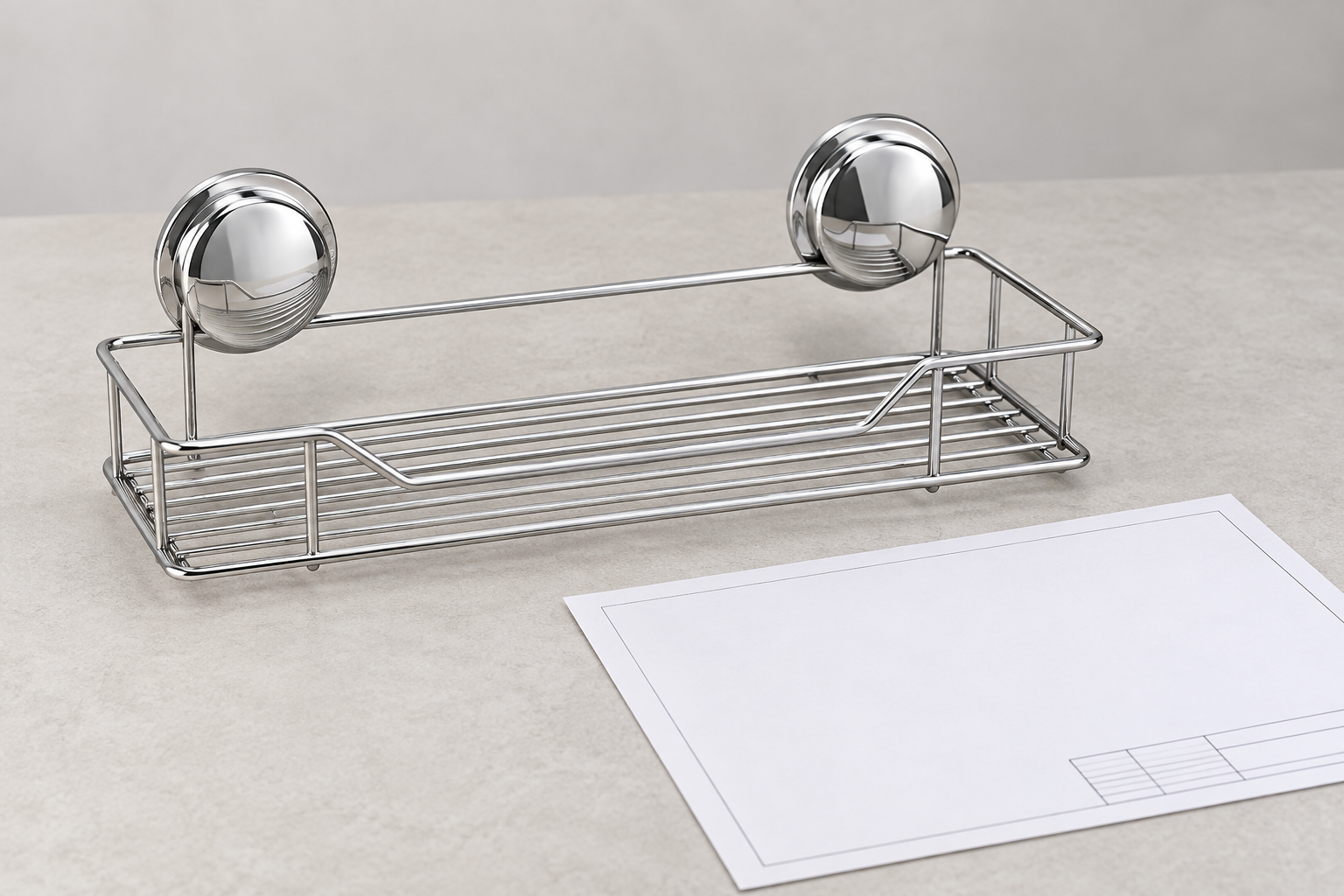
The illustrated Koitor chrome wire basket is a real baseline product with two round suction mounts and smooth front covers. It does not have an approved indicator in the project reference set. For a sourcing discussion, the baseline lets buyer and factory ask whether a new feature can be integrated without degrading the existing cup, cover, wire connection, or bathroom appearance. Koitor’s no-drill bathroom accessories manufacturing page describes the relevant product family.
Write an intended user action next to every proposed signal. For example, if a cue is intended to indicate that the assembly may need attention, the instruction should explain that the user must unload and inspect the product under the approved installation guidance. It should not tell the user that a color alone guarantees continued adhesion. This distinction influences the artwork, physical mechanism, sample review, and any future packaging claim.
How should buyers compare possible indicator concepts?
Compare concepts by the physical state they observe and by the evidence needed to connect that state to a useful warning. A cue tied to a cover position is different from one tied to deformation of a rubber cup, and both differ from a device intended to sense pressure. These approaches should not be treated as interchangeable. The buyer should ask for a supplier drawing, a working sample, an explanation of its signal path, and a test plan before using any one of them in a product specification.
| Proposed concept | What the buyer must clarify | Main review risk |
|---|---|---|
| Assembly-position cue | Which completed installation step moves the marker, and can a user see it? | A correct-looking cue may reflect cover position rather than the wall seal. |
| Cup-deformation cue | Which cup movement drives the display, and will product tolerances affect it? | Normal variation may create ambiguous readings. |
| Pressure-responsive cue | Where is pressure sensed, how is the chamber sealed, and what is the reference? | Added passages or seals may change the original mounting system. |
| No indicator, clearer instructions | Can installation marks, illustrations, or inspection guidance address the problem? | The buyer may still need a physical cue for the chosen sales channel. |
This comparison is a procurement framework, not a catalogue of current Koitor indicator products. Before requesting a mold or tooling quotation, decide which user problem justifies the added parts and whether a revised instruction sheet would solve it more simply. Where a concept includes a seal, spring, valve, or window, the buyer should request an actual design package rather than ask an image generator or sample maker to infer those hidden components.
A useful supplier submission contains a section view, component list, proposed materials, assembly sequence, visual-state explanation, and a sample that can be compared with the buyer’s baseline product. Request tolerance and fit information for the actual mating parts. Do not accept a polished front-view rendering as proof that the mechanism fits behind a cover or survives the intended bathroom environment.
What must remain compatible with Koitor’s baseline suction assembly?
A proposed indicator must be evaluated against the existing product geometry before any public claim is made. Koitor’s reference component set includes a black rubber cup with a center connection, a locating metal base, and a smooth electroplated front cover. The illustrated wire basket is held through its own product-specific mounting arrangement. The references establish what is present today; they do not establish free space, pressure pathways, or a safe modification for an indicator.
Start the engineering review with the functional interfaces. The rubber contact edge needs the intended wall-contact shape. The cup’s center connection must continue to mate with the specified base and cover. The basket wires and mounting plates must remain correctly located and supported. Any extra component should be checked for interference during assembly, removal, cleaning, and packaging. A feature that blocks the cover from seating or puts debris near the contact face is a design problem even if the cue itself moves as intended.
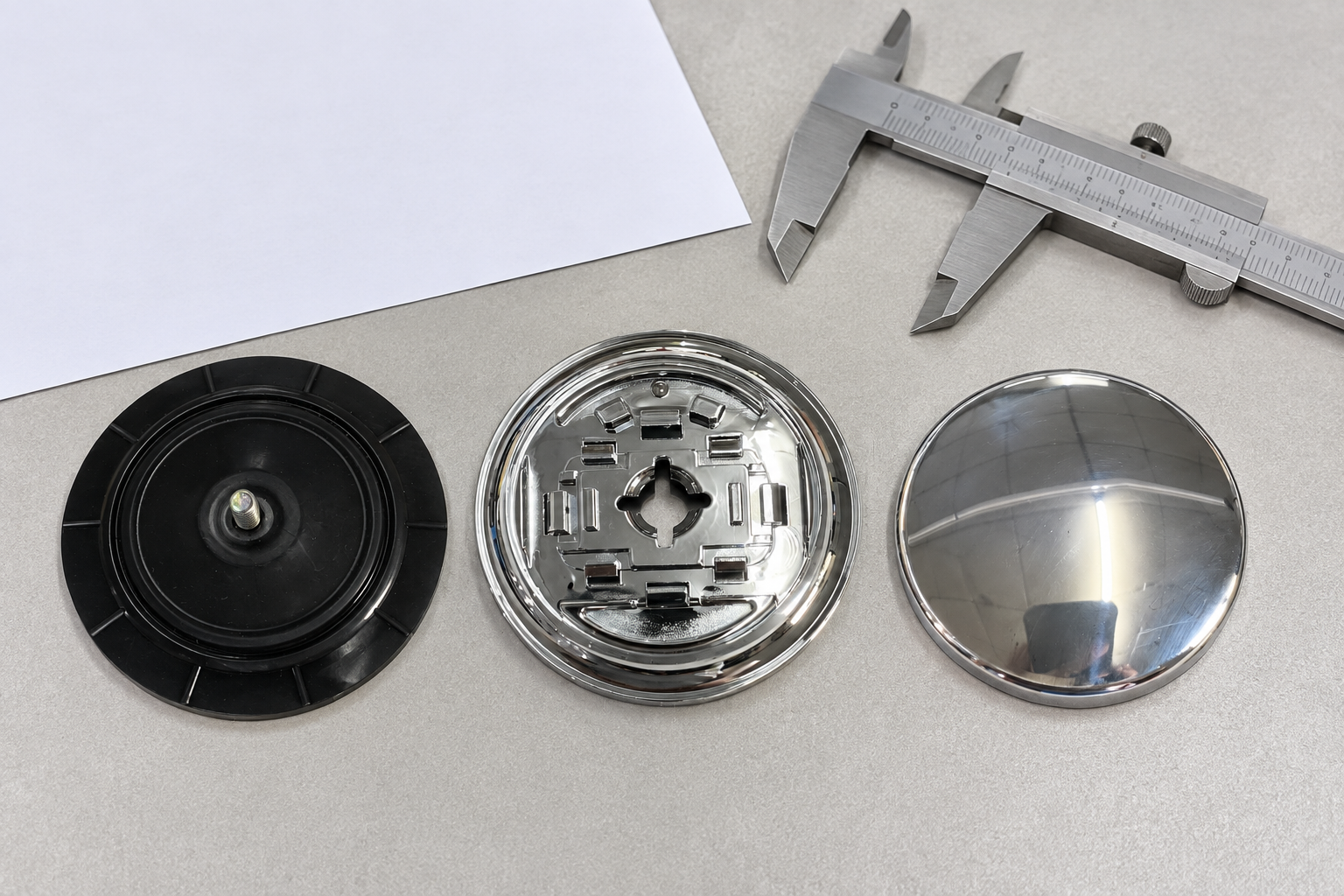
The photograph shows baseline parts only. It should not be read as a drawing of a pressure sensor or a finished indicator. A buyer who wants a modified front cover should provide the desired viewing position and get a controlled drawing from the supplier. A window cut into a cover, a taller cap, or a second moving part can change appearance, cleaning access, assembly time, and the relationship between the user cue and the actual suction state.
Koitor Hardware is a family-owned custom metal hardware factory specializing in bathroom and home storage products. Its flexible small-batch OEM approach is useful for reviewing drawings or physical samples before committing to a new accessory format. That manufacturing role does not imply an approved indicator design or a pressure-testing capability. The buyer and factory should agree the prototype boundary and any external validation needs case by case.
Which sample tests and observations make the cue meaningful?
Test the proposed cue against the intended user action on the actual product, rather than judging it only by appearance. A sample program should record the baseline assembly, the modified assembly, the installation surfaces chosen by the buyer, the observed cue states, and the conditions that caused each state. The buyer should set any numerical thresholds, loads, time intervals, and acceptance criteria in a separate agreed specification. No universal value can be inferred from a photograph of a suction cup.
- Define the claim boundary. State what the cue is intended to communicate and what it does not establish. Use plain words that a user could act on.
- Document the baseline. Keep an approved unmodified sample, drawing revision, and photographs of the rubber cup, base, cover, and accessory.
- Review the prototype mechanism. Confirm its part list, assembly sequence, visible state, and effect on existing interfaces.
- Observe normal variation. Compare multiple samples and installations under the buyer’s planned conditions. Record ambiguous or inconsistent states.
- Check the warning state. Establish whether the cue changes at a useful point under the agreed method and whether users notice it.
- Review repeat use and handling. Examine cleaning, removal, repositioning, packing pressure, and the condition after transport.
- Approve the instructions. Match each cue state to a clear user action and avoid a guarantee that the sample evidence cannot support.
For a proposed suction cup vacuum indicator mechanism, the strongest evidence is a reproducible relationship between the cue and the specific condition the buyer has defined. A false reassuring state is particularly important to investigate. A cue that appears “good” when a seal is incomplete may be worse than no cue because it can change user behavior. A cue that changes too often can also be ignored. The buyer should decide how both errors will be observed and documented.
Do not substitute a bench fit check for a finished-product validation. A marker might move correctly in a loose component sample while the assembled basket’s cover, bracket, or wire path constrains it. Conversely, the basket may assemble well while the display is hidden behind a bottle. Observe the assembled product in the intended orientation, with realistic bathroom lighting and the likely contents in place, under an agreed test plan.
How do cost, packaging, and retail language affect selection?
Include the entire product program in the decision, not just the price of an added indicator part. A new cover or internal moving element can change tooling, assembly instructions, inspection points, spare-part identity, retail artwork, and packing orientation. A feature that makes sense on one premium SKU may add needless cost or confusion to a trial assortment. Ask the factory to quote the baseline and proposed variant as separately identified products.
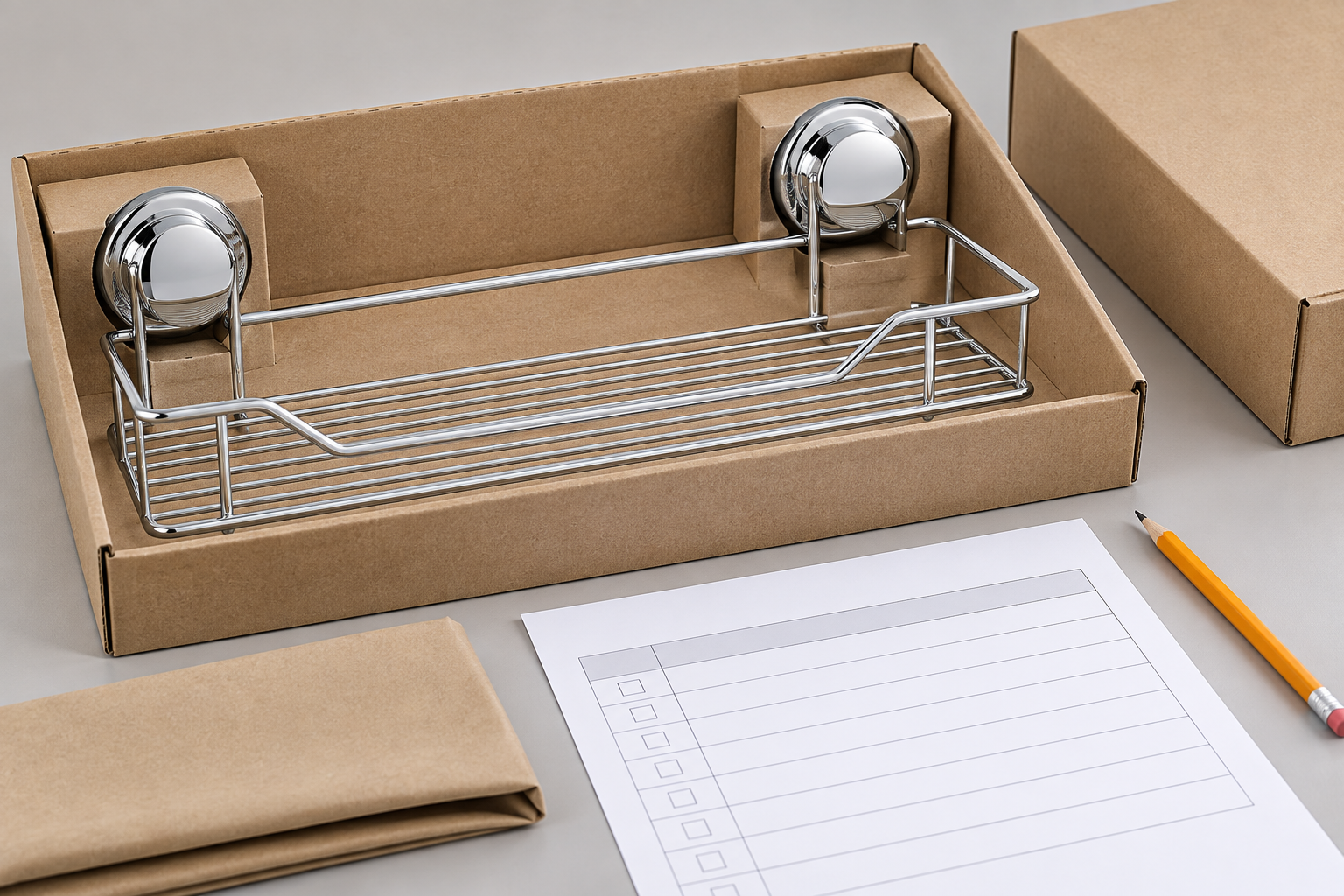
Packaging needs a physical sample review. A protruding cue can be pressed during transport; a viewing window can be obscured by a label or carton insert; a replacement component can be packed with the wrong variant. Use an approved packing arrangement for the exact assembly revision. The buyer should inspect the cue immediately after unpacking and verify that the product still matches its approved visible state and finish.
Retail language should describe what has actually been demonstrated. “Vacuum indicator” could be interpreted by a customer as a measured safety signal. If the mechanism merely records a cover position, use wording that reflects that narrower behavior. If the buyer wants to claim a pressure-related warning, obtain the appropriate evidence for the finished product and intended instructions. Do not attach a numerical load or wall-compatibility promise to a visual cue without product-specific substantiation.
For small-batch OEM development, a staged decision is practical: first approve the baseline structure, then a functional indicator prototype, then the user instruction and pack sample. Record each revision so the supplier does not mix indicator and non-indicator components. A clear revision trail also lets an importer compare customer feedback with the exact version shipped. Koitor can review the metal accessory interfaces and packaging implications from a buyer’s drawing or sample, while specialist indicator design or testing must be scoped and confirmed separately.
What should be on the importer’s indicator-feature checklist?
The buyer checklist should turn a proposed suction cup vacuum indicator mechanism into a sample-ready brief. It should identify the existing accessory, the intended visual message, the physical state behind that message, and the decision owner for any design change. For a distributor or private-label brand, it should also connect the prototype to its retail instruction and package rather than allow the feature to appear only in an engineering drawing.
- Which approved product model and assembly revision will receive the proposed feature?
- What specific user problem should the cue solve, and what action follows each visible state?
- Does the concept show assembly position, cup deformation, pressure response, or another defined state?
- Which product-specific drawing and physical sample prove the added parts fit?
- What changes to the rubber cup, metal base, cover, bracket, or wire geometry are proposed?
- How will the buyer examine inconsistent, hidden, or misleading cue states?
- What validation method and acceptance criteria will support the final instruction and retail copy?
- How will indicator and baseline variants be separated in parts, packaging, and repeat orders?
- Who signs off the functional sample, appearance sample, packaging sample, and final claim wording?
If the checklist cannot answer the basic state-and-action questions, keep the concept at brief stage. A buyer does not need to approve tooling to learn that the use case is unclear. Send the factory the actual basket or holder sample, desired user outcome, and any market-specific packaging requirements; then request a feasibility review. The Koitor contact page is the route for that drawing or sample discussion.
FAQ: What do buyers ask about vacuum indicator concepts?
Does a visible indicator prove that a suction accessory will stay attached?
No. It can represent only the physical state for which the product-specific mechanism has been designed and validated. Finished-product holding behavior also depends on the mount, surface, installation, load, environment, and use conditions.
Does the current Koitor basket pictured here include an indicator?
No. The images show the documented baseline basket and component set. A proposed indicator variant would need its own approved drawing, working sample, and review.
Can a cover-position marker be marketed as a pressure gauge?
Only if its measurement behavior and wording are supported by the actual design and evidence. A marker linked only to cover movement should be described according to that observed function.
What should a buyer send for an OEM feasibility review?
Provide the baseline product sample or drawing, intended visual message, user action, target finish, planned retail instructions, packaging concept, and expected order quantity. Flag any features that cannot change.
Should an importer compare indicator and standard versions?
Yes. Separate samples help the buyer evaluate whether the extra feature provides a useful user benefit relative to its tooling, assembly, inspection, packaging, and communication costs.
Collaborez avec Koitor Hardware
Review a No-Drill Accessory Development Brief
Send Koitor your current product drawing or sample and describe the user decision a proposed indicator should support. The factory can review the metal accessory interfaces, sample plan, packaging and small-batch OEM options before quotation.
Fabrication pour compte de tiers / Marque de distributeur
Transformez ce guide d'approvisionnement en cahier des charges
Indiquez-nous le produit souhaité, ses dimensions, sa finition, la quantité commandée et vos exigences en matière d'emballage. Votre équipe recevra une analyse pratique de la faisabilité de la fabrication avant l'établissement du devis.
 English
  Español
  Português
  Français
  Deutsch
  العربية