
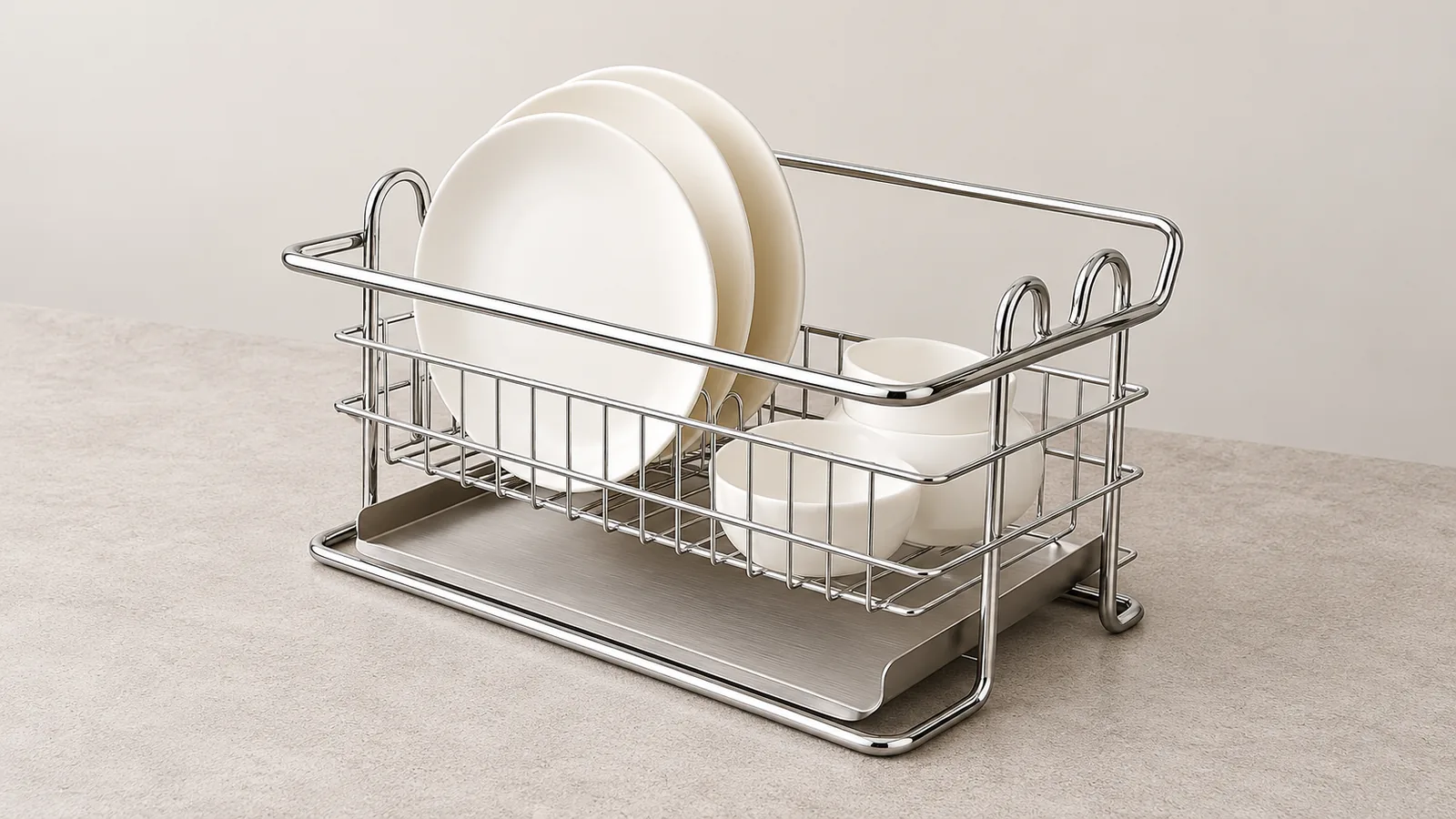
Kitchen dish rack plate slot spacing design should be based on the buyer’s actual dish profiles and their loading and removal paths, not the number of divider gaps in a photograph. Specify plate diameter, depth, rim shape and support contact, then check finished clear gaps and neighboring dishes on a physical sample. Approve the intended mixed arrangement before using it as the basis for retail capacity wording or an OEM production order. Plate fit and drainage are separate requirements: an open wire rack can still be unsuitable for a particular dinnerware assortment.
For kitchenware importers and private-label brands, the objective is a repeatable specification that the factory can quote, sample and reproduce. A rack that looks spacious when empty may require skipped positions for deeper plates or leave insufficient space to remove a large dish. This guide focuses on freestanding wire dish racks and plate-divider interfaces. It does not establish a universal slot dimension, drying time, non-scratch claim or load rating.
Which plate dimensions should define a dish rack fit brief?
Provide complete plate profiles, including diameter, depth, rim shape and the underside foot ring. Diameter describes the outer size, but it does not explain how a plate sits between dividers or how much neighboring space it occupies.
The plate profile is the side shape of the dish from its rim to its underside. A shallow flat plate and a deeper coupe-style plate may have similar diameters yet occupy different space when inclined in a rack. The supplier should see the actual profile instead of assuming that every dinner plate behaves like the one shown in a product photograph.
The foot ring is the raised region on the underside of some dishes. Its position can affect where the plate contacts lower support wires. Record the actual underside when the contact arrangement matters; a top-view diameter sheet alone cannot establish it. Include the rim’s thickness and any unusual edge shape that may interact with a divider.
Identify a mandatory assortment using neutral sample codes. Separate everyday plates, side plates, deeper dishes and bowls. If bowls are intended for an open compartment rather than the plate slots, state that distinction. Trying to classify every dish as a plate-slot occupant can obscure the design requirement and inflate an advertised capacity.
| Dish characteristic | What buyers should supply | What sample review should confirm |
|---|---|---|
| Outside diameter | Largest and smallest mandatory dishes | Clearance from rim, frame and surrounding counter features |
| Dish depth | Side profile and actual sample | Space occupied between neighboring positions |
| Rim thickness and shape | Finished dish, not an outline only | Contact with dividers during placement and removal |
| Underside foot ring | Underside photograph or sample | Intended support contact on lower wires |
| Bowl profile | Defined bowl assortment | Whether slots or a separate area are appropriate |
| Mixed dish group | A recorded intended loading map | Practical capacity and accessible removal sequence |
Manufacturer product pages often explain their prong arrangement and overall dimensions without providing an OEM fit method. For example, Joseph Joseph’s Extend Steel product page describes its own expandable layout and protective prongs. That illustrates a specific product architecture; it is not evidence that another rack has the same capacity, protection or geometry. Do not copy those features into a Koitor drawing unless they are part of a separately confirmed project.
Ask the commercial team which dishes the product must support together. A “family dinner set” request is not precise until its plate and bowl profiles are defined. The sample register should identify optional or excluded dishes as well as mandatory ones, so an exception remains visible during quotation and approval.
How do clear gap, divider pitch and support angle differ?
Clear gap is the usable space between finished divider surfaces; divider pitch is the repeated distance between corresponding features. Support angle describes how a plate sits in that geometry. These three terms should not be used interchangeably on an OEM drawing.
A repeated centerline dimension can help describe fabrication, but the wire itself occupies part of that distance. Finishing and local joining features may also affect the usable space. Buyers should therefore identify whether a dimension controls pitch, clear gap or overall rack width, and mark the actual measurement points.
Curved divider loops require special attention to measurement location. The clear gap can vary along the loop, and a plate may contact the structure at more than one height. A single front-view measurement may not describe the passage encountered by a deeper rim. Review both the loaded resting position and the path used to put the plate there.
Support angle is a result of the plate profile and its contacts with the lower wires and divider structure. It should not be guessed from a catalog photograph. Observe the actual mandatory dishes in the finished sample and decide whether the resulting arrangement is acceptable for the intended use. Any numerical criterion should be agreed for that design and supported by the relevant project review.
Increasing a clear gap does not automatically improve every aspect of fit. A broader gap may accommodate a deeper dish but change support for a small or thin plate. Increasing pitch may also reduce the number of positions within a fixed counter footprint. A factory should explain those tradeoffs rather than promise a universal solution.
An OEM dish drainer slot design should also identify boundaries around the divider area. The perimeter rim, end frame and any neighboring utensil compartment can obstruct access even when central slots work well. Review the first and last relevant positions rather than assuming all repeated spaces behave identically.
Where a rack includes a removable collection tray, check that the tray and support frame remain in their intended assembled positions during plate review. Do not remove a normal component merely to make the fit demonstration easier. The approval sample should represent the product configuration that the buyer intends to sell.
How should buyers approve mixed loading and removal access?
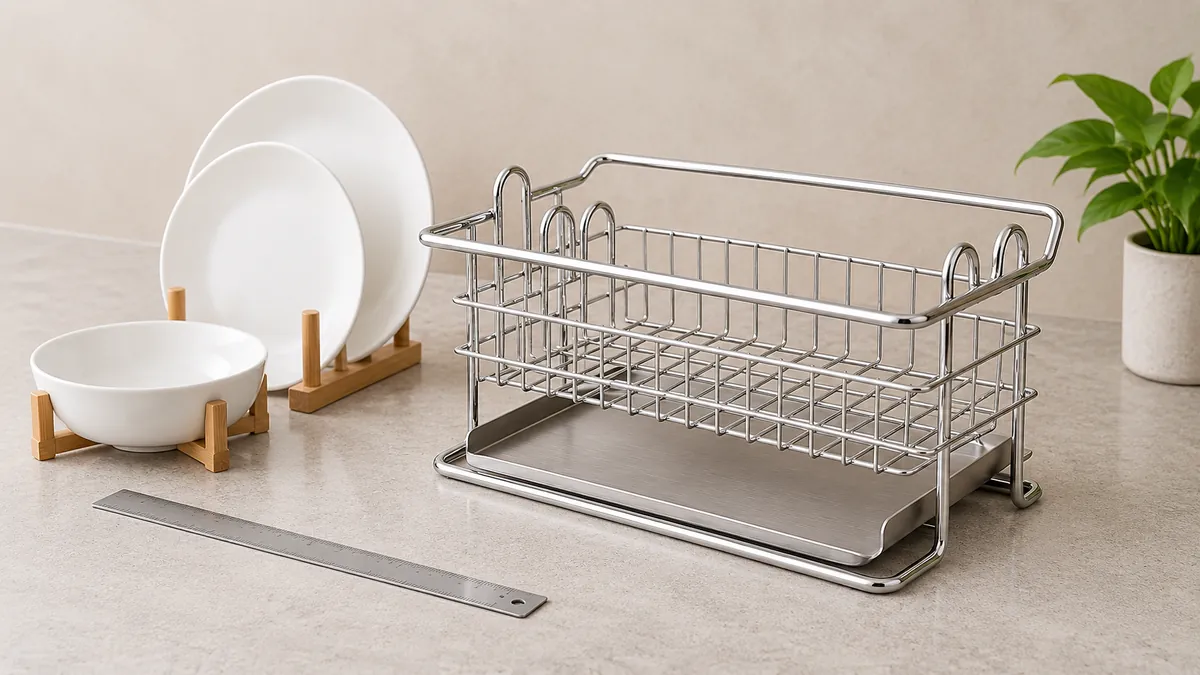
Use a documented dish assortment and loading map, then review individual removal from relevant occupied positions. Nominal slot count does not show whether plates and bowls can be used together within the intended counter space.
Start with one mandatory plate at a time. Identify the sample revision and record the position, orientation and contact regions. Note whether the plate settles where intended, encounters a frame member or requires an unusual approach. Describe the observation clearly rather than labeling the entire rack “too small.”
Next, load the intended group of plates and bowls. Include the larger and deeper profiles instead of using only identical flat dishes. If a deeper dish requires an empty neighboring position, record that condition and adjust the practical capacity description. An unoccupied gap is not necessarily a defect, but it should not be counted as usable for that approved dish arrangement.
Check removal as well as storage. The reviewer should be able to follow the agreed handling path without forcing a plate against a wire or disturbing a neighboring dish unexpectedly. Observe the first and last positions, the plate closest to a rim and the largest mandatory dish. These positions may expose access limitations hidden by the central layout.
Include the surrounding installation envelope. The loaded rack needs space beside the sink and, where relevant, beneath an overhead cabinet. Plate height above the frame and upward removal travel can matter more than empty rack height. Provide the intended counter layout as a drawing or measured photograph instead of asking the factory to assume a typical kitchen.
Kitchen drying rack plate fit should be reviewed separately from the water path. Use Koitor’s kitchen dish rack drainage approval guidance for tray coverage, collection and sink-interface decisions. This plate-fit review should stay focused on divider contact, usable positions and handling access rather than duplicating drainage requirements.
Finally, record the outcome for each mandatory dish and the mixed arrangement. Use compatible, compatible with a stated restriction or not compatible as clear categories. Add sample photographs and drawing revision references. A retail capacity statement should describe the arrangement approved by the buyer, not a count inferred from repeated wires alone.
Which fabrication, finish and packaging changes can alter spacing?
Changes to wire size, bend profile, divider placement, joining or finish can affect the finished dish interface. Packaging distortion can also change the arrival sample, so fit approval should be connected to both production geometry and packing condition.
Wire bending establishes divider shapes and frame relationships. Joining fixes those components together. Buyers should identify the spacing and alignment features that need to match the approved sample rather than inspecting only overall length and width. Two racks with similar outer dimensions can have different usable positions inside them.
Local details also deserve attention. A projecting joint or abrupt wire end in a dish path can create interference even when the average slot spacing is correct. Review actual contact regions on the finished sample. Do not turn a smooth-looking photograph into a claim that the rack cannot mark any ceramic or glass surface.
Finish selection should be discussed with the structure. If wire diameter or finishing changes, repeat relevant clear-gap and contact observations. The allowance should be based on the selected process and finished sample, not an assumed thickness copied from another product. Kitchen dish rack plate slot spacing design remains a functional specification after color selection is complete.
Packaging should restrain the rack without pressing curved dividers together or distorting the support frame. Review where inserts bear on the product, how the tray is secured and how a customer removes the assembled rack. The packing concept should preserve the geometry that was approved, subject to the buyer’s distribution requirements and suitable verification.
Separate arrival damage from a design issue. Record pre-pack dimensions where needed and photograph the received sample before reshaping anything. If the divider gap differs after shipment, changing the production drawing may not address the packing cause. The factory and buyer need evidence from both stages to decide the appropriate correction.
Common mistakes include measuring centerline pitch but approving it as a clear gap, checking one flat plate while excluding deeper dishes, approving an unfinished structure and treating packaging as a cosmetic task. Another mistake is copying a competitor’s stated dish count without testing the buyer’s assortment. A controlled sample record makes these assumptions easier to identify.
How can Koitor develop a plate-fit sample from the buyer's brief?
Koitor Hardware can review dish samples, rack drawings and packaging requirements together before developing a custom metal storage rack sample. The discussion should separate mandatory plate fit from optional appearance and clearly identify unresolved dimensions.
Koitor Hardware is a family-owned custom metal hardware factory specializing in bathroom and home storage hardware. Approved capabilities include bending, welding, polishing, surface finishing, basic assembly and packaging preparation. These capabilities support practical sample development; they do not prove an unverified dish capacity, material grade, test result or load limit.
Pour fabrication de rayonnages de rangement sur mesure pour cuisines, supply a drawing or physical reference with a defined dish assortment. Mark the divider area, open bowl area, frame boundaries and support arrangement. Include the required counter footprint and practical removal space so a larger slot is not proposed at the expense of another fixed requirement.
Direct factory communication helps clarify which requirement controls the design when goals conflict. More dish positions, broader clear gaps and a compact footprint cannot simply be assumed to improve together. Request a proposed geometry and a revised sample that demonstrate the chosen tradeoff. The approval owner should decide whether a reduced practical capacity or a larger rack is commercially acceptable.
Keep the finished sample, approved drawing and dish register linked. A sample plate may be replaced by a different retail assortment later; that change should prompt review rather than inherit the earlier approval automatically. Repeat orders should refer to the same controlled fit requirements unless the buyer approves a revision.
MOQ can start from 100 pieces depending on product structure, material, finish and packaging. Samples usually take 5–7 working days after details are confirmed, while bulk production usually takes 4–6 weeks depending on the project. These are conditional planning statements. Confirm timing after the dish assortment and fit-critical sample changes have been settled.
What belongs in a plate-fit quotation and approval checklist?
Include the dish assortment, controlled rack dimensions, loaded layout and acceptance observations in the quotation brief. This helps the factory understand what the buyer expects to approve rather than relying on a general “large dish rack” description.
- Assign codes to mandatory, optional and excluded plates and bowls.
- Supply diameter, depth, rim profile and underside foot-ring information.
- Provide actual finished dishes where a drawing cannot describe contact clearly.
- Mark divider pitch and finished clear-gap locations separately.
- Identify the intended support contacts and plate orientation.
- Define the mixed loading map and any intentionally skipped positions.
- Review first, last and frame-adjacent positions as well as central slots.
- State counter footprint, overhead restrictions and removal access.
- Keep plate-fit approval separate from drainage and performance requirements.
- Specify material preference and finish appearance without unsupported guarantees.
- Include packaging restraint and arrival-condition observations.
- Confirm sample revision, approval owner, quantity and timing assumptions.
- Align retail dish-count wording with the verified assortment and arrangement.
Use a short acceptance sheet that records photographs, revisions and exceptions. A conditional approval should name the remaining task and who will confirm it. Do not let a styling approval or a successful empty-rack inspection become authorization for bulk production before the functional fit requirements are resolved.
Frequently asked questions about dish rack plate-slot fit
Kitchen dish rack plate slot spacing design approval should refer to an actual dish assortment and finished rack. These answers distinguish useful specification terms from unsupported capacity assumptions.
Is plate diameter enough to specify divider spacing?
No. Depth, rim thickness, foot-ring shape and supported orientation also affect fit. Provide complete profiles or actual dishes so the factory can review contact and movement rather than outer size alone.
Is divider pitch the same as the clear gap?
No. Pitch describes repeated feature spacing, while clear gap describes usable space between finished surfaces. Identify both terms and their measurement locations on the drawing where they matter to approval.
Can deeper bowls use every plate position?
That depends on the rack and bowl profiles. Some arrangements may require skipped positions or a separate open area. Approve the intended loading map and reflect any restriction in capacity wording.
Should a finish or wire-size change trigger another fit check?
Yes, where it affects the finished gap, support contact or removal path. Review affected dishes against the revised sample and drawing rather than assuming appearance approval covers function.
Does good drainage prove that plates fit correctly?
No. Drainage concerns the water path and collection arrangement; plate fit concerns support, spacing and access. Both requirements should be approved, but neither substitutes for the other.
How can buyers start a plate-fit sample review with Koitor Hardware?
Begin with representative dishes and the rack’s space requirements. Koitor can discuss the metal structure, manufacturability and sample options before quoting a small-batch OEM project.
Review Plate Fit Before Approving Your Dish Rack
Send Koitor your plate samples or profile drawings, rack concept, counter dimensions, finish preference, quantity and packaging requirements. Our factory team can review manufacturability and sample-development options before quotation.
Fabrication pour compte de tiers / Marque de distributeur
Transformez ce guide d'approvisionnement en cahier des charges
Indiquez-nous le produit souhaité, ses dimensions, sa finition, la quantité commandée et vos exigences en matière d'emballage. Votre équipe recevra une analyse pratique de la faisabilité de la fabrication avant l'établissement du devis.


 English
  Español
  Português
  Français
  Deutsch
  العربية