
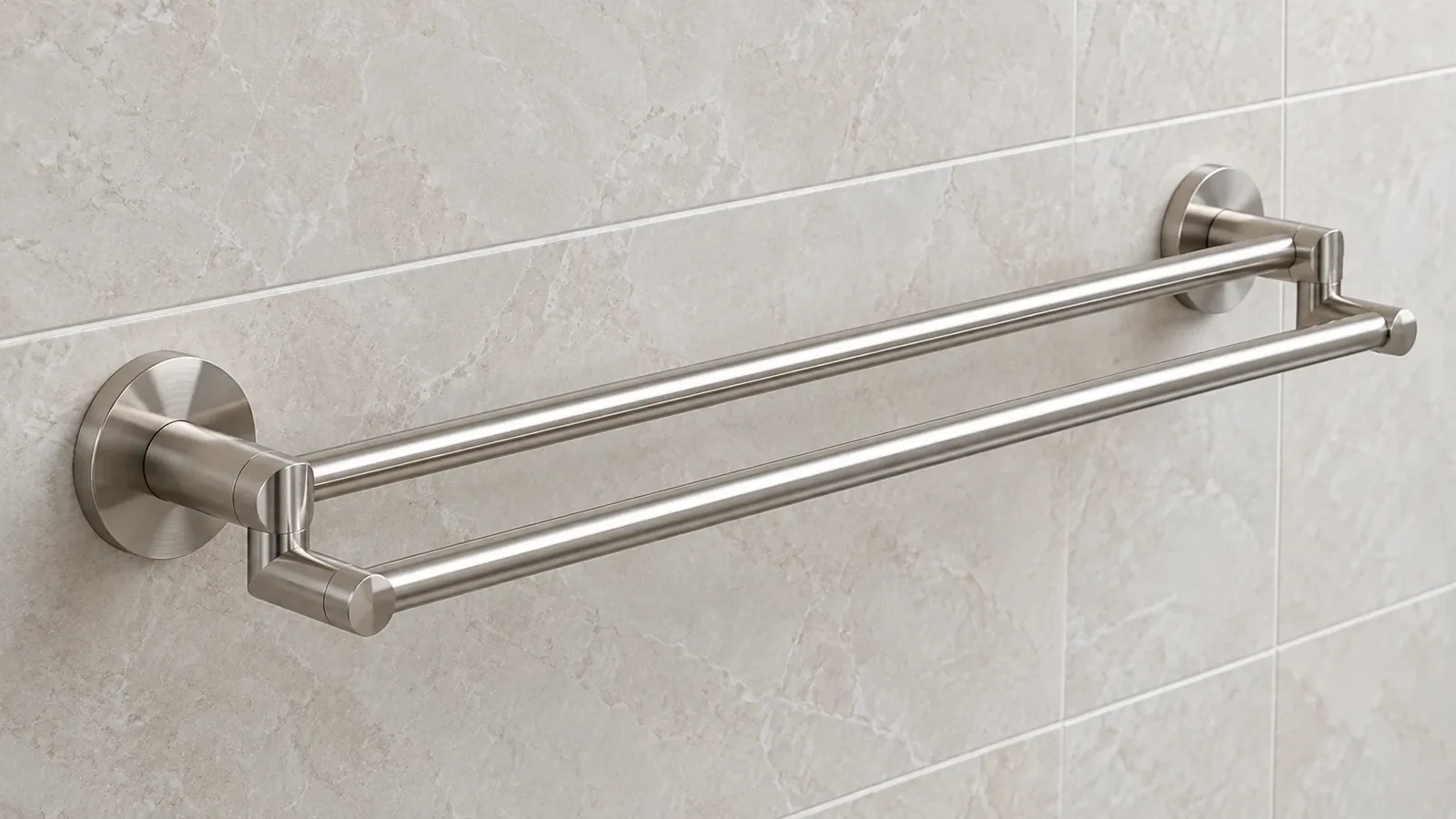
For an OEM double towel bar, double towel bar spacing should be specified as usable clearance between the two rails—not inferred from overall width or wall projection. Buyers should show the front and rear rail centerlines, clear gap, mounting centers and distance from the wall on a controlled drawing, then review both rails with the intended towel fold on a representative sample. There is no single spacing that suits every towel thickness, rail diameter, room layout or product style.
This distinction matters because a bar may look spacious in a front view while towels overlap or press together in use. The front rail can also project farther into the room, affect access to the rear rail or interfere with a nearby fitting. A dimensional drawing should make the geometry visible from the side and plan views, while a sample check should confirm that a buyer can place and remove the intended towel from each rail.
This guide is for importers, distributors and private-label bathroom-hardware developers approving a double-bar product. The examples describe buyer questions, not a Koitor product specification or a claim that Koitor currently manufactures the cited designs. A product’s dimensions, materials, mounting structure and performance must be confirmed for the project.
Which dimensions define usable double towel bar spacing?
Buyers should distinguish the rail-to-rail gap from overall projection and width. The rail-center distance describes the nominal relationship between the two bars; the clear opening between their surfaces depends on center distance and the actual rail diameters or profiles. Overall projection describes how far the assembly reaches from the mounting wall. Mounting centers identify the support locations. Each dimension answers a different fit question.
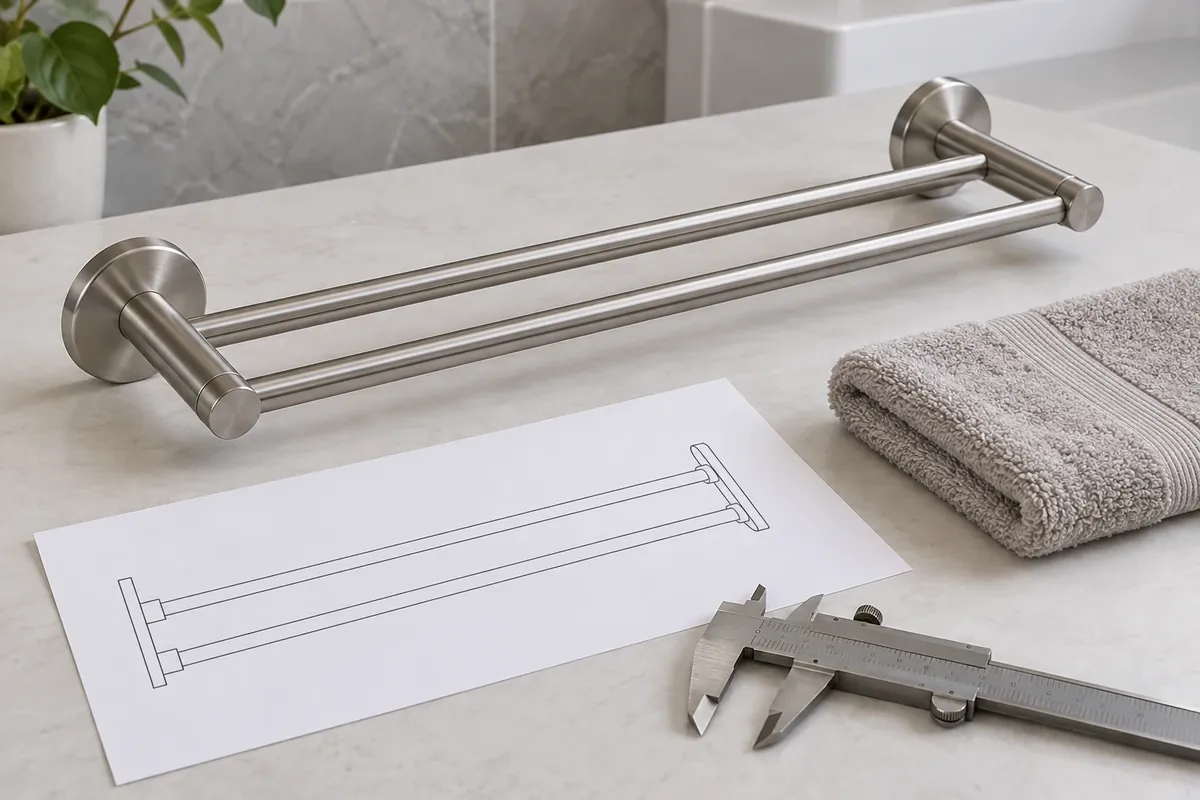
Request a side-view drawing that shows the front and rear rail centerlines and their respective projection from the wall. Add the clear gap between the closest surfaces if users need both bars accessible at once. A front view should show total width, end-support positions and mounting-center distance. If the bars are staggered vertically as well as front-to-back, show the height difference too. Do not expect a single catalog depth to communicate all these relationships.
Moen’s product specification for one double towel bar includes a dimensioned drawing and mounting details; American Standard’s product page describes a design intended to provide space for two towels. These are examples of product-specific configurations, not a universal dimensional standard. Their values should not be copied into another product’s drawing without checking towel size, rail profile, bracket shape, installation setting and target assortment.
Use a simple dimension set in the RFQ:
| Drawing item | Buyer question it answers | Pourquoi est-ce important ? |
|---|---|---|
| Front and rear rail centerlines | How far apart are the rails at their axes? | Provides a repeatable reference independent of visual estimation |
| Clear rail-to-rail gap | What open space remains between the rail surfaces? | Helps assess towel separation and hand access |
| Wall-to-rail projection for each rail | How far does each rail extend into the room? | Reveals stagger, wall clearance and possible interference |
| Overall width and mounting centers | How much wall space and support spacing does the product need? | Supports installation planning and bracket review |
| Rail diameter or cross-section | What surface envelope occupies the nominal spacing? | Changes the actual clear gap and contact area |
| Vertical offset, if present | Are rails separated in height as well as depth? | Affects access and how towels hang |
The drawing should also identify the intended mounting arrangement and show whether the supports hold one shared frame or separate pieces. A pivoting system and a fixed system are not interchangeable: a pivoting bar needs movement clearance and a defined open/closed position, while a fixed assembly needs sufficient access to load each rail in its installed position.
Why is overall projection not enough?
Overall projection gives the furthest point from the wall, but it does not reveal where each rail sits inside that envelope. Two products can share the same maximum projection and still have different front-to-rear clearance. One could place the rails close together; another could stagger them more. Without the two centerlines or clear gap, a buyer cannot tell whether the rear rail remains practical when the front rail is occupied.
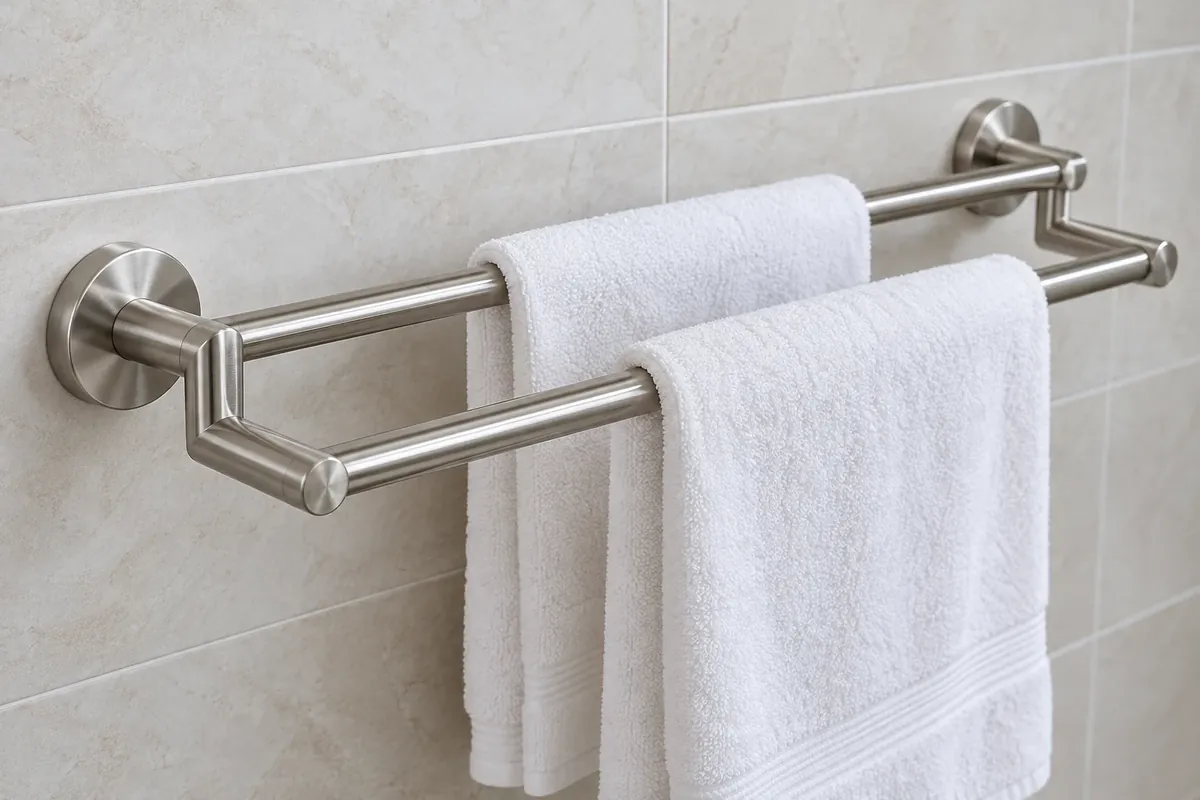
The towel itself changes the usable envelope. A thin, narrow hand towel folded once behaves differently from a thicker bath towel folded into several layers. The rail’s diameter, surface shape and the towel’s fold can reduce clearance. If two towels are intended to hang simultaneously, ask the product team to define the representative folded condition. The goal is not to prescribe a universal textile size; it is to make the intended use case testable.
Adjacent hardware can also affect usability. A towel bar beside a shower enclosure, vanity edge, cabinet door or robe hook may need different projection or support placement from one installed on an open wall. Installation height belongs to the site plan and user context, not a universal factory dimension. The supplier drawing can establish product geometry; the buyer’s installation or product brief should define the surrounding constraints.
Clearance should be evaluated in the intended state. If the product is fixed, place and remove a towel from each rail while the other is occupied. If the design pivots, check the defined movement range, stop positions and any clash between bars, supports and wall. If the product is only a decorative double rail with one towel expected at a time, document that use case instead of implying simultaneous two-towel access.
How should towel thickness and fold be represented?
Use one or more representative towel types from the target assortment and document how each is folded for the check. Record approximate folded envelope only when the buyer has a defined measurement method; otherwise retain labeled physical samples or controlled photographs as references. Avoid saying that a particular rail gap accommodates “all towels” or guarantees no overlap.
A sample test is a usability screen, not a durability or load test. It can show whether the selected towel can be hung and removed with the other rail occupied under a stated condition. It cannot establish wall anchorage, long-term deformation, corrosion resistance or suitability for every installation. Those are separate requirements with their own evidence and responsible suppliers.
What should buyers compare before approving a sample?
Compare the geometry options against the intended product brief rather than selecting a spacing by appearance alone. A small difference may matter when the towel is bulky or a nearby fitting limits projection, while a more widely staggered design may require extra wall space. The choice is a product decision with design and package consequences.
| Option to compare | Potential benefit | Vérification de l'acheteur | Trade-off or limit |
|---|---|---|---|
| Tighter fixed rail spacing | More compact wall envelope | Confirm each intended towel can be placed and removed with the other rail in use | Bulky folds may reduce separation or access |
| Greater front/rear stagger | May create more hand and towel clearance | Measure both rail projections and assess nearby-wall or fixture clearance | Can increase overall projection into the room |
| Vertical offset between rails | May separate towel edges and improve access in some layouts | Check hanging length, reach and the complete wall envelope | Changes the visual design and support geometry |
| Pivoting double bars | Can change the access or storage envelope | Define operating positions, stops, movement clearance and sample state | Adds joints and requires movement-specific checks |
| Different rail profile or diameter | Changes grip surface and occupied space | Confirm clear gap using actual profile dimensions | Center distance alone no longer describes the open clearance |
Treat this as a structured comparison, not a performance ranking. The buyer should use the exact proposed profile and supports. A rendered illustration or competitor specification can help frame the discussion, but the production-intent sample is the relevant item for approval.
What should the RFQ and technical drawing include?
State the intended product type—fixed or pivoting, two rails, mounting style and target market—then identify the geometry the supplier must return for review. Share the target towel fold or physical towel samples, the location constraints and any adjacent fittings that define the installation envelope. If the design is not final, label assumed dimensions as provisional and request a supplier drawing for buyer approval before sampling.
The drawing package should include:
- Product drawing number and revision, overall width and height, mounting centers, support locations and the wall reference plane.
- A side view with each rail centerline, separate wall-to-rail projection and the clear distance between the closest rail surfaces.
- Rail material/profile and outside dimensions as project-specific inputs, plus finish expectations and any visible-face requirements.
- The intended towel type or fold used for usability review, and whether both rails must be occupied simultaneously.
- Any expected proximity to a wall, shower screen, cabinet, vanity or adjacent bathroom accessory.
- For a pivoting design, movement states, stop positions, hinge/contact areas and the clearances to be checked.
- The sample revision, inspection or fit method, acceptance record and changes that require reapproval.
Do not substitute mounting centers for bar spacing. Mount centers are used to locate the product on the wall; rail spacing describes the relationship between the bars. Similarly, an overall product depth does not tell the buyer how much open space remains between rail surfaces. Keep those labels distinct in the drawing and quotation.
For a surface-finished metal product, discuss the finished dimensions where coating or plating changes the external profile. Do not assume finish thickness or a particular material grade; use the project specification and supplier confirmation. If the rail is made from a tube, wire, formed strip or a combination, the cross-section may change the clear gap even when centerline spacing stays constant.
How should the buyer review a physical sample?
Use a sample that represents the actual support geometry, rail profile, finish and mounting arrangement intended for production. Install it on an appropriate representative surface or fixture using the specified mounting method. Check the product in the orientation defined by the drawing; a sample placed at an arbitrary height or rotated for a photograph does not validate the installation envelope.
A practical sample review can follow these steps:
- Confirm that the sample ID and drawing revision match the quotation and product brief.
- Measure or verify mounting centers and overall dimensions against the approved drawing method.
- Check the two rail centerlines, clear gap and individual wall projections from the defined wall reference.
- Hang the selected towel on the front rail, then test access to the rear rail; repeat in reverse order.
- If simultaneous use is intended, place both representative towels and note any contact, overlap, blocked access or removal difficulty.
- Check nearby-fittings clearance using the installation envelope from the buyer’s product brief.
- For a pivoting product, review each agreed operating position and note any collision, pinch point or interference that needs engineering review.
- Record photographs from the front and side as supporting evidence, then document unresolved questions and approval limits.
A photograph supports identification and communication but does not replace a measurement where the drawing specifies one. The measurement record should state the datum, condition and method. If the rail is flexible or the sample is not mounted rigidly, the support condition may influence the result; document it so buyer and supplier can reproduce the review.
A sample can answer whether a particular towel and layout appear usable under the stated conditions. It does not prove universal fit across a retail assortment, long-term durability or safe wall installation in every substrate. Keep those decisions separate. If the buyer needs a broader assortment claim, test a defined range of towel envelopes or revise the product brief to state its intended use.
Which design changes require renewed review?
Recheck the sample when a change affects the rails’ relative position or the usable envelope. Examples include moving one rail, changing rail diameter or profile, adjusting support shape, changing mounting centers, moving the wall reference, introducing a vertical offset, or changing from fixed to pivoting. A finish change may also matter if external dimensions or surface contact change.
The supplier’s drawing should show which revision was sampled and which variants the sample represents. If a product family has several widths but shares the same rail spacing and supports, the buyer and supplier can document the rationale for representative sampling. Do not assume the narrowest, widest or longest version automatically covers every configuration; assess the feature that creates the tightest clearance or highest access risk.
For a pivoting model, a hinge or stop change should trigger a fresh movement review because the bar may swing through a different envelope. For a fixed model, a support change can shift rail position or reduce usable end clearance. The appropriate review depends on the altered feature and its role in the approved drawing.
What should a buyer take away?
Double towel bar spacing is a three-dimensional product decision: define rail centerlines and clear gap, show each wall projection, identify mounting centers separately, and choose the representative towel fold before sample approval. Confirm that each rail can be accessed in the intended occupied state and that nearby fittings do not defeat the design. Avoid copying a competitor’s dimensions as a universal rule.
Koitor’s documented bathroom-hardware scope includes towel bars and OEM metal product development. A project’s specific double-bar design, dimensions, materials and mounting method must still be confirmed through its drawing and sample. The fabricant de quincaillerie de salle de bains sur mesure page provides broader sourcing context. To discuss a project-specific arrangement, share the target towel, drawing and wall-clearance constraints through contacter Koitor.
Foire aux questions
Is there a standard spacing between two towel-bar rails?
This research did not identify one universal spacing that applies to every product. Rail profile, towel fold, support layout, projection and installation environment vary. Define the dimensions and intended use case for the specific product.
Should buyers specify rail-center distance or clear gap?
Where possible, specify both. Center distance is a stable geometric reference; the clear gap describes open space between the actual rail surfaces and depends on their profiles.
Does overall projection show whether the rear rail is usable?
No. Overall projection shows the assembly’s furthest reach from the wall, not the separation between the two rails. A side-view drawing should show each rail’s position separately.
Can one towel prove both bars are usable?
Not if the product is intended for simultaneous use. Review the defined towel condition on each rail and test access with the other rail occupied.
Does a sample review prove installation performance?
No. The sample can support a defined geometry and usability decision. Wall substrate, anchor selection, load and long-term performance are separate project requirements.
What if a supplier proposes different rail spacing?
Ask for a revised drawing showing both centerlines, clear gap, projection and mounting centers. Review the change against the intended towel fold and installation envelope before approving the next sample.
Technical references:
- Moen product specification: dimensioned double-towel-bar drawing
- American Standard product page: double-bar product context
- Retailer question illustrating front/rear spacing ambiguity
Review a double towel-bar specification
Share the intended towel fold, drawing and wall-clearance requirements so rail spacing and sample checks can be reviewed for your OEM product.
Fabrication pour compte de tiers / Marque de distributeur
Transformez ce guide d'approvisionnement en cahier des charges
Indiquez-nous le produit souhaité, ses dimensions, sa finition, la quantité commandée et vos exigences en matière d'emballage. Votre équipe recevra une analyse pratique de la faisabilité de la fabrication avant l'établissement du devis.
 English
  Español
  Português
  Français
  Deutsch
  العربية