
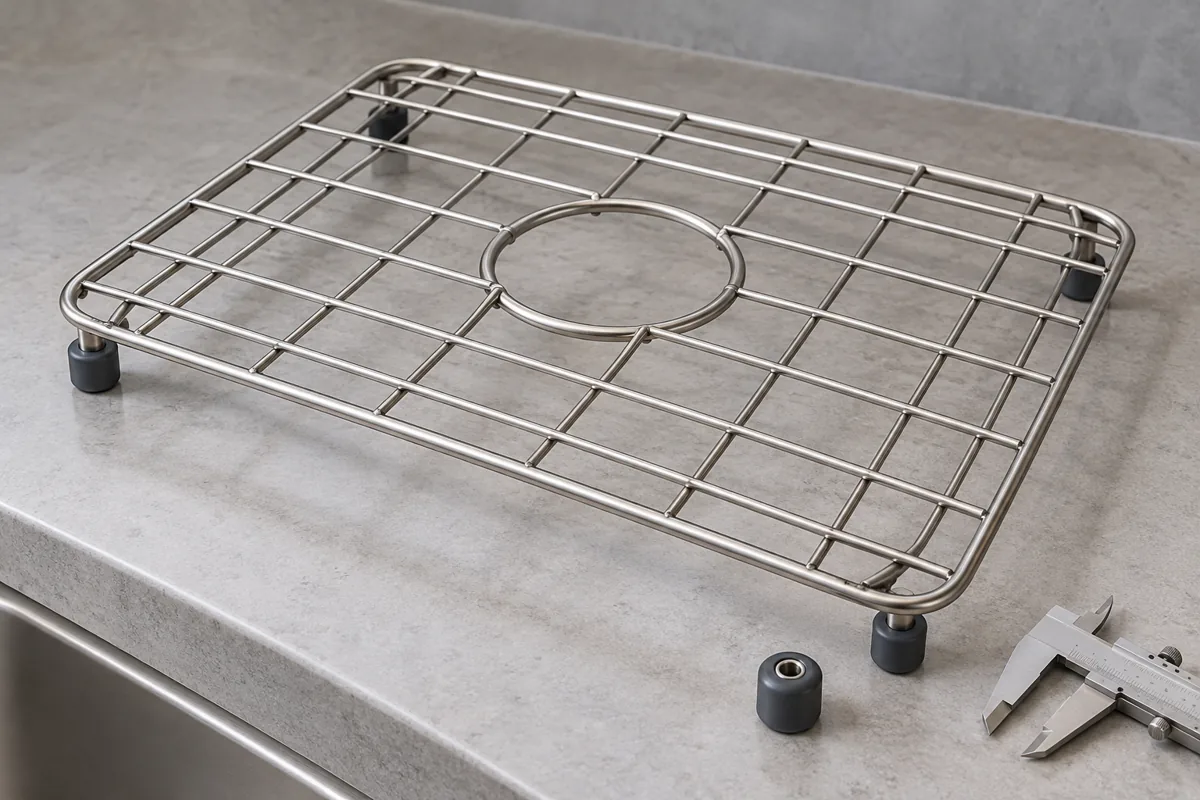
For a sink protector grid foot replacement fit, approve the exact grid interface, installed height, retention method, quantity and replacement-part identity—not just a product photo or a nominal foot diameter. Test a production-intent spare on a finished grid and record the approved part revision alongside the grid drawing and bill of materials (BOM). Sink-grid manufacturers sell feet or bumpers as model-specific accessories, which is a useful reminder that a part that looks similar may not fit another grid.
Why should OEM buyers define sink-grid replacement feet?
Buyers should define replacement feet because the feet are functional components in the grid assembly and may be ordered, packed or serviced separately from the metal grid. A missing or worn foot can change how a grid contacts the sink, so the intended spare must match the selected grid and the buyer’s replacement plan.
An OEM buyer may be developing a private-label sink accessory, coordinating a bundle, or deciding which service parts belong in an assortment. The decision is not simply whether a foot is rubber. Buyers need to know whether the item is a foot, a bumper, a sleeve or a protective cap; how it attaches; where it sits; how many are required; and whether a replacement is supplied loose, installed, or both.
Public manufacturer listings illustrate product-specific part identity. BLANCO lists a grid foot as an individual spare part and identifies a nominal 3 mm detail in that specific listing; Elkay describes feet as a feature of a bottom grid and includes a customer question about replacement bumpers; Franke separately describes rubber feet and protective bumpers on a grid product. These BLANCO spare-foot listing, Elkay bottom-grid page, et Franke grid accessory page are product-specific examples, not evidence of universal size or interchangeability. Buyers should tie each spare to the exact grid model and revision.
For a buyer, a useful approval record links the finished grid, the foot part number, the attachment detail and the replacement quantity. This avoids relying on a supplier’s general phrase such as “rubber feet included” when a product line contains different frames or support-wire dimensions.
Which dimensions and interface details should buyers specify?
Specify the mating geometry and the installed condition, then confirm them on a finished sample. The grid support diameter or shape, foot opening, wall thickness, insertion depth, retention feature and installed height all influence fit; a single outside diameter cannot describe the full connection.
The buyer and supplier should first identify the exact grid member that receives the foot. It could be a round wire end, bent leg, formed tab or another geometry. Record the relevant size at the contact area and state how it is measured. This is the core of a sink protector grid foot replacement fit review: an outside diameter alone is not enough if the foot also depends on insertion depth or an internal retention feature. Represent that feature in the drawing or sample record rather than inferring it from a photograph.
Installed height deserves its own check. Four feet that look alike may not place the grid level if one sits deeper, deforms, or is mounted on a different support position. Confirm the grid’s resting plane on a flat reference surface and check the clearance that the design is intended to provide. Do not set an assumed universal clearance without a product drawing and application requirement.
| Avis des acheteurs | What to record | Pourquoi est-ce important ? |
|---|---|---|
| Grid interface | Support member shape and size at the fit location | Determines whether the foot opening and retention feature can mate |
| Foot geometry | Opening, insertion depth, flange and internal retention detail | A matching appearance does not establish a secure fit |
| Installed height | Height from the grid support to the contact surface | Affects grid level and its intended separation from the sink |
| Positions and count | Foot locations, total installed quantity and spare quantity | Avoids mismatch between assembly, packing list and service kit |
| Revision identity | Grid drawing, foot part number and revision | Makes reorders traceable when a component changes |
When dimensions are critical, identify the measurement locations on a drawing or inspection sketch. Clarify whether the dimension applies to an uninstalled component or to the foot after installation. Material compliance, hardness and long-term performance should be established from the actual supplier’s specification and test method; the silhouette alone does not prove them.
How do feet, bumpers and protective sleeves differ?
Use the supplier’s part definition and assembly drawing to distinguish a support foot from a bumper or protective sleeve. Similar-looking elastomer pieces may have different positions and functions, so a buyer should not treat their names as interchangeable without confirming the design.
A foot commonly sits beneath a grid support and creates a defined contact point or clearance. A bumper may be intended to soften contact at a side or edge. A sleeve may cover a wire or leg over a longer section. These are functional descriptions, not fixed industry-wide definitions; the product drawing and supplier’s part list control the specific assembly.
Ask whether the proposed sink-grid replacement feet are identical at every position. Some designs may use different parts at corners or at distinct supports. If a grid has feet and separate bumpers, assign each an individual part number, quantity per assembly, location and replacement method. That information should also match the package contents and any customer service-parts list.
| Component label in the BOM | Typical question for the supplier | Buyer verification |
|---|---|---|
| Foot | Does it support the grid and establish installed clearance? | Confirm contact locations, installed height and quantity |
| Bumper | Is it intended to soften or protect a contact point? | Confirm its location and whether it is separate from the foot |
| Sleeve or cap | Does it cover a wire end or longer section? | Confirm insertion direction, coverage and retention |
| Spare component | Is it the same revision and specification as the installed part? | Match sample, part number, pack quantity and replacement notes |
These distinctions are particularly useful when the product includes several elastomer components. A broad BOM entry like “rubber accessories, four pieces” may not tell a warehouse which part to pick or a buyer which part to reorder. Use the exact part names established for that project and keep them consistent across drawings, sample labels, packing information and purchase documents.
How should buyers verify fit and retention on a sample?
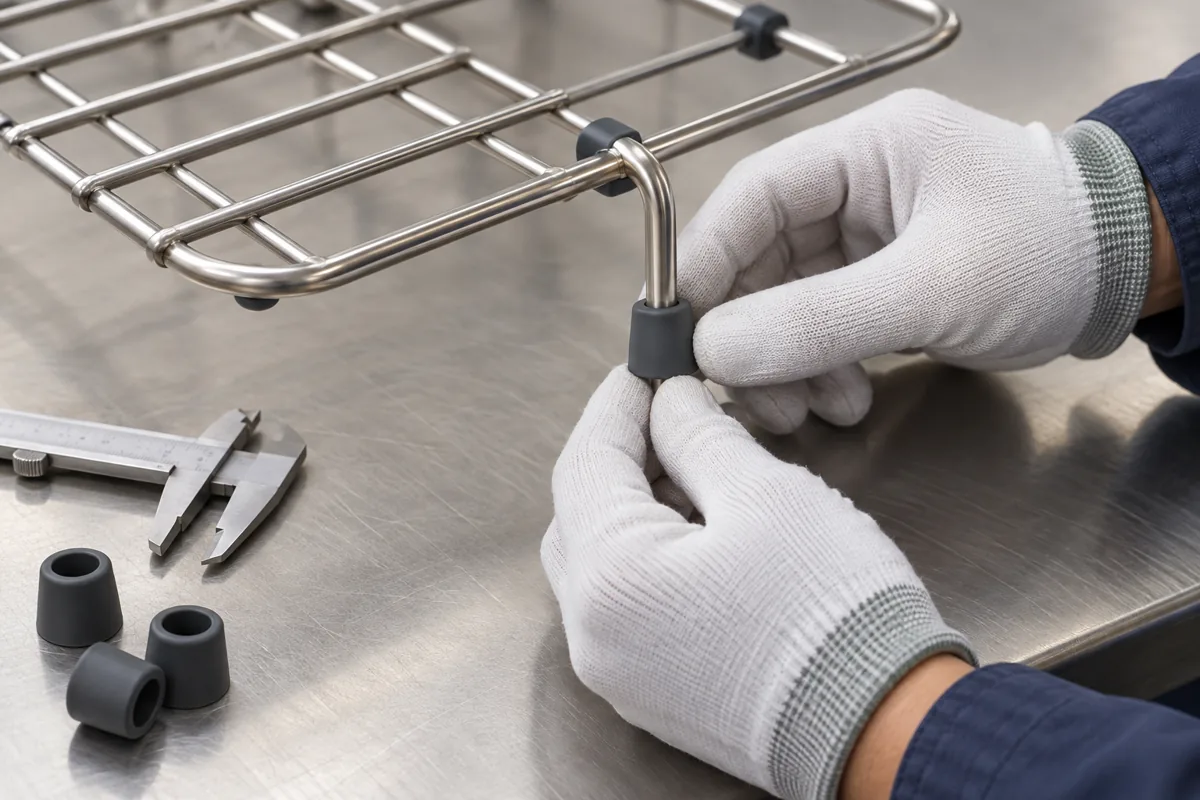
Verify the proposed replacement on a finished, production-intent grid and check the complete sequence: identify the part, install it using the approved method, inspect seating, place the grid on a flat surface, and confirm it remains in position during ordinary handling. A sample check establishes only the conditions and method actually reviewed.
Before testing, identify which grid revision and foot revision are paired. The sample should include the intended surface finish and any manufacturing variation that can affect the fit. A prototype made with a different wire diameter, coating or foot material may not represent the final assembly. If the supplier changes the support geometry or elastomer component, review whether the approval must be repeated.
During a fit check, note whether the component reaches its designed seated position, whether it rocks or sits visibly unevenly, and whether it can be removed and reinstalled as intended. If the design is not meant to be user-removable, do not instruct the buyer or end user to force it off. Removal and replacement should follow supplier-approved instructions, especially when a tool or a particular direction is required.
For retention, agree on a repeatable method before setting a pass/fail limit. A buyer could specify a project-level pull or handling check where appropriate, but the force, direction, sample count and acceptance threshold must be agreed for the actual product. A casual hand tug is not a standardized test and should not be described as proof of service life. Likewise, a one-time static check does not establish long-term resistance to wear, cleaning chemicals, temperature or repeated removal.
Keep results factual. Record the sample ID, component revision, grid revision, measurement method, observed fit, any loosening or deformation, and the disposition. If no defined test has been completed, state that fit was reviewed on a sample rather than implying a validated durability result.
What should be documented for replacement-part ordering?
Document the sink-grid model or drawing number, the foot’s supplier part number and revision, quantity per grid, spare quantity per sales unit and the applicable replacement instruction. The replacement record should let purchasing, production and after-sales teams identify the same component without guessing from a product image.
First decide whether spare feet are included with each grid, sold in a service pack, or available only through a replacement request. Each option has different packaging and inventory implications. If spare feet are included, list the quantity and distinguish loose spares from the feet already installed. If replacement parts are ordered separately, make sure the commercial description and part number uniquely identify the approved fit.
A sample can be approved while the replacement pack remains ambiguous. Therefore check the bill of materials against the carton contents and customer-facing spare-parts list. If one grid requires four feet and the intended service kit contains two, state that difference explicitly; do not leave it to an assembler or warehouse to infer the packing quantity.
Change control matters when suppliers or materials change. A new foot may have a different opening, internal geometry, hardness, color or supplier revision even when the external shape seems unchanged. Buyers should request notice of a component substitution and assess whether it changes fit, appearance, installed height, package count or any agreed test. Reorder the approved version only after the responsible buyer accepts the relevant change.
For related kitchen sink accessories, buyers may also review the product-specific considerations in Koitor’s kitchen sink dish-rack drainage design guide. Drainage is a separate design question from replacement-foot compatibility, but both should be considered in the context of the selected accessory and its approved sample.
What can an OEM supplier support in a fit review?
An OEM supplier can support a fit review by comparing the buyer’s drawing, sample and component list, then clarifying which interface details and change records are still missing. Koitor Hardware is a family-owned custom metal hardware factory focused on bathroom and home-storage products; sink-grid feet, molded components and the specific sink-grid product capability must be confirmed for each project rather than assumed.
For a related metal accessory project, a supplier discussion can separate the metal grid questions from the supplied component questions. Buyers can share the support geometry, target installed height, component count, intended spare-part model and sample revision. The review can then identify which metal dimensions are under the factory’s scope and which elastomer specifications or tests must be confirmed by the component supplier.
This division of responsibility matters in OEM sourcing. A metal manufacturer may be able to discuss wire form, assembly and sample coordination, while a separate supplier controls the foot’s material formulation or molded dimensions. The product brief should name the responsible party for each specification and require approval of the assembled sample before the buyer freezes the BOM.
Koitor’s broader OEM home-storage hardware manufacturing information describes the type of drawing and sample discussion buyers can prepare for related metal storage programs. It should not be read as confirmation that Koitor currently offers a particular sink-grid foot or molded spare part.
What should buyers include in a sink-grid foot RFQ?
An RFQ should show the grid and foot interface, specify the intended part identity and quantity, and describe the sample and change-control checks needed for the buyer’s program. A photo is useful context, but the drawing, component list and sample revision make the purchasing request actionable. Avoid common mismatches such as buying by photo, applying one brand’s dimension to another grid, confusing feet with bumpers, leaving spare quantity unstated, or accepting a silent component substitution.
- Grid outline and drawing revision, with the foot attachment area identified.
- Support-member geometry and the agreed measurement locations.
- Foot or bumper type, supplier part number, material specification and revision, when known.
- Number and location of installed feet, plus separately packed spare quantity.
- Required installed height or clearance, if controlled by the application.
- Sample requirements, including the intended finish and representative production geometry.
- Fit, seating, level and retention checks with method and acceptance limits where required.
- Packaging, labeling and BOM details for installed components and replacement kits.
- Change-notification and reapproval expectations for grid or component substitutions.
- Any market-specific material or chemical requirements supported by buyer documentation.
Share sensitive drawings only through the agreed supplier process. If material details are not yet selected, mark them as open questions instead of allowing a generic rubber description to become an implied specification.
Frequently asked questions about sink-grid replacement feet
Are sink-grid replacement feet interchangeable between brands?
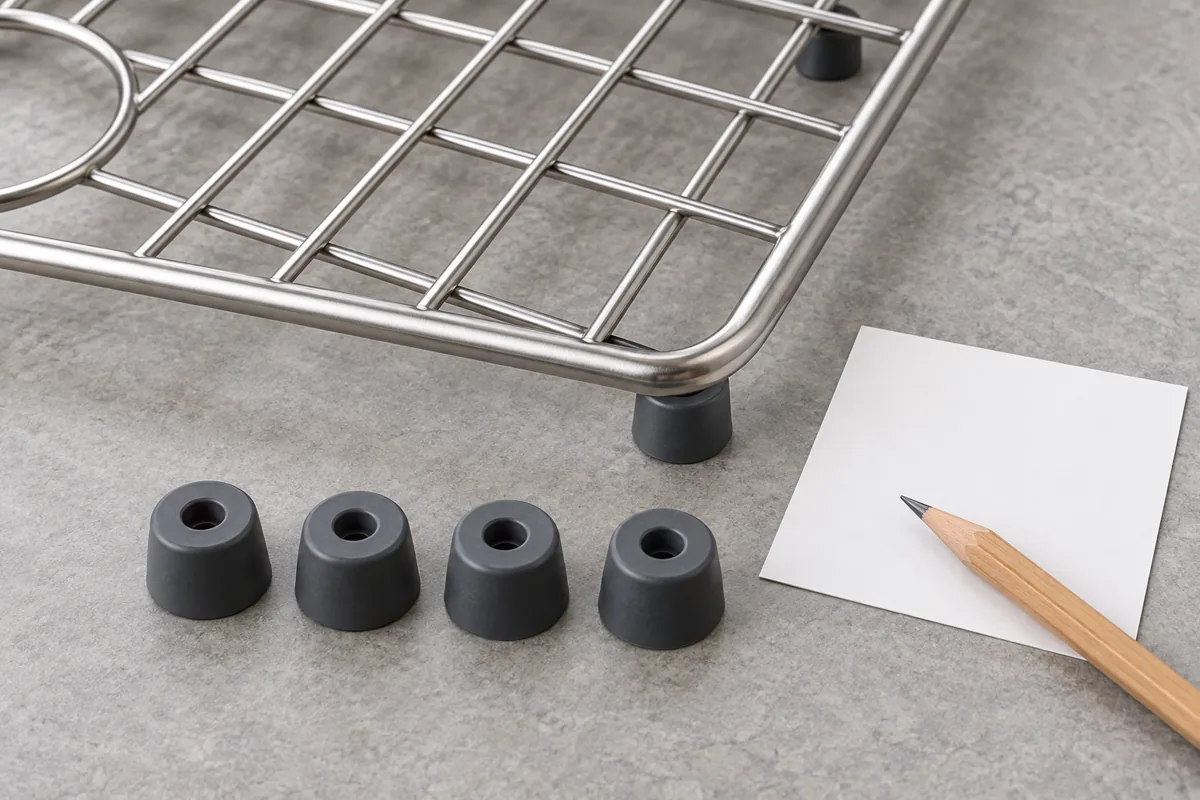
Not automatically. The opening, retention feature, installed height and support geometry may differ. Confirm fit against the exact grid model and revision; a manufacturer’s spare-part dimension applies to its listed product unless the supplier documents otherwise.
For sink protector grid foot replacement fit, ask the supplier to identify the receiving grid member, foot revision and installed condition, then verify those details on the finished sample.
Should buyers specify rubber hardness for a replacement foot?
Specify a material or hardness requirement only when the buyer has a defined use case, test method and supplier-supported range. Appearance alone does not identify hardness, chemical resistance or service life. Confirm the component supplier’s technical documentation for the selected part.
Can a sample fit check prove that a foot will last for years?
No. A fit check verifies the sample condition and the checks actually performed. Long-term wear, compression set, cleaning-agent compatibility and repeated-removal performance require separate product-specific requirements and evidence.
Should replacement feet be supplied loose or installed?
That is a packaging and service decision for the product owner. State whether the grid ships with all feet installed, whether spare feet are packed separately, and the exact quantity per unit or service kit.
What if the grid uses a different support-wire diameter in a later revision?
Treat the wire change as a potential interface change. Recheck the foot fit, installed height and retention on a representative finished sample, update the drawing or BOM if needed, and approve the revised pairing before repeat production.
Review a Metal Accessory Specification With Koitor
Share the grid drawing, component interface, part list and sample revision for a practical OEM discussion. Sink-grid products, molded feet and material-specific requirements must be confirmed for the individual project.
Fabrication pour compte de tiers / Marque de distributeur
Transformez ce guide d'approvisionnement en cahier des charges
Indiquez-nous le produit souhaité, ses dimensions, sa finition, la quantité commandée et vos exigences en matière d'emballage. Votre équipe recevra une analyse pratique de la faisabilité de la fabrication avant l'établissement du devis.
 English
  Español
  Português
  Français
  Deutsch
  العربية