

A hardware kit packing inspection checklist helps an importer verify that the correct mounting parts and instructions are present before a bathroom-accessory carton is sealed. Start with a buyer-approved, revision-controlled kit definition, then choose a repeatable way to check part identity, quantity and placement. Counting, weighing, visual inspection and camera-based inspection answer different questions; none should be treated as proof of everything. Trial the chosen method with deliberately missing and similar-looking wrong parts before relying on it for production pack-out.
What problem does a mounting-kit inspection solve?
A product can leave the factory with its metal body intact and still create an avoidable installation complaint if a screw, anchor, bracket, plate or instruction sheet is missing. The buyer’s first task is to distinguish a true pack-out omission from a kit that was present but separated or discarded during unpacking. That distinction starts with clear placement instructions and evidence tied to the individual saleable unit or agreed inspection sample.
This guide begins after the product team has approved which parts belong in the installation kit. It does not replace the engineering bill of materials, the mounting design review or the broader retail packaging plan. Those define what the product needs and how the kit is packed; the inspection question is whether the approved kit was actually assembled correctly before carton closure.
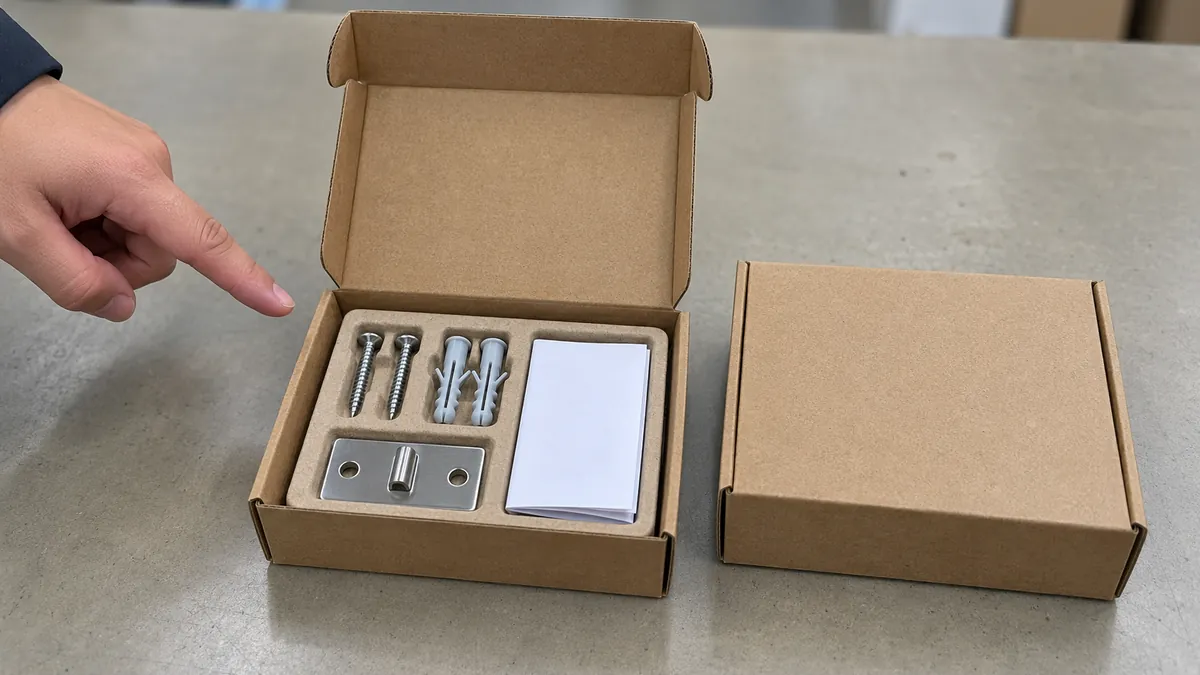
For a generic wall-mounted towel bar, a kit might include two screws, two compatible wall anchors, a mounting plate or pair of brackets, and an instruction leaflet. The exact contents depend on the product design and intended wall conditions. Do not copy this illustrative list into a purchase order without engineering approval. If the product has multiple mounting options, the buyer should specify which option is included in each SKU and how the alternatives are identified.
What must buyers define before checking the kit?
First approve a controlled kit specification that is unambiguous to the pack-out operator and the receiving team. A useful record identifies each component by name or drawing reference, quantity per saleable unit, material or finish where it matters, and the revision that applies to the order. Photographs can help identify a distinctive plate or anchor, but a photo alone may not distinguish similar sizes or revisions.
The buyer and supplier should also decide where the kit sits in the carton, whether it is sealed in a bag or compartment, and how an end user will find it. A kit that slides behind a product insert may be reported as missing even when it was packed. Add a plain placement note or a clear visual instruction where the pack design makes the kit easy to overlook. Keep customer artwork and labeling under the brand owner’s control.
Before sampling, settle these questions:
- Which kit revision applies to each product SKU and order?
- Which characteristics identify similar-looking screws, anchors, brackets or plates?
- Is quantity checked per individual kit, per carton, or through an agreed sampling plan?
- At what point is the kit checked: before bag sealing, after bag sealing, or after the final carton is packed?
- How is the kit restrained so it does not become separated from the product during handling?
- What record is retained, by whom, and for which lot or packing date?
- What happens when a part, supplier, instruction revision or package layout changes?
The buyer’s specification should not promise a perfect outcome just because a check is performed. Instead, it should define the method, sample size or control frequency, defect examples, responsibility, record retention and escalation path. The appropriate control depends on the consequence of a missing or incorrect component, the packing process, the buyer’s requirements and available evidence.

Which inspection method can detect which packing error?
A good hardware kit packing inspection checklist separates three questions: are all expected pieces there, are they the correct pieces, and are they in the right package? A count can detect a quantity shortage when parts are distinguishable. A visual comparison may identify a wrong component or instruction revision if the components are visible and the reference is clear. A weight check can flag a package whose mass differs from an expected range, but it cannot identify a part by name and may miss a small difference within normal variation.
| Method | Can help detect | Restriction importante | Buyer action |
|---|---|---|---|
| Manual count and visual layout | Missing pieces, obvious wrong shapes, incorrect instruction sheet | Repetitive handling, hidden or overlapping parts, inconsistent layouts | Define a fixed layout and train against approved samples |
| Weight check | A missing component that creates a measurable package-mass difference | Normal component and package variation can hide a light missing part; equal-mass substitutions look similar by weight | Test representative correct packs and fault packs before setting limits |
| Camera or vision inspection | Visible component presence, position, orientation or selected appearance differences | Opaque bags, glare, overlap, changing pack variants or poor image contrast can block detection | Validate the exact package and components with deliberate fault trials |
| Carton-level audit | Whether expected kits appear to be present in selected finished cartons | Does not necessarily prove each individual unit is correct | Define sampling and traceability to cartons, SKU and packing lot |
| End-user feedback | Reveals recurring confusion or apparent missing-kit complaints | Comes after shipment and may not prove where separation occurred | Compare complaint evidence with retained packing and receiving records |
Cognex describes kit inspection as checking whether the correct components are present in the correct positions, while noting practical challenges such as glare, overlap and variation in packaging. That is useful context for evaluating vision systems, not evidence that a particular factory uses one. See Cognex’s kit-inspection overview.
Mettler Toledo’s checkweighing guidance explains that missing-component detection by weight depends on the missing part being distinguishable from ordinary variation in the complete package and components. In practical terms, compare the lightest missing item with the spread of real package weights. If normal variation is too large, weight alone is not a reliable discriminator. A weight pass also cannot confirm that a screw has the correct thread, length or finish if a wrong part has a similar mass. See Mettler Toledo’s checkweighing guide.
How should buyers challenge-test the selected method?
Do not evaluate a proposed check only with complete, ideal packs. Prepare a controlled trial using approved components and examples of the errors the buyer needs the process to catch. A small challenge set could include one pack missing a screw, one missing an anchor, one containing a visually similar but incorrect screw, and one with an outdated instruction sheet. Keep those challenge packs clearly segregated so they cannot enter saleable production.
Record whether the method detects each seeded condition and what evidence supports the result. For manual inspection, confirm that an operator can distinguish the approved part and see every item in the prescribed layout. For weighing, use representative packaging and production-intent components so ordinary mass variation is included. For camera inspection, include the actual bag, insert, lighting and product variation that could obscure parts. A method that works on exposed components may not work through a reflective or opaque package.
The trial is evidence about the proposed detection method under the tested conditions; it does not establish that every later production unit will be free of missing or incorrect parts. Repeat it when the kit changes materially, such as a screw supplier or size change, a new bag or insert, a revised instruction leaflet, or a different arrangement that hides components. The buyer and supplier should define who approves a change and whether a new trial or sample review is needed.
Choose controls that match the risk and operating reality. A visual check may be practical for a low-variation kit with clearly separated parts; a more structured count or inspection record may be appropriate when several similar components are packed together. If a buyer requests automated equipment, confirm its capability and acceptance criteria with the responsible supplier rather than assuming a camera or checkweigher is available.
How can a missing-kit complaint be investigated?
When a distributor or end user reports a missing item, preserve the package and identify the SKU, lot, order, carton and instructions revision before drawing conclusions. Ask for photographs of the opened carton and remaining contents, but treat these as observations rather than proof of where the kit was lost. Compare the complaint with the approved kit list, pack layout, carton design and any retained inspection record.
A practical investigation follows the chain:
- Confirm the required kit revision and quantity for the affected SKU.
- Check whether the bag or loose parts could have moved under the insert or into a protective sleeve.
- Review the packing step and the available evidence for the relevant production date or lot.
- Compare other reported units from the same SKU and shipment without assuming every unit shares the same cause.
- Decide whether the likely issue is omission, wrong part, poor visibility, instruction confusion or separation during transit or unpacking.
- Agree a corrective action that targets the supported cause and a way to check whether it worked.
Do not label every complaint a factory packing defect without evidence, and do not dismiss a buyer’s report because a packing record exists. A record is only as useful as its scope, timing and traceability. If records cover a carton sample rather than every saleable unit, say so accurately. If a kit may have been discarded with the insert, improve placement visibility and instructions, then verify the revised pack presentation with a sample.
What should a buyer include in the RFQ and inspection agreement?
A buyer can make quotations and pack-out controls more comparable by providing the same kit specification and asking suppliers to confirm the process they can support. Keep the requirement concrete and avoid terms such as “all parts checked” unless the method and scope are defined.
- Attach the approved kit drawing or component schedule with revision.
- State per-unit quantities and identify parts that look similar.
- Specify the approved instruction version and language responsibility.
- Show the intended kit location and whether parts are bagged, boxed or retained in an insert.
- State the check point and whether the requirement is unit-level, carton-level or sample-based.
- Define the defect examples, escalation contact, record format and retention period.
- Agree how changes to hardware, supplier, layout or packaging trigger review.
- Ask for a production-intent pack sample before approving the final arrangement.
For custom metal bathroom hardware, the mounting kit may be supplied or specified by different parties. Identify who selects the anchors and screws for the target installation conditions; do not assume that a generic wall plug suits every wall. Koitor’s documented role is custom metal bathroom and home-storage hardware manufacturing. Buyers should confirm the project-specific scope for accessory parts, packaging and inspection before quotation rather than infer it from a generic product image. Review the custom bathroom hardware manufacturer overview and contact Quincaillerie Koitor with the drawing, kit list and target-market requirements.
Foire aux questions
Does a package weight check prove that every screw is included?
No. It can help flag a mass difference when that difference exceeds normal package and component variation. It cannot identify the screw type and may not detect a light missing piece or a similar-mass substitution.
Should every kit be opened and counted?
That depends on risk, buyer requirements and the agreed control plan. Specify whether the check applies to each kit, a defined sample, or a carton audit, and be clear about what that scope can establish.
Can a camera inspect a sealed hardware bag?
Only if the contents remain visible and distinguishable through that exact bag and arrangement. Opacity, glare, overlap and package variation can interfere, so the buyer should review evidence from a representative production-intent setup.
Does a complete sample prove that mass production will remain complete?
A sample demonstrates one observed pack, not every future unit. Pair sample approval with a defined production control, change notification and traceable records appropriate to the order.
Is an installation-kit list the same as a packing inspection checklist?
No. The kit list defines what belongs in the pack. The inspection checklist defines how the buyer and supplier confirm the approved parts, quantities, identity and placement at an agreed point before sealing.
Keep the hardware kit packing inspection checklist with the current kit revision and pack-out record so later receiving questions can be traced to the same approved configuration.
Discuss a hardware kit and pack-out requirement
Share the approved kit list, product drawing, package layout and inspection scope so the requirements can be clarified before sampling or quotation.
Fabrication pour compte de tiers / Marque de distributeur
Transformez ce guide d'approvisionnement en cahier des charges
Indiquez-nous le produit souhaité, ses dimensions, sa finition, la quantité commandée et vos exigences en matière d'emballage. Votre équipe recevra une analyse pratique de la faisabilité de la fabrication avant l'établissement du devis.

 English
 Español
 Português
 Français
 Deutsch
 العربية