

Compare samples from multiple suppliers against the same written product brief—not against memory, a supplier’s presentation, or whichever sample looks best at first glance. For bathroom and home-storage metal hardware, an importer should identify each sample, verify the same critical dimensions and configuration, inspect finish and assembly consistently, and keep supplier evidence separate from what can be seen directly. Then assess packaging, communication and commercial terms on separate parts of the decision record. A sample comparison can support a supplier shortlist; it cannot prove hidden material properties or guarantee mass-production consistency.
The practical goal is a traceable decision: which sample meets the required configuration, which differences need clarification, and what must be confirmed before an award or production approval.
Why should buyers compare samples against one common brief?
A comparison is only useful when every supplier was asked to quote and sample the same intended product. To compare samples from multiple suppliers fairly, “a chrome bathroom basket” cannot be the entire brief: it can conceal different dimensions, wire gauges, mounting kits, weld locations, finish expectations and packaging. If suppliers interpreted the request differently, the buyer may be comparing different products rather than different suppliers.
Before ordering samples, freeze a short common brief. Include the drawing or marked reference image, product dimensions, material and finish expectations, mounting configuration, included hardware, packaging level, target market, expected order range and any critical-to-quality features. Label uncertain requirements as open questions instead of letting each factory make its own assumption.
The brief does not need to prescribe every manufacturing detail. It should make the intended outcome and the comparison points unambiguous. For example, state the basket’s usable inside dimensions if fit matters, identify whether the wall fixing kit is included, and specify which visible surfaces need a consistent finish. Where the buyer has not selected a material grade or test method, ask suppliers to state their proposal and supporting evidence rather than treating unlike proposals as equivalent.
Keep the same brief revision with every sample request. When a clarification changes the design, issue the same revision to all suppliers still in the comparison. This helps the buyer distinguish a real capability difference from a difference caused by timing or incomplete information.
How should importers identify and control each sample?
Give every physical sample a unique ID as soon as it arrives. A simple code such as S-A, S-B and S-C is enough if the code is linked to the supplier, date received, product revision and sample status in a comparison sheet. Put the ID on a removable tag or bag, not on a cosmetic surface.
Record whether the sample is a standard catalog item, a modified item, a prototype or a production-intent sample. These are not interchangeable categories. A modified prototype may demonstrate design understanding but may not use production tooling or the final finish process. Ask the supplier to identify deviations from the brief and list any temporary components or hand-finished areas.
Use one controlled photo setup and measurement method for all samples. Photograph the same views, include a scale only when it can be read reliably, and record the measuring instrument and reference points for critical dimensions. Keep raw observations separate from conclusions: “rear rail is 4 mm above drawing dimension” is an observation; “this supplier has poor quality” is a broader conclusion that one measurement alone does not support.
For traceability, save the sample ID on the photo filenames, measurement sheet, supplier response and quotation version. If a sample is revised, preserve the original record and create a new revision rather than silently replacing the first assessment.
Which product features should be compared first?
Start with fit and function, then examine construction and appearance. A consistent review sequence reduces the risk that a polished finish distracts from a mounting mismatch or a dimension that prevents installation.
For a wire basket, towel rack, shelf or similar metal product, compare:
- Overall geometry: outside dimensions, usable space, squareness, symmetry and alignment against the drawing.
- Interfaces: mounting-hole or bracket positions, included fasteners, mating parts and clearance to adjacent surfaces.
- Stability and assembly: whether the sample sits or mounts as intended, whether parts align, and whether any unintended wobble or interference is observable.
- Wire and formed features: visible bends, rail heights, spacing, cut ends and consistency between left and right sides.
- Joints: weld location, visible spatter, sharp projections, gaps or distortion. Appearance does not reveal weld penetration or structural strength.
- Surface condition: scratches, pits, stains, uneven gloss or obvious color differences under the same lighting.
- User-facing edges: burrs, sharp points or areas likely to catch a cloth or contact the user.
Set acceptance criteria before scoring. A small cosmetic variation may be acceptable on a hidden surface but not on a prominent front rail; a dimensional difference may be critical if it affects installation but minor if it is outside the fit interface. Record the location, severity, evidence and disposition for each deviation.
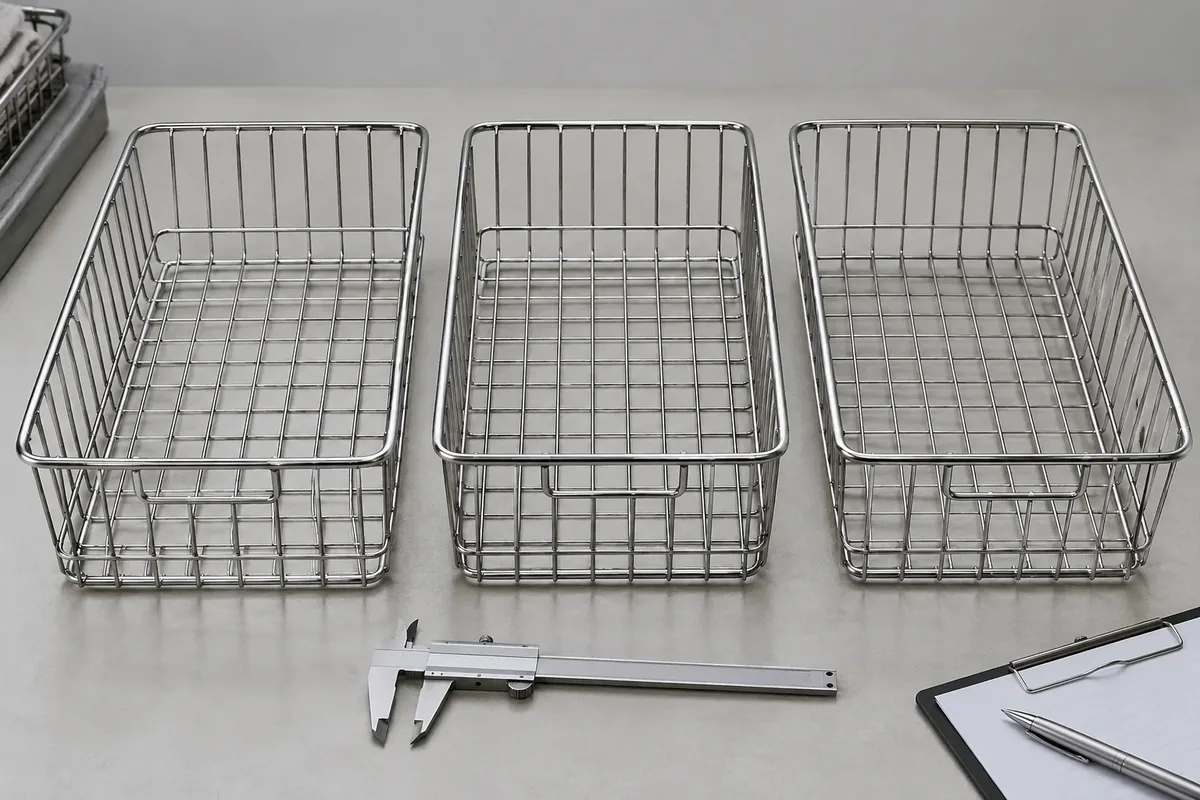
Avoid turning a sample review into an unsupported laboratory test. A visual check can flag an apparent finish defect; it cannot verify the stainless grade. A hand measurement can identify a dimensional discrepancy; it does not establish long-term durability. If the decision depends on a hidden property or performance claim, define the appropriate document, test method, acceptance criteria and responsible reviewer.
How should finish, material and supplier evidence be assessed?
Separate what the buyer observes from what the supplier declares. Record visible finish characteristics under comparable lighting and note the sample’s stated material, finish process and any supporting documents. Do not infer a grade from color, weight or a magnet response alone. If grade or coating properties are contract requirements, specify how they will be documented or tested and who will review the evidence.
Compare color and gloss with a buyer-approved reference when appearance is important. Use a consistent light source and viewing angle, and note whether the sample has a protective film or handling marks. Photograph defects before cleaning or polishing anything. Do not “improve” one sample during the comparison while leaving the others untouched.
Ask each supplier to identify the sample’s production route and any non-standard steps that affect the quote, but treat answers as supplier statements until supported by agreed records. Useful questions include whether the sample used the proposed production tooling, whether the final finish is represented, and whether any part was sourced separately. A clear answer can help the buyer identify risks; it does not on its own prove factory-wide process control.
A supplier that flags a discrepancy and proposes a documented correction may be easier to evaluate than one that simply says “same as requested.” Still, responsiveness should be scored separately from product conformance. Fast replies do not establish product quality, just as a single sample does not establish repeatability.
How can packaging and quote scope be compared fairly?
Inspect packaging as its own workstream. A product sample may arrive in protective wrapping that differs from the retail or export pack-out. Ask what the sample packaging represents, then compare the intended production package against the same requirements for every supplier: individual protection, separation of metal surfaces, component bagging, carton configuration, labeling and any buyer-provided artwork.
Look for plausible contact points where products could rub, bend or mark one another in transit. That review identifies questions for pack testing or a shipping simulation; it is not proof that a package will survive every route. Record the packaging materials and configuration actually received, and request a separate production-intent pack-out sample if the packaging decision is material.

Normalize commercial terms to the exact sample configuration. Keep product price, MOQ, tooling, sample fee, courier cost, packaging, payment terms and lead-time assumptions in separate fields. A lower quote may exclude a component, finish or packing step present in another supplier’s offer. Do not award a supplier based on a sample score while silently treating different quote scopes as equal.
| Comparison area | Record consistently | Decision it supports |
|---|---|---|
| Product configuration | Drawing revision, dimensions, mounting kit and included parts | Whether samples represent the same intended item |
| Fit and construction | Reference-point measurements, alignment and visible joint observations | Which deviations affect use or require clarification |
| Finish and evidence | Visual condition, declared materials/process and supplied records | What is observed versus what needs verification |
| Emballage | Actual sample pack and proposed production pack-out | Whether a separate packaging sample or test is needed |
| Commercial scope | Price basis, MOQ, tooling, sample/courier fee and lead time | Whether offers are comparable on equivalent terms |
| Supplier response | Open questions, response completeness and revision control | What needs confirmation before award |
What should the final comparison matrix and decision contain?
Score distinct dimensions independently rather than collapsing everything into one intuitive winner. When buyers compare samples from multiple suppliers, a useful matrix can have four tabs or sections:
- Product: conformance to the common brief, fit interfaces, visible construction and finish observations.
- Evidence: material or finish declarations, drawing revision, sample provenance and unresolved technical questions.
- Conditionnement : protection, pack-out representation and any required follow-up.
- Commercial and communication: quote scope, MOQ, tooling, timing assumptions and response completeness.
Use buyer-defined weights only after deciding which features are critical. A mounting interface that determines whether the product can be installed may be a pass/fail gate, not a low-weight score that a low price can offset. Record the reason for each score and list any open issue beside it. Avoid false precision: a score of 87 versus 84 is not meaningful unless the criteria, evidence and weighting are consistent.
The outcome should be one of three clear dispositions:
- Advance: sample meets the defined requirements and the remaining commercial or evidence questions are manageable.
- Hold for clarification or revision: one or more material questions remain unresolved, or a corrected sample is needed.
- Reject from this comparison: a documented critical requirement is not met or the supplier cannot support the required configuration.
If a supplier sends a revised sample, compare it against the same brief and preserve the previous result. Once selected, identify the approved sample and drawing revision in the order record. Sample approval establishes a reference point for the agreed configuration; it does not replace incoming, in-process or final production controls.
What should buyers send an OEM factory before requesting samples?
A complete request helps a factory prepare a relevant sample and makes supplier responses easier to compare. Send:
- A drawing, marked photo or physical reference with a revision identifier.
- Product dimensions and the critical fit or mounting interfaces.
- Material and finish requirements, or a request for a clearly stated supplier proposal.
- The exact hardware kit and packaging scope to be represented.
- The sample type required: catalog, modified, prototype or production-intent.
- The destination market and any buyer-owned documentation or labeling requirements.
- The expected order range, target MOQ and any tooling assumptions to quote separately.
- The evaluation criteria, required records and deadline for questions or sample dispatch.
- The name or role of the person authorized to approve changes.
Koitor Hardware is a family-owned custom metal hardware manufacturer serving bathroom and home-storage product development. Buyers can share drawings or a physical sample through the contact page and discuss the intended configuration with the team. For broader OEM scope, see Koitor’s custom bathroom hardware manufacturing information. Confirm project-specific materials, processes, MOQ, timing and packaging in the actual quotation; this guide does not imply that every option is available for every product.
Foire aux questions
Does the best-looking sample indicate the best supplier?
No. Appearance is one comparison dimension. Buyers should also check conformance, fit, included components, evidence, packaging and quote scope. A polished sample does not prove hidden material properties or mass-production consistency.
Should buyers order the same product sample from several suppliers?
That can be useful when suppliers are being compared for the same intended design. Send one controlled brief and require each supplier to identify deviations. If the samples differ in configuration, first determine whether the difference came from the brief, supplier interpretation or an intentional proposal.
Does sample approval guarantee bulk quality?
No. Approval documents the agreed reference configuration and visible characteristics. Buyers should separately define production controls, inspection criteria, change approval and acceptance records for the order.
What if one sample has a lower price but more open questions?
Keep the price and open technical questions visible in separate fields. Ask the supplier to clarify the exact configuration and quote scope before comparing totals. Do not assume that missing evidence means failure, but do not treat an unanswered requirement as confirmed.
How should a buyer handle a sample that differs from the drawing?
Record the difference, its location and the likely buyer impact, then ask the supplier to explain whether it is intentional, temporary or a production limitation. Decide whether to accept, revise or reject against criteria established before the comparison.
Comparing Metal Hardware Samples?
Share the common product brief, sample type and required finish or mounting configuration. Koitor can review the metal hardware scope and clarify which sample and production details need separate confirmation.
Fabrication pour compte de tiers / Marque de distributeur
Transformez ce guide d'approvisionnement en cahier des charges
Indiquez-nous le produit souhaité, ses dimensions, sa finition, la quantité commandée et vos exigences en matière d'emballage. Votre équipe recevra une analyse pratique de la faisabilité de la fabrication avant l'établissement du devis.


 English
 Español
 Português
 Français
 Deutsch
 العربية