

For buyers searching for packaging EPR Spain guidance, the first question is not simply “Who made the carton?” It is which operator is the packaging producer for the particular packaging type, sales route, own-brand arrangement and date of first placement on the Spanish market. Since 12 August 2026, the EU Packaging and Packaging Waste Regulation (PPWR) applies and changes the producer definition used in Spain; MITECO’s current guidance also sets out a transition-year reporting window for 2026 packaging. The practical response is to determine the responsible operator with current official guidance, then request traceable material and weight data from the factory or packaging supplier.
This is a buyer-side sourcing guide, not a legal opinion. A Chinese factory may provide packaging composition and pack-out records, but those records do not decide which company is legally responsible, complete Spanish registration, appoint a representative, or file a declaration. Read MITECO’s current RPP packaging guidance and obtain advice for your exact business route.
What changed on 12 August 2026?
From 12 August 2026, Spain’s Ministry for the Ecological Transition (MITECO) says manufacturers, importers or distributors that first place transport, service or primary-production packaging on the Spanish market can be considered producers across domestic, commercial and industrial packaging categories. The own-brand case is treated separately: the person or company commissioning the design or manufacture of packaging or a packaged product under its own brand may be the producer, subject to the stated microenterprise exception for a manufacturer located in Spain. These rules make it unsafe to assign responsibility based only on who physically packed a metal rack.
The new date did not erase the 2026 reporting year. MITECO says the annual filing for 2026 packaging is due from 2 January through 31 March 2027 and must be divided according to which operator was the producer under the rules applicable when the product was commercialized. For some product packaging, MITECO distinguishes operators that remain producers throughout the year, stop being producers on 12 August, or become producers after PPWR applies. The page gives separate cases for transport, service and primary-production packaging. Therefore, do not apply a single “before versus after” rule to every carton or every customer.
The EU PPWR text sets its application date at 12 August 2026. Spain’s registry page is the operational place to check how the Spanish register and transition reporting are presented. See the official Regulation (EU) 2025/40 and MITECO’s live instructions before relying on this summary.
Who may have to register or appoint a representative?
Start with the company that first makes the relevant packaged product or packaging available on the Spanish market. Then check packaging category, own-brand commissioning, where each operator is established, and whether the sale goes through an importer or directly to an end user. The contract or sale date matters during this transition year.
| Business route or role | Buyer-side question to resolve | Practical next step |
|---|---|---|
| Spanish importer buying packaged hardware from an overseas supplier | Does the Spanish company first place the relevant packaging on Spain’s market, and which packaging categories are involved? | Confirm the legal producer role and registration scope with MITECO guidance or a qualified adviser; collect packaging data by SKU and component. |
| Spanish distributor or retailer that commissions own-brand packaged products | Which legal entity commissions the design or manufacture under its own brand? Does the specific microenterprise exception apply? | Keep the brand/commissioning agreement, entity details and packaging scope with the SKU record. |
| Foreign business importing or acquiring packaged products and selling them directly to Spanish end users for the first time | Does MITECO’s direct-to-end-user cross-border rule apply to this exact route? | Check whether an authorised representative in Spain is required and who will handle registration and reporting. |
| Foreign factory selling to a Spanish importer | Is the factory itself placing packaging on the Spanish market, or is the Spanish importer the first-market operator? | Do not assume the factory is the producer just because it packs the goods; establish the contractual and market route. |
| Marketplace or platform with its own buying and resale activity | Is the platform acting as distributor/retailer and importing or acquiring goods that it first places on the Spanish market? | Separate its own resale activity from any marketplace-only role and confirm current MITECO instructions. |
MITECO specifically says that a foreign-established operator first marketing packaged products directly to Spanish end users is a producer and must designate an authorised representative in Spain for extended producer responsibility. This is a specific direct-sale condition. It should not be generalized to every overseas manufacturer, every business-to-business shipment or every sale through a Spanish importer. A company with a Spanish subsidiary may have a different representation route; check MITECO’s current wording. For packaging EPR Spain decisions, use the actual first-sale route and legal entity rather than a supplier’s generic registration statement.
For private-label hardware, keep the commercial description separate from legal assignment. A buyer may select the brand and approve artwork, while the contract may identify another entity as commissioning the packaging. The facts and current rule determine the answer. An invoice, factory registration number or membership certificate on its own does not establish that the correct entity, packaging category and reporting period have been covered.
What should an importer request from a hardware supplier?
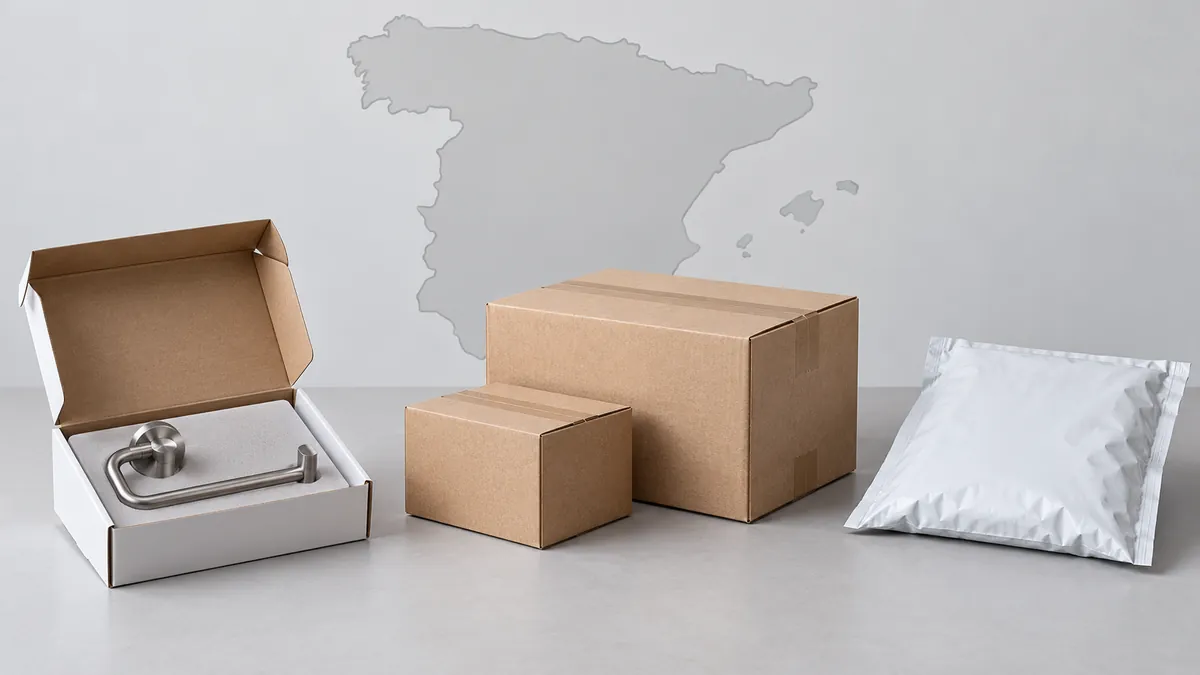
Ask for information that lets the responsible operator reconcile packaging data against the items actually sold in Spain. Keep product packaging, grouped packaging and transport packaging as separate records where they are separately placed on the market or treated as different categories. The EU packaging dataset guide for buyers is broader than this Spain article; see Koitor’s PPWR transport packaging empty-space ratio guide for one distinct design measurement, not a producer-role answer.
A useful supplier data sheet can include:
- Product SKU, model and packaging revision, with an effective date.
- Each packaging component, such as the product carton, insert, protective sleeve, fastener bag, label, grouped carton or shipping carton.
- Component material as the supplier can substantiate it, including layered or mixed materials where known.
- Unit weight and unit of measure, the measurement method or source, and whether the number is measured or estimated.
- Pack-out quantity: components per product, products per inner or master carton, and any pallet or transport configuration in scope.
- Market and shipment period covered, distinguishing a packaging change during the year.
- Supporting record, such as a packaging specification, bill of materials, scale record, supplier declaration or dated photo.
- Owner and revision history so later material substitutions do not silently overwrite the data used for an earlier report.
For metal bathroom accessories, the carton may contain a product, mounting hardware, a protective sleeve and a printed insert. The master carton and pallet wrap may be added at another stage. A supplier should identify what it knows and mark unknown or estimated values honestly. Do not ask the factory to certify a legal category or choose the producer on the importer’s behalf.

Set the information request up as an ordinary sourcing change-control task. When a supplier changes a carton grade, insert, sleeve or pack quantity, ask for a new revision and effective date. Where a shipment contains several SKUs sharing one master carton, document the allocation method and assumptions instead of assigning the full carton weight to every product without explanation. If a shipment is repacked or consolidated after leaving the factory, identify which operator has that record.
What should the 2026 Spain packaging report include?
MITECO says producers or their authorised representatives must collect annual information about packaging placed on the market and submit it through the relevant electronic procedure before 31 March of the following year. Its current page lists the 2026 reporting period as 2 January–31 March 2027, inclusive. It also explains that the 2026 declaration must reflect the producer status applicable on the commercialization date, with different treatment around 12 August 2026.
That means an importer should not wait until March 2027 to reconstruct a year’s packaging. Maintain a dated register with at least the following fields. This is the practical recordkeeping layer of packaging EPR Spain reporting, not a substitute for checking who is the producer:
| Record field | Example of the information to retain |
|---|---|
| First-market date | Contract or sale date used for the relevant Spanish placement, retained with the transaction record |
| Responsible operator | Legal entity identified after reviewing role, brand and sales route |
| Packaging category | Domestic, commercial or industrial as applicable under official instructions |
| Packaging component | Carton, sleeve, bag, insert, label, transport carton or other component |
| Material and weight | Supplier-supported value, with unit, source and measurement status |
| SKU and revision | Product model and packaging specification version |
| Quantity | Number of units or packaging components placed on the Spanish market |
| Evidence and changes | Supporting document, contact, date received and effective date of any change |
MITECO currently identifies a simplified annual information procedure for producers introducing less than 15 tonnes of packaging per year. Do not read that as an exemption from registration or from other producer obligations. Confirm eligibility and required fields in the current procedure; reporting rules and guidance can change. The ministry’s electronic filing procedure is the source to consult for the active filing form and dates.
A useful monthly reconciliation compares three records: sales or import data for the Spanish market, the packaging specification effective for each SKU, and supplier or warehouse pack-out evidence. Investigate gaps such as a new carton revision that appears in shipments but not in the packaging register, or products sold under own brand where the commissioning entity is unclear. For the producer determination and any required system participation, use MITECO’s current guidance or a qualified compliance adviser.
How can buyers avoid common reporting mistakes?
The common operational failure is treating packaging data as a static attribute of a product. Packaging can change while the SKU stays the same. A new insert, a different polybag, a carton size change or one extra unit per master carton can change what needs to be reconciled. A stable product code is not enough to identify the packaging that accompanied each market placement.
Use these controls:
- Assign a packaging revision. Connect each packaging specification to the SKU, effective date, order and market.
- Separate packaging levels. Record retail, grouped and transport components distinctly instead of collapsing everything into “carton.”
- Keep source and confidence. Mark a component weight as measured, calculated from a verified material specification, or estimated.
- Map each sales route. Separate Spanish importer sales, cross-border direct sales, private-label orders and marketplace resale.
- Freeze the reporting snapshot. Save the data version used for the filing and preserve later corrections as a new revision.
- Check the date rule. For 2026, retain contract/commercialization dates and ask an adviser how MITECO’s transition cases apply to the actual packaging category.
- Reconfirm the live instructions. Use the Ministry’s current filing page when preparing a report; this article’s information is current to 26 October 2026.
These are recordkeeping practices, not a legal test that decides who the producer is. Koitor Hardware is a family-owned custom metal hardware manufacturer serving B2B buyers; it may help buyers request packaging and pack-out records when those data are available. It does not determine Spanish producer status or represent an importer in the RPP. For a wider supplier-data context, buyers can also review the Germany LUCID register guide, which concerns Germany and should not be substituted for Spanish rules.
What should an importer confirm before the first order ships?
Before issuing a purchase order, align the parties on the facts needed to classify the route and maintain usable records. Ask the Spanish importer, brand owner, overseas seller and packaging supplier to identify their respective roles in writing, but treat that allocation as an input to legal review rather than as a substitute for it.
Importer checklist
- Which company first places the packaged product or packaging on the Spanish market?
- Is the sale through a Spanish business customer, distributor, retailer, marketplace, or directly to a Spanish end user?
- Who commissions the own-brand product or packaging, and what exception may apply?
- Which packaging components and categories are in scope under current MITECO guidance?
- Is a Spanish RPP registration, authorised representative or producer-responsibility system step required for the identified operator?
- Who will collect material, weight and unit-count data from the factory, importer or warehouse?
- Is the 2026 data split around 12 August 2026 relevant to this operator and packaging category?
- Who owns the annual filing and evidence archive, and who checks the 31 March 2027 deadline?
- How will packaging changes be communicated before the next production or reorder?
A written responsibility matrix helps, even if a compliance adviser later revises it. It should name a legal entity and an operational contact for each data task: supplier measurements, importer sales records, producer-role review, registry filing, system participation and annual sign-off. A supplier should not be asked to collect data it cannot verify, and a buyer should not interpret missing packaging data as proof that no obligation exists.
Foire aux questions
Does every importer of hardware automatically become Spain’s packaging producer?
No. The answer depends on packaging type, first placement, brand or commissioning arrangement, establishment and sales route. MITECO’s current guidance should be applied to the specific transaction and date.
Does a Chinese factory need to register in Spain because it packs the goods?
Not solely because it physically packs them. The factory may need to supply packaging specifications and measured or otherwise supported weights, but the importer or seller must establish which operator is the producer under the applicable rule.
What is the reporting deadline for 2026 packaging data?
MITECO currently lists the 2026 declaration window as 2 January through 31 March 2027. The producer must identify which packaging it is responsible for using the applicable rules and commercialization dates. Check the live MITECO filing procedure before submitting.
Does the under-15-tonne simplified declaration remove registration duties?
Do not assume so. MITECO describes a simplified annual information procedure for qualifying producers below that volume; confirm both registration and reporting obligations separately.
Which packaging materials should an importer report?
Use the fields and categories required by the active MITECO procedure. As a sourcing control, request a revision-controlled component list and supplier-supported material and weight data for each packaging level. This article does not define the legal reporting schema.
Is this guide legal advice?
No. It summarizes official ministry guidance for buyer planning as of 26 October 2026. Producer status, registration, representative appointment, system participation and report scope depend on the operator’s facts and the rules in effect. Confirm the current MITECO instructions or consult a qualified adviser.
Work with Koitor Hardware
For a bathroom or home-storage hardware RFQ, share the product drawing or reference sample, target market, SKU plan and packaging-data fields your team needs to collect. Koitor can discuss supplier-side production and pack-out information that is available for the selected product; the buyer should confirm legal producer status and Spanish reporting obligations with the appropriate adviser.
Planning a hardware order for the Spanish market?
Share the product drawing or sample, target market and packaging data fields your team needs to collect. Koitor can review supplier-side information available for the selected project; confirm legal status and reporting with an adviser.
Fabrication pour compte de tiers / Marque de distributeur
Transformez ce guide d'approvisionnement en cahier des charges
Indiquez-nous le produit souhaité, ses dimensions, sa finition, la quantité commandée et vos exigences en matière d'emballage. Votre équipe recevra une analyse pratique de la faisabilité de la fabrication avant l'établissement du devis.
 English
 Español
 Português
 Français
 Deutsch
 العربية