
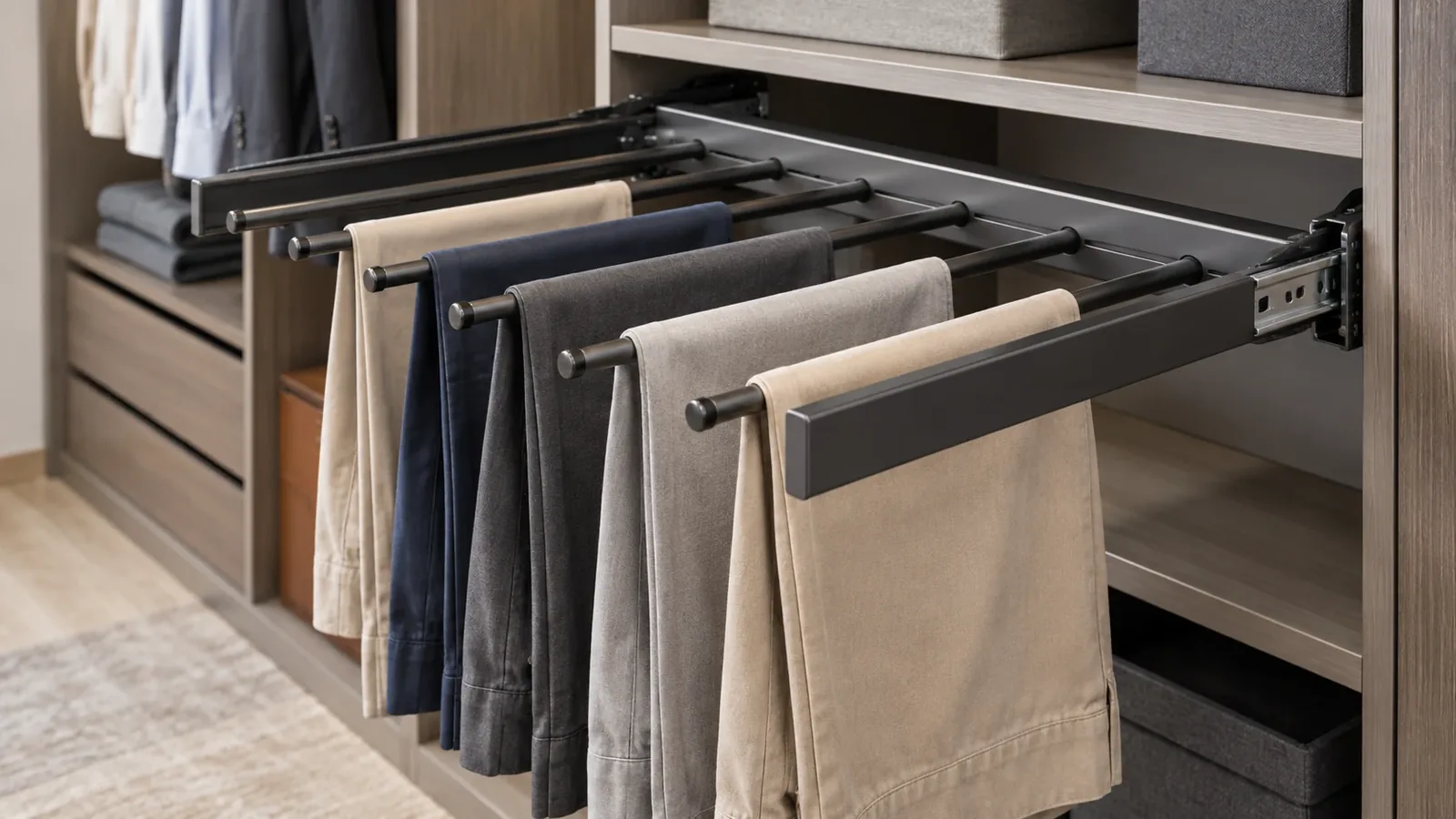
A pull out pants rack should be specified and approved with the garments it is expected to hold, not just a headline pair count. Buyers should define representative fabric types, garment widths and lengths, bar spacing, access to individual pairs, and the cabinet opening and travel path. Then load a physical sample, withdraw and return it, and retrieve middle garments while observing slippage, catches and interference. Product pages show that racks use different architectures, including hinged arms and cabinet-width variants, but each model’s claims and dimensions apply to that specific product.
A closet-hardware importer often compares racks by bar count or stated capacity. Those numbers alone do not show whether a customer can place the intended garments, pull the assembly out, reach a pair in the middle and return the rack without snagging fabric or adjacent items. A bar layout that works with lightweight trousers may feel crowded with thicker or wider garments. A rack can also fit the cabinet but still be awkward to use after it is loaded.
One user discussion about closet rods describes garments slipping off removable rods and difficulty finding a practical spacing arrangement. It is an observed use concern, not evidence of a general product defect or its prevalence. A Rev-A-Shelf product page describes a particular hinged-arm rack and its own non-slip design. A Häfele wardrobe hardware catalog presents rack forms and cabinet-width/depth options. These examples illustrate architecture and fit variables; they do not establish universal retention, load or slide performance, and their brand claims must not be transferred to another product.
The buyer’s job is to convert a broad promise such as “holds 10 pairs” into a reproducible sample check. Identify the garment set, cabinet and operating sequence behind the intended assortment. Then define the observable acceptance criteria so the buyer, manufacturer and any slide supplier review the same configuration.
For a pull out pants rack, the useful comparison is therefore the loaded sample in its cabinet context, not pair count in isolation.
Which reference garments and cabinet dimensions should buyers use?
Choose a reference garment set that reflects the intended market and product positioning. Include differences that may affect fit and handling: lightweight suit trousers, denim or heavier fabric, wider cuts, different hems, and the longest or bulkiest items the rack is expected to accommodate. These are examples to consider, not a universal required mix. Record the actual reference items by buyer sample code, and note folded or draped width, fabric thickness at the contact area, overall length and any unusual belt loops or hardware that could catch.
The test set should reflect how customers are expected to load the rack. If the commercial claim is based on one garment per bar, do not test by doubling items onto a bar and assume that matches the intended use. If some arms are designed to pivot or lift independently, document how that motion relates to the garments. The approved arrangement should make it clear which bars are loaded and which remain clear for access.
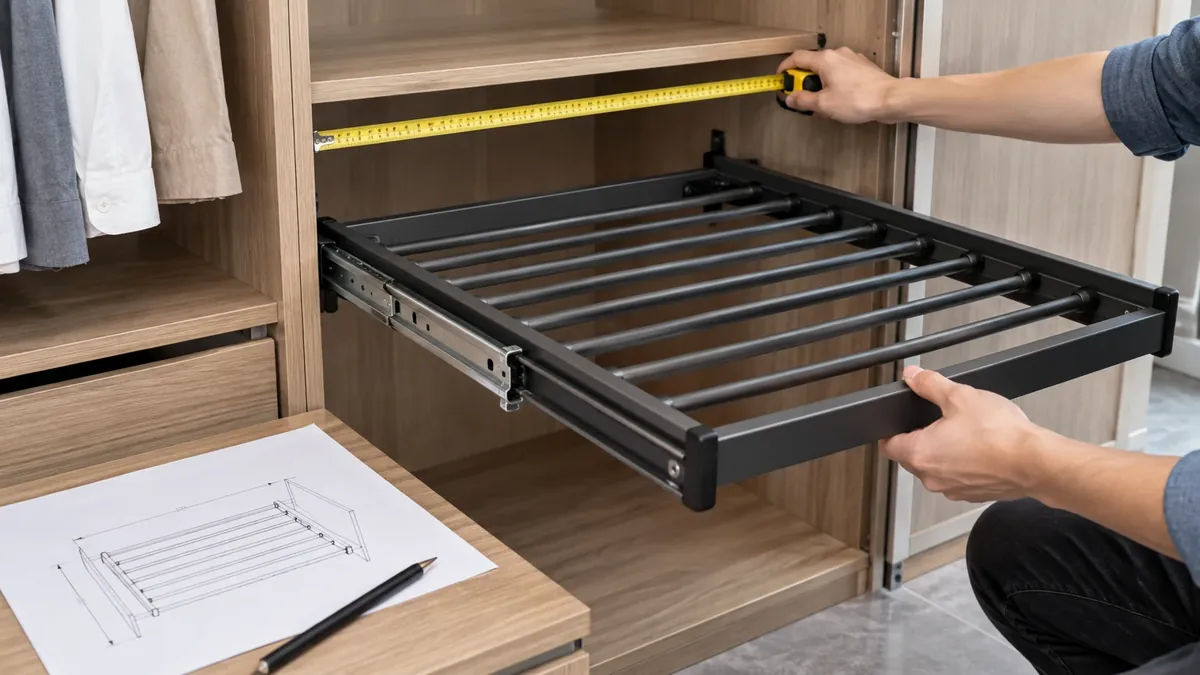
Measure the intended cabinet opening and the rack installation envelope. At minimum, record clear internal width, depth and vertical clearance; mounting position; front-frame or door interference; and the required extension path. For an installed sample, check the rack both retracted and extended. A drawing should show critical dimensions and distinguish the outer frame from usable garment space between the bars and side rails.
| Reference input | What to document | Why it matters during approval |
|---|---|---|
| Garment set | Sample ID, fabric type, folded width and representative thickness | Makes capacity and retrieval checks repeatable |
| Bar layout | Usable bar length, center-to-center spacing and end treatment | Affects which garments fit and how they can be loaded |
| Cabinet envelope | Clear width, depth, height and mounting position | Shows whether the frame and loaded garments fit the target cabinet |
| Extension path | Available travel and any door, shelf or neighboring hardware interference | Reveals obstruction that a static fit check misses |
| Motion design | Fixed, removable, hinged or other bar/arm behavior | Determines the sample operation to evaluate |
| Contact surface | Material/finish reference and areas that touch garments | Identifies the exact surface to review for handling and appearance |
Use more than one cabinet reference when the assortment promises several sizes or fits multiple furniture ranges. One convenient cabinet does not prove the whole range. Identify the narrowest and shallowest intended installations as well as a typical configuration. If the buyer does not have physical cabinets for every target model, record the measured opening and create a mock-up or fixture that reproduces the limiting boundaries.
How should buyers evaluate bar spacing and garment retention?
Bar pitch is a design input, not a standalone promise of capacity. Spacing that leaves room for fingers and thicker garments may reduce the number of bars available in a fixed frame. A compact pitch may increase the nominal number of positions while making middle garments harder to load or retrieve. Compare usable bar length and spacing against the reference garments rather than judging from an unloaded rendering.
Retention is similarly conditional. A garment’s tendency to stay in place can depend on fabric, drape, contact geometry, orientation, surface treatment, how it is folded or hung, and how the frame is moved. A branded product may describe its own arms as non-slip, but a general phrase does not tell an importer what will happen with the importer’s garment range. Avoid promises that all materials will remain in place or that a particular texture prevents slipping under every condition.
During sample review, use a consistent procedure:
- Load each reference garment on the bar or arm in the specified orientation.
- Add neighboring garments to the other positions in the intended assortment arrangement.
- Slowly extend and return the frame through its normal travel.
- Observe whether hems, belt loops or fabric edges catch on bar ends, joints or adjacent parts.
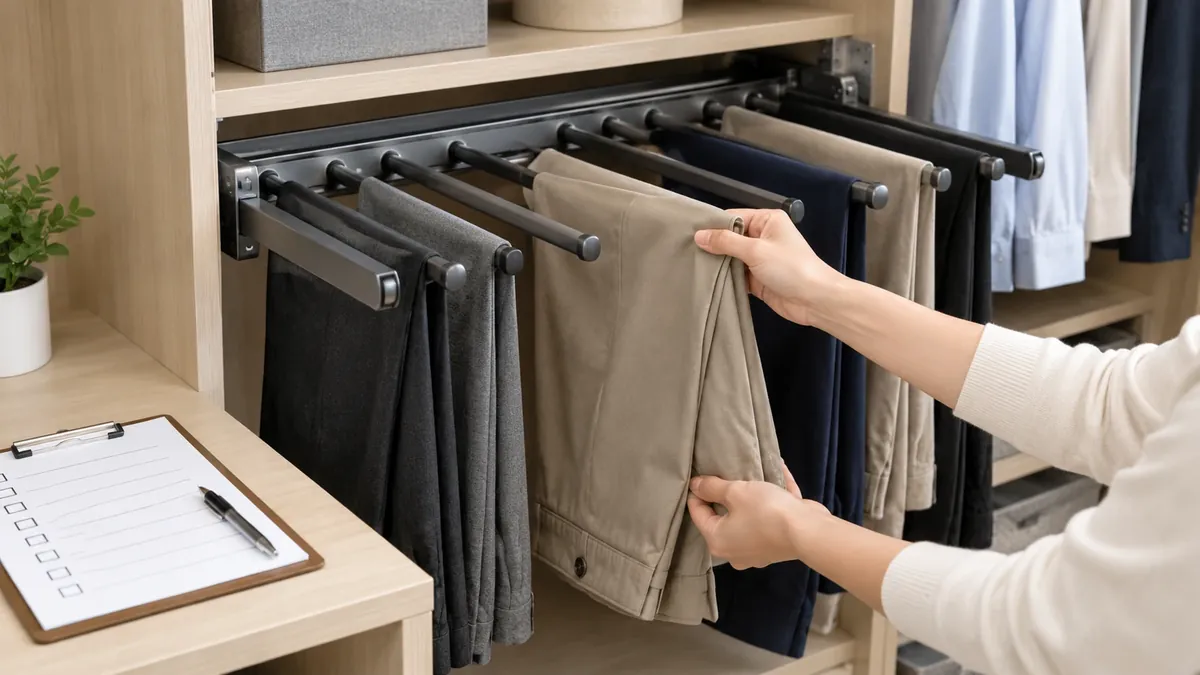
- Retrieve a garment from the middle without removing neighboring items unless that is the intended use.
- Repeat with the thickest or widest reference items and note any change in access.
- Record unexpected movement, contact marks, interference or difficulty using the approved test description.
This is a comparative product-use check, not a standardized durability or load test. If the buyer requires quantified load, cycle or retention performance, specify the test method, conditions, sample quantity and acceptance threshold separately. Do not treat a few manual operations as proof of long-term reliability.
Which rack architecture and finish should the RFQ identify?
Products may use removable straight bars, pivoting or hinged arms, fixed crossbars, or other arrangements. Each changes how garments are loaded and accessed. A hinged arm can expose one position independently in a particular design; a removable rod may simplify loading but can also create a separate handling step. The correct arrangement depends on the product, garment mix and user sequence. Buyers should request drawings or sample operation details for the specific design instead of assuming that a category name implies a common mechanism.
Define the assembly boundary clearly. Identify which parts are included in the rack, whether runners or slides are supplied with the frame, who specifies the cabinet mounting, and which components come from another manufacturer. If slide rails are purchased, record their exact model and published requirements separately from the metal rack’s dimensions. The frame supplier cannot validate a slide model that was not identified, and slide specifications do not independently prove garment retrieval quality.
For metal bars and frames, specify the material and finish only to the level the buyer has verified or can approve. Ask how the proposed surface, joints and end treatments will be represented in the sample. Review visible areas and garment-contact points under the agreed inspection conditions. Do not infer coating composition, corrosion resistance, fabric compatibility or a guaranteed non-slip result from color or appearance alone. If the product needs a particular finish performance, define the method and request evidence for the exact surface system and production configuration.
An importer should also consider the final package. The rack may have projecting bars or arms that can contact other parts during transit. Review how moving components are restrained, which surfaces are separated, and whether the packed product matches the approved retail configuration. Packaging claims require their own review; neither a stronger carton nor one successful sample automatically guarantees damage-free shipments.
What should sample approval and the RFQ record contain?
A useful approval record connects the drawing, garment set, cabinet and operating check. Save the product revision, the rail/slide model if applicable, garment references, loading arrangement, test sequence and observations. Mark changes made after the sample review. A moved bar, altered end cap, surface change or revised arm mechanism may change retention, access or fit, so identify which checks must be repeated.
Request the supplier’s proposed dimensions and tolerances for review when the buyer has not established them. Do not insert a generic tolerance without regard to the design, process or fit requirement. Identify critical interfaces—mounting points, frame width, usable bar length, bar spacing and clearance—so quotation and sample discussion focus on functional features. Ask the manufacturer to call out manufacturability concerns before a design is frozen.
A comparison between supplier quotations is only meaningful when the included architecture and scope match. Confirm whether the quotation includes the moving frame, bars, mounting hardware, slides, finish, packaging and samples. If some items are by others, name the responsible supplier and make interfaces explicit. This prevents a low headline price from hiding a different configuration.
| RFQ or approval record | Buyer should provide or confirm | Evidence to retain |
|---|---|---|
| Product envelope | Target cabinet clear dimensions and installation location | Dimensioned drawing and reference cabinet record |
| Garment mix | IDs and representative width/thickness/length | Loaded sample arrangement and review notes |
| Bar geometry | Quantity, usable length, spacing and end features | Approved drawing and sample measurements |
| Mechanism | Fixed, removable, hinged or other specified movement | Demonstration and documented operating sequence |
| Slide/runner scope | Exact model, supplier and interface responsibility | Supplier data for identified component |
| Surface and appearance | Approved finish sample and garment-contact areas | Signed or otherwise controlled finish reference |
| Emballage | Retail pack and restraint requirements | Packed sample and agreed check record |
For any public capacity statement, document the configuration behind it: the garment references, the number loaded, the cabinet or fixture, and the arrangement used. A capacity result from a specific model should not be broadened into a universal claim for other garment sizes or rack dimensions.
What mistakes create avoidable revisions?
Selecting by pair count alone. A larger number of bars does not prove that intended garments fit or can be reached. Load the actual reference garments and check the middle positions.
Testing only lightweight samples. A layout may behave differently with thicker, wider or longer items. Include boundary garments relevant to the assortment.
Checking the rack only while extended. Cabinet fit, mounting position and retracted clearance matter too. Move between the full operating positions and check the doors and neighboring hardware.
Ignoring end and joint details. Open ends, caps, transitions or frame edges may affect garment contact. Review the actual sample and identify the surfaces that need attention.
Treating “non-slip” as a universal outcome. It may describe a product-specific feature or test context. Buyers should ask what surface and garment conditions are represented and avoid transferring one brand’s promise to another design.
Combining slide and rack acceptance into a vague pass/fail. The metal frame, bars and purchased runner may have different suppliers and specifications. Record the component models and test the assembled system while keeping each responsibility visible.
Changing the assortment after approval. New garment widths or a different loading pattern may invalidate the earlier retrieval check. Re-evaluate the rack against changes that affect how it is used.
These checks are intended to uncover a mismatch before mass production, not to create an elaborate test program without a buyer decision behind it.
How can a manufacturing partner support product development?
A metal manufacturer can review drawings and samples for frame geometry, bar construction, joints, finish access, assembly sequence and packaging interfaces. Koitor Hardware is a family-owned custom metal hardware factory and specialized OEM manufacturer with documented experience in metal forming, welding, finishing and assembly for bathroom and home-storage hardware. This supports a practical conversation about a metal storage concept and the manufacturability of its defined features.
The research for this article did not confirm a current Koitor pull-out pants rack SKU, non-slip coating system, hinge or slide supply. A buyer should therefore treat this article as a sourcing and approval guide, not a product availability statement or a performance claim. Ask the factory to identify what it can produce directly, what requires engineering review, and what must be specified by a separate component supplier.
For a new or revised item, share the garment references, cabinet envelope, drawing or sample, motion sequence, finish expectations and packaging needs. The manufacturer can discuss practical adjustments and clarify which features need a physical sample review. Small-batch OEM capability can be relevant to a trial or product-development discussion, but no article can guarantee MOQ, price, delivery time or a particular technical outcome. Keep each quotation tied to the same approved specification.
For related product-development context, read Koitor’s OEM home storage hardware manufacturing overview.
Buyer checklist before requesting a quotation
- Identify the target buyer and cabinet range.
- Record cabinet clear width, depth, height, mounting location and extension path.
- Choose reference garments representing the intended assortment, including boundary sizes.
- Specify bar count, usable length, spacing, orientation and end details.
- Define whether bars or arms are fixed, removable, hinged or otherwise movable.
- Record expected loading arrangement and how individual garments should be retrieved.
- Identify the exact slide/runner model and supplier responsibilities if purchased separately.
- Mark critical dimensions and open tolerances on a drawing.
- Provide an approved surface or finish reference for review.
- Define the sample sequence and observations to retain.
- Specify packaging configuration and which components must be restrained.
- Tie the quotation to the same model, included parts, sample scope and order assumptions.
Foire aux questions
How many pairs should a pull out pants rack hold?
There is no universal number that proves a rack is suitable. It depends on the rack’s bar geometry, cabinet envelope and the size and thickness of the garments. Define the arrangement used to substantiate any capacity statement and check it with actual references.
What is the best bar spacing for trousers?
The appropriate spacing depends on garment widths, fabric thickness, loading orientation and the access the buyer wants. Compare candidate pitches with the reference garments in a physical sample. Do not select spacing solely to maximize bar count.
Do non-slip bars guarantee that garments will not move?
No universal guarantee follows from that phrase. Retention depends on the specific surface, garment and movement conditions. Ask which product configuration and test context support a claim, then conduct a buyer-relevant sample check.
Should a rack include its own slide rails?
That is a sourcing-scope choice. If rails are included, record the exact model and responsibilities for installation and testing. If supplied separately, validate the assembled combination and keep the rack and runner requirements distinct.
What should importers record when approving the sample?
Record the drawing revision, rack and slide configuration, cabinet dimensions, garment references, load arrangement, operating sequence, observed fit or retrieval issues, finish reference and packaging configuration. Recheck relevant items when a controlled design changes.
Discuss a custom home-storage hardware concept
Share your drawing, sample and sourcing requirements with Koitor Hardware for a practical OEM manufacturing discussion.
Fabrication pour compte de tiers / Marque de distributeur
Transformez ce guide d'approvisionnement en cahier des charges
Indiquez-nous le produit souhaité, ses dimensions, sa finition, la quantité commandée et vos exigences en matière d'emballage. Votre équipe recevra une analyse pratique de la faisabilité de la fabrication avant l'établissement du devis.
 English
 Español
 Português
 Français
 Deutsch
 العربية