

An AI image can help an importer and a manufacturer discuss the look and intended use of a new bathroom or home-storage product. It is not, by itself, a dimensioned specification, verified construction drawing or reliable basis for a firm manufacturing quote. A useful AI product render to manufacturer handoff pairs one selected image with a short brief that separates what is confirmed, what may change and what still needs engineering or supplier review.
That distinction lets the image do its useful job—communicate visual direction—without treating attractive but unverified details as production requirements. For a metal shower basket, for example, the rendering may suggest a wide rectangular shape and a suction-mounted installation. It may not show how many mounting points are needed, how the supports connect to the basket, which dimensions matter, or whether the depicted joins can be formed and finished as shown.
What can a product render communicate—and what can it not prove?
A visual concept is strongest when the buyer uses it to describe appearance, product family, intended use, broad proportions and finish direction. Autodesk describes product sketching as an early visual stage for exploring and communicating ideas before progressing to concept CAD. Its guidance also distinguishes realistic renderings from CAD drawings containing precise dimensions and specifications for manufacturing. The same distinction is useful when an AI-generated image is the starting point.
| A concept image can help communicate | A concept image cannot reliably establish |
|---|---|
| General silhouette, number of tiers and intended placement | Exact width, depth, height, spacing or tolerance |
| Approximate visual balance and user-facing features | Wire diameter, tube wall, sheet thickness or material grade |
| Desired finish direction, such as polished or dark-coated appearance | Finish process, coating specification, corrosion life or color tolerance |
| Apparent mounting family, such as suction, adhesive or screw fixing | Hidden load path, mounting surface compatibility or safe capacity |
| Which areas the buyer wants to look different from a reference | Weld type/location, joint strength, bend radius or finishing access |
| A starting image for discussion | Packaging, assembly sequence, tooling, quantity cost or production readiness |
An AI model may invent a fastener, bridge two parts without a plausible joint, change the number of supports between views or place a hidden bracket where the reference has none. The image can still be useful as a visual proposal, but buyers should mark those details as questions rather than quietly converting them into specifications.
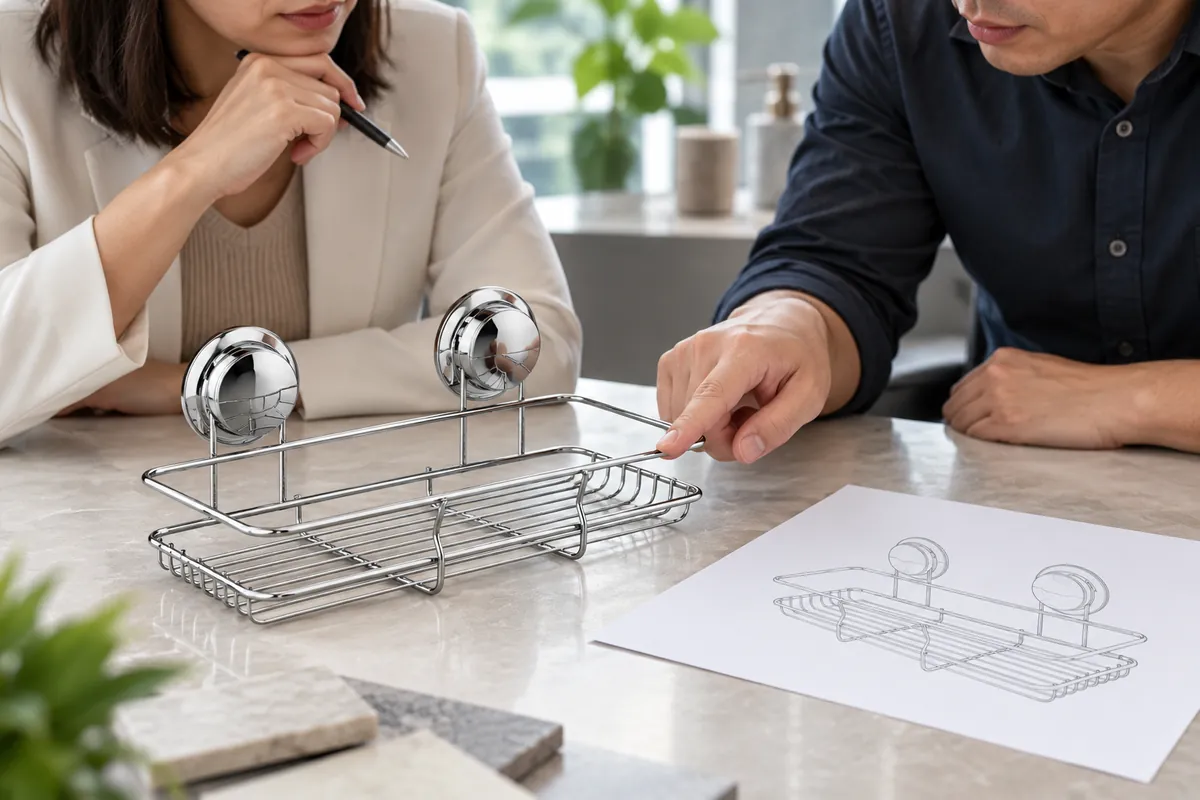
Mark the concept as must-keep, flexible or unknown
Choose one image version as the discussion baseline. Then annotate the concept using three categories. A buyer can mark up a PDF, add numbered callouts, or use a separate page; the exact tool matters less than making each statement unambiguous.
| Label | Meaning | Example for a wall-mounted basket |
|---|---|---|
| Must keep | A functional or visual requirement the buyer needs the factory to preserve if feasible | One basket, chrome appearance, and a two-point suction mounting concept |
| Flexible | A preference that may change to improve manufacturability, reliability or cost | Front-rail height, corner radius, wire spacing or a visible support shape |
| Unknown / ask factory | An element the image does not define or the buyer cannot validate | Basket depth, support-wire routing, mount spacing, weld locations or pack-out |
Do not mark every visible line as “must keep.” If a shape is an AI artifact, a lighting highlight or a guessed connection, the factory may waste time trying to reproduce something the buyer never intended. State the user need behind a feature: “keep bottles from sliding forward” is more useful than “copy this exact front wire,” unless that exact wire is a real requirement.
Separate the main functions from styling. A buyer might require the basket to hold a defined set of bottles, fit within a target space, and use suction mounting, while remaining open to a different wire arrangement or support geometry. The target dimensions, surface, contents and performance criteria still need confirmation; the concept image does not supply them.
Example: turn a shower-basket render into useful questions
Suppose the selected image depicts a single-tier chrome wire basket attached to a tiled wall. The buyer can describe the visual idea, then ask the factory to review the construction questions that the image leaves open. Keep the real product form internally consistent: for a two-cup suction design, show two round suction mounts and the support wires that connect those mounts to the basket. Do not send a view with one mount and another view with two and expect the factory to infer which is correct.
The image also may not reveal whether the basket has a separate wall-facing frame, where the support wires join the basket, how the wire ends are finished, or whether a bottle-clearance feature is functional or decorative. Ask the supplier to identify any ambiguous line or impossible-looking intersection before the buyer approves a construction direction.
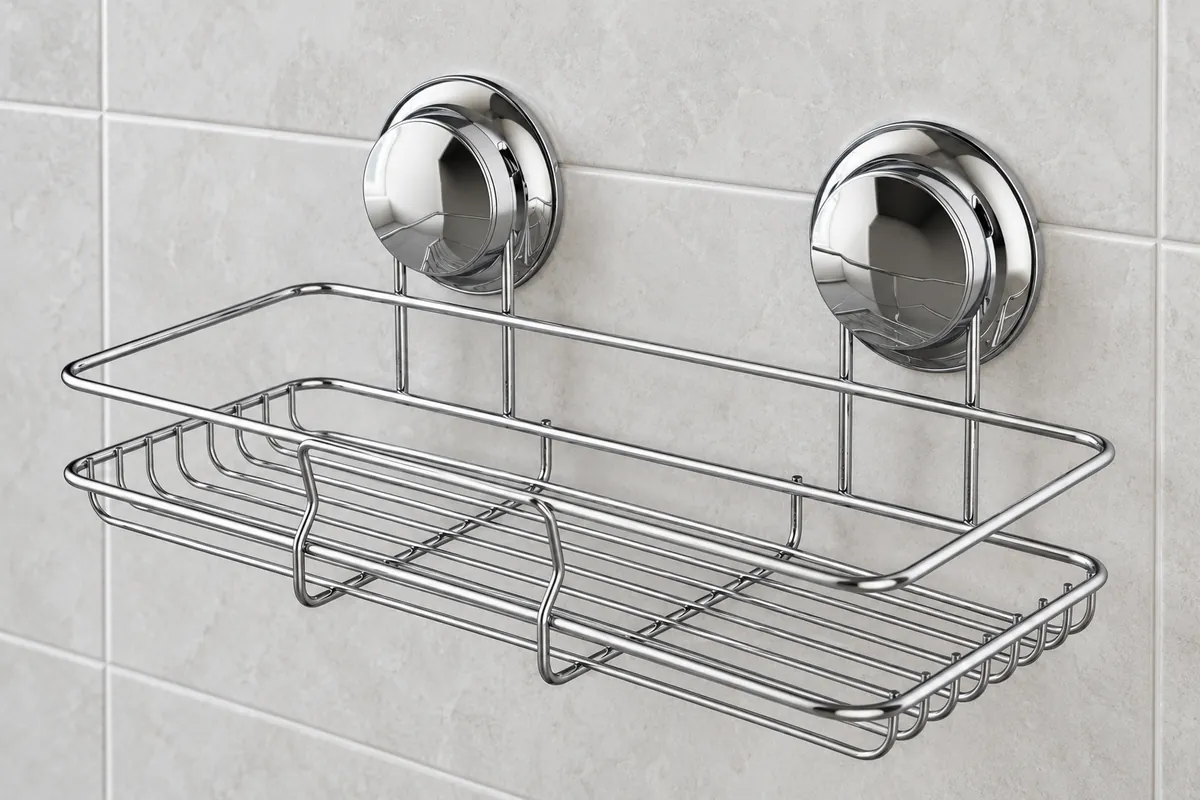
Useful clarification questions include:
- What is the target outer envelope, and which dimensions are fixed by the intended bathroom space?
- What products or containers should fit inside, and which clearances are important?
- Is suction mounting mandatory, or may the supplier compare another mounting option?
- What wall surface and use conditions should the mounting design be reviewed against?
- Which visible features are functional requirements, and which are only styling preferences?
- Which joints, wire routes or attachment points are hidden by the perspective in the image?
- What material and finish direction should be considered, and what evidence will define final approval?
- What order quantity, packaging level and target price range should inform an initial feasibility discussion?
The buyer does not need to answer every technical question before making contact. The point is to disclose known requirements and label unknowns. A factory can then say what can be reviewed from the available information, what assumptions it is making and what it needs next. Do not interpret that preliminary discussion as a validated load rating, final design approval or binding quotation.
Send one versioned image with a concise factory brief
The AI product render to manufacturer brief should be short enough to review quickly but specific enough to prevent the factory from guessing the buyer’s priorities. Include:
- Intended product and user: for example, a shower basket for bathroom storage, not merely “make this picture.”
- Use environment: indoor bathroom, shower exposure, installation surface and cleaning conditions that the buyer knows.
- Required function: what should fit, how the item will be accessed, and what must not move or interfere.
- Target envelope: approximate or confirmed maximum dimensions, explicitly labelled as targets until approved drawings exist.
- Mounting direction: suction, adhesive, screw or another concept; state whether it is fixed or open to comparison.
- Material and finish direction: preferences or required standards, if known; do not infer a grade or process from the image’s color.
- Volume and commercial context: expected trial quantity, future volume range if known, packaging needs and any target cost assumptions.
- Decision labels: mark requirements, negotiable styling and open engineering questions separately.
- Reference control: filename, revision/date, and one contact responsible for approving changes.
An opening message could read: “We are exploring a one-tier bathroom wire basket for private-label development. The attached image is concept direction, not approved construction. Must keep: one basket and two suction mounting points. Flexible: wire layout and front-rail detail. Please review whether the support path and basket arrangement appear feasible, list any missing dimensions or surface assumptions, and suggest the next drawing or sample information you would need. Target size and order quantity are noted below; no final price is requested from the image alone.”
If the buyer has several generated variations, identify one as the baseline and label the others as comparisons. Avoid sending a folder of similar renders without noting which view controls. If a later image changes the mounting method or basket shape, issue a new revision and summarize what changed instead of silently replacing the old image.
What should the factory return at the feasibility stage?
The first exchange should reduce uncertainty, not pretend to eliminate it. Ask the factory to return a concise response in four parts:
| Response area | Useful factory feedback |
|---|---|
| Image interpretation | Which features appear clear and which cannot be identified from the chosen view |
| Construction options | Plausible assembly or support approaches for the stated function, with trade-offs and open questions |
| Missing inputs | Dimensions, wall condition, product contents, finish, quantity or packaging data needed for a more specific review |
| Next controlled deliverable | A marked-up concept, preliminary drawing, physical reference, sample discussion or another agreed step |
The supplier should not be expected to certify performance or produce a production-ready design from pixels. Koitor’s documented role is to discuss custom bathroom and home-storage metal hardware against buyer drawings or samples and review feasibility within the available information. That does not mean every image is manufacturable, that Koitor converts images into CAD automatically, or that a firm unit price can be guaranteed from a render.
A useful reply may recommend changing a support location, clarifying a mounting dimension, simplifying a joint or providing a reference sample. Record the proposal and ask the buyer-side decision owner to approve or reject it. Keep the original concept and each accepted revision so later sample feedback can be compared to the same baseline.
Move from visual concept to drawing, sample and quotation
Treat the work as stages with separate evidence:
- Concept discussion: one image and a brief identify the intended product and unresolved assumptions.
- Feasibility response: buyer and factory clarify function, geometry, mounting direction and material/finish questions.
- Controlled drawing or specification: dimensions, interfaces, critical features and approved construction are recorded in an agreed format.
- Sample review: buyer and supplier compare the physical sample with the agreed drawing or reference criteria and log revisions.
- Quotation basis: price, quantity, finish, packaging, tooling assumptions and order scope refer to the same approved revision.
For a sheet-metal example, Protolabs describes a quoting workflow that accepts 3D CAD files and optional 2D drawings, and notes that a drawing is useful for details such as threaded-hole information and welding requirements. That is a description of Protolabs’ own process, not a universal requirement for every metal hardware factory. It illustrates why buyers should ask their chosen supplier which file and details it needs for the particular product and quote.
When you are ready for the broader drawing or sample checklist, see how to prepare drawings or samples for a custom hardware factory. For file-format choices and the role of STEP, DXF and PDF in a metal hardware RFQ, use the sheet-metal RFQ file-format guide. Those articles cover later handoff decisions; this guide is limited to making the first AI concept conversation clearer.
Common mistakes when asking a factory to quote from an AI image
- Treating appearance as dimensions. Perspective and lens effects can distort proportions. Provide measured targets or ask which dimensions are needed.
- Assuming hidden construction. A polished render may conceal brackets, joints, screw access, weld locations or support geometry.
- Sending inconsistent views. One image shows two mounts and another shows one; the supplier cannot know which controls.
- Calling the material from its color. A silver image does not identify stainless grade, plating, polishing, coating or thickness.
- Requesting a firm quote without a shared scope. Quantity, material, finish, mounting, packaging and revision assumptions all affect what is being priced.
- Approving an AI-generated dimension or label as factual. Generated text, dimensions and symbols may be invented; confirm them in buyer-controlled specifications.
- Skipping revision control. The factory may quote or sample from a superseded image if the baseline is not identified.
- Treating feasibility feedback as a guarantee. Early review is conditional until actual geometry, materials, drawings and acceptance criteria are confirmed.
Foire aux questions
Can a factory give a firm quote from an AI render?
A factory may be able to discuss a preliminary range or identify missing inputs, depending on its process and the information supplied. A firm quotation needs an agreed scope and assumptions. Ask the supplier what it requires; do not present an image-only estimate as comparable to a quote based on a controlled drawing and order specification.
Should I generate several product views?
Use views that clarify the same concept, but check that they do not contradict each other. One consistent front, side and three-quarter view can help; label the baseline version and point out any view that is only illustrative. If geometry changes between views, resolve that before asking the factory to assess it.
Does the rendering need to be perfect before contacting a manufacturer?
No. It should be clear enough to explain the intended function and visual direction. A rough image with honest notes about unknown details can be more useful than a polished render that hides every unresolved decision.
The practical takeaway is simple: use the AI product render to manufacturer handoff as a structured conversation, not as a substitute for product engineering. Choose one concept, state the use and requirements, mark negotiable details and unknowns, and ask what evidence the factory needs for the next stage. For a custom bathroom hardware discussion, contacter Koitor with the concept, target use, approximate size, mounting direction and expected quantity.
Have a Hardware Concept to Review?
Send one concept version with its intended use, target size, mounting direction, finish preference and open questions. Koitor can discuss the product information needed for a feasibility conversation; a render alone is not a production specification or firm quote.
Fabrication pour compte de tiers / Marque de distributeur
Transformez ce guide d'approvisionnement en cahier des charges
Indiquez-nous le produit souhaité, ses dimensions, sa finition, la quantité commandée et vos exigences en matière d'emballage. Votre équipe recevra une analyse pratique de la faisabilité de la fabrication avant l'établissement du devis.
 English
 Español
 Português
 Français
 Deutsch
 العربية