
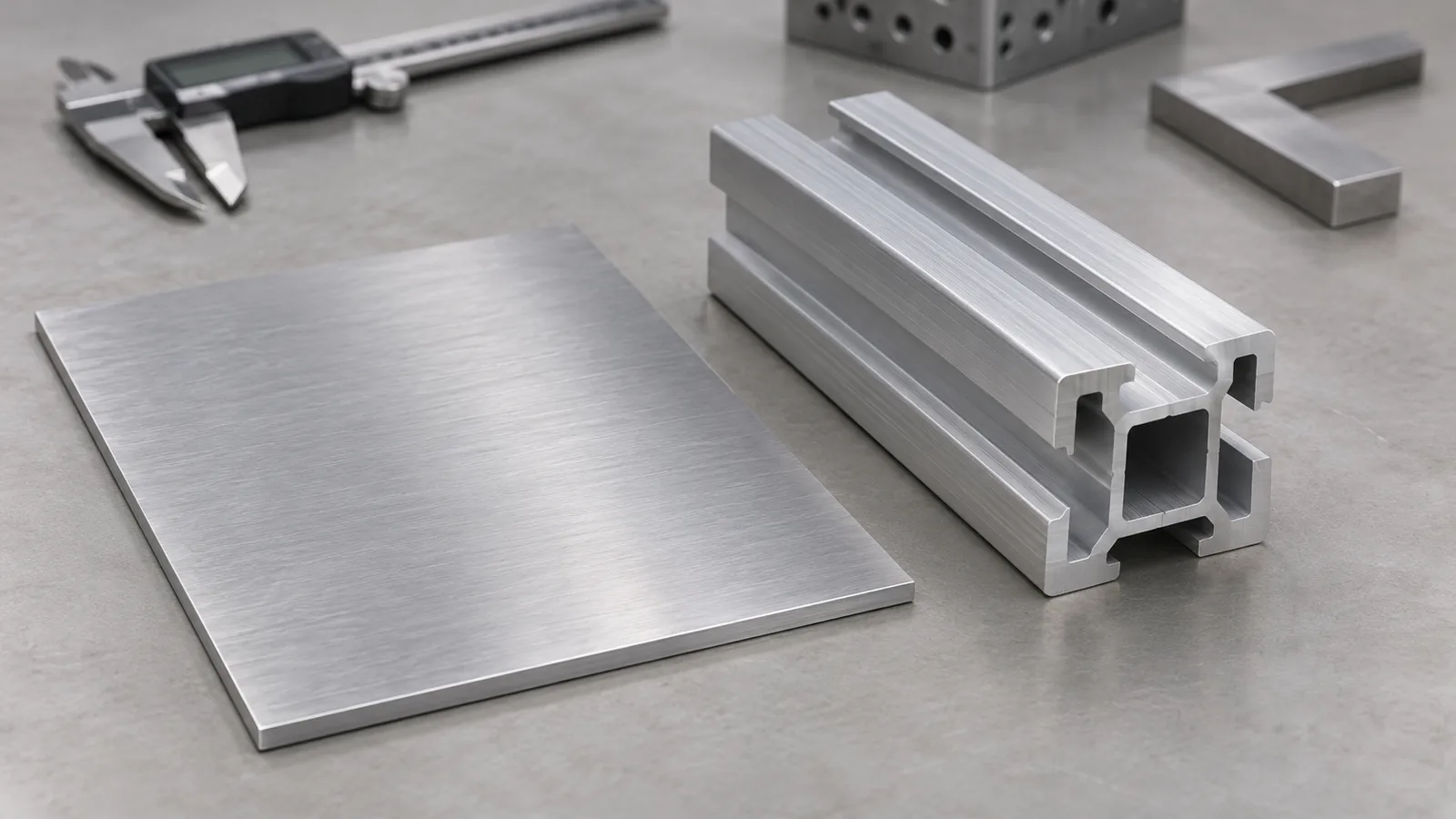
Aluminum 5052 vs 6061 is not a simple ranking of a “better” and “worse” alloy. The useful answer depends on the specified alloy, temper, product form, part geometry, forming and joining route, surface finish, and functional requirements. A common comparison is 5052-H32 sheet against 6061-T6, but those are particular material conditions rather than every possible 5052 and 6061 product. For a buyer, the drawing and material callout must identify what the supplier is quoting before strength, bendability, cost or appearance can be meaningfully compared.
Start with what the alloy number does and does not tell you
5052 and 6061 identify different aluminum alloy families. The designations do not, by themselves, tell a buyer the temper, product form, thickness, dimensions, certification, surface condition or suitability for a specific part. A material name without its condition may be enough for an early concept discussion, but it can leave important assumptions open in a production quotation.
Temper is a separate part of the material designation. It describes the condition produced by processing such as work hardening, heat treatment or stabilization, depending on the alloy family and temper code. The suffix matters because two pieces with the same alloy number but different tempers can behave differently during forming or machining. Product form matters too: sheet, plate, bar, tube and extrusion are not interchangeable just because their chemistry family shares an alloy number.
The phrase “5052 versus 6061” often compresses several choices into one shorthand. In supplier comparisons, 5052-H32 sheet may be discussed for formed sheet applications while 6061-T6 may be discussed in a different context involving its specified condition, machining or strength requirements. That comparison can be a useful starting point, but it does not establish that every 5052 condition bends better than every 6061 condition or that one alloy is the right choice for every bathroom or home-storage component.
For an overseas buyer, the first clarification is simple: which exact alloy, temper and product form is included in the quote? If the answer is uncertain, mark the material as provisional and request the supplier’s proposed callout. Do not silently accept a substitution based only on the shared word “aluminum.”
What commonly differs between 5052 and 6061
At a qualitative level, 5052 and 6061 belong to different alloy families with different alloying systems and typical fabrication considerations. Common sheet comparisons focus on 5052-H32 and 6061-T6. The former is often considered where a sheet component must be formed; the latter may be considered where its specified condition and the part’s machining or strength needs are relevant. These are tendencies used for screening, not guarantees for a particular supplier, thickness, bend radius or finished product.
6061 is a heat-treatable alloy family; many commonly quoted 6061 products are supplied in a T6 condition. 5052 is generally treated as a non-heat-treatable alloy family and is commonly work hardened for supplied tempers such as H32. This distinction can influence how a product team considers forming and post-processing. It does not answer the whole design question: geometry, thickness, material state, tools, bend orientation, joining, finishing and acceptance still matter.
The buyer should avoid copying a property number from a web table into a design decision without matching the exact specification and product form. A property table may compare only one temper, thickness range or test condition. It may not apply to the purchased stock or to the completed assembly. If a minimum mechanical property is part of the contract, cite the applicable material specification and require the corresponding documentation from the responsible supplier. Do not assume that a generic alloy article or a supplier’s marketing page is a material certificate.
| Buyer dimension | 5052 consideration | 6061 consideration | What to confirm |
|---|---|---|---|
| Alloy family | Different alloy system from 6061; frequently discussed for sheet products | Different alloy system; often supplied in a heat-treated temper such as T6 | Exact alloy designation and governing specification |
| Temper | Common sheet examples include H32; other conditions exist | Common product comparisons use T6; other conditions exist | Full temper suffix on the quotation and material record |
| Product form | Sheet behavior is not a proxy for bar, plate or tube | Extrusion or bar data is not automatically a sheet comparison | Sheet, plate, bar, tube or extrusion and dimensions |
| Forming | Suitability depends on temper, thickness, bend geometry and tooling | A particular temper can affect forming response; no universal outcome | Representative forming review for the actual part |
| Machining | Part and stock form determine whether machining is relevant | Some applications consider 6061 for machining; exact condition matters | Required features, stock condition and finish |
| Joining and finishing | Joint design and surface preparation remain part-specific | Heat and finishing effects depend on the actual operation | Joining method, cosmetic faces and finish requirements |
| Acceptance evidence | Material identity and dimensions need defined verification | Same; nominal alloy alone does not establish all properties | Certificate, inspection or test only as required by contract |
This matrix is a purchasing checklist, not an engineering data table. It intentionally avoids universal cost, strength and bend limits because those require the exact condition and application.
An aluminum 5052 vs 6061 review should also distinguish the design’s mandatory material requirements from preferences that can be proposed for optimization. If the drawing specifies a grade and temper because of a validated design, buyer approval or contract, treat that callout as controlled. If the material remains open during development, ask the supplier to present a documented alternative and explain what would change in fabrication, finish, inspection and cost. Do not convert a preliminary suggestion into a silent production substitution.
Why temper and product form matter in fabrication
Forming a sheet component
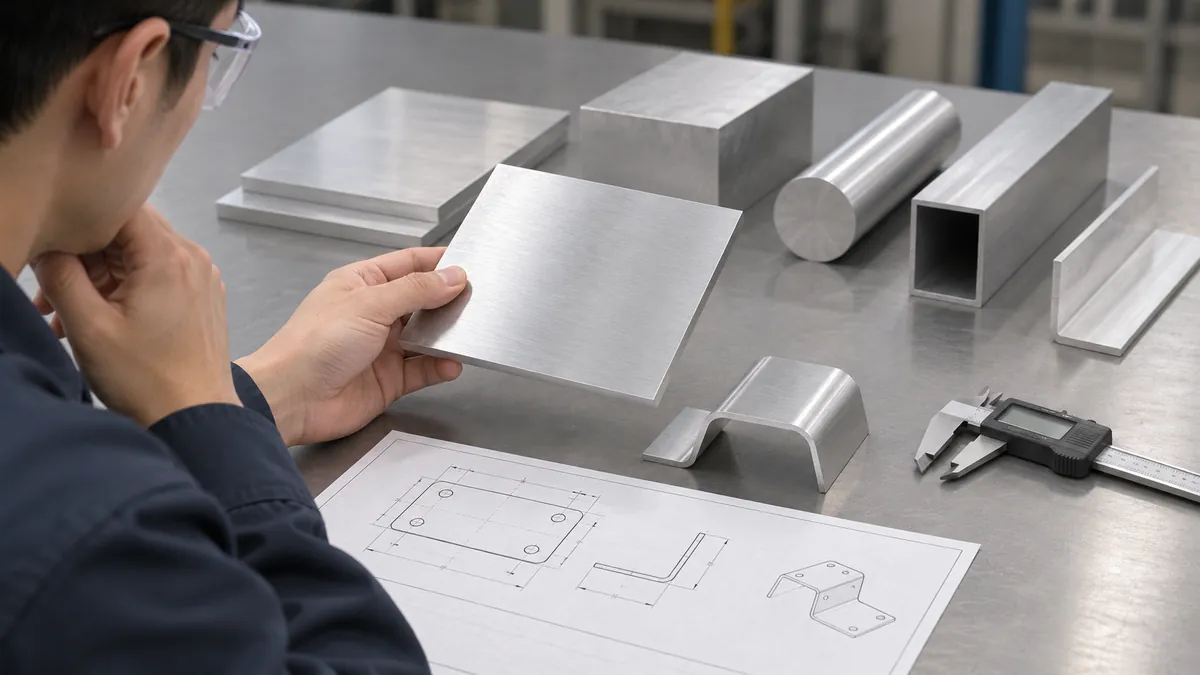
If the part is made from sheet and needs bends, a buyer should identify the alloy and temper together with thickness, bend geometry and any critical finished dimensions. A general statement that one alloy is “more formable” is not enough to approve a tight bend on an unseen design. The practical result depends on the material condition, bend radius, orientation, tooling, process control and whether the finished part has to meet a particular appearance or fit requirement.
A supplier can review the drawing and flag a bend that may require a larger radius, a different condition or a sample. That review should be tied to the actual part rather than a generic claim. If the product includes several bends, identify which dimensions and surfaces matter after forming. The buyer should also clarify whether the requested condition is supplied by the material source or achieved by a later process, and which party controls the corresponding records.
The part’s geometry may matter as much as alloy selection. A narrow flange, hole close to a bend, formed edge or repeated bend can create different risks than a broad simple panel. This article does not provide bend-radius design values. If the drawing includes a critical bend, refer to the project’s approved engineering basis and ask the fabricator to confirm feasibility for the exact material and tooling before releasing the order.
Machining and extruded forms
Some product designs include machined features or use an extruded profile rather than formed sheet. These are different product forms and should not be collapsed into a sheet comparison. A 6061-T6 profile data sheet cannot automatically establish the behavior or properties of a sheet bracket. Likewise, a sheet supplier’s experience does not prove a given extrusion is available in the dimensions and temper needed for a project.
If machining is part of the route, tell the supplier which dimensions, holes, threads or interfaces require control and whether the feature is machined before or after forming or joining. Ask what material state the quotation assumes. A material substitution that changes the stock form can alter material utilization, process sequence and inspection, even where the visible geometry remains similar.
Joining and finish
Both alloy family and temper should be considered in context with the intended joining process and surface finish. The buyer should identify whether the component is welded, mechanically fastened or assembled with other materials, and whether a cosmetic face will be visible. Do not infer weldability, finished appearance or corrosion resistance from the alloy number alone. Those questions depend on the exact material condition, joint design, filler or joining method where applicable, surface preparation and acceptance requirement.
A surface-finish request should identify the intended result, not just a broad color word. If the part will be anodized, coated or polished, confirm the supplier’s proposed material and finishing sequence. Ask whether a visible sample is needed to agree appearance. A finish sample can show the appearance of that sample; it does not independently prove alloy identity or long-term performance.
A custom assembly can include several materials and processes. One component may be formed, another machined, and a third supplied as a purchased fastener. Keep each component’s material callout associated with its part number and revision so a bill-of-material change does not make the specification ambiguous. If the supplier proposes a new product form or temper to solve availability or fabrication concerns, review the effect on the finished assembly before approval.
A material selection workflow for buyers
- Describe the part function. State what the component supports, connects, covers or locates in the product, without relying on a material name to define function.
- Identify the product form. Specify sheet, plate, bar, tube or extrusion, with thickness or section dimensions.
- State the full material callout. Include alloy, temper and applicable specification when required. If the choice is still open, label it as a supplier proposal.
- Mark critical fabrication details. Show bends, holes, threads, cosmetic surfaces, joints and dimensions that control fit.
- Clarify finish and environment. Describe the required appearance and use conditions without assuming an alloy alone guarantees corrosion performance.
- Ask for a feasibility review. Have the supplier confirm the quoted condition and flag forming, machining, joining or finishing assumptions.
- Define evidence. State when a certificate, sample, inspection record or test is contractually required and what it must demonstrate.
- Control substitutions. Require review when alloy, temper, product form, source or process changes in a way that could affect requirements.
The supplier’s response should make the proposal easy to evaluate. Ask it to list the complete designation, product form, thickness or section, relevant process assumptions, available material records and any difference from the request. If a source provides a certificate, verify that it identifies the supplied material lot or is otherwise traceable according to the contract. A catalog description or invoice line may be useful for purchasing but does not necessarily satisfy a material-documentation requirement.
An aluminum 5052 vs 6061 comparison can also expose a difference in sourcing assumptions. One offer may be based on a stocked sheet condition while another assumes a different temper or product form. The buyer should ask whether the quoted material is confirmed for the requested quantity, whether the lead time includes obtaining that condition, and whether minimum order or remnant assumptions affect the price. These are supplier-specific commercial facts; do not infer them from the alloy designation or a public article.
If the project is still at prototype stage, record the status of the material decision. A prototype material may be selected for availability or ease of evaluation and later replaced before production. That can be reasonable, but the change should be explicit because a sample made from one temper does not automatically validate forming, finish or assembly using another. Identify the material used on the sample and what the buyer approved: dimensions, appearance, fit, process sequence or another defined characteristic.
For production, align three records: the controlled drawing or specification, the purchase order, and any material documentation required by the contract. Each should refer to a compatible designation and revision. If the drawing says “6061” while the purchase order says “6061-T6 sheet” and the supplier document identifies an extrusion condition, the discrepancy should be resolved before cutting or machining. The exact documentation set depends on the buyer’s requirements; this article does not prescribe a certification level or regulatory obligation.
The receiving process should use the same language. A warehouse label may shorten a designation for storage, but the purchase and inspection records should preserve the full material identity required by the order. If a batch is split across cartons or sent to more than one fabrication site, keep the lot or source reference linked to the relevant components where the contract requires traceability. This is a document-control practice, not proof that any particular supplier’s records are complete. The buyer should agree in advance which documents are expected, who checks them and what happens if the delivered designation does not match the order.
When a discrepancy appears, pause the affected material decision and compare the drawing, order and supplier documentation before releasing it to production. Ask the supplier to identify whether it is a clerical mismatch, a proposed substitution or a genuinely different product form. Correct the record through the buyer’s approval process; do not rely on an informal assurance that the materials are “close enough.” If the technical owner accepts an alternative, update the controlled documents and retain the decision so repeat orders use the approved basis.
The buyer may also compare a commercial quote only after the technical basis is aligned. Ask suppliers to separate material, fabrication and finishing assumptions where possible, and to state whether the price reflects a prototype, a small production batch or a repeat order. A difference in price may come from stock form, available dimensions, yield, setup, machining or finishing rather than from the alloy family alone. A quotation is an offer for a defined scope, not an independent ranking of material quality.
For a part with a cosmetic finish, clarify whether the sample represents the finish, the base material, or both. A finish sample can help compare appearance under agreed conditions. It should not be used alone to infer an unmeasured alloy or temper. Likewise, a material certificate does not establish that the finished formed part meets every dimensional or visual criterion. Keep the evidence matched to the question it answers.
This sequence lets a supplier quote the same material basis the buyer expects. It also makes alternatives easier to review: if the preferred material is unavailable, the supplier can describe the exact substitute and the buyer can compare its consequences instead of accepting “equivalent aluminum” without detail.
Hypothetical hardware example
Imagine a formed cover or bracket used in a home-storage assembly. The drawing shows two bends, a mounting hole pattern and a visible outer face. A team is considering 5052-H32 sheet and receives a second proposal for a 6061 product. Before comparing prices, the buyer should confirm whether both proposals are sheet of the same thickness and whether the 6061 temper and supply form are appropriate to the proposed forming sequence. If the second proposal is an extrusion or plate, it is not a like-for-like material substitution even if both options are aluminum.
The buyer should mark the bend geometry and mounting features, clarify the finish and ask the supplier to explain any process change. A representative sample may be useful to review fit and appearance, but the sample cannot establish an unrequested mechanical property or the full material traceability record. If a material property is contractually critical, define the required evidence separately. This keeps the decision aligned with the finished product rather than a simplified alloy ranking.
This example is hypothetical. It is not a Koitor order, customer history, test result or claim that Koitor stocks or processes either alloy in a particular temper. It demonstrates the questions needed for an informed RFQ.
Common sourcing mistakes
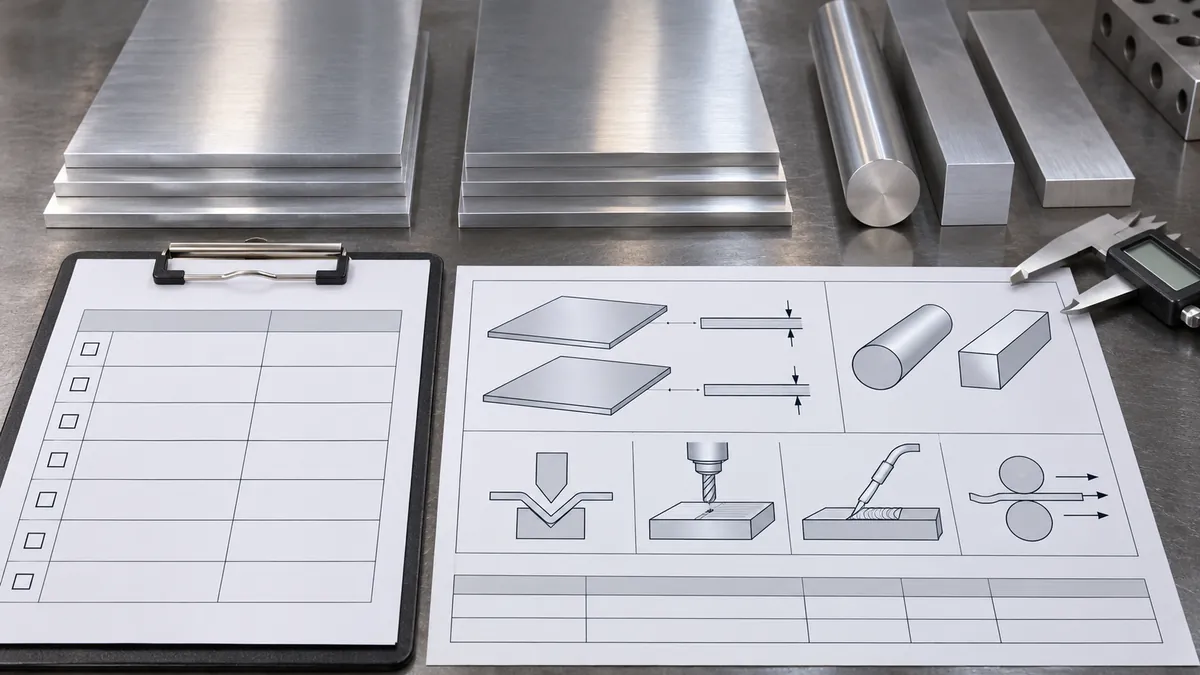
- Treating alloy numbers as a quality ranking. Define the product requirements before selecting a material.
- Comparing 5052 and 6061 without temper. Include the full condition in the quote and drawing.
- Comparing different product forms. Sheet, extrusion, bar and plate data are not automatically interchangeable.
- Using a general property chart as a certificate. Request contractually required evidence from the responsible source.
- Assuming all 5052 bends the same way. Temper, thickness, geometry and tooling affect the actual result.
- Assuming 6061-T6 is always stronger and therefore better. A property comparison does not establish the best finished design.
- Changing material and process at once. Separate and document both changes for evaluation.
- Ignoring the finish and assembly. Review cosmetic faces, joining and later operations before approving a substitution.
- Treating a sample as proof of every property. Inspect only the stated dimensions and appearance unless other evidence is separately supplied.
- Leaving material responsibility unclear. Identify which party controls sourcing, records and substitution approval.
Foire aux questions
Which is better, aluminum 5052 or 6061?
Neither is universally better. The choice depends on the exact alloy and temper, product form, geometry, forming or machining route, joining, finish and functional requirements.
Is 5052 always easier to bend than 6061?
No absolute rule applies to every temper, thickness, geometry and tooling setup. Common sheet comparisons such as 5052-H32 and 6061-T6 are useful context, but a supplier should review the actual part and conditions.
Is 6061 always stronger than 5052?
A broad statement can hide differences in temper, form, dimensions and property data. Compare the exact specification and the property relevant to the design; do not use an alloy label alone to predict finished-part performance.
What does the temper suffix mean?
The temper code indicates a material condition produced by processing. Its meaning depends on the alloy family and designation. Include it in the material callout rather than treating the alloy number as a complete specification.
Can I substitute 6061 for a 5052 sheet part?
Not automatically. Confirm product form, temper, thickness, bend geometry, joining, finish, dimensions and evidence requirements. A substitution should be reviewed against the assembly and approved specification.
What should I include in an aluminum RFQ?
Provide the drawing revision, alloy and temper or clearly mark them as open, product form, dimensions, finish, quantity, critical features, forming/joining details and required inspection records.
Does the alloy number guarantee corrosion resistance?
No single alloy designation establishes the performance of a complete product in every environment. The material condition, finish, design, exposure and maintenance all matter; specify the application and verify the relevant requirement.
How can Koitor help with material review?
Koitor Hardware is a family-owned custom metal hardware factory. Buyers can share a drawing or sample and clarify the component’s form, finish and project requirements. Specific stock, temper availability and process capability must be confirmed for the individual project.
Sources and scope
Scope note: This article gives a buyer framework, not a material specification or engineering approval. Verify exact alloy, temper, product form and applicable documentation with the supplier. No Koitor material stock, test result or performance guarantee is claimed.
Review an aluminum hardware drawing and material callout
Share the controlled drawing, alloy and temper assumptions, product form, finish and critical fabrication details. Koitor can discuss the surrounding custom hardware project within its confirmed scope.
Fabrication pour compte de tiers / Marque de distributeur
Transformez ce guide d'approvisionnement en cahier des charges
Indiquez-nous le produit souhaité, ses dimensions, sa finition, la quantité commandée et vos exigences en matière d'emballage. Votre équipe recevra une analyse pratique de la faisabilité de la fabrication avant l'établissement du devis.


 English
 Español
 Português
 Français
 Deutsch
 العربية