

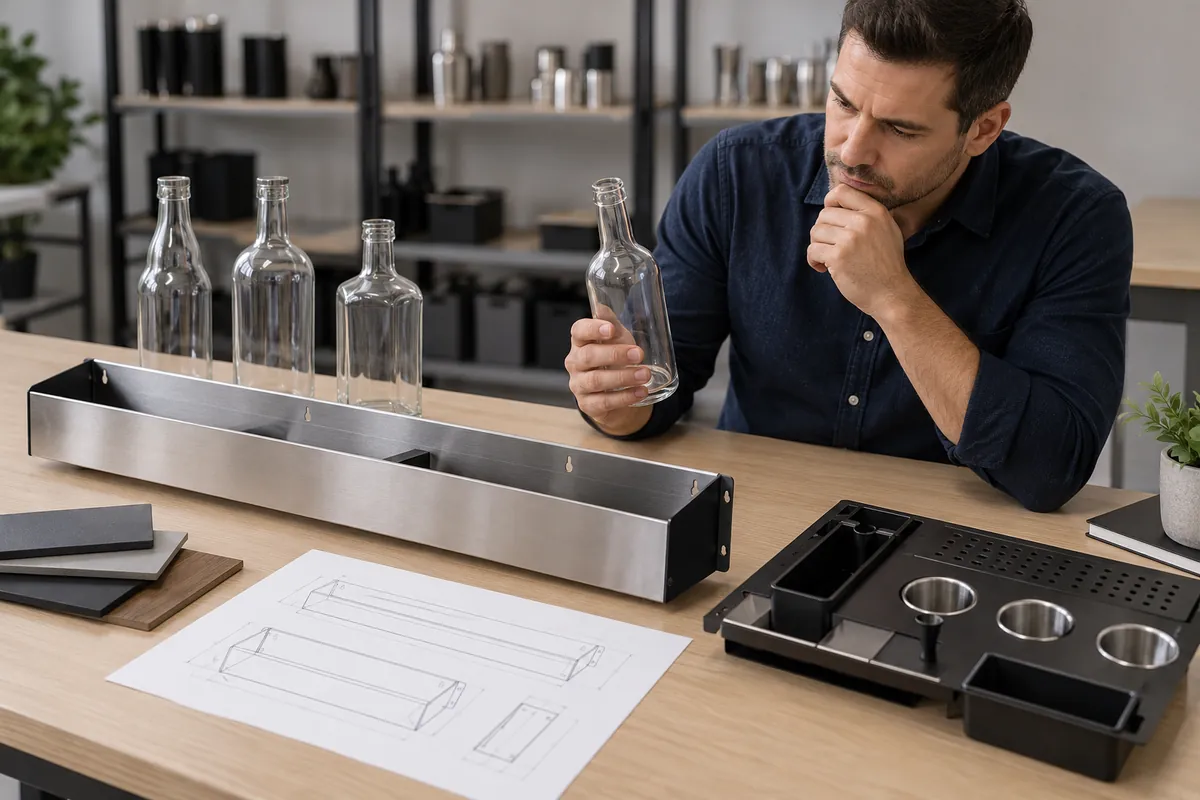
For procurement, the bar speed rail specification starts with the exact reference parts and intended arrangement. A bar speed rail specification should tie together the working bottles, the rail’s usable trough, the attachment method and the bar surface where the rail will be installed. A product photo or advertised bottle count cannot establish how a particular bar team will reach, identify and return its own bottles. Importers should evaluate the complete service arrangement before freezing a private-label SKU or committing to a mounting pattern.
A speed rail is a fixed open holder for bottles used at a workstation. It is different from a freestanding wine rack designed to store bottles horizontally. This article covers the buyer’s service-layout and installation-interface decisions. It does not establish a universal capacity, load rating, food-service certification, fastener suitability or current Koitor barware capability.
Start with the service station, not the catalog count
Ask the buyer or operator to identify the actual bottle set before choosing a rail. Record each bottle’s body diameter, shoulder shape, height, neck, pouring attachment and filled or empty handling condition if relevant. A bottle’s nominal volume does not define its outside envelope. Different suppliers’ bottles can have different shoulders, tapers or speed pourers, so a layout that works with one named set may not transfer to another.
Tablecraft’s published 22-inch single speed rail, model 5122, is described as a stainless single-tier rail with two pre-drilled mounting holes. That is a model-specific specification from its manufacturer, not a universal mounting standard. Tablecraft’s bar-solutions sheet also ties its illustrated bottle counts to specified Pourmaster bottles, distinguishes single and double rails and lists hanger straps as an accessory. These examples show that a quoted capacity and an attachment option depend on the actual manufacturer configuration. They are not evidence of a Koitor capacity or a cross-brand fit claim.
Translate the bar manager’s use into a working sequence: which bottles are needed together, in what order they are reached, which are replenished most often, and whether the operator uses one or both hands while working. A rail should be assessed as a tool-location layout rather than simply a row of circular bottle bases. The buyer should decide whether the open trough, side lips or any dividers are intended to locate bottles, separate them or merely prevent them from moving out of the holder under routine handling. Do not assume a decorative edge retains a bottle unless the design and approved criteria establish that function.
The buyer’s workstation drawing should show the bar face, counter edge, nearby equipment and the usable area behind the counter. Include the rail length and its end clearances, as well as where an operator stands and approaches. If the workstation already has taps, drawers, refrigeration, plumbing, electrical outlets or cleaning access, record those obstructions. The relevant envelope is the installed one, not the rail’s bare length alone.
How do single and double rails change the decision?
A single rail places bottles in one row. A double rail creates another row and can increase the number of positions, but the additional row changes reach, bottle retrieval, visibility, installation depth and collision risk. These are configuration questions rather than automatic advantages of one format.
Mock up the actual bottles in both proposed arrangements. In the single row, check whether bottles can be lifted vertically or need to tilt and whether a front retaining lip interferes with gripping. In the double row, examine whether bottles in the rear can be grasped while the front row is occupied. Check for hands contacting bottle necks, pour spouts or the bar surface. A buyer should be able to state which row is used for which part of a shift and whether a staff member must move a front-row bottle to reach a rear one.
Do not rely on a supplier’s stated bottle count as a substitute for an in-use layout review. Ask which bottle model and orientation produced that figure and whether the product is shown with standard bottles, the supplier’s proprietary bottles or a specific pouring attachment. Then repeat the arrangement using the buyer’s intended bottles. Compare the fit at the widest body point and the path needed to lift out each bottle. Count only positions that can be used as intended in the approved layout.
| Buyer question | Evidence to request | Approval note |
|---|---|---|
| Which bottles define the layout? | Named samples or controlled bottle drawings | Record the brand or buyer reference without implying universal fit |
| Single or double tier? | Full-size layout with all intended bottle positions occupied | Note reach, removal path and any blocked position |
| What is the usable rail space? | Current controlled rail drawing and sample | Distinguish overall length from usable inside length |
| What does the capacity claim mean? | Manufacturer’s named bottle size and arrangement | Keep the claim tied to that exact configuration |
| How is it mounted? | Hole pattern or hanger-accessory drawing | Record what the quote includes and who installs it |
| Who owns the installation decision? | Bar-surface detail and approved fastener plan | Obtain qualified installer or responsible supplier confirmation |
This table is a sourcing checklist, not a test protocol. If the buyer requires a loaded evaluation, define the bottle identities, fill state, positions, handling, observation period and acceptance criteria with the responsible supplier. Do not infer a safe working load from a product photograph, rail length, material label or an informal bottle count.

What should the mounting interface include?
The rail, bar face, attachment hardware and installation owner make up one interface. Before quoting, confirm whether the rail attaches directly through pre-drilled holes, uses a documented hanger strap or employs a different manufacturer-approved arrangement. Record which fasteners and accessories are included, which are optional, and whether the attachment hardware is sold separately. Avoid assuming that hanger straps or mounting holes have a standard location across manufacturers.
Obtain a controlled drawing that shows the mounting-hole locations, hole type, spacing, edge distances and any relevant bracket or strap interface. Match it against the actual bar face or customer-supplied fixture drawing. The substrate can be wood, metal, stone, a laminated panel or another construction; fastener choice and structural suitability depend on that exact build. The product supplier can provide its component information, but a qualified installer or responsible fixture supplier should confirm the substrate, fastener and installation method. An article or catalog listing cannot determine whether a particular bar top can safely accept the attachment.
Clarify whether the rail is mounted beneath a counter overhang, to a vertical face, to an existing fixture system or to a custom panel. Check tool access and installation sequence. If the rail must be installed after plumbing, equipment or wall panels, determine whether a drill or driver can reach each fastener. If the buyer expects removal for cleaning or replacement, specify how the rail comes off and whether the original holes remain usable. Do not promote one mounting approach as inherently stronger or more appropriate for every bar.
The mounting sample should reproduce the bar face or a representative fixture panel. Inspect that the rail sits in the intended orientation, the hole pattern aligns, and no fastener head or bracket obstructs the bottle path. If a hanger accessory is used, confirm how it engages and whether the installation instructions clearly identify the intended parts. Record any shims, adapters or customer-supplied hardware as explicit exceptions instead of silently incorporating them into the finished SKU.
How should the installed sample be reviewed?
An installed sample answers questions that a loose rail on a tabletop cannot. It lets the buyer compare the rail against the actual workstation, including surrounding equipment and normal operator movement. Use a consistent sequence:
- Identify the rail, revision, mounting accessory and fasteners.
- Confirm the bar-face material and the approved installation drawing.
- Install the rail using the agreed instruction and responsible installer.
- Place the named working bottles in the intended sequence and row.
- Reach for and return each bottle from the normal operator position.
- Repeat rear-row removal with all front positions occupied, when applicable.
- Check for contact with the countertop, adjacent fixture, equipment or operator’s hand path.
- Inspect the rail’s fit, visible finish, ends, holes and accessible fasteners.
- Remove and reinstall only if that is part of the intended service requirement.
- Record the final configuration, accepted sample and any limits on the layout.
The list is intended to make observations comparable. It does not define a load, vibration, corrosion, sanitation or durability test. If a project has such a requirement, create a separate written method, specify the exact configuration and agree on a pass criterion before production. A single successful bottle placement is evidence of that observed placement only.
Finish review should cover visible and contact surfaces. A buyer may care about matching nearby bar equipment, exposed edges, scratches, weld appearance or a particular finish reference. Request a physical finish sample or controlled color/appearance standard where needed. Do not assume a finish label proves corrosion performance or compatibility with cleaning chemicals. Obtain care instructions from the responsible supplier for the actual rail and finish.
If the rail is fabricated from metal, drawing feasibility may involve cutting, punching, bending, joining, polishing and finishing. Each step can affect the interface dimensions or visible appearance, but the actual process and control plan must be confirmed for the supplier and product. Koitor’s documented metal-component knowledge does not mean Koitor currently produces bar speed rails, bottles, pour spouts or bar fixtures. The article’s technical guidance is limited to general drawing and sample-review practice.
What belongs in the RFQ and SKU master?
A complete RFQ lets suppliers quote comparable configurations. Include the service-station drawing, intended bottle set, required row format, rail dimensions, mounting face, attachment option, finish reference, pack quantity and target product identifiers. If the project does not yet have a controlled bottle drawing, send physical examples and identify them clearly. State which dimensions and installation decisions remain pending.
Request a quotation that separates the rail from optional accessories or customer-supplied fasteners. Ask for the current drawing, sample lead time, finish confirmation, packaging description and any stated capacity basis. If a supplier claims a particular number of bottles, require that figure to reference the named bottle model and arrangement. Keep catalog marketing text separate from approved product data.
The SKU master can record:
- Finished SKU, market and customer-facing name.
- Rail supplier, part number and drawing revision.
- Single- or double-row configuration.
- Approved working-bottle models and pouring attachments.
- Usable rail envelope and bottle positions from the drawing.
- Mounting-hole or hanger-interface revision.
- Included and optional hardware.
- Bar-face assumptions and installation owner.
- Finish reference and care source.
- Packaging unit, accessories and unpacking inspection.
- Sample approval date and authorized deviations.
Before a reorder, compare the quotation, BOM, drawing, sample and product image. Changes to bottle suppliers, pouring tops, rail dimensions, mounting holes, hanger hardware or finish may affect the approved arrangement. Renew the relevant review when a change touches the service path or mounting interface. Keep a specific configuration record rather than a broad note that says “fits bar bottles.”
How is a speed rail different from a wine rack?
A speed rail holds bottles upright at a fixed work area so they can be reached during service. A wine rack organizes bottles for storage, often horizontally, and its cell geometry is evaluated around bottle diameter, shoulder and retrieval. Koitor’s separate wine-rack discussion covers that storage-fit question. A rail’s buyer decision is about upright working access, the number and order of positions, mounting and clearance at the bar face. The shared word “bottle” does not make the two products interchangeable.
That distinction also keeps the buyer from overloading the article with unrelated rack details. If the project is actually a freestanding cellar rack, assess the correct rack format and storage orientation. If it is a service rail, freeze the intended working bottles and the installation interface. When the product combines storage and service in a custom fixture, define each function and its own acceptance criteria.
For a metal-component supplier discussion, buyers can review Koitor’s fabrication sur mesure de rayonnages métalliques de stockage et OEM home storage hardware context. Those pages describe the company and do not claim a current barware catalog. A buyer may share the fixture drawing, sample bottles and mounting details through the contact page for a scoped discussion about the metal component.
Should an importer use a published capacity as a universal count?
No. A manufacturer’s capacity statement belongs to the named rail and bottle configuration it documents. Bottle shape, neck hardware, row format, spacing and removal method can change the usable layout. Ask for the basis of the count and confirm it against the buyer’s actual working set. If the bar layout has a rear row, verify access when the front row is full.
The same evidence boundary applies to installation and performance. A drawing showing two mounting holes does not prove suitability for every surface or fastener. A visual check does not establish safe load, long-term wear or sanitation. A product-specific supplier claim should not be copied into a private-label listing unless the buyer holds evidence for that product and use.
A clear purchase decision results when the buyer can answer four questions: Which bottles define the working layout? Can each one be removed and returned in its intended position? How does the rail attach to the actual bar face? Who verifies the installed configuration? If those answers are recorded in the RFQ, approved sample, BOM and final product content, the rail becomes a defined SKU rather than a photo-led assumption.
Source basis: Tablecraft 22-inch Single Speed Rail, model 5122 et Tablecraft Bar Solutions sheet. Product facts are limited to those manufacturer’s named configurations; the article does not present a Koitor product, test result or installation approval.
Keep the bar speed rail specification tied to the named sample, drawing revision and included components.
Reviewing a Metal Bar Rail?
Share the workstation drawing, working-bottle samples, mounting interface, finish reference and pack scope for a bounded metal-component feasibility discussion.
Fabrication pour compte de tiers / Marque de distributeur
Transformez ce guide d'approvisionnement en cahier des charges
Indiquez-nous le produit souhaité, ses dimensions, sa finition, la quantité commandée et vos exigences en matière d'emballage. Votre équipe recevra une analyse pratique de la faisabilité de la fabrication avant l'établissement du devis.
 English
 Español
 Português
 Français
 Deutsch
 العربية