

Blind rivet vs pop rivet is usually a terminology question, not a comparison between two opposite fastening technologies. “Blind rivet” names a fastener category that can be set from one side of a joint, while “POP” is a brand name that is also used informally for blind rivets. A purchase request using “pop rivet” may mean the generic category or a specific branded product. Before ordering, identify the actual manufacturer, part reference, diameter, grip range, material and required configuration.
What is a blind rivet?
A conventional blind rivet is a fastener designed to be set when the installer has access from one side of the joint. A typical design includes a rivet body and a mandrel. A suitable setting tool pulls the mandrel, causing the rivet body to form the joining feature on the inaccessible side. The exact construction and setting behavior depend on the rivet family and the specified product; this overview is not an installation tutorial.
The word “blind” describes the access condition of the joint. The installer can set the fastener from one side even though the far side may not be accessible for conventional handling. It does not mean that the backside of the assembled joint occupies no space. The formed portion and any remaining mandrel material still need physical clearance. A buyer designing a metal bracket, basket or rack should check the actual assembly envelope and nearby components.
“Blind rivet” is the category name. It does not identify a manufacturer, brand, diameter, grip range, material combination, head style, finish, strength class or a specific model. A drawing that says only “blind rivet” may be sufficient for an early concept, but it can be incomplete for a purchase order or production release if those attributes affect fit and function.
The buyer should treat the fastener specification as a set of fields. The category tells the reader what general type of component is intended. The maker or brand requirement identifies a source condition, if the project requires one. The exact part number and variant identify the item to be bought. These levels are related but not interchangeable.
What does “POP rivet” mean?
POP is a brand name associated with blind rivets. The term is also used colloquially in some contexts to refer to a blind rivet generally. That common usage can create ambiguity in a quotation. One buyer may use “pop rivet” as shorthand for the fastening category, while another may require a component from a particular brand or product family. The words alone do not tell the supplier which intent applies.
A branded fastener request should name the required manufacturer or product reference and identify whether an equivalent is allowed. If the buyer requires a particular brand, make that a controlled specification and confirm how authenticity and substitution will be managed. If the buyer uses “pop rivet” generically, state that the key requirement is the blind-rivet category and provide the dimensional and material information needed to select a component. This avoids a supplier interpreting casual language as a brand restriction—or substituting a generic item when the buyer expects a specified brand.
Do not make legal conclusions about trademark ownership or registration from a product-name comparison. This article uses “POP” as the brand name discussed by the original fastener maker and explains the informal usage observed in the reviewed manufacturer sources. It does not determine trademark status in any jurisdiction or authorize another supplier to use a mark.
A useful specification map has three levels:
| Level | Example of what it identifies | What remains to confirm |
|---|---|---|
| Fastener category | Blind rivet | Exact construction and application scope |
| Brand or manufacturer requirement | POP brand required, or “equivalent permitted” | Current product family and substitution rule |
| Exact component | Named model or part code | Diameter, grip range, material, head and drawing revision |
The core buyer question is not simply “Which term is better?” It is “Which exact component does this order require, and does the buyer need a specific brand or only a category-equivalent part?” That distinction should be reflected in the drawing, approved sample, quotation and purchase order.
How do the names relate in a quotation?
Consider three fictional purchasing cases. Case A reads “blind rivet, brand unrestricted.” That identifies a category but still needs a suitable component reference and technical attributes. Case B reads “POP brand required,” with a named model or part number. That is a brand-specific request, subject to the buyer’s purchasing terms and current product availability. Case C reads “pop rivet, equivalent allowed.” That wording is ambiguous until the buyer confirms whether “POP” is being used generically or as a source restriction.
These examples use fictional wording; they are not real quotations or product approvals. Their purpose is to show how a small terminology difference can change what a supplier is expected to provide. A buyer can prevent the ambiguity by adding a note such as “blind-rivet category; manufacturer equivalent permitted if the approved dimensional and material requirements are met” or “brand and part number required; do not substitute without written approval.” The actual wording must follow the buyer’s technical and commercial decision.
A quote should not silently replace an unclear phrase with a different component. If the supplier proposes an alternate manufacturer or part number, ask for a marked substitution that lists the changes and the supporting product information. If the buyer has not defined whether an equivalent is acceptable, keep that question open until the responsible product owner decides. Do not assume equivalence from matching nominal diameter alone.
In a blind rivet vs pop rivet quote review, resolve the brand requirement separately from the engineering attributes. A category name can also hide variant attributes. A buyer may need to specify a particular head shape, body material, mandrel material, grip range or finish. The exact fields depend on the joint and the product design. This article does not offer a strength table, edge-distance calculation, hole size, grip-range chart or installation recipe; those require the selected manufacturer’s current product documentation and the actual joint design.
What does the fastener do in a metal hardware assembly?
In a bathroom or home-storage metal assembly, a rivet may join sheet or formed components where a permanent mechanical connection is part of the design. The joint’s behavior depends on the selected fastener and the parts being joined. Naming the fastener category does not prove a load rating, vibration performance, corrosion resistance, tamper resistance or safety outcome. If a joint is critical, the buyer should state the application and required evidence and obtain technical confirmation from the fastener supplier or design owner.
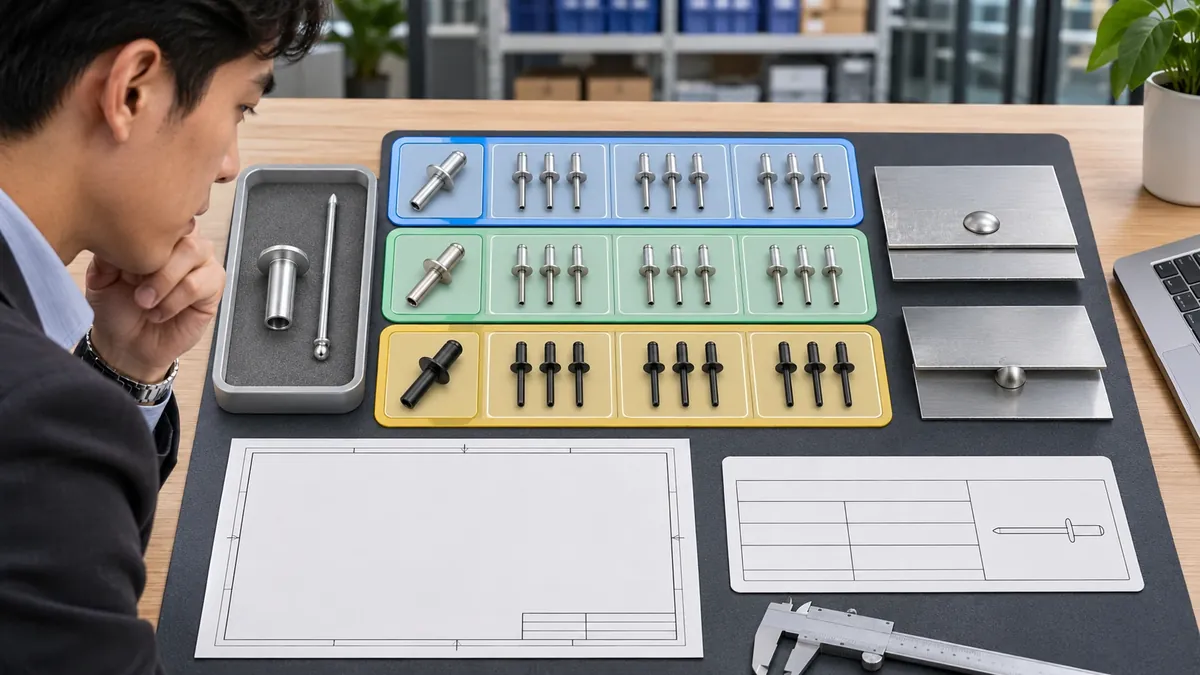
A physical drawing should show the hole and joint stack sufficiently for the chosen fastener to be reviewed. The supplier may need the material types, thicknesses, access side, cosmetic face, finish, assembly sequence and relevant clearances. A blind rivet can be set from one side, but this does not remove the need to confirm the back-side formation space or the tool access required for installation.
For a private-label product, the approved component should be identifiable in the bill of materials and purchase documents. If one fastener is substituted during sampling, record whether the drawing, finish, material or installation process changed. A sample with an unspecified rivet may look acceptable but fail to preserve traceability for repeat orders. The buyer should determine which component characteristics require inspection and which documents accompany the approved sample.
How should a buyer specify the fastener?
Start with the assembly requirement and the exact drawing revision. Identify which layers are being joined, the accessible setting side, the finished surfaces, the surrounding clearance and the feature the rivet connects. The fastener supplier may need these details to select a product family, but the buyer should not rely on an informal category name where component identity affects the part.
Then define the attributes that are controlled for the project. Depending on the design, these may include nominal diameter, grip range, head form, body material, mandrel material, finish, brand or manufacturer, part number and any approved equivalent. Include the appropriate hole and joint information from the design owner. This article does not prescribe numeric values; obtain them from the approved drawing and the selected manufacturer’s current technical data.
Distinguish required features from preferences. If a branded product is mandatory, state that substitution requires written approval. If a buyer accepts an equivalent, identify which technical attributes must match and what evidence will support the substitution. A statement that two parts are “the same size” may not establish that they are functionally equivalent. The responsible engineer or product owner should define the critical characteristics for the joint.
A sample review should compare the actual supplied rivet with the approved reference. Verify the package label, manufacturer, part number, configuration and relevant dimensions against the order documents. Inspect the completed assembly for the agreed acceptance criteria. A visual inspection may confirm that a rivet is present and seated in a certain way, but it does not establish hidden performance or compliance with an unspecified test. Request supplier documentation or testing only when the project requirement calls for it, and keep the test method and conditions attached to the result.
If the fastener is exposed to a corrosive environment or contacts dissimilar materials, treat material and finish compatibility as a separate engineering question. A blind-rivet or POP label does not establish corrosion performance. For an existing discussion of a specific fastener issue in metal storage racks, see stainless-steel fastener galling. That article addresses galling and should not be treated as a universal rivet selection guide. If the project drawing or sample is incomplete, prepare drawings and samples for a custom hardware factory before releasing a production requirement.

What should buyers avoid assuming?
A category name is not a part number. “Blind rivet” does not specify the exact product or all attributes needed for an order. Record the selected model and the features that are controlled by the project.
An informal brand name is not a confirmed brand requirement. When a request says “pop rivet,” clarify whether the buyer intends POP as the named brand or is using the term conversationally for a blind rivet. Confirm whether equivalent products may be proposed.
One-side setting does not mean zero rear clearance. The formed portion still needs space behind the joined layers, and the setting tool needs access from the working side. Review the joint stack and surrounding components in the actual assembly.
The name does not guarantee performance. Do not infer strength, vibration resistance, corrosion protection, tamper resistance, service life or safety from the category or brand phrase alone. Use product-specific evidence and the relevant design requirement.
A matching nominal diameter does not prove interchangeability. Other dimensions, grip range, head shape, body and mandrel materials, finish, setting method and approved source may matter. Compare the complete part reference and technical information.
A supplier’s sample does not automatically become the production standard. Record the approved component, drawing revision and acceptance criteria. If a sample uses an alternate part, document that explicitly before repeat orders.
How can a manufacturer support a sourcing decision?
A custom metal hardware manufacturer can review the assembly drawing, sample and specified fastener interface within its confirmed project scope. Direct communication can help identify questions about access, component fit, finish contact or a proposed substitute. It does not establish that the hardware manufacturer produces the rivet, owns a particular setting tool, certifies the joint or supplies a specific brand.
For an OEM bathroom or home-storage product, separate the metal assembly requirements from the fastener maker’s product claims. The factory may coordinate a bought-in component as part of an assembly if that scope is confirmed, while the fastener manufacturer remains the source for product-specific technical information. If a buyer requires a branded part, the quote and order should state that requirement. If a supplier proposes an equivalent, the buyer should review the specific change before approval.
A sample review can be structured around three records: the released drawing, the exact fastener reference, and the finished assembly. The drawing defines the required joint and interface. The part reference identifies what was purchased. The sample shows the assembly in the reviewed configuration. If any of these differ, record the discrepancy and obtain approval from the responsible product owner. This process supports traceability without claiming that a visual sample proves every performance outcome.
A supplier should not be asked to infer a hidden requirement from a product name. If the buyer needs a particular brand, state it. If the buyer needs a functional equivalent, define the criteria. If the need is still unresolved, ask for options and supporting information before issuing the purchase order. This prevents a conversational phrase from being mistaken for a precise manufacturing instruction.
How should a buyer resolve a name mismatch before approval?
Treat the blind rivet vs pop rivet wording mismatch as a document-control question, not as a request for the factory to guess. Start by putting the drawing callout, quotation wording, and proposed fastener reference side by side. Record which item is the buyer-approved source for the component identity. If the quotation says “POP rivet” while the drawing names a generic blind-rivet feature or a specific part number, ask the buyer to confirm whether the brand is mandatory, illustrative, or simply informal terminology. Keep the answer in the same revision-controlled record used to release the assembly.
A useful clarification request is narrow: “Does this callout require the named manufacturer and part number, or may we quote a technically reviewed alternative?” That question does not assert that an alternative is equivalent. It asks who has authority to approve the choice. If the answer preserves a branded part, the quote and purchase record should retain that exact identification. If the answer allows alternatives, the proposal should identify the offered maker and component reference and show what information the buyer will compare. The buyer or responsible design authority decides acceptance.
For a sample review, compare the delivered fastener label and supplied product reference with the approved documentation. A visual resemblance or a sample that can be set once is not enough to establish identity, interchangeability, or suitability for every production lot. Keep the sample decision tied to the exact joint design and revision. If the stack-up, material, hole, access condition, or fastener reference changes, route the change through the buyer’s normal engineering approval. This is change control, not a claim that every variation necessarily causes failure.
The same separation helps purchasing and receiving. The purchase order can name the category where the buyer is flexible, but it should identify a specific approved part when identity is controlled. The receiving record should use the information available from the package or supplier documents; it should not turn a brand-like word on an old email into proof that the delivered item is the approved component. Where the package or documentation is ambiguous, hold the identity question for the responsible buyer rather than silently updating the bill of materials.
This approach avoids two opposite mistakes. One is treating every casual use of “POP” as a binding maker requirement when the buyer intended only a blind-rivet category. The other is replacing an explicitly named component because someone assumes that every blind rivet is interchangeable. Resolve the intended level of control first, then compare the actual offered fastener and assembly evidence within that scope.
Buyer checklist before ordering blind rivets
- State whether the requirement is for the blind-rivet category or the POP brand.
- Identify the exact manufacturer and part number if a branded item is required.
- Record whether an equivalent may be proposed and which attributes must match.
- Link the fastener to the correct drawing revision and assembly location.
- Confirm the joint stack, accessible setting side and required rear clearance.
- Specify the required diameter, grip range, head form, body and mandrel materials when controlled.
- Review finish and material compatibility for the actual environment and mating parts.
- Verify the supplied package label and component reference against the purchase order.
- Record sample approval and any alternate part used during evaluation.
- Request only the product-specific evidence required by the design or buyer specification.
Foire aux questions
Are blind rivets and POP rivets different technologies?
Not necessarily. Blind rivet is the fastener category. POP is a brand name that is also used informally for blind rivets. Clarify whether the request names a general category or requires a particular branded part.
Is every blind rivet a POP rivet?
No. The category includes products from different manufacturers. POP is a specific brand name, so a generic blind rivet request does not automatically require that brand.
Does “POP rivet” specify a diameter or grip range?
No. The phrase does not identify the exact dimensions or product reference. The buyer should specify the required model or the controlled attributes.
Can I substitute another blind rivet for a named POP part?
Only if the buyer permits an equivalent and approves the proposed component against the project’s defined requirements. Matching one nominal dimension does not prove equivalence.
Can a blind rivet be installed without access to the back of the joint?
It is designed to be set from one side, but the formed portion still occupies space behind the joined layers. The assembly also needs suitable tool access and the correct product-specific setup.
Does the brand or category guarantee joint strength?
No. The name alone does not establish strength, vibration behavior, corrosion performance or service life. Use the selected manufacturer’s data and project-specific engineering requirements.
What should a purchase order include?
Include the category or brand requirement, manufacturer and exact part number where required, relevant technical attributes, drawing revision and substitution rule. Confirm the approved source and any required evidence.
Does a sample prove that the rivet is suitable for every production lot?
No. A sample demonstrates the reviewed configuration under the stated inspection conditions. Keep the approved component identity and production acceptance requirements in the controlled records.
Sources and scope
The category/brand distinction and general body-and-mandrel description are based on GESIPA UK’s explanation of POP rivets et GESIPA USA’s guide to rivet types. These manufacturer sources support terminology and a conventional setting concept. The article does not adopt broad performance guarantees, legal trademark conclusions, strength values, edge distances, grip-range charts or installation instructions.
This is general fastener-sourcing education, not an installation procedure, joint design calculation, trademark opinion or performance guarantee. Confirm the chosen part and assembly requirement with the responsible product and fastener suppliers.
Discuss a related hardware project with Koitor
Share the relevant drawing or sample, product revision, finish, order quantity, and packaging scope to clarify the manufacturing discussion.
Fabrication pour compte de tiers / Marque de distributeur
Transformez ce guide d'approvisionnement en cahier des charges
Indiquez-nous le produit souhaité, ses dimensions, sa finition, la quantité commandée et vos exigences en matière d'emballage. Votre équipe recevra une analyse pratique de la faisabilité de la fabrication avant l'établissement du devis.
 English
 Español
 Português
 Français
 Deutsch
 العربية