
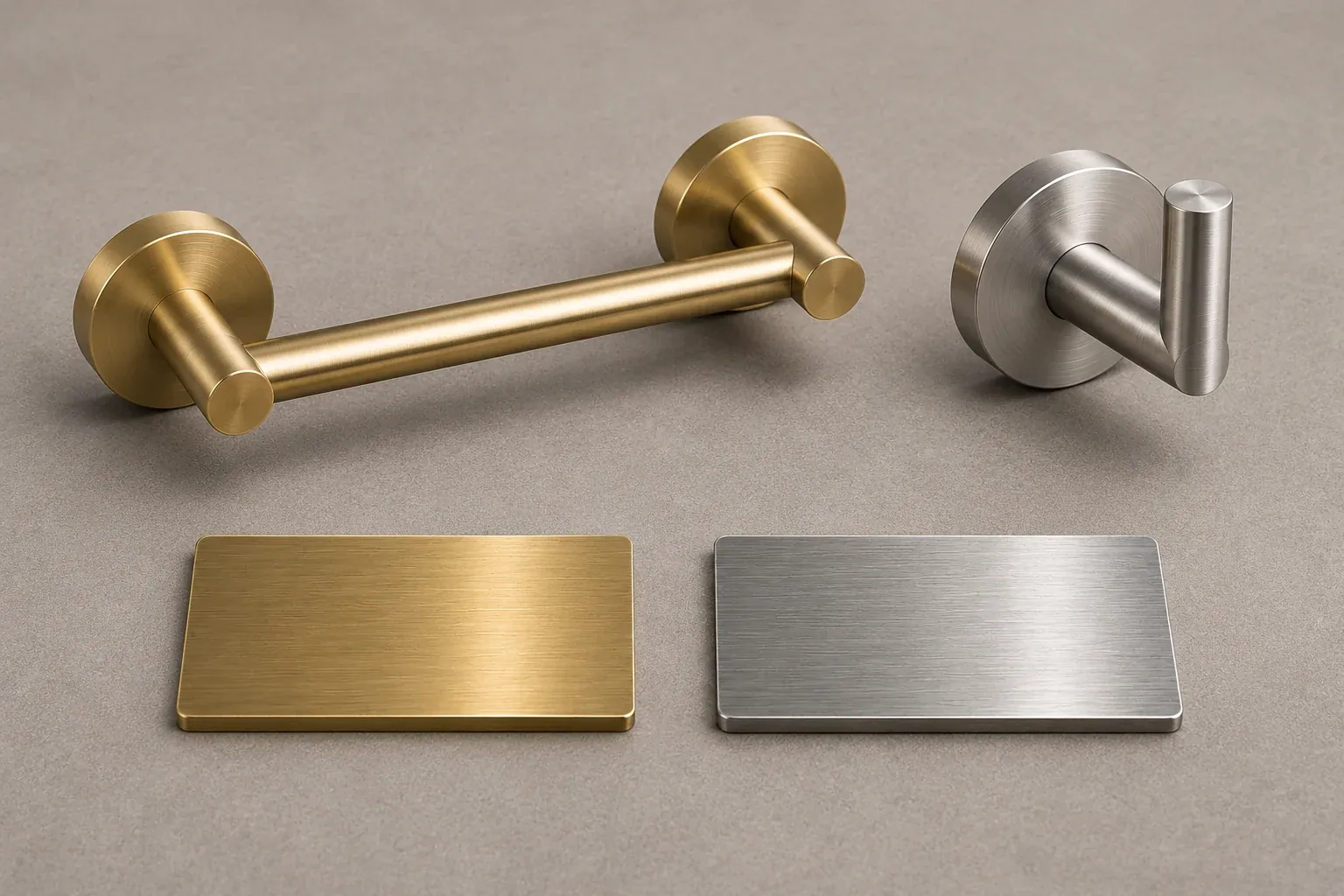
Brass vs stainless steel is a useful comparison only after a buyer identifies the finished component, alloy, shape, manufacturing route, surface treatment, environment, and assembly interfaces. “Brass” describes a family of copper-zinc alloys, while “stainless steel” describes a family of iron-based alloys whose corrosion behavior depends on grade and service conditions. Neither label gives a universal verdict on price, strength, corrosion resistance, appearance, or suitability for every bathroom or home-storage product.
For an OEM quotation, compare equivalent designs and evidence. State the same finished geometry, function, visible faces, use environment, finish expectation, joining method, inspection, and packaging scope for both alternatives. Then ask suppliers to identify material assumptions and process boundaries. This guide helps product teams frame that comparison; it does not claim that Koitor manufactures every brass component or performs every material-specific process in-house.
What Do Brass and Stainless Steel Identify?
Brass is not one fixed composition. Copper and zinc proportions, additional alloying elements, product form, and processing affect the material selected for a particular application. The International Copper Association describes brass as a copper-zinc alloy family and discusses variations in copper alloys. That makes a generic “brass” label incomplete for a controlled product specification. A buyer should request the actual alloy designation or supplier material declaration for the part and revision.
Stainless steel is also a material family rather than one grade. The applicable grade, product form, surface condition, fabrication, and service environment influence selection. The Australian Stainless Steel Development Association (ASSDA) explains that stainless grade choice is tied to the environment and corrosion factors. Its grade-selection guidance is a reminder to specify actual conditions rather than assuming that the word “stainless” means identical performance in every setting.
A finish name can obscure the difference between substrate and surface treatment. A brass component may be polished, brushed, plated, coated, or left with a specified natural appearance. Stainless steel may have a mechanically brushed surface, polishing, passivation, plating, or another treatment depending on the design. A brass-colored item is not necessarily brass, and a silver-colored item is not necessarily stainless steel. Confirm what metal is underneath the visible surface and which treatment creates the appearance.
The distinction matters commercially. A buyer comparing “brass hardware” from one supplier against “stainless hardware” from another may be comparing different base materials, wall thicknesses, geometries, finishes, and bought-in components. Before ranking either proposal, use a component list and drawing to establish what each quote actually covers.
How Do Product Form and Geometry Change the Comparison?
A brass vs stainless steel decision should begin with the part’s function and form. A decorative fitting, threaded insert, tube, wire basket, mounting plate, bracket, fastener, and cast-looking handle do not have the same geometry or manufacturing route. A recommendation for one small component should not be carried over to a complete towel bar or storage rack without checking the design and load path.
For a formed sheet or wire component, the buyer should identify the required thickness or wire diameter, bend radii, hole positions, joining features, and visible surfaces. For a machined part, define threads, tolerances, tool access, surface requirements, and whether a hollow or solid form is required. For an assembled product, map each component’s material and finish so that an alloy substitution does not silently change fasteners, inserts, end caps, or mounting interfaces.
Material may change how a supplier forms, machines, joins, finishes, and inspects the part. A route that is practical for one alloy or product form may not transfer directly to another. The SPIROL white paper comparing brass and stainless-steel inserts concerns threaded inserts for plastics, not bathroom racks or finished hardware. Its useful lesson for this broader discussion is limited: product form, installation method, material, and corrosive agents can affect selection. Its dated insert cost comparisons and numerical property ratios should not be treated as current universal data for another product category.
Ask for a design review using the production-intent part. If a proposed alternative requires different tooling, joining, finishing, or fasteners, record those changes and obtain approval before the quote is considered equivalent. A material name by itself does not establish manufacturability, assembly fit, or finished-product performance.

What Manufacturing Route Should Buyers Compare?
The manufacturing route connects material choice to cost, appearance, lead time, and quality controls. Depending on the component, operations may include cutting, stamping, wire or tube forming, machining, welding, grinding, polishing, plating or coating, assembly, and packaging. Not every part uses every operation, and the responsible supplier should confirm which process is included in the specific proposal.
Ask how the part will be produced in the proposed material and whether the same finished geometry can be maintained. A bend, thread, hole, weld, or cosmetic edge may need a different process sequence or tooling when a material changes. If an existing sample is the reference, ask whether it represents the proposed alloy and production route or only the appearance. A visually similar prototype made by a different process may not establish that the production method is interchangeable.
Joining also affects the comparison. The product may use welds, screws, rivets, threaded inserts, or purchased fasteners. Confirm the joint design, visible condition, access for finishing, and compatibility of dissimilar components. Where the assembly includes two metals, the design owner and supplier should evaluate the actual contact, moisture, and environment conditions rather than infer suitability from a material-family comparison alone.
The buyer should separate what the factory controls from outsourced steps. A custom hardware manufacturer may form and assemble the product while a specialist supplier performs a coating, plating, or other finishing operation. Ask who owns the process specification, sample approval, incoming and outgoing inspection, and change notification. The goal is traceable scope, not an unsupported claim that one factory performs every step.
How Do Finish and Service Environment Affect Selection?
Appearance requirements should be defined separately from base material. Specify color, sheen, texture, grain direction, visible faces, and approved sample where those details affect the collection or retail presentation. A brass component and a stainless component may both be finished to similar colors, but similar appearance does not mean identical construction, care, or replacement conditions.
The intended environment should be described in practical terms: indoor bathroom, shower area, coastal location, hospitality project, kitchen, laundry, or another use. Include cleaning frequency, expected cleaning agents, moisture exposure, ventilation, and whether the part is likely to contact other metals. The buyer and technical owner can then confirm which material and finish requirements apply. Avoid turning a general material property into a guarantee for every product and environment.
For stainless steel, grade, surface condition, fabrication, and exposure remain relevant. For brass, alloy identity, finish route, and the product’s maintenance and use conditions matter. Either family can require a defined finish or protective treatment. A supplier should support any performance statement with evidence that matches the finished part and specified conditions; color photographs, a material label, or a magnet test are not substitutes for a controlled material record.
Care instructions should come from the supplier responsible for the product’s complete construction. Do not apply generic polishing or chemical advice to a plated or coated item unless the finish provider confirms it. If a buyer expects a product to coordinate with an existing range, approve an actual component under consistent lighting and document acceptable variation. This is especially important when a visible finish is purchased from an outside processor.
How Should Buyers Compare Quotes Fairly?
A fair quote comparison holds the design and commercial scope constant. The buyer should send the same drawing revision, quantity, target environment, sample, packaging requirements, inspection plan, and delivery assumptions to each supplier. Ask each one to state the alloy, product form, process route, finish, bought-in parts, exclusions, and any assumptions used to price the proposal.
| Comparison field | Brass proposal | Stainless-steel proposal | Evidence to retain |
|---|---|---|---|
| Material identity | Exact alloy or approved declaration by component | Exact grade or approved declaration by component | Supplier material documents tied to part and revision |
| Part form | Sheet, tube, wire, machined, cast, or bought-in form as applicable | Same geometry and function, with any route differences stated | Drawing and process review |
| Manufacturing route | Forming, machining, joining, finishing, and assembly scope | Route and any tooling or sequence changes | Written process scope and quotation assumptions |
| Surface appearance | Color, texture, sheen, visible faces, and treatment | Finish condition, grain, coating, or other route | Approved sample and visual acceptance criteria |
| Environment | Location, cleaning, moisture, and metal contacts | Same stated use conditions | Product-specific requirements and relevant evidence |
| Commercial scope | Quantity, tooling, inspection, packaging, and exclusions | Same cost basis and scope | Comparable quotations and revision history |
| Contrôle des modifications | Substitution approval and processor responsibility | Substitution approval and processor responsibility | Written change record and sample approval |
Do not compare a finished brass fitting with an unfinished stainless component or a brass machined item with a stamped stainless bracket and call the price difference a material premium. First normalize design, finish, production quantity, inspection, and packaging. Then identify which differences are caused by material and which come from process, supplier scope, or order conditions.
If suppliers cannot quote the same route, ask them to explain the difference and identify what would need to change. Record an alternate proposal separately instead of merging it into the original comparison. The buyer can then decide whether the trade-off is acceptable with the engineering, quality, and commercial owners.
Build an Equal-Scope Comparison Before Reviewing Price
An equal-scope comparison begins with the customer requirement, not with a supplier’s preferred material. Write down the part’s function, dimensions, mounting interface, target environment, appearance, quantity, and inspection endpoint. Then ask each supplier to answer those same items. If a supplier cannot quote one alternative, record that response as a route limitation and ask what design or volume assumption would change the result. Keeping the questions aligned helps the buyer distinguish an actual material trade-off from a difference in supplier interpretation.
The comparison should include the complete assembly. A lower-cost metal for the visible body may require a different fastener, insert, end cap, or protective part. A finish route may add another supplier, handling step, sample approval, or inspection record. Those effects belong in the commercial comparison even if the metal itself is not the only cost driver. Ask suppliers to list included operations and exclusions rather than trying to infer them from a single unit price.
For a new product, compare a production-intent sample against the same functional checklist for each alternative. Check fit to the mating component, installation access, visible joining features, and packaging contact points. Record whether samples were made with planned tooling and whether finishing was performed by the intended processor. If prototypes use a different route, identify what remains unverified before the buyer approves production. This prevents a sample made to illustrate appearance from being treated as proof of the complete manufacturing proposal.
Separate Material Evidence From Appearance Evidence
Material evidence and appearance evidence answer different questions. A supplier declaration or traceable material record supports the identity of the supplied stock or component within the scope of that record. A sample supports review of shape, surface, color, and assembly fit. Neither one automatically proves every mechanical or corrosion claim. If a project depends on a specific property, define the test or document that the responsible technical owner accepts and identify the exact part, lot, and condition to which it applies.
For color and texture approval, review the same visible surfaces under consistent lighting and compare assembled components together. A flat coupon can be useful for initial screening but may not represent a bend, weld, edge, or machined feature. If two suppliers provide samples in different forms, ask for a representative production-intent part before approving a collection match. Record accepted variation in the buyer’s own specification rather than relying on a generic term such as “brass finish” or “stainless look.”
The article’s focus is brass vs stainless steel, but the manufacturing route may add a coating or plating that changes the visible surface on either substrate. Keep the finish stack and material identity in separate fields. If a specialist processor controls the finish, define how the material declaration, approved sample, and change notice are shared across the manufacturer and processor. This is especially useful when the finished product contains a combination of purchased and fabricated parts.
Decide What a Substitute Must Preserve
A material substitution should preserve the requirements that matter to the buyer: function, interface dimensions, installation, appearance, service conditions, quality evidence, packaging, and any market-specific documentation. Not every project needs identical mass or finish route, but the design owner should explicitly decide which properties can change and which are acceptance-critical. Ask the supplier to mark the proposed deviations on the drawing or quotation so they are visible before approval.
The buyer should also decide whether the supplier may make future material or processor changes without notice. For many private-label programs, the specification should require prior approval for a change that could affect the visible surface, assembly, service conditions, test evidence, or declared material. A controlled substitution process avoids accidental variation between sample, first order, and reorder. It also gives the buyer a place to assess a new supplier or finishing route without assuming that a previous approval transfers automatically.
When the choice is still uncertain, a small trial can compare assembly and appearance with the intended packaging. Define the trial question, sample count, acceptance owner, and what result would change the design decision. Do not call a trial a validation of long-term field performance unless the test method and exposure actually support that conclusion. A bounded trial is a way to reduce a specific uncertainty, not a universal endorsement of one metal family.
How Should the Sample and Material Records Be Approved?
The sample approval should connect appearance to construction. Record part number, revision, material designation, finish route, supplier, and the surfaces reviewed. If the buyer approves a brass sample for a product that will be quoted in stainless steel, the sample does not prove that the second material will have the same color, texture, or process result. Ask for a production-intent sample in the actual proposed construction when these attributes matter.
Inspect the full part rather than a flat coupon alone. Review bends, edges, welds, threads, mating surfaces, end caps, and installation interfaces. Check whether finish buildup changes assembly fit or fastener engagement. If the product includes visible dissimilar metals, approve the assembled appearance and document which components may vary by lot or supplier.
A useful record includes the approved drawing, material declaration, quotation revision, finish specification, sample photographs or physical sample ID, inspection criteria, packaging arrangement, and change-control owner. A certificate may support a material or process declaration, but the buyer should confirm what it covers and whether it is linked to the delivered lot. Do not infer chemical composition, corrosion life, or mechanical performance from an appearance sample alone.
When a supplier proposes a substitute because of availability, cost, or processing constraints, treat it as a change. Confirm the exact material, form, finish, joining method, and testing or inspection required. Decide whether a revised prototype or pilot lot is needed before releasing serial production. Keep the approved and rejected alternatives in the project record so that production and reorder teams do not mistake an exploratory sample for the released specification.

How Can an OEM Factory Support the Decision?
A custom hardware factory can help translate a buyer drawing or physical sample into a part and assembly discussion. Koitor Hardware is a family-owned custom metal hardware factory focused on bathroom and home-storage hardware. Approved company information supports customization from buyer drawings or samples, fabrication planning, finishing requirements, assembly, and packaging discussions. It does not establish that Koitor manufactures every brass alloy product or performs every material-specific operation in-house.
A useful RFQ includes the drawing revision, product function, target quantity, surface reference, use environment, installation method, packaging, inspection need, and the material or finish question that remains unresolved. Ask the factory to identify which operations are performed internally and which are coordinated with a specialist supplier. Where an outside processor controls the surface finish, clarify how sample approval, lot identity, and change information are transferred.
The factory can also compare whether the proposed design is compatible with the requested route. For example, a component may need a geometry change, different access for polishing, a different joining sequence, or a revised packaging separator. Any recommendation should be tied to the actual drawing and sample; it should not be generalized into a claim that one metal is always simpler or cheaper.
Review Koitor’s custom bathroom hardware manufacturing scope et OEM home-storage hardware page. Send the drawing, sample, material records, and project requirements through the contact page. A complete-part comparison can then separate product design, manufacturing scope, finish coordination, and the evidence needed for approval.
Foire aux questions
Is brass always more expensive than stainless steel?
There is no universal answer. Alloy, product form, geometry, manufacturing route, finish, quantity, inspection, packaging, and supplier scope all affect a quote. Compare equivalent finished parts and commercial assumptions.
Is stainless steel always stronger than brass?
A family-level label is not enough to answer a product-specific strength question. The actual grade, alloy, geometry, section, joint, load direction, and acceptance requirement matter. Ask for evidence that applies to the designed component.
Which material is better for bathroom hardware?
Neither family is universally better. Identify the exact alloy or grade, finish, environment, cleaning, assembly, appearance, and service evidence for the product before deciding.
Does a brass-colored finish mean the part is brass?
No. Color can come from plating, coating, or another finish system on a different substrate. Request the material declaration and finish specification for each component.
Can brass and stainless steel be used in one assembly?
That depends on the specific contact, geometry, environment, finish, and design requirements. Have the responsible engineering and supplier teams review the actual assembly rather than relying on a general rule.
Can an insert comparison determine the material for a towel rack?
No. An insert study concerns that insert application and cannot establish performance or cost for a complete rack. Use product-specific requirements and evidence.
What should a buyer request before approving a substitution?
Request the new material identity, product form, manufacturing and finish route, sample, inspection evidence, packaging impact, and documented approval against the drawing revision.
What belongs in the RFQ?
Provide the same drawing, quantity, use environment, finish reference, inspection criteria, packaging, and change-control requirements to every supplier. Ask them to state material and process assumptions.
Collaborez avec Koitor Hardware
Share the drawing revision, sample, proposed alloys or grades, finish target, service environment, quantity, and packaging requirements. Koitor can help clarify custom metal hardware scope and supplier coordination; the responsible material and finish suppliers must confirm their declarations and process-specific evidence.
Compare the Complete Part Before Choosing the Metal
Send the drawing, sample, finish reference, and intended environment for a sourcing review.
Fabrication pour compte de tiers / Marque de distributeur
Transformez ce guide d'approvisionnement en cahier des charges
Indiquez-nous le produit souhaité, ses dimensions, sa finition, la quantité commandée et vos exigences en matière d'emballage. Votre équipe recevra une analyse pratique de la faisabilité de la fabrication avant l'établissement du devis.


 English
 Español
 Português
 Français
 Deutsch
 العربية