
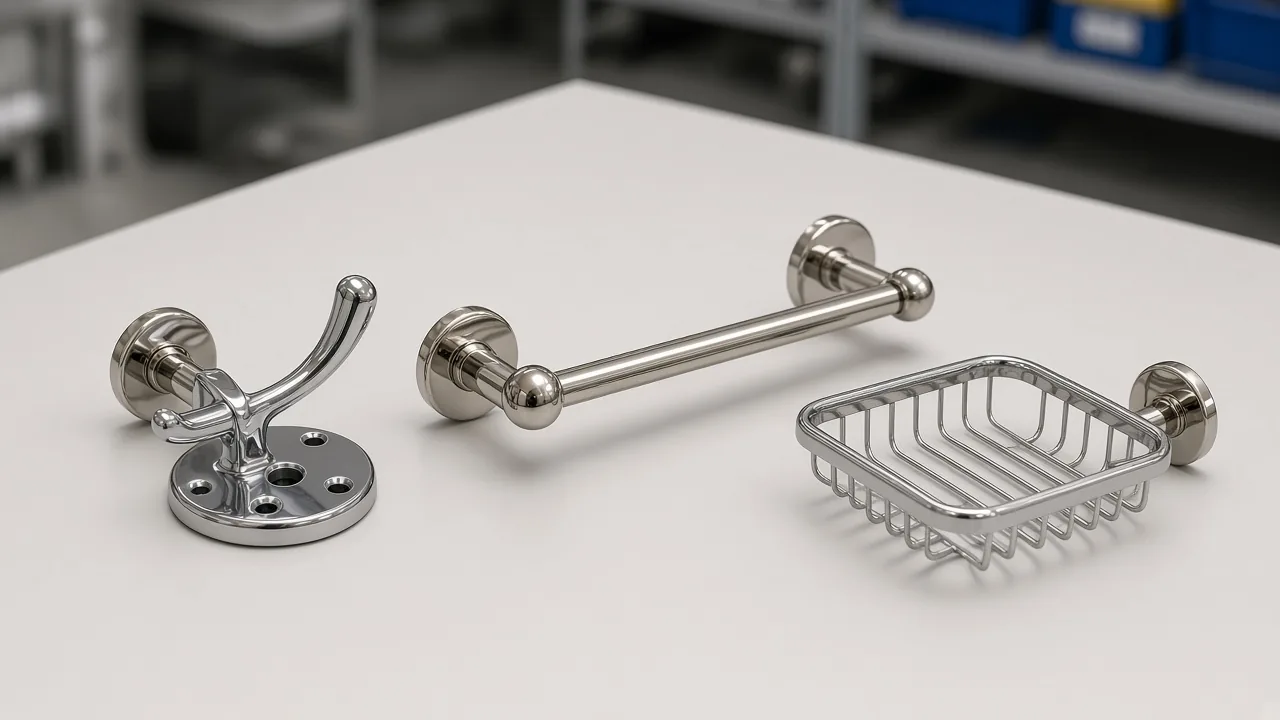
Chrome plating rack contact marks bathroom accessories buyers should treat as a zoning problem, not as a promise of mark-free chrome. Electrolytic racks have to hold and conduct through the part, so a small contact witness is often part of the process. The useful work is to freeze where those witnesses may appear, how they are viewed, and which retained sample is the boundary.
This page is written for electrolytically chrome-plated bathroom accessories such as robe hooks, towel bars, and soap baskets with screw-mount interfaces. It does not set rules for powder-coating rack or ground marks, and it does not repeat a general dish-rack plating-defect list. Those are different processes or different product scopes and should stay in their own files.
Importers who skip a zone map often argue later from a single lifestyle photo. A mark under a flange can be ordinary. The same mark on the front of a hook is usually not. Write the zones before the first production bath, and keep a boundary piece next to the sealed sample.
What is a rack contact mark, in buyer language?
A rack contact mark is a small area where the plating rack or a contact tip touched the part in the electrolytic bath. The finish there may look thinner, duller, slightly darker, or faintly shaped like a tip. It is not automatically a pit, a burn, a skip, or a copper-show-through. Those other defects have their own causes and should not be renamed as “rack marks” to make them easier to accept.
The mark exists because the part must be held and the current must travel. Moving the contact can move the witness. It does not, by itself, remove the need for a contact. Asking for “no marks anywhere” without a racking plan or a hidden-face zone is usually an unkeepable listing line, not a serious specification.
Copper, nickel, and chrome stack-up still matters, because a contact area can also reveal a thin stack or a different color if the system is weak. This page does not rewrite that stack. It only asks where a contact witness may sit and how it should be judged on a finished bathroom accessory.
Selective plating and masking boundaries are a different tool. Masking is for keeping finish off a thread, a socket, or a chosen face. Do not use a masking note as a substitute for a rack-contact zone map, and do not assume a masked thread automatically hides every contact on the hook body.
How should buyers freeze zones, light, and a boundary sample?
Divide the part into zones the inspector can point to: primary visible faces (the surfaces in a normal standing view after install), edges, and hidden faces (under a flange, against the wall, inside a socket, or otherwise out of ordinary view). Draw them on a simple photo or a drawing view. If two people cannot point to the same zone, the map is not finished.
Viewing conditions belong in the same file. Agree a light type, a distance, and a time window as a project method, and keep that method separate from any sampling-plan numbers. This article does not publish a Koitor-standard lux figure or a universal viewing distance. Third-party visual-quality examples exist in the industry; treat them as examples, not as Koitor rules, and write the method you will actually use.
EN 248 scope for bathroom accessories can help you know which standard conversation applies to a coated accessory, but a scope checklist is not a zone map. Use it beside this file, not instead of it.
| Zone or control | What the buyer should freeze | Usual risk if left vague | What to retain |
|---|---|---|---|
| Primary visible face | Front and top surfaces seen after install in a normal standing view | A contact tip on a hook front or a bar face becomes a listing and returns issue | Photo of the zone and a sealed unit with a clean visible face |
| Edge | Rims, wire ends, and the line between face and underside | A witness on an edge is argued as both ‘hidden’ and ‘obvious,’ depending on who holds the part | Edge close-up on the boundary sample |
| Hidden mount face | Underside of a flange, wall-facing plate, or inside a socket | A fair process contact is rejected, or a large bare patch is excused as ‘on the back’ | Flange-off or underside photo in the seal set |
| Viewing method | Light, distance, and time as a project agreement | One inspector uses a raking desk lamp, another uses a phone flash at two centimetres | A short written method, stored with the samples, not inside a sampling-plan sentence |
| Boundary sample | The worst contact still accepted, marked by zone | Later lots drift until a mark appears on a visible face and no one can prove the old limit | A tagged piece next to the sealed sample |
| Racking plan | Where contacts are intended to land on this SKU | A new rack or a new bath moves the witness onto a face the listing shows | A simple racking sketch or photo with the first article |
What should first-article and incoming checks look at?
First-article parts should be reviewed in the agreed light, in the install orientation when that is practical, and with the flange or plate in place and then off if the hidden face is in scope. Look for contact witnesses and also for other plating faults, but record them under their own names. A pit is not a rack mark. A burnt tip is not a rack mark.
Measure a witness only when the file asks for a size or a location, and write the measurement method separately from any lot-accept numbers. A millimetre reading on a hidden-face mark does not, by itself, accept a carton.
If the factory changes the rack, the bath, or the hanging orientation, treat that as a process change that can move the witness. The zone map is not a license to park a new mark on a visible face because “rack marks are allowed.” The map says where they may occur, not that any mark is welcome.

What the factory can control, and what stays a project agreement
A plating line can plan contact points, train racking, and present first-article parts in the agreed zones. A factory can also keep a boundary sample and a racking photo with the sealed unit. It cannot honestly guarantee mark-free chrome on every face of every shape, and it cannot copy a powder-coat ground rule onto an electrolytic hook.
Koitor can review zone maps and chrome bathroom accessories as a family-owned China OEM manufacturer of bathroom and home-storage metal hardware. The buyer still has to freeze the visible faces for the SKU and say how marks will be viewed.
Incoming inspection should use the same map and the same light as the first article. A distributor who inspects under a warehouse skylight will not match a lab booth unless that difference is written and accepted. If the program needs one method, write it and use it at both ends.
For quotation, send the zone map, a boundary sample if one exists, and the parts to be plated. MOQ, sample timing, and lead time remain project-specific under careful approved wording.
Buyer checklist for chrome plating rack contact marks bathroom accessories
Use this list before the first production bath and again at incoming inspection.
- State that this file covers electrolytic chrome bathroom accessories, not powder-coat rack marks and not a general dish-rack defect catalog.
- Draw primary visible faces, edges, and hidden mount faces on a photo or a view of the actual SKU.
- Write a viewing method (light, distance, time) as a project agreement, separate from any sampling plan.
- Ask for a racking plan or photo that shows where contacts are intended to land.
- Retain a boundary sample for the worst accepted witness in each relevant zone.
- Review first-article parts in the install orientation when practical, with hidden faces photographed.
- Name other plating faults separately; do not relabel pits, burns, or skips as rack marks.
- If racking or the bath changes, re-check the zones; do not assume the old map still holds.
- Keep measurement methods and lot-accept numbers in separate clauses.
- Do not print a mark-free chrome claim unless the program has a method and a proven result you are willing to stand behind.
- Store the map, the method, and the boundary piece with the sealed sample.
- Use the same map at the factory and at incoming, so one raking lamp does not reopen the file.
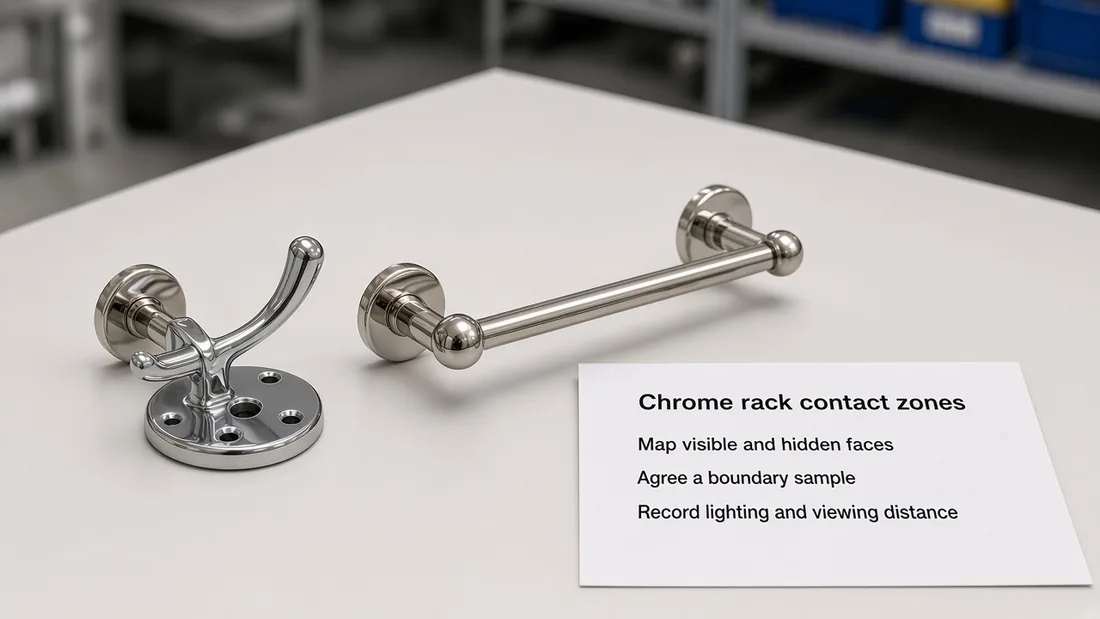
Hook balls and decorative tips attract contacts because they are easy to hang, and they are also easy to see in a lifestyle photo. If a ball is a primary visible face, the racking plan should put the contact elsewhere, often on a hidden flange or inside a socket, and the first article should prove it.
Towel-bar faces are long, so a mid-span witness is hard to defend as hidden. Contacts usually belong at the post interface or under a flange. If a new rack hangs the bar from the mid-span, reopen the zone review even if the previous lot was clean.
Wire soap baskets have many short lands. A contact on the back plane may be fair; a contact on the front rim that holds the soap is usually a visible-face issue. Define front rim, back plane, and underside before arguing a single bright spot.
Install orientation should be marked on the first-article card. A hook laid on its back on a table shows faces that a user never sees, and hides the face they see every day. Judge the part as it will hang, then flip it for the hidden-face photos.
Phone-flash close-ups will make almost any chrome look uneven. If customer-service teams use phone photos, tell them the viewing distance and to include a room-light shot. The claim packet and the inspection method should not silently use two different lights.
A boundary sample that is not tagged by zone is only a shiny spare. Write the zone, the date, and the drawing revision on the bag. If the tool or the rack changes, take a new boundary or formally retire the old one.
Family SKUs that share a hook body but change a post length may need different racking. Do not copy one hook’s contact plan onto a longer bar without a trial. The zone names can stay; the landing points may not.
Repair or touch-up over a contact mark is a different decision from accepting a witness. If a lot is repaired, the file should say whether that repair is allowed on a visible face, and the finish must still match the sealed unit. Quiet blending on a hook front is how shade mismatch starts.
Do not import powder-coat ground language into this electrolytic file. A powder ground pad is a different process witness. Mixing the two vocabularies confuses inspectors and lets the wrong neighbor page set the rule.
Do not treat a dish-rack plating-defect gallery as the acceptance list for a robe hook. Kitchen racks and bathroom accessories share chrome as a word, not as an automatic zone map. Keep the product and the process in this file.
When the zone map, the viewing method, the racking plan, and the tagged boundary sample are in the same packet, chrome plating rack contact marks bathroom accessories can be inspected without a weekly argument. If the file only says “good chrome, no obvious marks,” the argument is already scheduled.
Hidden-face acceptance is not a blank cheque. A large bare patch, a sharp rack scratch, or a contact that cuts through the stack is still a finish failure even under a flange. The zone map relaxes only the small process witness you agreed to, in the place you agreed to, at the viewing method you wrote.
If a listing shows the underside of a glass-shelf-style bracket or an open flange, that underside has become a visible face for that SKU. Re-label the zone. Catalog photography can change the map without anyone changing the tool.
Training photos should include a fair hidden-face witness, a rejected visible-face witness, and at least one non-contact defect that must not be called a rack mark. A single ‘bad chrome’ photo teaches the wrong lesson.
Export cartons that bump chrome against chrome can add rubs that look a little like contact marks. Pack trials belong beside this file so a transit rub is not excused as a bath witness, and a true rack mark is not blamed on the carton.
Set-screw holes and post sockets are convenient contact points, and they are often hidden after assembly. That only works if the contact does not throw a halo onto the visible collar. First-article photos should include the collar with the screw in and out, because a later retail photo with the screw removed will show the halo.
Internal threads can be protected by masking or by a contact that sits inside the thread. If the thread is a functional surface, say whether a witness is allowed and whether the screw still starts by hand. A cosmetic rule that ignores thread function will come back as an install complaint.
Bright nickel or other under-layers can show at a contact as a slightly warmer or cooler spot. Inspectors should know the agreed stack so they do not call every color shift a rack mark. If the stack itself is in question, stop and use the stack-up file rather than widening the zone.
Rework baths and double-dips can move or multiply witnesses. If a lot was re-hung, the racking photo from the first article may no longer be true. Ask whether any piece was re-processed before you accept a new pattern of marks as “the usual contact.”
Storage of boundary samples matters as much as tagging. A loose hook in a shared tray will pick up new rubs and then become a false limit. Bag the piece, keep it with the sealed unit, and do not lend it to the line as a daily working gauge.
When several factories or several plating shops can run the same SKU, each shop needs its own racking trial against the same zone map. A map is portable; a hanging trick is not. Do not assume a second shop can copy the first shop’s hidden-face landing without a new first article.
Retail returns that show a mark on a visible ball should be compared with the zone map and the boundary sample, not only with a verbal “that’s plating.” If the mark is outside the map, it is a process drift or a different defect. If it matches the boundary and the zone, the file already anticipated it and the listing should not have promised a perfect ball.
Photography for the catalog should avoid angles that turn a hidden flange into a hero detail, unless you have already re-zoned that face. Marketing and inspection must share the same idea of what the customer will see. A beauty shot from below can undo a careful hidden-face plan.
Small accessories in a set — a hook, a bar, and a paper-holder — should not silently share one contact story. Write the zones per SKU, then say which landings are shared. A set that is boxed together will be judged together in a bathroom, even if the racking was done on different frames at different times.
If a buyer’s market uses a published visual standard, extract only the parts you will actually follow, and write them as project methods. Do not paste a third-party document as if it were a Koitor certificate, and do not leave the file pointing at a standard no one on the line has in hand.
Foire aux questions
Can a buyer demand zero rack marks on every face?
You can ask, but the file should also show a racking plan that makes it possible, or the claim will not survive production. Most programs do better by protecting visible faces and allowing a defined witness in a hidden zone.
Are all dull spots on chrome rack marks?
No. Pits, burns, skips, and thin-stack color changes have other causes. Name them separately so the zone map is not used to accept the wrong fault.
Does a hidden-face zone allow any size of mark?
No. It allows the agreed process witness, viewed by the agreed method. A large bare area or a cut-through scratch is still a fail.
Should powder-coat ground marks use this map?
No. Use a powder-coat file for that process. This page is electrolytic chrome bathroom accessories only.
How should a first sample be submitted?
Send the zone map, the racking photo or sketch, parts reviewed in the install orientation, hidden-face photos, and a proposed boundary sample. A single beauty shot of a hook front is not enough.
What if a second plating shop runs the same hook?
Run a new racking trial against the same zone map. Hidden-face landings do not automatically transfer from shop to shop.
Can a contact sit in a set-screw hole?
Often that is a good hidden point, but check the visible collar for a halo and confirm the screw still starts by hand if the thread was used.
Can one boundary sample cover a whole finish family?
Only if the parts rack the same way and the visible faces are truly the same. A longer bar or a different hook ball usually needs its own check, even when the family name is shared.
Collaborez avec Koitor Hardware
Need chrome bathroom accessories quoted with a rack-contact zone map?
Send Koitor the zone map, a boundary sample if one exists, and the parts to be plated. Our team can review the electrolytic chrome construction and small-batch OEM options before quotation.
Fabrication pour compte de tiers / Marque de distributeur
Transformez ce guide d'approvisionnement en cahier des charges
Indiquez-nous le produit souhaité, ses dimensions, sa finition, la quantité commandée et vos exigences en matière d'emballage. Votre équipe recevra une analyse pratique de la faisabilité de la fabrication avant l'établissement du devis.


 English
 Español
 Português
 Français
 Deutsch
 العربية