
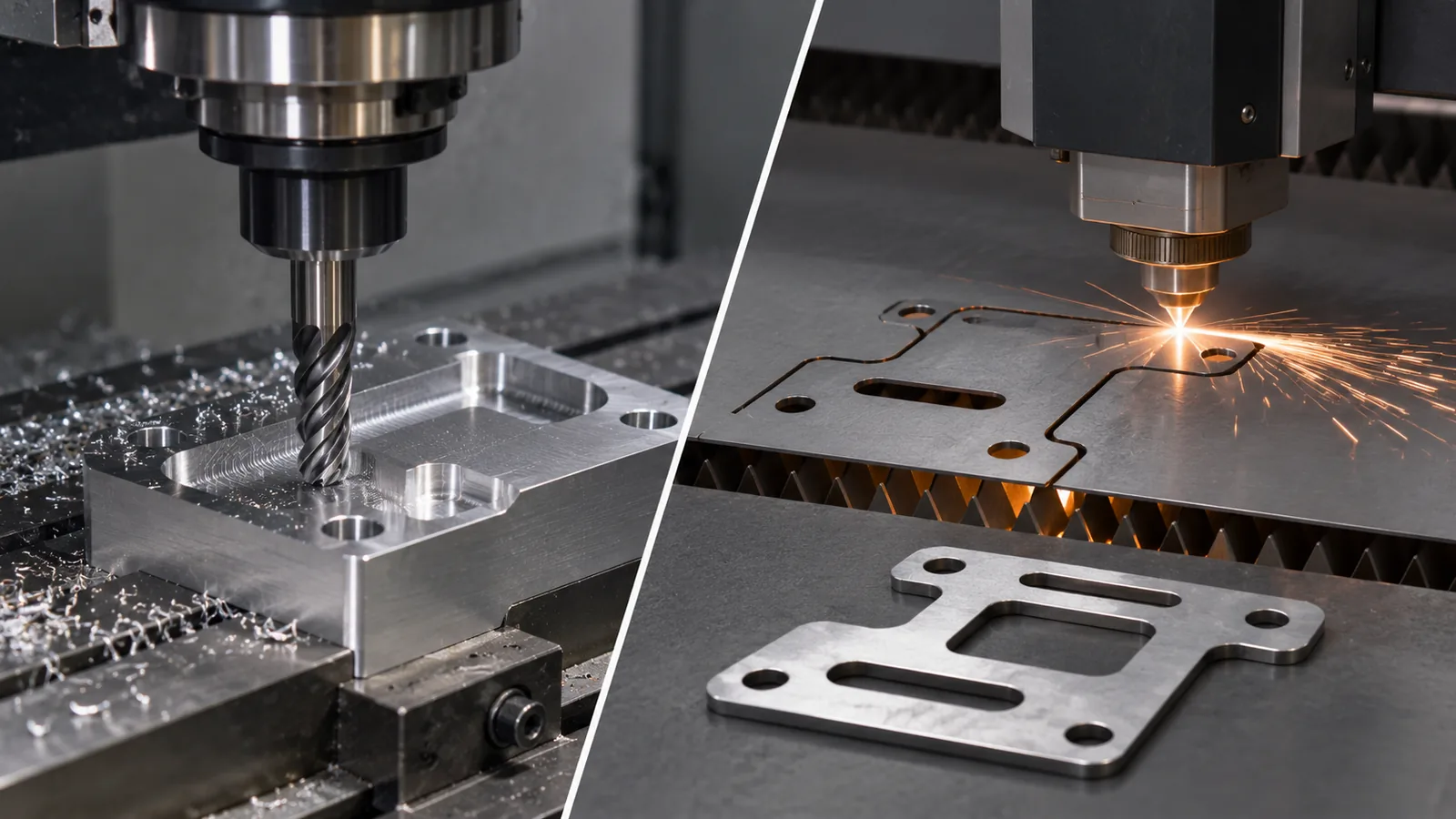
CNC vs laser cutting compares two different kinds of terms. CNC means computer numerical control: a way to control equipment using programmed instructions. Laser cutting names a cutting process that uses a concentrated beam of light. A laser cutter can itself be CNC-controlled. In many informal comparisons, “CNC” is shorthand for a router or milling machine with a physical cutting tool, contrasted with a laser process. A buyer should clarify that shorthand before comparing material, features, edge requirements, cost or capability.
Separate the control method from the cutting process
A machine can be numerically controlled without using a laser. A router or mill may use a rotating tool to remove material along a programmed path; a laser cutter uses a focused beam to cut material under a defined system and setup. These are not parallel labels: one describes a control method and the other a cutting mechanism. Because a laser system may also follow computer-controlled paths, a phrase like “CNC versus laser” can be ambiguous.
The practical comparison usually intends to contrast mechanical tool cutting with light-based cutting. Before a supplier quote is evaluated, ask what the supplier means by “CNC”: router, milling machine, another mechanically tooled operation, or simply a numerically controlled machine. Ask what laser type and material configuration the alternative assumes if that distinction matters. Do not compare products based on a phrase that different vendors use differently.
The control method alone does not state what a machine can make. CNC describes how instructions direct equipment; the physical tool, machine architecture, workholding, material, setup and process determine the operation. Laser describes the energy used to cut, but does not specify every detail of the equipment or the finished edge. Neither term by itself guarantees precision, speed, price, material range or part quality.
| Term | What it describes | What it does not establish | Buyer clarification |
|---|---|---|---|
| CNC | Computer numerical control of equipment using programmed instructions | A specific cutting mechanism or machine type | What machine and physical process does the quote mean? |
| Router/mill shorthand | A machine using a physical cutting tool to remove material | Universal ability to cut every material or make every feature | Which tool, material, depth and geometry are in scope? |
| Laser cutting | A process using a concentrated beam as cutting energy | A universal tolerance, thickness range or edge condition | Which laser system and part capability are proposed? |
| CNC laser cutter | A laser process controlled numerically | That every file or program will transfer without validation | How are the file, setup and resulting features verified? |
This naming distinction is the core of the CNC vs laser cutting question. If both proposals are numerically controlled, the useful comparison is the actual cutting mechanism and part requirement, not whether one vendor calls its machine CNC.
Compare features on the actual component
Cut-through profiles versus machined features
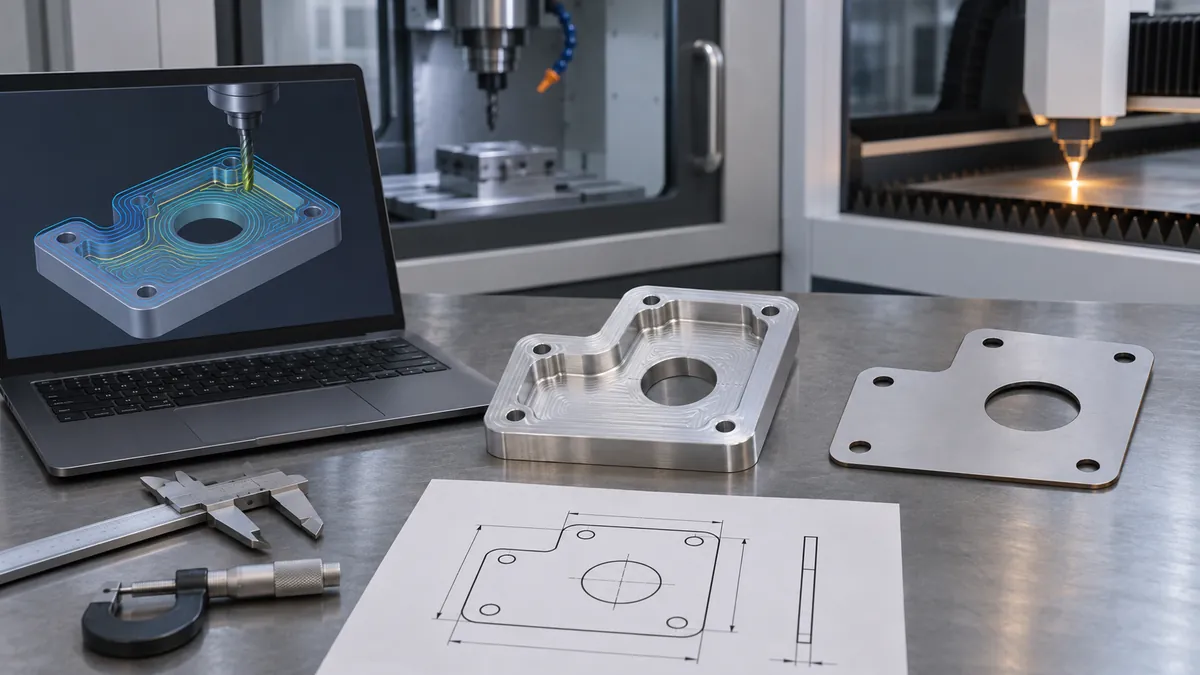
A laser process is commonly evaluated for cutting a profile through material. A router or mill with a physical tool can remove material from a workpiece and may create pockets, slots or other features depending on the equipment, tool and setup. This is a general distinction, not a claim that every geometry is possible or that a process is suitable for every material. The product drawing determines whether the job is a cut-through contour, a machined feature or a combination of operations.
For a bracket, plate or housing component, identify which features go through the full thickness and which require a recess, counterbore, pocket, tapped hole or controlled depth. A part that looks like a flat profile in a rendering may require a feature that is not merely a cut-through. Ask the supplier how it proposes to create that detail and how it will inspect it. If the process involves more than one operation, clarify the sequence and how the part is located between operations.
Material and thickness
Material compatibility depends on the actual machine and cutting setup. A physical tool engages the material mechanically; a laser uses a beam whose performance depends on the system and workpiece. A generic comparison chart may focus on wood, plastics or craft applications and not reflect a metal hardware component. Do not apply hobby-machine material claims to a metal manufacturing quote without supplier-specific evidence.
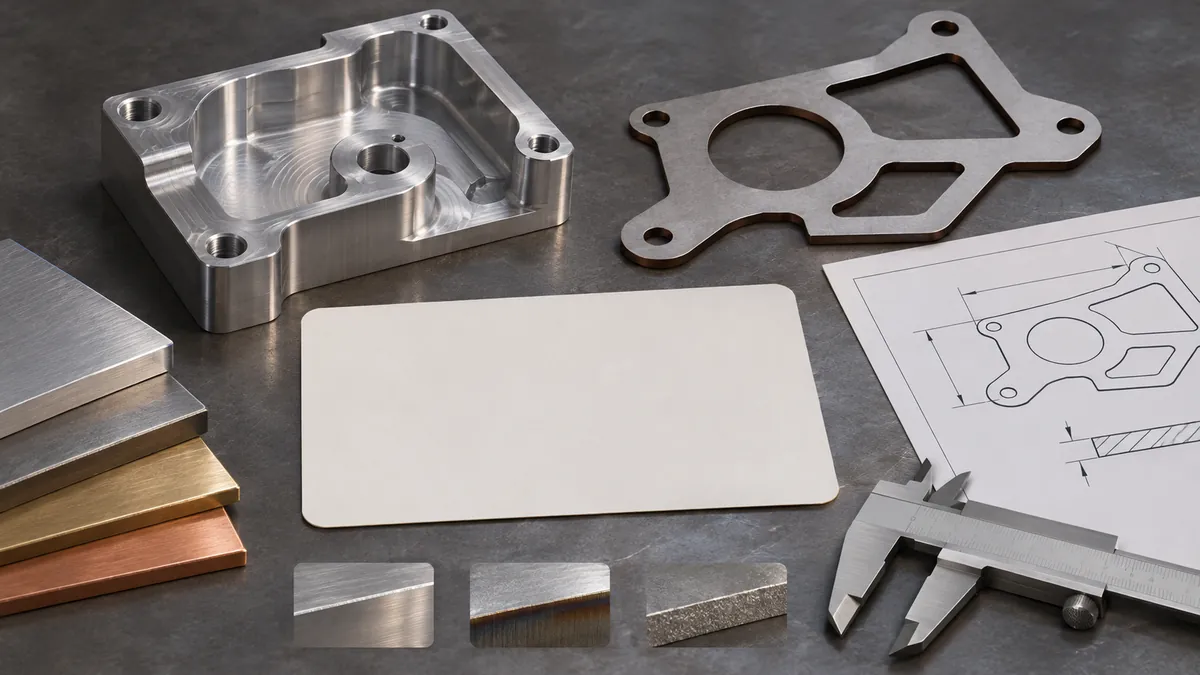
State the exact alloy or material description, product form, thickness and any surface layer. If the material is open, ask the supplier to list the assumption. If two quotes use different materials, the process comparison is confounded: the buyer cannot attribute the difference to cutting method alone. A process change should not silently change the substrate, temper, coating or supplied condition.
Edge condition and downstream work
A mechanically cut or laser-cut edge can require different secondary operations depending on the actual equipment, part geometry and acceptance needs. A buyer may care about burrs, sharpness, edge taper, roughness, heat effects or visible marks, but these should be included only when relevant to the component. Define the edge that is delivered and whether deburring, grinding, polishing or other finishing is part of the quote.
If the blank will be bent, welded, coated or assembled, explain the next operation. A cut edge near a bend, weld or cosmetic face may matter more than a hidden edge on a noncritical interior feature. Ask the supplier to identify whether its proposed route includes preparation for the next step. Do not assume that a process name tells you whether downstream cleanup is included.
Access, part holding and geometry
A tool’s physical access and a laser system’s path access are different considerations. A deep pocket, narrow internal corner, small slot or feature close to a clamp may create constraints that are not obvious in an overall view. The supplier should review the feature and workholding approach for the actual stock size and part geometry. A drawing should show critical depths and datums rather than relying on a shaded 3D model alone.
If a part must be repositioned or flipped, confirm which features are critical across setups and how alignment is maintained. This is a supplier process-planning issue, but the buyer should make the functional requirements visible. A proposal can be technically plausible and still miss a datum relationship if the drawing does not identify it.
Cost, timing and quality are not determined by the acronym
A broad statement that CNC is cheaper or laser is faster does not resolve a purchasing decision. Cost and lead time can depend on machine availability, setup, material, nesting, programming, cutting path, tool wear or consumables, quantity, secondary work, inspection and packaging. A quote for a profile cut may not include a machined pocket or edge preparation. A different proposal may include additional inspection. Compare equivalent scope rather than process slogans.
For a fair comparison, send the same drawing revision, material, thickness, quantity and finish to each supplier. Ask each to name the proposed machine/process, identify included operations and list exclusions. If a supplier uses “CNC” as a catchall for numerically controlled laser cutting, ask it to distinguish that from router or mill work. If a job combines cutting and machining, request a breakdown by operation where it helps clarify the offer.
Quality is similarly specific. A process label does not show whether the part meets dimensions or visual requirements. Define critical hole positions, slot size, profiles, depth, edge criteria and inspection method. A sample can help confirm the features that were actually checked, but it does not prove unmeasured material properties or future lot performance. Match evidence to the requirement and retain the drawing revision associated with approval.
Assign responsibilities for process planning
The buyer owns the product definition and the supplier owns its manufacturing plan unless a contract says otherwise. The buyer should provide controlled geometry and acceptance requirements; the supplier should identify what machine or process it proposes and whether the part can be produced as drawn. Neither party should quietly convert a terminology shortcut into an unstated assumption about the delivered result.
When the buyer says “CNC,” the supplier should ask whether that means a physical tool operation or simply a numerically controlled process. When a supplier says “laser,” it should state the process assumption clearly enough for the buyer to understand what will be cut and what secondary work remains. If a quote includes both laser and machining, identify which features belong to each operation. This prevents a profile cut from being mistaken for a completed component with all pockets and depths finished.
The supplier does not need to expose confidential program details for the buyer to approve the product. A project-level confirmation can identify the planned operation type, stock assumptions, critical setup or datum concerns and evidence to be provided. If the buyer has an approved process requirement, that requirement and change pathway should appear in the controlled specification. Otherwise, the supplier may propose a route while remaining responsible for meeting the agreed finished-part criteria.
If a process or equipment change is proposed after quotation, assess whether it affects material, geometry, edge, cost, lead time, inspection or downstream finishing. Record the change and buyer decision against the part revision. A route substitution that leaves all acceptance criteria intact may need a different level of review than a change that alters a critical slot, exposed edge or mating surface. The product owner should make that determination rather than assuming all substitutions are harmless or all are prohibited.
This responsibility split is also useful when several companies participate. One vendor may provide a cut blank, another may machine a recess and a third may apply a finish. The RFQ should identify the handoff condition and who verifies dimensions at each stage. If the first supplier is not responsible for finished-part inspection, do not treat its cut-only report as acceptance of the complete assembly. Define the boundary between operations before placing the order.
Consider a representative sample
A sample is useful when the drawing contains a feature or edge condition that the buyer and supplier have not previously validated. Define what the sample is intended to demonstrate: hole fit, pocket depth, edge appearance, assembly alignment or another measurable characteristic. Keep the sample linked to the same material, drawing revision and proposed route as the quotation. If those conditions change, the previous sample may not answer the new question.
The inspection record should identify what was actually checked and how. A photograph can document a visible area but cannot establish a controlled dimension. A measurement of one slot does not prove all other features or a future production lot. If the part will be coated or bent after cutting, inspect the relevant requirement at the stage that determines acceptance. Agree whether the buyer needs an intermediate blank or the fully finished sample.
For repeat orders, preserve the approved sample or record with the drawing revision and purchasing specification. If the supplier changes a machine, tool, material source or finishing sequence, ask whether that change affects the accepted feature set. The supplier can provide an explanation without exposing its complete CAM file. The buyer can then decide whether a documented review, new sample or additional inspection is warranted.
For a multi-step part, define the condition of the workpiece as it moves from one supplier to the next. If a cut blank is shipped for machining, identify which edges and dimensions are already accepted and which remain open. If a finished assembly is the purchase item, make sure the quote includes the operations needed to reach that state. This prevents “cut to profile” from being mistaken for complete part manufacture. It also helps the buyer compare proposals that divide operations differently without judging one process from its name alone.
Where a supplier cannot meet a feature exactly as drawn, request a written deviation that identifies the affected dimension, proposed alternative, reason and impact on fit or function. The buyer’s engineering owner should accept or reject it before the process plan is updated. A verbal statement that the difference is “normal” is not a substitute for an approved dimensional change. Keep any accepted deviation attached to the order and inspection record so it is not carried into later revisions without review.
| Quote item | Keep constant across proposals | Ask the supplier to disclose |
|---|---|---|
| Part definition | Drawing/model revision and quantity | Which files and revision are being quoted |
| Matériau | Grade, form, thickness and finish | Any substitute or sourcing assumption |
| Feature scope | Profiles, pockets, slots and depths | Proposed route for each feature type |
| Edge and finish | Cosmetic faces and post-cut condition | Included deburring, grinding or other work |
| Inspection | Critical dimensions and acceptance method | How each controlled feature will be verified |
| Commercial scope | Lot size, packaging and delivery assumptions | Setup, exclusions, secondary operations and lead-time basis |
The table helps the buyer compare complete proposals. It is not an equipment ranking and does not supply a universal process crossover point.
A practical process-clarification workflow
- Translate the label. Ask whether “CNC” means router/mill cutting or another process, and identify whether the laser system is also computer-controlled.
- Classify the features. Mark cut-through contours, pockets, depths, holes, slots and surfaces that need a separate operation.
- Specify the stock. Identify material, product form, thickness, surface condition and quantity.
- Mark critical acceptance. State dimensions, datums, cosmetic faces and edge conditions that matter to function or appearance.
- Describe downstream work. Note bends, welds, coatings, assembly or other operations that may be affected by the edge.
- Request the actual route. Ask the supplier to name the machine/process and explain assumptions for the part.
- Compare like-for-like quotes. Align material, lot size, inspection, finishing and packaging scope.
- Validate a sample where needed. Check the defined features and record the result against the controlled revision.
- Control changes. Require approval for material, process or geometry substitutions that affect agreed requirements.
The process choice should follow the component’s function and the supplier’s verified capability. If a feature cannot be made or measured as drawn, the supplier should raise that gap before production. The buyer can then revise the design, clarify acceptance or seek a different route with the product owner’s approval.
That is the practical meaning of CNC vs laser cutting for a sourcing team: compare the actual process and the actual part definition, not two shorthand labels.
Hypothetical hardware example
Imagine a flat mounting plate for a home-storage assembly. It has an external profile, a set of holes, a shallow recessed feature and a visible edge after coating. One vendor says “CNC cutting”; another offers laser cutting. The buyer should first clarify whether the first vendor means a router or mill using a physical tool, or a numerically controlled laser. The shallow recess may require a separate machining operation regardless of which route makes the outline.
The buyer sends both suppliers the same material, thickness, drawing revision and finish. It marks the hole positions that control assembly, identifies the visible edge and specifies whether the recess depth is critical. Each supplier lists its proposed operations and edge treatment. The buyer compares the samples or inspection evidence against those requirements rather than deciding that one acronym sounds more precise or economical.
This example is hypothetical. It is not a Koitor customer project, machine claim or test result. It demonstrates how naming ambiguity can be resolved before comparing a manufacturing quotation.
Common sourcing mistakes
- Treating CNC and laser as mutually exclusive. A laser cutter may itself use computer numerical control.
- Leaving “CNC” undefined. Ask whether a router, mill or another process is meant.
- Using a consumer-machine chart for metal hardware. Confirm the actual industrial supplier capability and material.
- Assuming a laser can create every machined feature. Distinguish cut-through profiles from pockets, depths and other operations.
- Comparing quotes with different stock. Hold alloy, product form and thickness constant.
- Ignoring the supplied edge. State whether deburring or downstream finishing is included.
- Choosing from a speed or price slogan. Compare actual scope, setup and lot assumptions.
- Treating a successful sample as broad proof. Record only the features and conditions reviewed.
- Leaving file and revision control open. Identify the drawing and model that govern.
- Changing the route without approval. Review substitutions that affect controlled requirements.
Foire aux questions
Is CNC cutting the same as laser cutting?
Not exactly. CNC describes computer numerical control, while laser cutting describes a process. A laser cutter can be CNC-controlled; “CNC cutting” is often used informally to mean router or mill work with a physical tool.
Which is more accurate, CNC or laser cutting?
The comparison is too broad without identifying the actual machine, process, material, geometry, setup and tolerance. Compare the supplier’s ability to meet the critical drawing features and review evidence for the specific part.
Can a CNC router cut metal?
The answer depends on the router, tooling, workholding, material, thickness and application. Confirm the actual supplier’s capability; do not transfer a consumer-machine claim to a production metal part.
Can laser cutting make pockets or recessed features?
A laser is commonly used for cut-through paths. A pocket or controlled-depth feature may require another process depending on the design and system. Ask the supplier to identify the operation for the exact feature.
Is laser cutting always cheaper or faster?
No universal rule applies. Setup, material, geometry, quantity, machine availability, finishing and inspection all affect the commercial result. Compare equivalent quotations.
What should I provide for a quote?
Provide the controlled drawing/model revision, material, thickness, quantity, critical features, edge requirements, finish, downstream operations and inspection expectations. Ask the supplier to state what “CNC” means in its proposal.
Should the buyer specify a process?
Specify it when the route is a contractual or validated requirement. Otherwise, define the finished part and acceptance criteria and ask the supplier to propose a process, with a clear approval path for relevant changes.
How can Koitor help clarify a cutting-route question?
Koitor Hardware is a family-owned custom metal hardware factory with approved drawing and sample communication. Buyers can share the part and requirements for project-specific discussion. This does not establish Koitor ownership of CNC routing, milling or laser equipment.
Sources and scope
Scope note: This guide clarifies the naming and buyer comparison questions. It does not recommend a machine, quote a universal tolerance or claim that Koitor provides a specific CNC or laser cutting service.
Clarify a cutting route for a custom metal part
Share the controlled drawing, material, thickness, feature requirements and quote assumptions. Koitor can discuss the surrounding custom hardware project within its confirmed scope.
Fabrication pour compte de tiers / Marque de distributeur
Transformez ce guide d'approvisionnement en cahier des charges
Indiquez-nous le produit souhaité, ses dimensions, sa finition, la quantité commandée et vos exigences en matière d'emballage. Votre équipe recevra une analyse pratique de la faisabilité de la fabrication avant l'établissement du devis.


 English
 Español
 Português
 Français
 Deutsch
 العربية