

A deep key cabinet is useful only when its interior layout fits the keys, fobs, tags or bunches the buyer expects people to store. A stated hook count is not the same as usable capacity. For an importer, the approval question is whether representative key sets hang without unintended overlap, remain accessible, clear the cabinet door and allow the cabinet to close in its intended mounting position.
Start with the actual key envelope, not an abstract “one key per hook” assumption. A bare short key, a large plastic-headed key, a fob with a loop, and a multi-key ring occupy different space. The buyer should provide a representative sample set or dimensional profile, then review clear internal depth, hook or rail spacing, door intrusion, label access and the closed-door condition. This is a storage-fit check; it does not establish lock quality, theft resistance or any security rating.
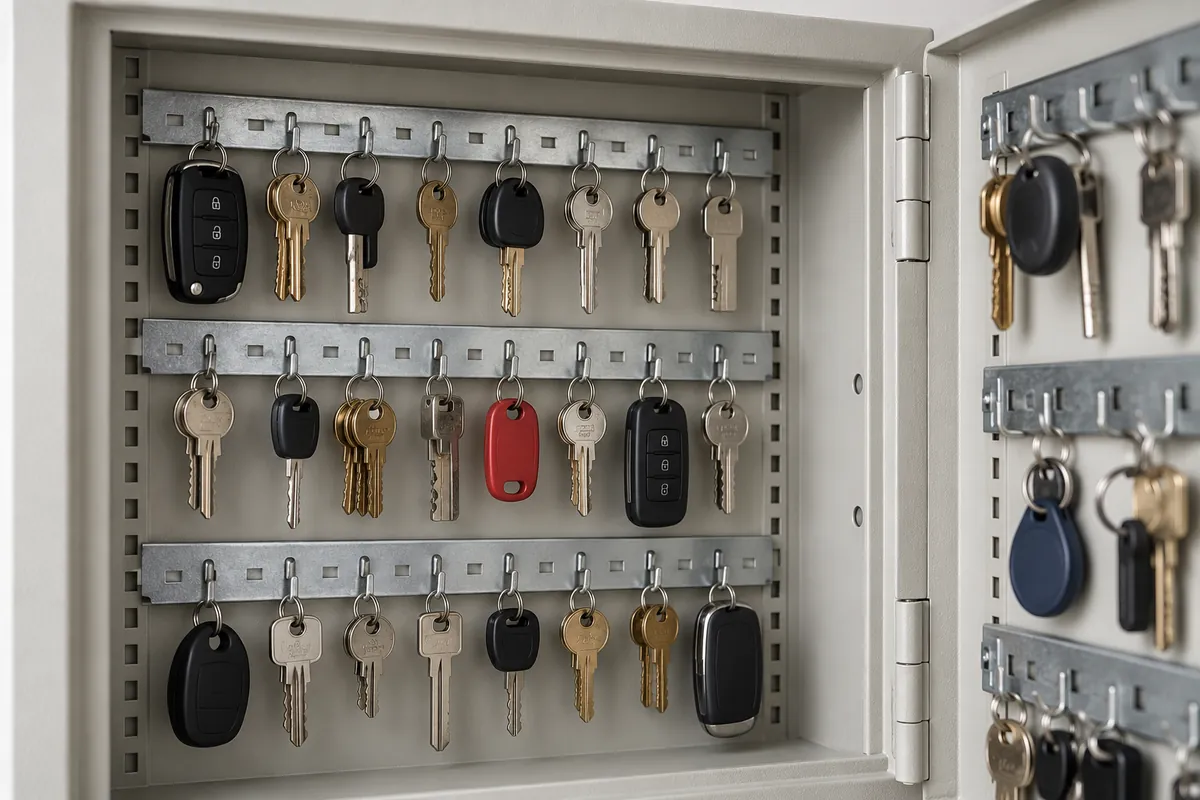
Define the stored key sets before comparing cabinet capacity
Prepare a small set of representative contents for the product the buyer intends to sell. Include the largest likely key head, the longest key, the thickest fob, any tag or label that must remain readable, and a typical ring or small bunch if users are expected to hang more than one item. If the cabinet is for a property manager or fleet operator, collect anonymized sample sets from the intended user group rather than assuming household keys represent the whole use case.
Record the hanging envelope in the orientation used inside the cabinet. The envelope includes more than the key’s length: a fob may extend outward from the cabinet wall; a ring may make neighboring keys swing; a label may need to face forward; and a bulky bunch may need to hang at a slightly different angle to clear an adjacent rail. A photograph can help communicate the layout, but dimensions or a physical reference sample are more reliable for an approval record.
Capacity claims should identify the holder system that produced the count. For example, DURABLE’s product data sheet for its KEY BOX CODE 36 identifies capacity for 36 KEY CLIP holders and says its rails can be attached at different heights. This is the capacity of that named product with its specified holder system; it is not evidence that a different fob, loose key ring or mixed bunch configuration will fit 36 positions. Compare a cabinet against the exact holders or contents included in the intended sales unit.
| Capacity input | What the importer should record | Why a stated number alone is insufficient |
|---|---|---|
| Individual key or holder | Type, overall envelope, attachment point and label/tag dimensions | Different holders project different distances and may face different directions |
| Multi-key bunch | Number and arrangement of keys, ring or clip size, and typical hang orientation | Several keys on one hook create an overlapping envelope and may swing |
| Rail or hook layout | Number of positions, pitch, rail height and adjustment options | Nominal positions may not be usable when neighboring items collide |
| Usable cavity | Clear depth, width and height after door hardware, rails and internal projections | External cabinet depth does not equal free internal storage volume |
| Door and lock intrusion | Hinges, lock body, latch or other internal parts that occupy space | Keys near the door edge can foul hardware when the door closes |
| Access requirement | Label visibility, hand clearance and removal path | A count can be technically hung but inconvenient to identify or remove |
Treat the count as a claim tied to an approved configuration. If the manufacturer specifies a capacity with its own key clips, tags or rail system, preserve the product model and content assumption in the buyer file. If the private-label pack substitutes a different tag or encourages multiple keys per hook, repeat the layout check rather than borrowing the original count.
Measure usable depth and the door’s closed position
Exterior dimensions are useful for shipping cartons, shelf space and mounting plans. They do not tell the buyer how much room remains inside after the door panel, lock, rails and hooks are installed. Ask for internal width, height and depth at the relevant locations, with the dimension datums shown. A nominal depth taken at the outer wall may include the door thickness or housing projection and therefore overstate the free cavity.
Review the cabinet in both open and closed states. With the door open, place the representative key sets in their planned positions and observe the front-to-back envelope. Then close the door slowly and check for contact with the keys, labels, rings, lock body or rail ends. A key that fits with the door wide open may rotate or swing into the door as it closes. Repeat the check at positions near the hinge, latch and corners, where clearances can differ.
If the cabinet uses rails that can be mounted at different heights, record the approved rail positions and the assembly arrangement. An adjustment feature can help organize the contents, but it does not automatically solve every depth or overlap issue. Moving one rail may create more vertical room while reducing the space for another row, or it may place large fobs where they interfere with a lock or door panel. Review the entire populated layout.
A useful dimensional drawing marks:
- Clear cavity depth from the inside face of the closed door to the nearest key or rail interference.
- Interior height and width between cabinet sides, including any folded edge or internal flange.
- Distance from each rail or hook position to the door plane, side walls, hinges and lock body.
- Spacing between neighboring hanging positions and between rows.
- Door opening angle and the swept path of the key sets, if items can move.
- Mounting orientation and any floor, wall or fixture clearance that affects the door path.
Do not invent a single “minimum depth for a key bunch.” The answer depends on the selected key set, how it hangs, whether it can move, the cabinet’s door hardware, and the buyer’s required access. A representative layout allows the team to determine which dimensions control the fit for that product.

Test accessibility as well as fit
A crowded cabinet may allow every key to be hung but make labels hard to read or a target key difficult to remove. Buyers should decide whether the user needs to identify items while the door is open, reach around adjacent key bunches, or return a tag without disturbing neighboring sets. These details affect practical storage capacity even when nothing physically prevents the door from closing.
Use a repeatable sample procedure:
- Confirm the cabinet and rail revisions match the approved drawing.
- Install rails in the intended positions and record the holder or hook type.
- Place the largest representative key sets in assigned locations.
- Fill adjacent positions with the other representative contents, not only the biggest item by itself.
- Check label visibility and hand access to each designated key.
- Open and close the door using the normal path, checking hinges, latch, lock hardware and cabinet walls for interference.
- Remove and return selected keys to confirm the arrangement remains understandable and repeatable.
- Photograph the populated cabinet in open and closed positions and record the layout.
- Note every unused position, collision, blocked label or required rearrangement.
Set acceptance criteria before the sample review. A project might require every designated position to be reachable, all specified labels to remain legible, and the door to close without contacting contents. The exact criteria should reflect the intended user and cabinet design. A buyer should not write “holds 36 keys” if its tested configuration has fewer positions after allocating space for large bunches or service items.
Sample results also need boundaries. If only a representative subset was tested, say what that subset contains. If rails are adjustable, identify the approved position for each holder type. If a key set was supplied by a user, document its approximate envelope and whether it represents a typical or maximum configuration. This creates a defensible product specification without implying that all possible key shapes fit.
Keep storage capacity separate from security claims
A cabinet can be evaluated for fit, visibility and access without being approved as a security product. A combination lock, key cylinder or electronic keypad may be present, but that does not establish a tested security grade, resistance to forced entry or suitability for a regulated key-control program. The buyer should request separate evidence from the responsible lock supplier or qualified specialist for any such requirement.
Some manufacturers state the capacity of a specific cabinet with a defined holder, and another product may list an independent lock or mounting feature. These statements should be interpreted only within their model scope. A key cabinet product page, physical thickness, powder-coated finish or mounting kit cannot by itself establish theft-prevention performance. Avoid converting a storage-fit test into a security assurance.
If the intended application requires access logging, restricted key control, fire-rated installation, controlled emergency access or a particular security certification, pause the ordinary capacity review and involve the project owner. Those questions may affect cabinet location, lock choice, mounting, access procedure and required testing. This article does not provide security-system design or compliance advice.
The distinction is important for private-label product content as well. A title such as “secure key cabinet” may imply a performance level beyond the evidence available. Match listing language to documented product attributes, and keep a separate approval file for any security or lock claim. If the scope is simply passive storage, describe the observed capacity configuration and usable dimensions accurately.
Approve a representative layout and the included mounting kit
The sample should represent the cabinet configuration buyers will receive. Confirm the body, door, hinges, latch or lock housing, rail count, hook type, label system, finish and mounting hardware. If any component is substituted after sample approval, decide whether it changes internal clearance or usability. A visually similar cabinet can have a different lock intrusion or rail pitch that changes the tested capacity.
The mounting kit also belongs in the review. Record whether screws, plugs, a template or other mounting parts are included, but do not treat the kit as universally suitable for every wall. The installer or project professional should confirm the actual substrate and fixing method. The cabinet’s open-door load and the direction in which contents hang can also matter to a project-specific mounting assessment; no load or anchorage capacity is assumed here.
A complete approval record should include:
- Cabinet model, drawing and revision.
- Internal and external dimensions with named datums.
- Key holder or hook type and number of positions.
- Representative content set, including larger fobs and bunches.
- Approved rail positions and any intentionally unused locations.
- Open-door access and closed-door clearance photos.
- Door, hinge and lock configuration.
- Finish, labels, index sheet and contents included.
- Mounting kit and the substrate assumption given to the installer.
- Capacity wording approved for the listing and pack.
- Owner, date and change conditions for reapproval.
That record can support purchasing, packaging and customer-service teams. It tells them what “capacity” means for the chosen item rather than leaving the phrase to be interpreted as any combination of keys. If an accessory tag or new key holder is added later, compare its envelope with the approved layout before updating the capacity statement.
For metal-product manufacturing facts and project discussions within Koitor’s documented scope, buyers can review the OEM home-storage hardware information or contact the project team. This does not establish that Koitor currently manufactures key cabinets, locks or security systems.
Importer checklist for key-cabinet capacity approval
Before approving the SKU, confirm that the file answers these questions:
- Is the intended product passive key storage, or does the project also require lock/security performance?
- What exact keys, tags, holders, fobs or bunches define the representative content set?
- Are the key sets identified by envelope and orientation rather than by a generic count?
- What are the clear interior dimensions after rails, lock and door hardware are installed?
- Which dimension is the usable depth, and where are its measurement datums?
- Are rail spacing, mounting height and holder type recorded for the reviewed layout?
- Does the populated cabinet close without contacting the largest representative contents?
- Can users identify and remove the intended keys without moving unrelated sets?
- Are the photographed open and closed samples tied to the current model and revision?
- Does the package include the same rails, holders, labels, index sheet and mounting parts?
- Is any capacity claim limited to the configuration actually checked?
- Are security, lock, anchoring and access-control claims reviewed separately by responsible specialists?
- What design or supplier changes require a new sample check?
If the buyer cannot provide representative keys, request a measured dummy or a drawing of the largest intended holder before sign-off. A single empty cabinet sample cannot demonstrate loaded capacity. An unresolved user-content assumption should be shown as open rather than converted into a guaranteed number.
Frequently asked questions about deep key cabinet capacity
Does a stated key count fit every key or fob combination?
No. A manufacturer’s count may refer to its own holder system and arrangement. Large fobs, labels and multi-key bunches occupy more space and can overlap. Confirm the exact contents and layout that the count describes.
Are exterior cabinet dimensions the usable cavity dimensions?
No. Exterior dimensions include the body and door, while usable interior space can be reduced by the door panel, lock body, rails and hooks. Ask for internally dimensioned drawings and verify the loaded clearance on a sample.
Can adjustable rails solve every depth or overlap problem?
No. Moving a rail can change clearance in one area while creating a collision or access issue elsewhere. Record the intended rail positions and evaluate the complete populated cabinet.
Does a key cabinet capacity test prove security protection?
No. A layout and door-closure check evaluates storage fit. Lock effectiveness, forced-entry resistance and security certification require separate, documented assessment by the responsible specialist.
Should a cabinet capacity statement mention the included holder type?
Yes. If the nominal count depends on a named holder, label or rail arrangement, the buyer should preserve that assumption in the product specification and listing. A different content system may need a separate fit review.
Can one empty sample verify that a cabinet holds its stated capacity?
No. The cabinet should be populated with representative contents in the actual intended layout. The reviewer should check accessibility and door closure as well as the number of positions.
Manufacturer examples and project review
DURABLE’s KEY BOX CODE 36 product sheet states a capacity for 36 of its KEY CLIP holders, gives external dimensions and notes that its rails can be mounted at different heights. The matching KEY CLIP holder page identifies a holder designed for that product family. These are model-specific examples and do not establish that any loose key or fob will fit the same quantity.
A second supplier example, Innovative Tools’ key cabinet, lists its own dimensions, a capacity statement and digital-lock feature for that model. Buyers should keep those attributes within that supplier’s stated scope rather than use them as general key-cabinet standards. The same principle applies to any quote: compare actual usable dimensions, holder system and representative contents.
For each deep key cabinet SKU, retain the tested key and fob set, layout revision and closed-door clearance record so the stated capacity can be reviewed later.
Define Capacity With the Contents You Expect
Share the cabinet drawing, representative key or fob envelopes and intended rail layout for a product-fit discussion. Lock performance, mounting suitability and security claims require their own qualified review.
Fabrication pour compte de tiers / Marque de distributeur
Transformez ce guide d'approvisionnement en cahier des charges
Indiquez-nous le produit souhaité, ses dimensions, sa finition, la quantité commandée et vos exigences en matière d'emballage. Votre équipe recevra une analyse pratique de la faisabilité de la fabrication avant l'établissement du devis.

 English
 Español
 Português
 Français
 Deutsch
 العربية