
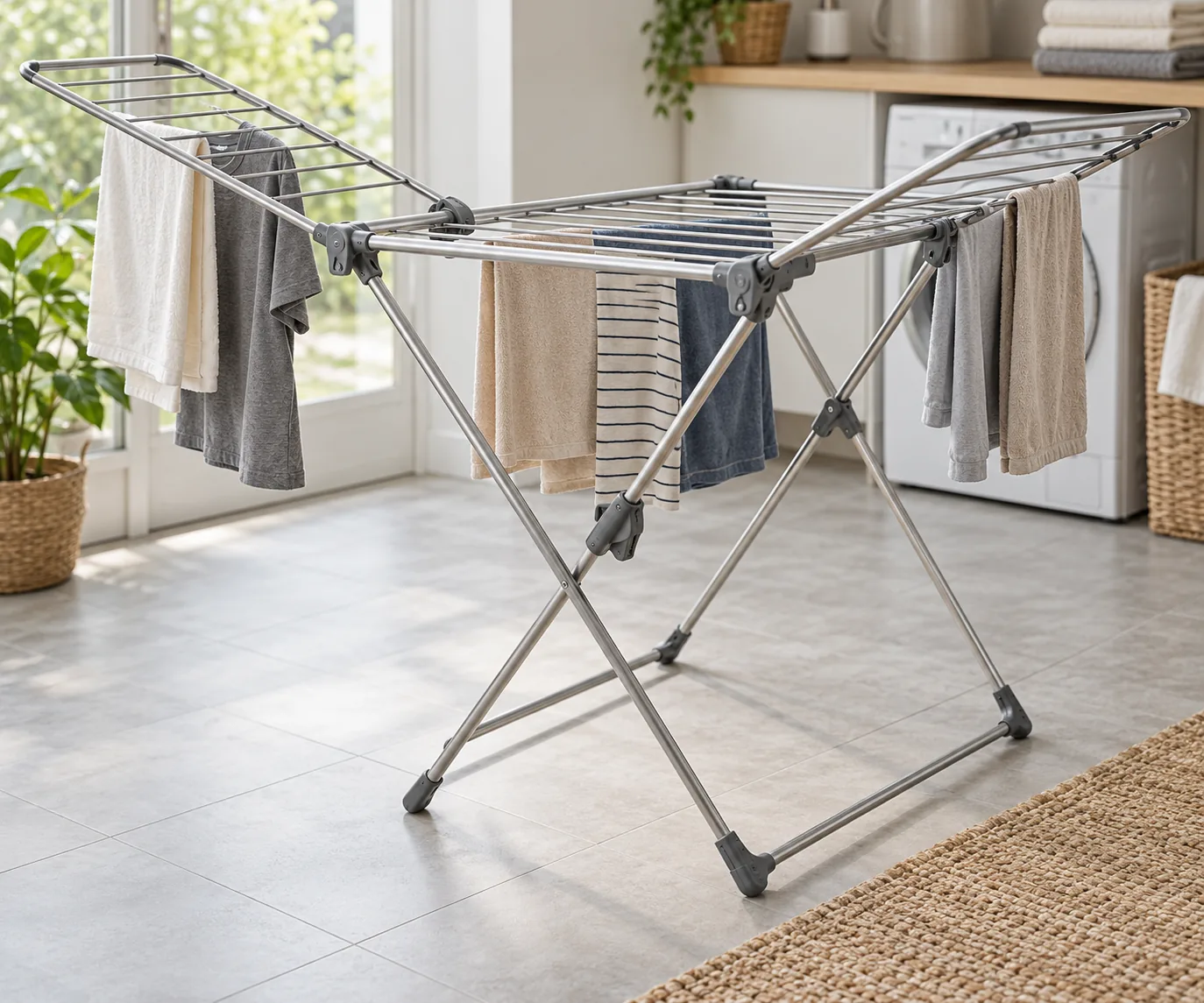
Pour drying rack hinge replacement, OEM buyers should control the rack model and revision, identify the hinge or wing-lock part by a unique ID, and specify the mating tube geometry before approving a spare component. A replacement that looks similar can still differ at the pivot, tube seat, stop, or locking face. Buyers should confirm fit on the actual rack assembly, document installation and removal, and preserve the approved component reference for reorders. A sample check can establish fit for the named assembly; it does not prove cycle life, load performance, or compatibility with every rack in a product family.
This guide turns individual repair complaints into a product-development and after-sales checklist. It is not a consumer repair tutorial, and it does not claim that Koitor manufactures folding drying racks or polymer hinge parts. The examples below show that some brands identify replacement parts for specific rack models. That is evidence that part-level identification can matter; it is not proof that components are interchangeable across suppliers.
Why should spare-part fit be designed before launch?
A folding rack depends on moving joints and locking features to move between stored and deployed positions. Depending on the design, a product family may include a hinge body, pivot pin, wing locker, tube cap, latch, or another purchased part. A broken or missing clip can make a wing difficult to retain or prevent a user from keeping the rack in its intended position. The repair discussions that inspired this topic describe individual problems; they cannot establish how often any part fails or what caused a particular failure.
For a private-label buyer, the sourcing question is broader than “Can we buy a spare clip later?” It includes whether the part can be identified, whether its interface is controlled, whether it can be replaced without damaging the metal frame, and whether the buyer can order the correct revision for the correct rack. These decisions affect product documentation, supplier records, packaging, customer service, and the design itself.
Public spare-parts catalogues provide model-specific examples. Brabantia lists separately identified plastic under-rack hinge sets and wing lockers for named drying-rack lines. Foxydry lists replacement clips for specified models. These catalogues show that some manufacturers sell identified components against particular product references; they do not establish universal dimensions, compatibility, material grades, or a common replacement system. A buyer should treat the exact model and component reference as part of the part definition.
Identify the rack, revision, and component before requesting a quote
Start with a controlled product identity: rack model, revision, finish, and configuration. If the rack has multiple widths, wing arrangements, tube profiles, or colors, note which version the replacement is for. A general label such as “drying rack hinge” is not enough to distinguish a left-side part from a right-side part, a first revision from a changed interface, or one tube diameter from another.
Give each replaceable component its own part number or other unique identifier. Link that number to a drawing, sample, supplier, material responsibility, and the rack revisions in which it is approved. If a component has a left/right orientation or comes as a matched set, encode that distinction in the records and packaging. Avoid relying on a photograph alone: similar-looking clips may have different internal bores, pivot offsets, locking faces, or release details.
| Record field | Buyer-controlled information | Why it helps |
|---|---|---|
| Rack identity | Model, revision, size/configuration, and finish | Prevents a part from being assigned to the wrong product version |
| Component identity | Part number, drawing revision, and left/right or set designation | Makes the replacement item searchable and traceable |
| Responsible supplier | Manufacturer or approved component source, where known | Clarifies who controls material and component changes |
| Assembly location | Photo or drawing view showing where the part sits | Reduces ambiguity when several clips or hinges appear similar |
| Approval record | Reference assembly, sample date, and accepted revision | Connects the approved component to a physical rack configuration |
If the original rack is already in the market, use an authenticated sample or a controlled drawing to identify the part. Do not assume a marketplace photo, customer description, or unverified measurement is enough to authorize a new component. When the buyer cannot confirm which rack revision is involved, mark the request as unresolved and obtain product identity before committing to fit.
Specify the metal-to-component interface
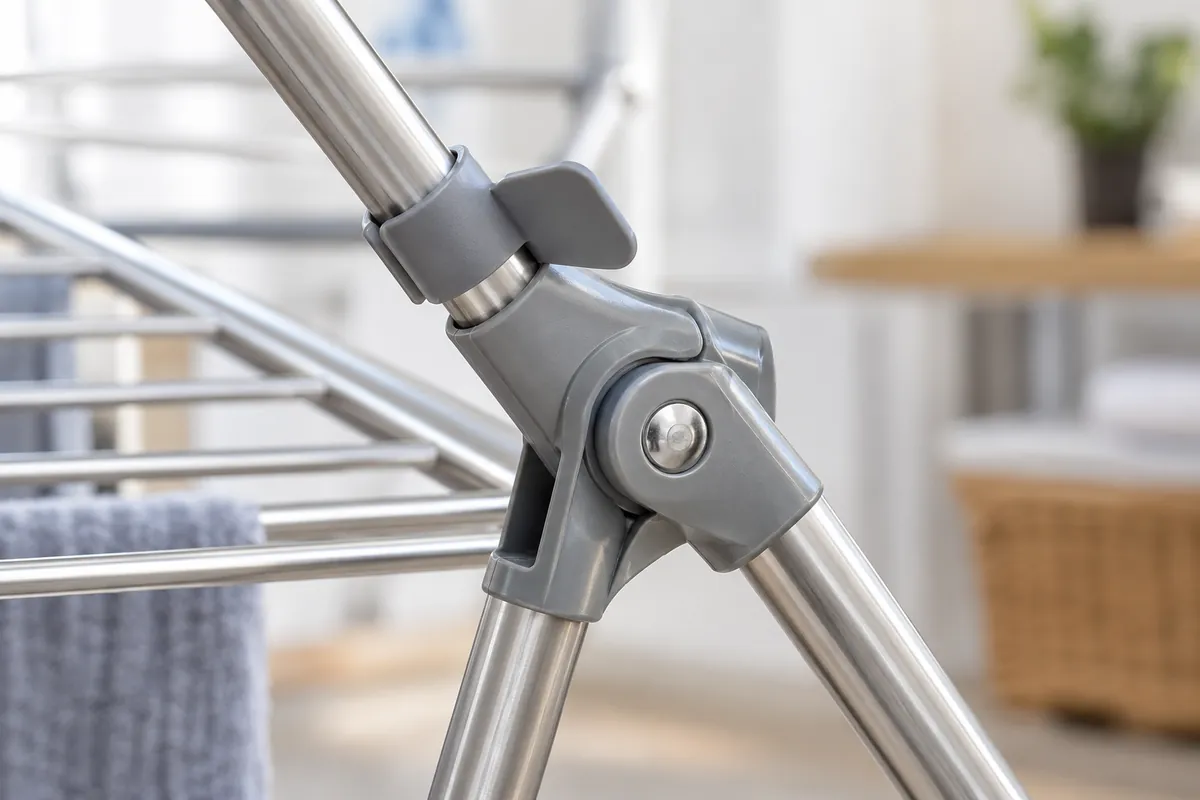
The drawing should describe the installed interface, not merely the outer shape of a polymer cover. Identify the tube or wire members that pass through or locate in the component; the relevant outside diameter or profile; the pivot axis; retention features; stops; and the direction in which the rack moves. Where a part clamps, snaps, rotates, or slides onto a frame, show the functional surfaces and the assembly sequence.
The mating definition may include, as applicable, tube outside diameter, wall condition, hole or pin location, pivot-center distance, clip opening, engagement depth, stop position, and clearance through the folding path. Specify which dimensions control fit and which are cosmetic. State whether measurements apply to the metal frame before coating or to the finished assembly if surface build affects the interface. Agree datums and a measurement method so buyer, supplier, and inspector do not compare different features.
The component material is a separate supplier-controlled input. Ask the responsible component supplier to identify the proposed resin or other material and any color or additive requirement needed for the project. Do not infer material grade or performance from color or appearance. If material change is restricted, state the change-approval process; if it is not, identify which evidence the buyer needs before accepting a substitute. No universal polymer is right for every hinge geometry and environment.
For a custom product, the buyer may not yet know whether a hinge should be a single molded part, a multi-piece pivot, or a purchased clip paired with a metal bracket. Keep the functional requirements and interface clear while allowing the supplier to explain feasible construction options. Compare options by fit, assembly, serviceability, part count, packaging, and project cost—not by assuming the most complex or heaviest design is automatically better.
Design for assembly and future service
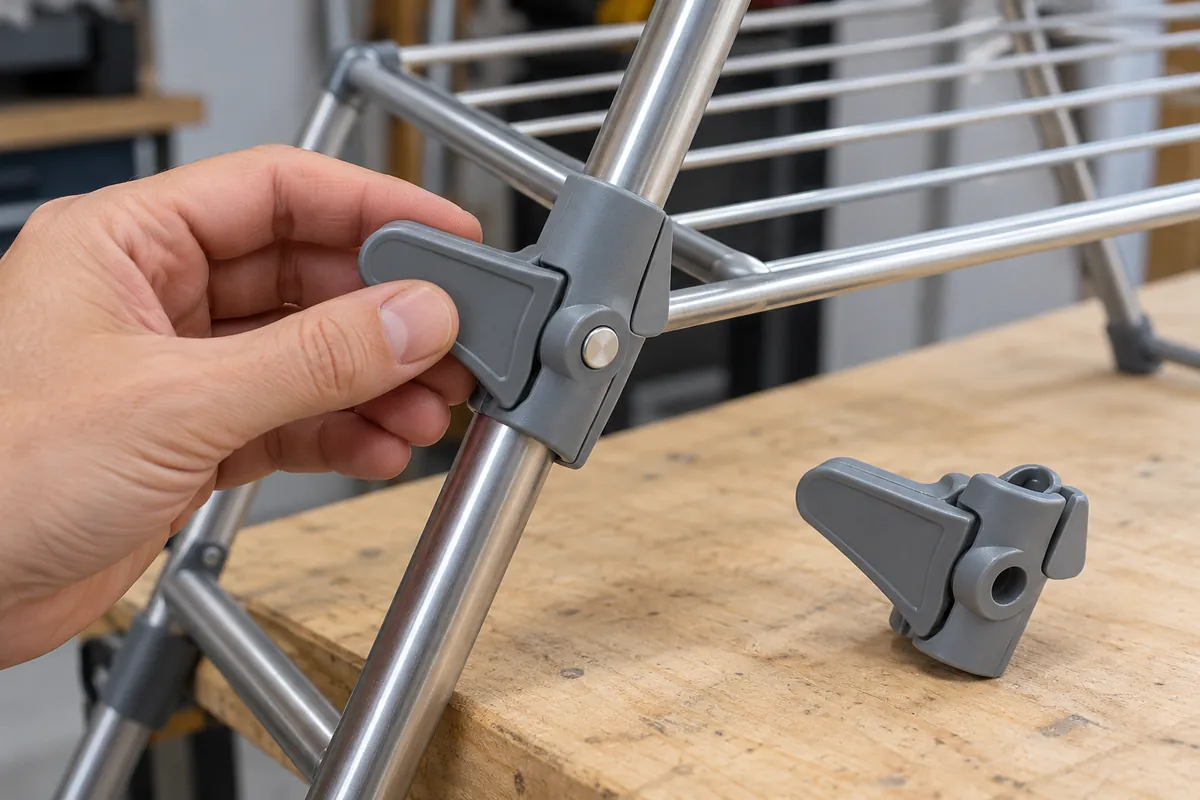
A replaceable component is useful only if the correct part can be installed in the intended location without introducing a new fit problem. At development, observe how the hinge or locker is assembled to the frame and how it can be removed. Identify whether removal requires releasing a clip, withdrawing a pin, separating tubes, or replacing a paired set. These observations should be performed on the actual design by the responsible product team or qualified supplier; this article is not an instruction for consumers to repair a loaded rack.
Consider how a buyer will distinguish a spare part after several product revisions. A part label, bag label, barcode, or service diagram can refer to the part number and compatible rack revision. If color variants share a form, state whether color is a separate SKU or a controlled option. If left and right parts look similar, use clear orientation cues in the documentation. The packaging should protect small pieces from loss and keep identification attached to the item through warehouse picking.
For an imported product, the brand should decide who holds the component drawing, who may approve a material or tooling change, whether the metal-frame and polymer-part suppliers can communicate interface changes, and how superseded stock is handled. A component that has been revised for one rack version should not silently substitute into earlier inventory. Change control should link the component revision, assembly drawing, bill of materials, service documentation, and approved sample.
Designing serviceability has trade-offs. A detachable clip can simplify replacement but may require a release feature, access space, instructions, and separate packaging. A permanently fixed joint can reduce loose parts but may make replacement impractical. The preferred choice depends on intended product life, target market, supplier arrangement, after-sales policy, and actual design. Do not promise a spare-parts period or universal service route unless the brand has confirmed it.
Validate the replacement on the complete assembly
Do not approve a hinge by comparing it with the old part on a table alone. Fit the proposed component to the correct rack revision and operate the assembly through its intended open and folded positions. Check that the pivot follows the expected path, the part seats in the specified location, the locker engages and releases as designed, and adjacent members do not collide. Observe whether the frame has to be forced or distorted during installation.
Record the sample as a controlled configuration: rack model and revision, component number and revision, frame dimensions, finish, any pin or fastener reference, reviewer, date, and photos of the installed and removed states. State what was observed and under what procedure. If a repeat-cycle or load test is required, define the fixture, movement, cycle count, sample quantity, acceptance criteria, and responsible party in the project plan. A casual open/close demonstration is not a cycle-life test.
| Contrôle d'échantillon | What to record | What it does not prove by itself |
|---|---|---|
| Part identity and orientation | Part number, revision, side, and installed position | Compatibility with other rack revisions |
| Mating fit | Tube/profile references, seating, pivot, and retention observations | Material identity or long-term wear resistance |
| Open/fold operation | Motion path, engagement, release, and interference | A validated cycle-life claim |
| Replacement access | Removal and reinstallation procedure on the reference assembly | That every user can safely perform a repair |
| Change comparison | Differences from the approved part and assembly | Approval of an unreviewed substitute |
If a replacement does not fit, treat that as a design or identification issue to investigate—not an invitation to file, bend, or force the part until it appears to work. Determine whether the wrong revision was selected, a dimension changed, the frame finish differs, or the part itself is outside the agreed specification. Escalate to the supplier and update the controlled record only after the root cause and disposition are agreed.
Build inspection and supplier controls around the part number
An incoming inspection plan should let an inspector connect the delivered item to the approved component. Check the part label or other identity, quantity, color where controlled, visible damage, and agreed critical dimensions or functional features. If appearance matters, define the inspection area and acceptance criteria. A visual check cannot establish hidden resin identity, internal defects, or service life; those require appropriate documentation or test evidence agreed for the project.
For bought-in hinges and clips, confirm how the rack supplier controls the sub-supplier and what happens when the sub-supplier changes tooling, resin, colorant, or a functional feature. The contract or quality plan should define whether the buyer must approve changes before shipment, what first-article samples are required, and how lots are identified. Keep a reference sample or controlled drawing when practical, but identify its revision and storage conditions so it remains meaningful.
The purchase specification should avoid unsupported absolutes such as “never cracks,” “fits all racks,” or “lasts for life.” Instead, state the actual rack models, mating dimensions, operating checks, documentation, and any agreed tests. If the brand needs replacement-part availability, set the commercial term and ordering process directly with the responsible supplier. A product page that lists parts for one named series is not a promise that another supplier can supply equivalents indefinitely.
A practical buyer checklist
Before approving the part or placing a reorder, confirm that the product record answers these questions:
- Which rack model, revision, size, and side does the component fit?
- What unique part number and drawing revision identify it?
- Which tube or frame profile, pivot, stop, and locking surfaces define the interface?
- Who supplies and controls the component material, color, and any tooling?
- How is the part installed, released, and replaced on the actual rack sample?
- Which open/fold observations and tests are required, and who performs them?
- How will the part and compatible rack revision be identified in packaging and service information?
- What approval is required before a supplier or component revision changes?
This checklist helps compare suppliers on a controlled assembly rather than on vague claims of “universal fit.” For metal-frame projects, Koitor’s verified expertise covers custom metal hardware, formed frames, assembly interfaces, and sample development; plastic-component production, drying-rack manufacture, and cycle testing are not confirmed capabilities and should be verified with the project-specific component supplier.
Make replacement planning part of the product brief
The best time to make drying rack hinge replacement manageable is before the first production approval. Give each part a traceable identity, control the metal-to-component interface, validate the correct revision on the assembled rack, and decide how future changes and reorders will be documented. That turns a small accessory from an anonymous spare into a controlled part of the product definition.
For an adjacent home-storage OEM discussion, share the proposed metal-frame drawing and component interface with Koitor through its OEM home-storage manufacturing page or contact page. Confirm plastic-part sourcing, material, testing, and after-sales commitments with the responsible supplier; the buyer should not infer those capabilities from a metal frame sample.
References:
- Brabantia drying-rack spare-parts catalogue — model-specific examples of separately listed hinge sets and wing lockers.
- Foxydry replacement clips for Foxydry Fold — model-specific replacement clips; not evidence of cross-brand interchangeability.
- Reddit folding-rack repair discussion — anecdotal problem discovery only, not failure-rate or root-cause evidence.
Discuss a metal-frame OEM project
Share the rack drawing, mating interface, and approved sample requirements for a project-specific review.
Fabrication pour compte de tiers / Marque de distributeur
Transformez ce guide d'approvisionnement en cahier des charges
Indiquez-nous le produit souhaité, ses dimensions, sa finition, la quantité commandée et vos exigences en matière d'emballage. Votre équipe recevra une analyse pratique de la faisabilité de la fabrication avant l'établissement du devis.
 English
 Español
 Português
 Français
 Deutsch
 العربية