
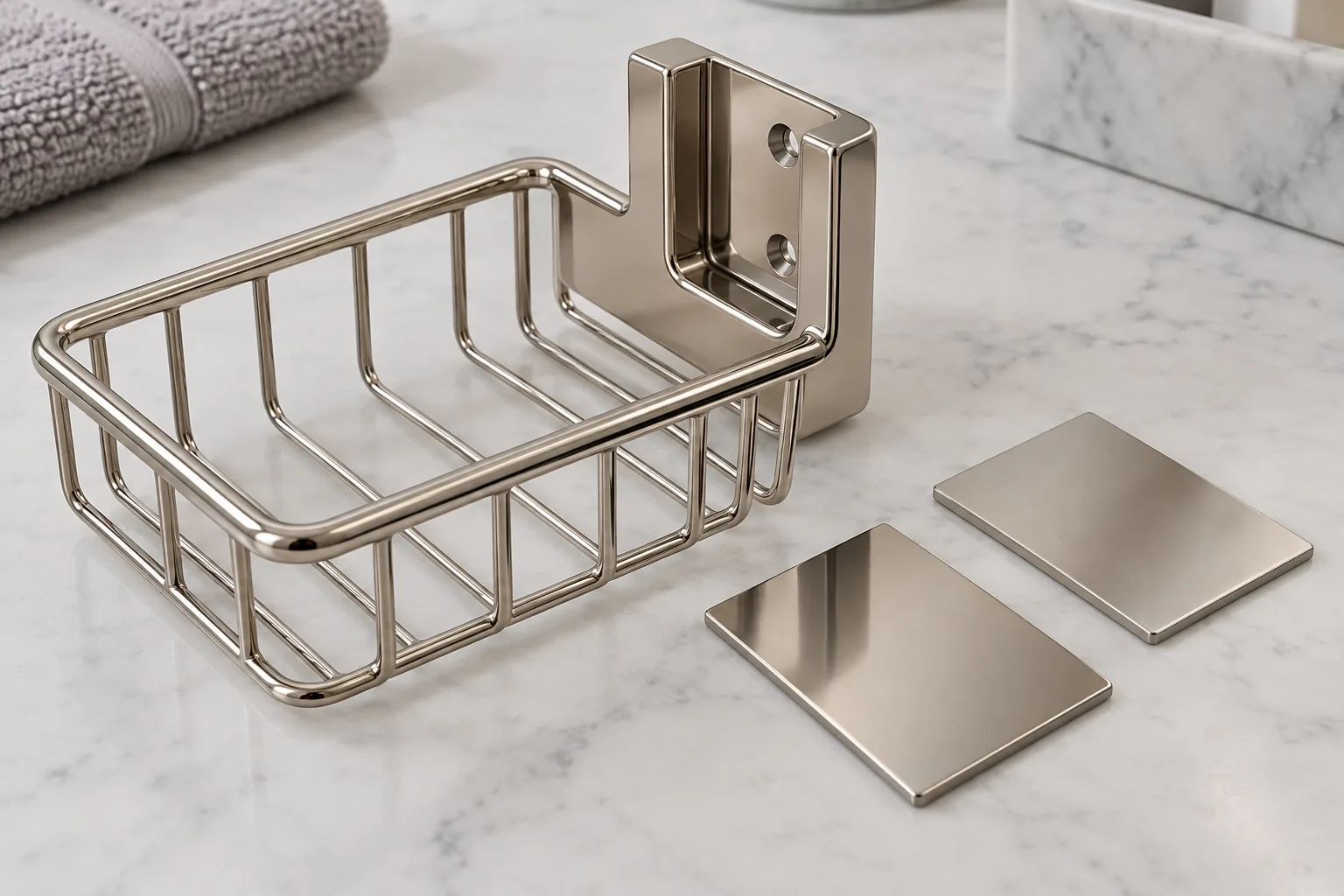
For a coated bathroom-hardware component with a recess, “electroless nickel versus electrolytic nickel recessed parts” is a process-selection question—not a universal ranking of which finish is better. Electroless nickel deposits through an autocatalytic chemical process and can provide more even coverage on complex shapes when the solution reaches and circulates around the surface. Electrolytic nickel uses external current, so part geometry and current distribution can affect local deposit thickness. Buyers should identify the actual substrate, recess, functional requirement, and finish system, then ask the specialist finisher to justify the proposed route with representative evidence.
This guide is about a buyer’s specification and approval task for a purchased or subcontracted finish. It does not mean every bathroom basket or rack needs nickel plating, and it does not imply Koitor Hardware operates a nickel-plating line. Koitor is a family-owned custom metal hardware manufacturer with experience in metal forming, welding, grinding, polishing, powder coating, assembly, packaging, and sample development. The appointed finishing supplier must confirm process suitability for the actual part.
What problem does this process comparison solve for hardware buyers?
Nickel deposition routes can behave differently when a component has an open channel, blind hole, deep return, internal thread, or other recessed feature. A buyer may specify a finish by name and assume the entire surface receives the same deposit. That assumption can be unsafe when a functional surface lies inside a recess or when a complex feature must hold a defined thickness, fit, or appearance requirement.
Electroless nickel is an autocatalytic deposition process; it does not rely on an external electrical current to drive nickel ions to a cathodic part. Electrolytic nickel is deposited with current, and the resulting distribution can be influenced by geometry, electrical contact, rack position, and current paths. The process labels describe different mechanisms, but neither label alone tells the buyer whether a particular bathroom-hardware feature will meet the drawing.
ASTM B733-22 describes autocatalytic nickel-phosphorus coatings for functional engineering applications and notes that uniform thickness on irregularly shaped parts depends on plating solution circulating freely over the surfaces. That condition matters: a recess is not automatically covered well just because the supplier calls the process electroless. The buyer should ask whether the actual bath flow, part orientation, drainage, and feature geometry are suitable. The Nickel Institute’s technical overview of electroless nickel likewise explains the uniformity advantage associated with electroless deposition while noting that solution conditions govern the result.
The commercial question is not simply “Which process has better coverage?” It is: “Which route meets this component’s appearance, fit, thickness, corrosion, wear, or other stated requirement, and what evidence will show that it does?” If the requirement is purely decorative, an electroless engineering nickel process may not be an interchangeable substitute for a specified decorative copper-nickel-chromium system. Define the end-use and finish purpose before comparing quotes.
What is different about electroless and electrolytic nickel?
Electroless nickel forms through chemical reduction in a controlled bath. Common engineering deposits are nickel-phosphorus alloys, so the selected phosphorus range and any post-treatment can affect deposit properties. The process does not need an anode-to-part current path in the way electrolytic plating does. This can help the deposit follow complex geometry more evenly, but the solution must reach each intended surface and remain within the qualified process conditions.
Electrolytic nickel is deposited using external electrical current. The electrical field and part geometry influence where current concentrates or is less available. Exposed edges may receive a different deposit than a deep or shielded region unless the supplier’s process design, racking, anodes, shields, or other controls address the geometry. Those controls are specific to the part and supplier; they should not be assumed from a general process description.
The differences that matter to the hardware buyer include more than surface coverage. Substrate preparation and activation, deposit composition, thickness strategy, dimensional build, ductility or hardness needs, corrosion environment, appearance, production volume, and inspection method can all affect selection. Electroless nickel is not a single fixed material with one universal property profile, and electrolytic nickel can also be selected in different deposit types and specifications.
| Buyer comparison point | Electroless nickel | Electrolytic nickel | What the buyer should verify |
|---|---|---|---|
| Deposition driver | Autocatalytic chemical reduction; no external plating current | External current drives deposition on the conductive part | Supplier identifies the actual route and deposit specification |
| Recessed geometry | Can coat complex surfaces evenly when solution access and circulation are adequate | Local deposit can vary with current distribution and geometry | Review the named recess, orientation, access, and representative sample |
| Composition and properties | Often nickel-phosphorus for engineering uses; deposit properties depend on chemistry and treatment | Deposit type and properties depend on the specified electrolytic process | Match property claims to the selected specification, not a generic process name |
| Dimensional impact | More even build may help on some complex shapes, but the specified thickness still changes fit | Build can vary across features and may need process controls or design allowance | Identify critical dimensions before and after finishing and agree inspection locations |
| Evidence | Supplier route records, suitable thickness method, and agreed sample or test evidence | Supplier route records and part-specific evidence for significant surfaces | Ensure method, location, sample identity, and acceptance rule match the claim |
Use this comparison to frame the RFQ, not to issue an unsupported process mandate. A practical decision about electroless nickel versus electrolytic nickel recessed parts separates the route mechanism from the finished-part acceptance criteria. A supplier can explain why one route is more appropriate for a specific substrate and functional purpose. The buyer then confirms whether that explanation satisfies the drawing and product risk. For higher-risk applications, an engineering or quality owner may need to approve the proposed deposit specification separately from the commercial buyer.

How do geometry and solution access change the decision?
First, define the feature precisely. “Recessed part” could mean a shallow open channel, a deep blind hole, a threaded bore, a folded return, or a narrow gap between joined surfaces. Each creates different access, wetting, drainage, and inspection questions. A product drawing should identify the feature and show its depth, opening, adjacent surfaces, and function clearly enough for the finisher to assess the process route.
Second, ask how the process reaches and leaves the feature. In an electroless process, the absence of external current removes one source of current-distribution variation, but it does not guarantee that solution circulation is adequate in every cavity. Trapped air, retained solution, poor flow, contamination, or an unfavorable orientation can still affect processing. The part may need to be oriented or racked so the solution can reach and drain from the relevant surfaces. The supplier should review the real geometry rather than relying on a simplified flat coupon.
In an electrolytic process, ask how the supplier addresses lower-current regions and whether the part position, electrical contact, auxiliary anodes, shields, or other approved controls are important. The buyer does not need to dictate bath settings without process expertise. Instead, ask the supplier to identify the expected coverage variation and how the critical area will be inspected. If a thread or mating face is involved, define the assembly condition after finishing and agree whether masking, machining allowance, or a design change belongs in the solution.
Third, separate “coverage” from “thickness.” A continuous deposit on a hidden surface is not the same as a specified minimum thickness there. A supplier may be able to demonstrate process reach but still need an agreed method and sample location to verify layer thickness. Conversely, measuring an accessible exterior area does not prove a blind feature has the same value. State what the drawing requires on each significant surface and what evidence will be accepted.
If the component is part of a decorative bathroom assembly, also consider whether a nickel layer is part of a larger finish stack. A decorative chrome appearance can involve multiple layers and a separate specification for the complete system. Do not compare an engineering electroless nickel coating directly with decorative nickel or chrome based on process name alone. A finish supplier should identify the system, layer functions, compatibility, and intended appearance before the buyer approves any substitution.
How should buyers frame electroless nickel versus electrolytic nickel recessed parts in an RFQ?
The RFQ should define the buyer’s outcome and make the supplier’s assumptions visible. If a source drawing already names a process or standard, treat that as a controlled requirement; do not change it silently to pursue uniform coverage. If the process is open for proposal, ask for the recommended route and rationale, then approve the sample and evidence plan before production.
Include these details where applicable:
- Part number, drawing revision, base material, material source, and any known substrate condition.
- A drawing callout or marked view of each critical recess, internal feature, thread, or mating surface.
- The function of each feature: appearance, fit, wear, corrosion protection, or another stated requirement.
- Whether the buyer requires electroless or electrolytic nickel, or invites a supplier proposal subject to approval.
- The named deposit specification, including applicable composition or post-treatment requirements where relevant and supported.
- Required thickness or functional criteria for each significant surface, with measurement locations and an agreed method.
- How the supplier will orient, rack, or otherwise process the component to allow access, current distribution control, and drainage.
- A production-intent sample and inspection record tied to the part and drawing revision.
- Changes that require notification or renewed approval, such as a substrate, supplier, process route, fixture, or geometry change.
If the finish specification includes a published standard, cite the exact document and revision required by the project. ASTM’s public summary for B733 identifies it as an autocatalytic nickel-phosphorus specification for functional engineering uses and outlines classification and test topics; the standard’s full text and applicability must be confirmed by the project’s technical owner. Do not quote a standard number as a complete acceptance specification unless the drawing also defines the required classification and project-specific conditions.
Quote comparisons should use equivalent scope. One supplier may quote an electroless route with a different deposit type, thickness requirement, or inspection approach than a second supplier’s electrolytic route. Normalize the substrate, significant surfaces, drawing revision, post-treatment, sample approval, packaging, and acceptance evidence before comparing price. A cheaper route may omit an important control, while a more complex route may not be necessary for the product’s actual requirement. Only the buyer’s requirement and qualified process evidence can settle that tradeoff.
What sample evidence should a buyer review?
Ask for a sample that represents the production-intent material, geometry, recess, and finishing route. Record the sample ID, part and drawing revision, supplier, finishing source, date, and any process deviation. A flat test coupon can help compare material or surface appearance, but it does not replace the actual part when geometry controls the question.
Review the sample in two ways. First, assess the finished surface against an agreed appearance reference on the significant surfaces. Second, inspect the functional feature: does the finished thread engage, does the mating face seat, does the bracket assemble, and is the specified recess covered to the agreed requirement? If the hidden feature cannot be inspected nondestructively or directly, agree on a representative section, witness piece, or supplier record that is appropriate for the claim. Do not make an unsupported assumption that the exterior finish predicts an inaccessible surface.
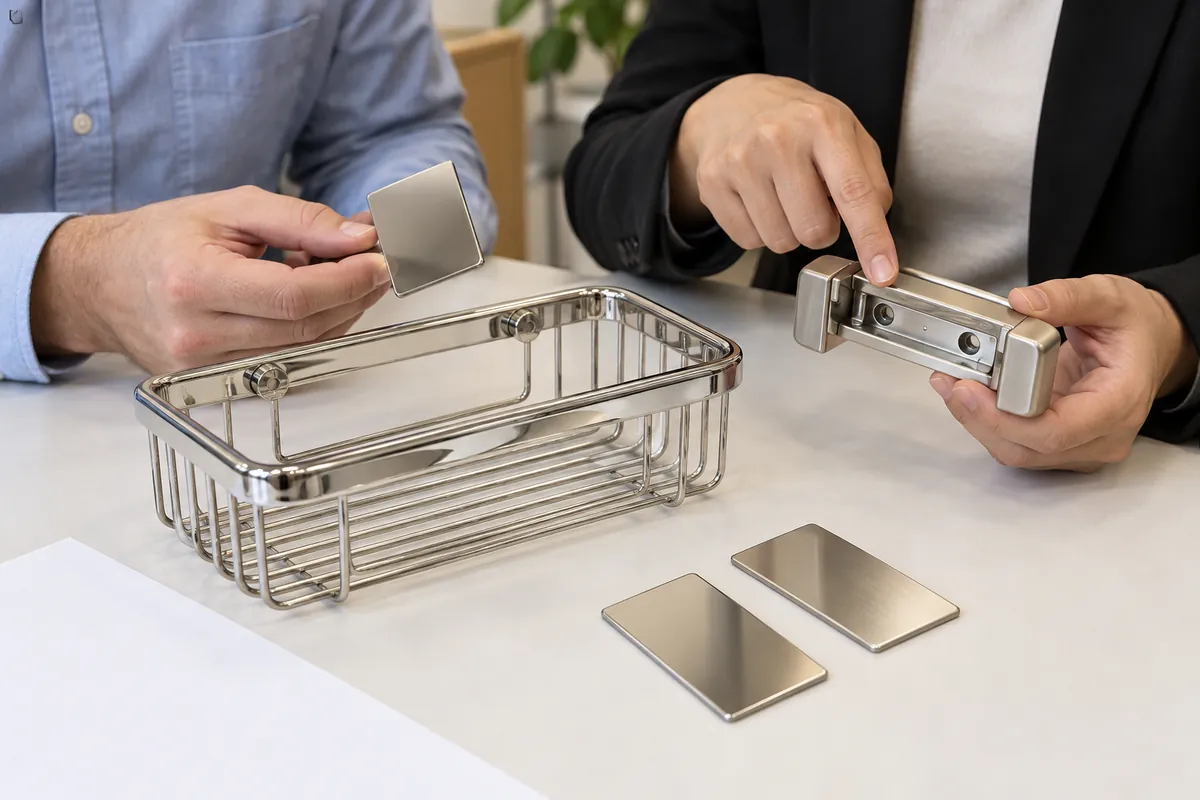
Ask the finishing supplier to connect every record to the specific claim it supports. A process traveler or supplier declaration can confirm which route was run; a thickness report can support a thickness requirement only at the stated location and by a suitable method; an appearance sample can support a visual comparison; and a test report can address only its defined test condition. Supplier evidence must be traceable to the approved part and route. Avoid accepting generic marketing statements such as “uniform plating” in place of the actual acceptance evidence.
For a process change, compare the new proposal with the last approved revision. Did the substrate change? Is the recess geometry different? Has the finishing source or layer sequence changed? Does the new route affect appearance, fit, or inspection access? If the answer could affect an approved requirement, obtain a reasoned review and decide whether a fresh sample or additional evidence is needed before release.
Frequently asked questions about nickel-plating recessed features
Does electroless nickel always provide the same thickness inside every recess?
No. The process can provide more even deposition on complex geometry, but solution access and circulation still matter. A deep or narrow feature should be reviewed by the appointed supplier and verified using an agreed method or representative sample.
Is electroless nickel a direct replacement for decorative nickel chrome?
Not automatically. Electroless nickel is often specified as a functional engineering coating, while decorative nickel-chrome systems have their own layer sequence and appearance requirements. A substitution needs technical review against the complete specification, substrate, appearance, fit, and service conditions.
Should a buyer specify the same thickness on the inside and outside surfaces?
Only if the product requirement calls for it and the supplier can propose suitable evidence. Define which surfaces are significant, what minimum or range applies, how it is measured, and what happens when a location cannot be measured directly. Do not assume a single accessible reading represents the entire component.
What is the shortest useful supplier question?
Ask: “For this material and drawing revision, which nickel route do you recommend for the identified recess, why is it suitable, and what production-intent evidence will demonstrate the agreed requirement?” That question makes the supplier state the route, geometry assumption, and verification plan without the buyer prescribing unqualified bath settings.
Collaborez avec Koitor Hardware
Review a Recessed Hardware Feature Before Quotation
Share the drawing revision, substrate, sample, critical recesses, and intended finish requirement. Koitor can review the fabricated component and its assembly interfaces; the appointed finishing specialist should confirm the nickel route and evidence plan.
Fabrication pour compte de tiers / Marque de distributeur
Transformez ce guide d'approvisionnement en cahier des charges
Indiquez-nous le produit souhaité, ses dimensions, sa finition, la quantité commandée et vos exigences en matière d'emballage. Votre équipe recevra une analyse pratique de la faisabilité de la fabrication avant l'établissement du devis.



 English
  Español
  Português
  Français
  Deutsch
  العربية