

Etching vs engraving describes two traditional ways of creating a mark, but supplier language now includes laser etching and laser engraving as well. In the classic distinction, chemical etching selectively removes material through chemical action, often with a patterned resist, while mechanical engraving cuts the surface with a tool. Modern laser labels cannot always be interpreted from that older contrast alone. A buyer should identify the actual method, the intended surface result and the evidence that will be used to approve it.
That distinction matters when specifying a logo, identification mark, nameplate or component label for a metal product. A process name can sound precise while leaving the mechanism, appearance, material, location and acceptance criteria unclear. When a drawing or supplier proposal says “etched,” ask whether the term means chemical etching, a laser-marking method, or another process used by that supplier. When it says “engraved,” ask whether a tool cuts a groove or whether the label is being used for a laser-produced mark.
Etching vs engraving: begin with the traditional distinction
In traditional chemical etching, a selected region of a material is exposed to a chemical action that removes material. A patterned resist or comparable mask may protect areas that should remain unchanged, leaving an image or text where material has been removed. The exact setup varies by material, marking provider, intended result and process. The buyer does not need a recipe to specify the purchase; the buyer needs a clear description of what is being supplied and a sample that represents it.
Traditional mechanical engraving uses a cutting or engraving tool to remove material along a programmed or guided path. The resulting line or recess depends on the tool, substrate, geometry and settings chosen by the specialist. “Mechanical” describes the tool-based action in this comparison, not a promise about depth, durability, speed, finish or cost. Those outcomes need to be assessed for the actual material and use.
The words are useful shorthand, but they do not automatically define a finished part. A buyer still needs to identify the surface, design, location, scale, color or contrast expectation, and what counts as an acceptable sample. A mark can be legible on a flat coupon yet difficult to read on a curved, brushed, coated or reflective part. The process description and the final acceptance criteria should therefore be separate pieces of the specification.
| Term used in a proposal | Traditional interpretation | What a buyer should clarify |
|---|---|---|
| Chemical etching | Selective material removal through chemical action, commonly using a patterned mask or resist | Which material and surface are included, where the mark appears, and what sample represents the result? |
| Mechanical engraving | A tool cuts or removes material along the intended mark | Is the description accurate for the supplier’s route, and what line width, location and appearance are expected? |
| Laser etching | A laser-related label whose use may vary among providers | What interaction and resulting surface change does the provider mean by “etching”? |
| Laser engraving | A laser-related label that may refer to a different or deeper-looking result, depending on provider terminology | What exact process name, sample and acceptance basis will control the order? |
The table is a buyer clarification aid, not a complete process standard. Sources describe traditional chemical action and tool removal as useful distinctions, while modern marking suppliers use laser terminology in ways that require provider-specific clarification. A buyer should not turn the table into a universal dictionary for every industry or machine.
Why laser terminology needs a separate question
Laser marking adds an important naming complication. Suppliers may use terms such as laser etching, laser engraving, laser marking, annealing or ablation in ways that reflect the equipment, material interaction, industry convention or sales description. One provider’s label does not necessarily tell a buyer enough to predict another provider’s result. A buyer should ask the proposed marking supplier to state what mechanism or process category it means and show the result on the specified material and finish.
Do not assume that every laser etch leaves the same depth, every laser engraving removes material in the same way, or a color change proves a particular mechanism. The Keyence material distinguishes chemical etching and laser etching in its discussion, but terminology can be provider-specific; it should be used to frame a question rather than to declare a universal rule. For an actual purchase, the supplier’s process description and a representative approved sample are more useful than translating a label from a different machine or industry.
The etching vs engraving choice should therefore be recorded at two levels: the business requirement and the process proposal. The requirement describes the job the mark must do; the proposal describes how the responsible provider expects to make it. If a buyer evaluates a sample only for logo resemblance, a later process substitution may go unnoticed even if that route changes a property that the buyer actually cared about. Conversely, naming an exact mechanism without a reason can constrain the quote while leaving legibility, placement or sample acceptance undefined. A short requirement-to-method review prevents both errors.
For procurement, this separation is also useful when quotes arrive from more than one source. Preserve each provider’s own terminology in the comparison sheet, then add a plain-language clarification column with the mechanism they have confirmed, or mark it unresolved. Do not silently normalize two offers as equivalent because they both say “laser engraving.” Ask each provider to state the substrate, expected result, sample basis and included review steps. The buyer can then compare the actual proposal while retaining the supplier’s technical ownership of the route.
The practical specification can avoid a terminology dispute by describing observable requirements. Identify the component, face, artwork revision, text, position, orientation, approximate dimensions, contrast or visual result, and any protected or excluded surface. Then identify the proposed supplier process in a separate field and request confirmation if the label is ambiguous. This makes the desired output testable without forcing the buyer to pretend to know a provider’s proprietary process details.
If the process itself matters for a contractual, regulatory, traceability or durability reason, do not rely only on appearance. Ask for the responsible supplier’s current method description and the evidence appropriate to that requirement. A photograph may show legibility and placement; it does not prove a hidden mechanism, chemical composition, corrosion performance, abrasion life or compliance status. Those are separate claims and require appropriate, project-specific support.
Compare the result, not a marketing label
A useful comparison begins with the job the mark must perform. Is it decorative branding, a model identifier, a traceability code, a permanent product label, or a reference that must remain readable after handling and cleaning? The answer affects the artwork, location, contrast, expected viewing conditions and validation method. It does not by itself select a process. A buyer can write the required function first and invite the supplier to propose a method, or specify a process when the design owner has already established one.
For a visible logo on a bathroom accessory, appearance and consistency may matter more than a broad claim that the mark is “permanent.” For a small identification code, readability and placement may matter more. For a label on a finished component, the substrate may already be polished, plated, painted or coated, and the marking route could affect the local appearance. A sample should use the actual substrate and relevant finish whenever practical. A generic sample on another alloy or surface does not settle how the production part will look.
Review the result under conditions that resemble the intended evaluation. Specify viewing distance or lighting only if they matter to the product decision and can be applied consistently. Identify whether the sample is judged before or after a protective coating, finishing step or assembly. Confirm whether artwork is supplied as vector data, a controlled drawing, or another agreed source. Define which party controls text, logo proportions, spelling, language, line weight and revision approval.
| Buyer requirement | Pourquoi est-ce important ? | Evidence to agree before production |
|---|---|---|
| Material and existing finish | Different substrates and coatings may respond differently to a marking route | A representative sample on the actual or agreed equivalent surface |
| Artwork and revision | A process cannot correct incorrect source content or an obsolete logo | Approved artwork filename, revision date and proof approval record |
| Position and orientation | A readable mark can still be misplaced or hidden after assembly | Drawing detail with datums or clear reference edges |
| Legibility and appearance | “Good contrast” or “clean mark” may be interpreted differently | Approved sample and observable acceptance notes |
| Product use and handling | Actual exposure can affect the buyer’s needed evaluation | Project-specific validation, if required, with method and responsible party identified |
| Contrôle des modifications | Substrate, finish, supplier or route changes can alter the result | Written notice and approval requirements for relevant changes |
The checklist does not imply that one marking process is always more durable or less expensive. Traditional sources explicitly caution against broad rankings such as universally faster, cheaper, stress-free or property-neutral. If a buyer compares costs, request comparable quotes that state artwork preparation, quantity, setup, included sampling, inspection and any secondary operation. A total that omits different scope is not a fair process comparison.
How to write a marking requirement into an RFQ
Begin with a controlled reference. Attach the current product drawing and artwork; identify the drawing and logo revisions; and point to the surface where the mark belongs. If the component is one item in a multi-part assembly, give it a part number and distinguish the marked part from adjacent components. A drawing balloon, detail view or photo can help establish location, but the released document should carry the requirement when it affects production.
Next state the functional reason for the mark. If it is branding, say that it is branding. If it identifies a part or lot, say what information must be readable and who supplies that information. If it is only a visual decoration, avoid implying that it serves as traceability or safety information. This separation prevents a supplier from making assumptions about variable data, data ownership or required permanence.
Then request the proposed process description in plain language. Ask whether the supplier means traditional chemical etching, mechanical engraving, laser marking, or another defined route. If a supplier uses “etching” or “engraving” for a laser result, request an explanation of the label and an actual sample. Do not demand an unsupported mechanism such as “must vaporize the metal” unless an engineer has specified it and the supplier confirms its applicability. The output and acceptance criteria should remain clear even if the process vocabulary differs.
Finally, define sample approval and changes. State whether the pre-production sample must use production-intent material, finish and process, how the mark will be inspected, and who approves the proof. A sample confirms only the features reviewed under the agreed conditions; it does not automatically establish long-term wear or every production lot’s consistency. For later orders, specify what happens if the provider, artwork, substrate, finish, position or marking route changes. Keep approved records linked to the correct drawing and purchase order revision.
For a product team comparing two offers, normalize their inputs before comparing unit prices. One supplier may include artwork setup, sample iteration and inspection; another may quote only the marking operation after receiving production-ready vector files. Ask each party to identify assumptions, excluded steps, minimum quantity, packaging or handling responsibilities, lead-time dependencies and whether the sample fee is separate. The purpose is not to force identical technology. It is to understand which part of the requested result each offer covers.
Common specification gaps and how to resolve them
“Laser etched” with no description
Ask the provider to explain what they mean by the phrase and to show the proposed result on the relevant substrate. Record the agreed process name in the quote or drawing notes if the method matters. If the buyer only cares about appearance, location and readability, specify those results and avoid creating an unnecessary dispute about naming.
Artwork supplied as an image capture
A screenshot can lose scale, sharpness, line weight and revision identity. Provide a controlled artwork file in a format agreed with the marking supplier. Request a proof with the expected size and placement, and approve the final content before the production file is released. Check that the proof has the right logo version, text, spacing and orientation.
Mark approved on a different surface
A sample on bare sheet may not represent a mark on a finished assembly. The actual substrate, surface texture, coating and curvature can change the visual result or process suitability. Identify what differs and agree whether another representative sample is needed. If an exact production surface is unavailable during early development, note that limitation and keep final approval open until the proper sample is reviewed.
“Permanent” without a defined evaluation
The word can hide several different expectations: resistance to handling, continued legibility after cleaning, resistance to abrasion or a specific service environment. Ask which use condition matters and who will define the validation method. Do not infer service life or chemical resistance from a process name, a photo or a supplier’s unrelated sample.
Method changed after sample approval
The approved sample is a baseline for a defined scope. If the marking provider, equipment, material, finish or route changes, ask whether the change may affect the observed result. Require notification and approval when the changed attribute is relevant to the buyer’s specification. Keep the change record connected to the new production revision rather than relying on memory or an email detached from the order file.
These gaps are manageable when they are surfaced early. The buyer does not need to specify every technical parameter independently. The buyer should state the product need, ask the responsible provider to describe the proposed route, review a representative result, and record the decision. That sequence protects the product requirement while allowing the specialist supplier to own its method details.

What the process name does not prove
An etching or engraving label alone does not prove that the mark will survive a particular number of cleaning cycles, that corrosion resistance is unchanged, that a logo is legally compliant, or that all materials can be processed. These are distinct statements. If any one is important to a buyer, identify the exact part, finish, condition, test or documentation needed and the party responsible for confirming it. Do not adopt a broad assertion from an unrelated material, machine or provider.
Likewise, a visible groove does not automatically identify whether chemical action, a cutting tool or a laser route created it. The appearance may help compare samples, but the method must be confirmed with the provider. A dark mark does not by itself establish a black coating; a bright mark does not prove a bare-metal recess. Surface appearance can arise from more than one route, depending on equipment and material. Keep process statements tied to actual supplier evidence.
In a custom hardware project, the company that supplies the component may not operate the marking process itself. The buyer should know who performs the marking, who controls artwork, which organization approves the sample, and who is responsible if the actual result differs from the released requirement. Sub-supplier involvement is not inherently a problem, but it should not be invisible when the process or traceability requirement matters.
The same discipline applies to Koitor-related project conversations. Koitor Hardware can discuss a confirmed drawing, product scope, finish and purchasing requirement as a family-owned custom metal hardware factory. This article does not claim that Koitor owns chemical etching or engraving equipment or offers either as a standalone service. A project-specific marking route, component and responsible supplier must be confirmed before the capability is represented in a quote.
Buyer checklist before approval
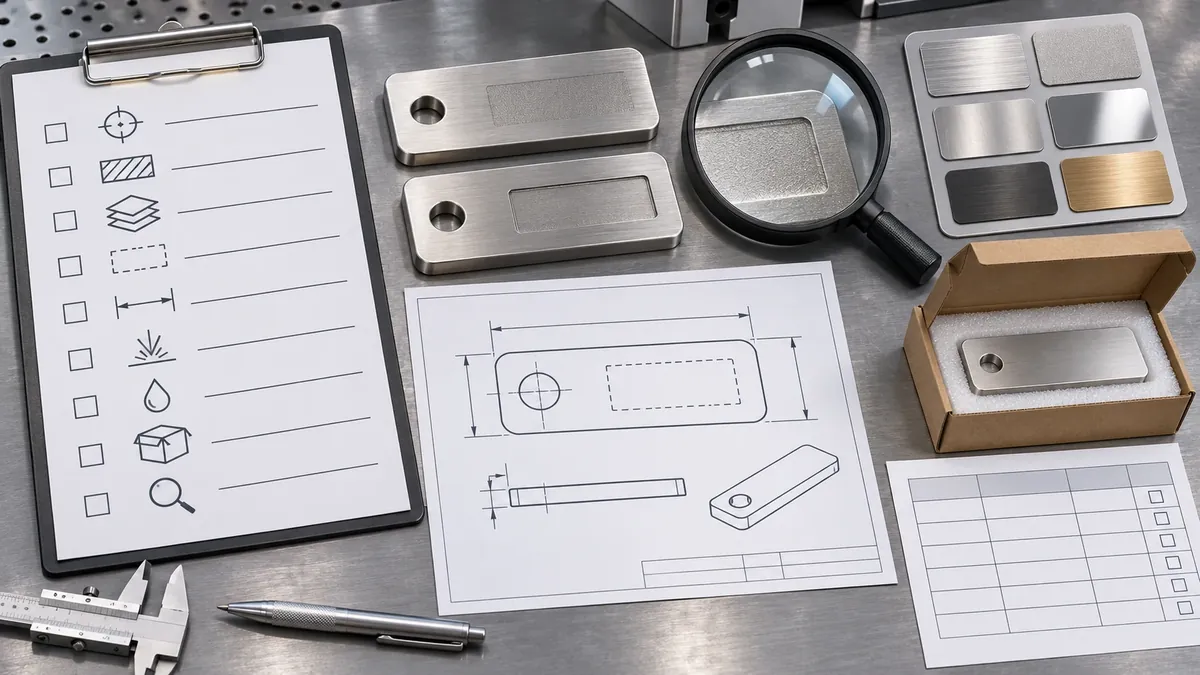
Before approving a marking proposal, confirm:
- The actual component, part number and mark location are identified.
- Material, base finish and any coating are stated.
- Artwork, spelling, scale, position and revision are controlled.
- The supplier has explained what “etching,” “engraving” or “laser marking” means in its proposal.
- The expected appearance and legibility are described in observable terms.
- The sample represents the relevant substrate and surface as closely as practical.
- The buyer knows who performs the work and who controls the process.
- Any durability or compliance claim has a separate, appropriate evidence requirement.
- The quote states setup, sampling, inspection, quantity and exclusions on a comparable basis.
- Changes to the supplier, method, artwork, material or finish have an approval route.
Foire aux questions
Does etching always mean a chemical process?
No. Traditional chemical etching is one meaning, but “laser etching” is also used in current marking terminology. Ask the provider what mechanism and output the label describes.
Is engraving always made with a hand tool?
No. Mechanical engraving can use guided or programmed equipment. The label should be clarified with the provider rather than assumed to mean manual work.
Is etching more durable than engraving?
There is no universal answer based on the process names alone. Material, finish, mechanism, mark design and use condition matter. Specify the result and request relevant evidence for the actual application.
Should an RFQ mandate a method or a result?
That depends on the design and purchasing requirement. If engineering has approved a particular route, state it. If method selection belongs to the supplier, define material, location, artwork, appearance and sample approval, then require a clear proposed process description.
Sources and scope
- Qualitetch: Chemical Etching vs Traditional Engraving — supports the bounded traditional distinction between chemical material removal and tool-based engraving; broad cost and performance claims are excluded.
- KEYENCE: Chemical Etching vs Laser Etching — illustrates a supplier’s distinction between chemical and laser terminology; it does not establish a universal vocabulary for all marking providers.
This guide is a buyer clarification framework, not an operating procedure, chemical recipe, laser parameter guide, materials compatibility ruling or durability guarantee. Exact provider terminology and the suitability of any method must be confirmed for the actual component, substrate, finish and requirement.
Collaborez avec Koitor Hardware
Clarify the proposed mark before a custom quote
Share the current drawing, artwork revision, product material and finish, expected quantity, sample requirement and intended use of the mark. Koitor Hardware is a family-owned custom metal hardware factory focused on bathroom and home-storage products. A project discussion can identify the confirmed product scope and unresolved requirement; a marking provider and process must be confirmed rather than assumed.
Clarify a Metal Marking Requirement
Share the approved drawing, artwork, substrate, finish and sample expectations so the actual marking scope can be reviewed before quoting.
Fabrication pour compte de tiers / Marque de distributeur
Transformez ce guide d'approvisionnement en cahier des charges
Indiquez-nous le produit souhaité, ses dimensions, sa finition, la quantité commandée et vos exigences en matière d'emballage. Votre équipe recevra une analyse pratique de la faisabilité de la fabrication avant l'établissement du devis.


 English
 Español
 Português
 Français
 Deutsch
 العربية